Moderated WTC 1 features list, initiation model / WTC 2 features list, collapse model

Hi tk,

I know it's a busy day, so just a quick question for now.

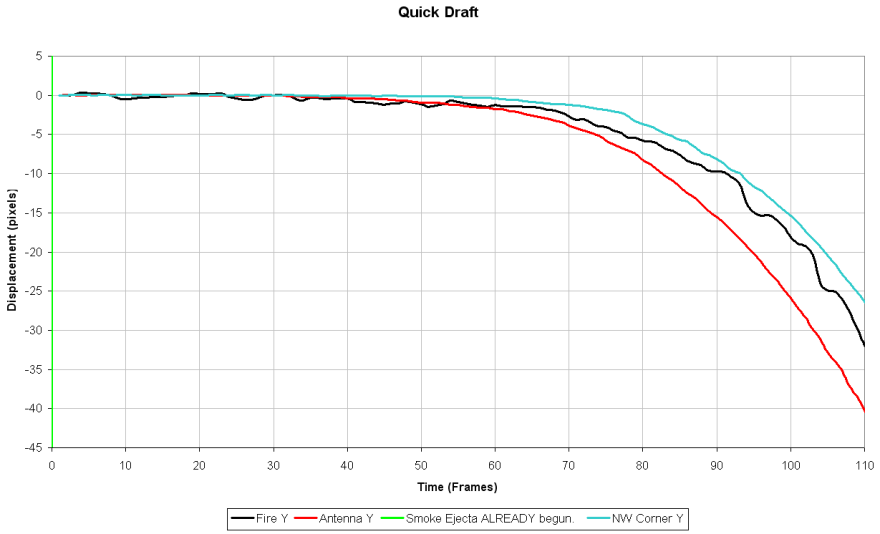
Funny thing is, in the simulation, the NW corner is rising the whole time, even tho it SEEMS to be falling.


In that passage did you reverse "rising" and "falling"? If not I'm confused, because the graph of the simulation shows the corner seeming to rise (between about t = 1.5 and t = 2.5), but under rigid rotation it must have actually been falling the whole time.

Respectfully,
Myriad
 
Hi tk,

I know it's a busy day, so just a quick question for now.


In that passage did you reverse "rising" and "falling"? If not I'm confused, because the graph of the simulation shows the corner seeming to rise (between about t = 1.5 and t = 2.5), but under rigid rotation it must have actually been falling the whole time.

Respectfully,
Myriad


Hey Myriad,

Nope, didn't reverse 'em.

From any camera taken from below the roofline (i.e, looking upwards at an angle), it is possible for a point to appear in the video to be falling when it is actually rising.

This'll help.

picture.php


Now, how do you get C to move into the magenta area, even tho the ball on the antenna is moving downward...??

I REALLY gotta run. Talk to you guys tomorrow.

tom
 
Hey Myriad,

Nope, didn't reverse 'em.

...

Now, how do you get C to move into the magenta area, even tho the ball on the antenna is moving downward...??

I REALLY gotta run. Talk to you guys tomorrow.


Sure, I get that part. Which means I guess the part I didn't get was that you're positing an axis of rotation other than a line in the plane of the north wall, parallel to the ground, at the base of the rotating upper block, which has been the default (though clearly over-idealized) assumption in most discussion cases. In that simplest case, no part of the upper block rises, but as soon as any part of the axis moves any distance away from the plane of the north wall (e.g. if the axis is a bit askew as it does seem to be), a small rise is at least geometrically possible.

Respectfully,
Myriad
 
GUys, how does that small antenna to the left of the big one manage to stay still while the large one falls downward and leftward?

NW corner is pulled inward, but posters have been able to basically ignore that for many pages. What about that small antenna?

nonrigid2.gif


Is that ..like...magic?
 
WD Clinger would have you believe that we cannot know if the small NW corner movement, inward more than downward, indicates the north wall did not tilt more tnan one degree when compared with a model undergoing rotation of one degree.

He suspects that during this movement, the north wall 98th floor famous hinge kicked out significantly to the north.

1degtilt.gif


Conservation of momentum, you know.
 
Early motion of the antenna relative to both the NW corner and SW corner fire from the NW NBC viewpoint:

dreh.gif


437537321.png


How does the antenna move independently of the SW corner fire if the whole upper unit is tilting southward?

The same early antenna motion is seen from other viewpoints.
 
just a reminder

I'll show step by step next weekend why fixing the symbols don't affect the conclusions or the graphs at all.

Posting more proof by blurry photo doesn't fix the formulae, or demonstrate that the output doesn't change.

I do a fair amount of multimedia presentation. It's just one man's opinion, but your overlays of line charts on top of a collapsing building don't impress. I can't think of a reason why you would do this.

Have you figured out parallax yet?
 
This was a nice link by Myriad:

http://en.wikipedia.org/wiki/Perspective_projection#Perspective_projection

First, this is a basic projection where all viewing lines are parallel. After this, non-parallel lines of sight will be considered.

It is important to remenber that some applications of this projection will be of movement covering only a few feet. The ability to use parallel viewing lines depends on what is being measured.


(This will replace the vector projection relations until I fix the graphics. The results should be identical with some terms fixed)

The graphic posted earlier:

(Actually, the lines of sight in this graphic are not perfectly straight. They are drawn to diverge from the Sauret viewpoint)
2aeo45k.png


The parallel case first:

1294543052_sauret_geometry1.png


As the top tilts theta, the positions of a(s), b(s) and r(s) change as a function of theta. We only care about theta 0 to 3 degrees.

a_b_r_relations.png


4 important features of these curves:


1) Shape of curves: Sinusoidal

2) Value ranges as theta goes from 0 to 3 degrees:


a_b_r_values.png


3) How quickly each point drops vertically as theta changes


a_b_r_slope.png


4) Comparing the relative rates of vertical drop as theta changes


a_b_r_ratios.png


These are basically ratios of how quickly one point will descend vertically relative to another.

The cotangent term is interesting. Obviously, as phi goes to zero, the ratio of vertical descent of the points a to r blows up to infinity. a drops much, much faster than r.

From the Sauret viewpoint, phi is about 13.8 degrees. As mentioned, we can expect a to drop about 3x that of r during the earliest movement, a very detectable range.

 
Last edited:
This was a nice link by Myriad:

http://en.wikipedia.org/wiki/Perspective_projection#Perspective_projection

First, this is a basic projection where all viewing lines are parallel. After this, non-parallel lines of sight will be considered.

It is important to remenber that some applications of this projection will be of movement covering only a few feet. The ability to use parallel viewing lines depends on what is being measured.


(This will replace the vector projection relations until I fix the graphics. The results should be identical with some terms fixed)

The graphic posted earlier:

(Actually, the lines of sight in this graphic are not perfectly straight. They are drawn to diverge from the Sauret viewpoint)
[qimg]http://i53.tinypic.com/2aeo45k.png[/qimg]

The parallel case first:

[qimg]http://www.sharpprintinginc.com/911/images/photoalbum/13/1294543052_sauret_geometry1.png[/qimg]

As the top tilts theta, the positions of a(s), b(s) and r(s) change as a function of theta. We only care about theta 0 to 3 degrees.

[qimg]http://www.sharpprintinginc.com/911/images/photoalbum/13/a_b_r_relations.png[/qimg]


4 important features of these curves:


1) Shape of curves: Sinusoidal

2) Value ranges as theta goes from 0 to 3 degrees:


[qimg]http://www.sharpprintinginc.com/911/images/photoalbum/13/a_b_r_values.png[/qimg]


3) How quickly each point drops vertically as theta changes


[qimg]http://www.sharpprintinginc.com/911/images/photoalbum/13/a_b_r_slope.png[/qimg]


4) Comparing the relative rates of vertical drop as theta changes


[qimg]http://www.sharpprintinginc.com/911/images/photoalbum/13/a_b_r_ratios.png[/qimg]


These are basically ratios of how quickly one point will descend vertically relative to another.

The cotangent term is interesting. Obviously, as phi goes to zero, the ratio of vertical descent of the points a to r blows up to infinity. a drops much, much faster than r.

From the Sauret viewpoint, phi is about 13.8 degrees. As mentioned, we can expect a to drop about 3x that of r during the earliest movement, a very detectable range.


Sigh.....are we STILL talking about this?

No one here (especially those of us who are engineers/physicists) is impressed with you posting trivial trig calculations or first order derivatives MT, so please stop. We are, in fact, UNIMPRESSED with your failed arguments up to this point.

You screw up your equations.....you use horrific notation.....and you come to unjustified conclusions.

Either read through the thread...admit you are wrong...or just go away.

At this point you are just boring.
 
You know what would be really cool?
If you were to list the underlying assumptions that accompany those equations.

The obvious ones that occur to me include:

1. you know accurately the location of the pivot point
2. the pivot point really is on the outer wall
3. the pivot point acts like a perfect hinge
..3a. the pivot point doesn't move during rotation
..3b. all motion is purely rotational
4. all rotation is perfectly in the plane of the sketch

In the collapse of any building, including the towers, I'd expect, a priori, none of them to be strictly true.

Over some small interval of time, I'd expect, a priori, none of them (except perhaps 3a) to be strictly true.

Perhaps you've already addressed this, & I just missed it. If so, please just point me to your comments. Please don't point to that giant pile of nonsense and say "somewhere in there".

Yeah, that'd be really cool...


tk

PS. and, yeah, what Newton just said, too...

PPS.
If you understood what you were posting, it would not be "interesting" that:

lim(ø➛0) [(∂bs/∂ϴ)/(∂rs/∂ϴ)] = ∞.

It'd be necessary.

Can you explain why?
Can you explain where else on the structure this same relationship holds?
 
Last edited:
From the Sauret viewpoint, phi is about 13.8 degrees. As mentioned, we can expect a to drop about 3x that of r during the earliest movement, a very detectable range.

That assumes that the axis of rotation is along the face of the building, which we don't know for certain. It may be interesting to point out that an internal axis of rotation reduces the apparent movement of the edge for a given drop of the aerial. In fact, if we express this in terms of the angle (let's call it alpha) between the vertical plane and the plane passing through both the corner of the building and the axis of rotation - which, for the case examined above, is assumed to be zero - it's trivial to show that, for alpha = 13.8 degrees, the apparent movement of the building edge is zero for small rotation angles, and for any alpha greater than this it will appear to rise.

Of course, for any non-zero value of the angle, the edge is actually rising. The angle has to be greater than the viewing angle for this actually to be seen, though. I think that's what tfk was getting at; it's fairly simple to visualise. The part of the building between the axis and the edge simply rises like one end of a seesaw.

Dave
 
Dave,

Of course, for any non-zero value of the angle, the edge is actually rising. The angle has to be greater than the viewing angle for this actually to be seen, though. I think that's what tfk was getting at...

Yup. I was curious to about his "delayed descent of the corner" claim, and started thinking about it as a result of the perspective angle.

When I used the diagram that MT had posted (assuming that the dimensions & perspective angles were approximately correct), then the location of the pivot point at which the corner would move along the sight line (& have little apparent motion) was about 55' inward from the outer wall.

In other words, suspiciously close, IMO, to the location of the northern-most line of core columns.

One non-observed consequence of this would be that, if the upper block truly acted as a rigid body, then a visible, horizontal external crack should have opened up on the exterior north face of the building during this rotation.

However, it is entirely possible that the core columns were the actual pivot axis, and the block rotated generally around this line, and the building deformed enough in the lower right quadrant of the upper block to not produce that crack.

There are undoubtedly other possible explanations for this "delayed descent of the northern column" observation other than "the roof sagged".

The funny part is that, if MT would simply do the proper "multiple perspective" vector analysis, he'd have the correct answer to all of this speculation.

He would be able to figure out the correct location of the pivot axis, figure out if it was a single line for all parts of the building (in other words, figure out FOR REAL if the building acted as "a rigid body"), he'd be able to figure out whether the pivot axis aligned with the north wall.

And most interesting, by plotting the motion of the axis of rotation, he'd have the single best measurement of when the "pure rotation" turned to "rotation & descent".

Ironic that he has repeatedly refused to do the one calculation that would answer all these questions, ain't it?


Tom
 
Last edited:
...
The funny part is that, if MT would simply do the proper "multiple perspective" vector analysis, he'd have the correct answer to all of this speculation.

...

Ironic that he has repeatedly refused to do the one calculation that would answer all these questions, ain't it?


Tom

I am waiting exactly for this. But not holding my breath.
 
Guys, wouldn't you be able to test that great theory by watching the movement 104th fl fire along the SW corner?

And how much earlier does the SW corner begin to move down before the NW corner in this video?

http://www.youtube.com/user/femr2?&MMN_position=312:312#p/u/100/HZinSlMeL4g

This information is shown using more than one viewpoint.

Where is you famous tilt, guys? Wouldn't you be able to see it by comparing the SW and NW corner movements?

Have you ever bothered?


As shown a few posts ago, how does your antenna begin to move downward from 2 viewpoints before the NW or SW corners?

Aren't you guys ignoring the SW corner?
 
Guys, wouldn't you be able to test that great theory by watching the movement 104th fl fire along the SW corner?

And how much earlier does the SW corner begin to move down before the NW corner in this video?

The south wall fell before the north wall. You said 0.5 seconds before,before. Are you saying something different now?

http://www.youtube.com/user/femr2?&MMN_position=312:312#p/u/100/HZinSlMeL4g

This information is shown using more than one viewpoint.

Where is you famous tilt, guys? Wouldn't you be able to see it by comparing the SW and NW corner movements?

Have you ever bothered?

Difficult to discern in this north view because of
Parallax error
Parallax error
Parallax error
............

As shown a few posts ago, how does your antenna begin to move downward from 2 viewpoints before the NW or SW corners?

Aren't you guys ignoring the SW corner?

Because the center perimeter columns of the south wall fell first pulling down the 2 hat trusses attached to them and the antenna, then south wall collapsed towards both south wall corners, then collapse of east and west walls towards north wall, then collapse of north wall.

As in WTC2, had the core collapsed first the top would not have tilted away from the core. At WTC7 the interior columns fell first and top did not tilt.

If NIST knew the core collapsed first, of what benefit to the conspiracy is it to claim the perimeter failed first instead.
 
Last edited:
Basquearch post 858: "Because the center perimeter columns of the south wall fell first pulling down the 2 hat trusses attached to them and the antenna, then south wall collapsed towards both south wall corners, then collapse of east and west walls towards north wall, then collapse of north wall."

Do you have the slightest bit of evidence for this? Sounds like you are just chanting the old NIST song with much tinier angles.


This is a great clip because the angle allows us to see a close-up of the northwest corner and we can see the SW corner 104th fl fire right next to it.

http://www.youtube.com/user/femr2?&MMN_position=312:312#p/u/100/HZinSlMeL4g

You would need to bury you head deeply in the samd not to see they begin to visibly move downward at just about the same time.

You have points on the NW corner and near the SW corner.

You could test all these silly ideas by just comparing the 2 points.

Parallax error? Holy $@*#!

Debunking on this forum seems to mean never fact-checking crappy ideas as long as they cast the illusion of contradiction. Rarely do I ever see a "debunker" on this forum fact-check his own claims.

Merely typing a claim constitutes "debunking".

U.S. and world history being questioned. Origins of wars being questioned. Let's try to be more honest when debating. please.
 
I can't think of a reason why you would do this.

He does it because it looks impressive to people of low intellect. The do not understand what it means but it clearly is deeply important.

I know another truther who just post pictures without explaining what he thinks is meaningful in the pictures. Even when challenged he refuses to divulge what he thinks is important. I think its an extension of the "we don't need proof, we only need doubt" mindset. So long as he doesn't tell anyone what the issue is it can't be debunked and the stupid are free to think the picture is deeply meaningful.
 

Back
Top Bottom