• Security incident: ISF was recently accessed by intruders. Please change your password, and change it anywhere else you used it. Read more

Merged Electric Sun Theory (Split from: CME's, active regions and high energy flares)

Status
Not open for further replies.
Peratt said:
1 .5 Electrίcal Discharges in Cosmic Plasma

An electrical discharge is a sudden release of electric or magnetic stored energy. This generally occurs when the electromagnetic stress exceeds some threshold for breakdown that is usually determined by small scale properties of the energy transmission medium. As such, discharges are local phenomena and are usually accompanied by violent prαesses such as rapid heating, ionization, the creation of pinched and filamentary conduction channels, particle acceleration, and the generation of prodigious amounts of electromagnetic radiation. As an example, multi-terawatt pulsed-power generators on earth rely on strong electrical discharges to produce intense particle beams, Χrays, and microωανes . Megajoules of energy are electrically stored in capacitor banks, whose volume may encompass 250 m^3 . This energy is then transferred to a discharge regίοn, located many meters from the source, vi α a transmission line.

The discharge region, or load, encompαsses at most a few cubic centimeters of space, and is the site of high-variability, intense, electromagnetic radiatιοη (Figure 1 .2) .On earth, lightning is another example of the discharge mechanism at work where electr-o-static energy is stored in clouds whose volume may be of the order of 3,000 km3. This energy is released in a few cubic meters of the discharge channel.

The aurora is a discharge caused by the bombardment of atoms in the upper atmosphere by 1–20 keV electrons and 200 keV ions spirιlling down the earth's magnetic field lines at high latitudes . Here, the electric field accelerating the charged particles derιves from plasma moving across the earth's dipole magnetic field lines many earth radii into the magnetosphere .

Unless and until you can explain how and why a "magnetic reconnection" event that suddenly heats plasma to a million plus degrees, emits gamma and x-rays galore, not to mention high speed particles, falls outside of Peratt's definition of an electrical discharge, forgetaboutit.

I note that MM just highlights magnetic energy, whereas, as usual, he forgets about the rest of the text.

Here is a very good paper (albeit a bit old, and therefore somewhat dated), but I think it is the first (and only?) paper that shows the deficits in the Carlqvist-Alfven model. MM will be happy as circuits are explicitly mentioned and papers that deal with circuit representation of various processes (e.g. by Spicer and by Ionson).

One of the things in the paper is that they discuss discharge models of solar flares, however, as far as I could see none of the models is actually labeled as such. I think we have to consider the section with models with parallel electric field as the part describing discharge models. Just below Eq. (26) this statement is made, making a difference between reconnection models and discharge models.

This shows the muddy waters we are dealing with: what do we call a discharge? Let's look at some of the definitions that we have come across here in the thread and some more:

Peratt: An electrical discharge is a sudden release of electric or magnetic stored energy. This generally occurs when the electromagnetic stress exceeds some threshold for breakdown that is usually determined by small scale properties of the energy transmission medium.

Dungey: The defining feature of a discharge in this context is the existence of a large current density. The electrons must reach at least relativistic energies ...

Oxford Reference (concise science dictionary): 2. The release of electric charge from a capacitor in an electric ciruit. 3. The passage of charge carriers through a gas at low pressure in ad discharge tube.

Alfvén: (Cosm. Eldy.) Traditionally a current through a gas is called a discharge.

Alfvén & Fälthammar: (Cosm. Eldy.) (no definition but (as in Alfvén) they say) Electric discharges in the laboratory are usually divided into two groups : non-sustained discharges, which depend upon an `external' ionizer to produce at least an essential part of the ions and electrons which carry the current, and self-sustained discharges, where the ionization is mainly produced by the discharge itself .

Alfvén: (Cosm. Pl.) does not even give a definition of what he means by a discharge, he just starts using the word.

Dictionary of Electronics: disruptive discharge Sudden, heavy current flow through a dielectric material when it fails completely under electric stress

And so we can go on and on and on.

So some want to define loosely, like Alfven just a "current through a gas" others in electronics want a dielectric to "feel completly under electric stress."
 
And so we can go on and on and on.

Not really. Unless one is attempting to suggest that it is physically impossible to suddenly release additional energy into a plasma simply because it's a "plasma", what's the problem with Peratt's definition of an electrical discharge in a plasma? Thanks for the references by the way.
 
Last edited:
Alfvén & Fälthammar: (Cosm. Eldy.) (no definition but (as in Alfvén) they say) Electric discharges in the laboratory are usually divided into two groups : non-sustained discharges, which depend upon an `external' ionizer to produce at least an essential part of the ions and electrons which carry the current, and self-sustained discharges, where the ionization is mainly produced by the discharge itself .

Well, in terms of coronal loops, we're talking about structures that last for hours and iron ionization states inside those filaments of +20. I'd say they fall into the self-sustained category, wouldn't you?
 
http://www.sciencedaily.com/releases/2011/01/110106164621.htm
http://www.sciencemag.org/content/331/6013/55

Oh how cute. LMSAL has *finally* figured out that the excess heat in the coronal comes from under the photosphere.
Where does either article say that? I see a lot about the transition region between the chromosphere and the corona, and, more broadly, quite a bit about the interface between the photosphere and the corona, but nothing about anything "under the photosphere".
I love how fast moving, million degree discharges are referred to as "hot gasses". That's so cute :)
Isn't that what spicules are? You aren't claiming that they are electric discharges, are you?
 
http://www.sciencedaily.com/releases/2011/01/110106164621.htm
http://www.sciencemag.org/content/331/6013/55

Oh how cute. LMSAL has *finally* figured out that the excess heat in the coronal comes from under the photosphere. I love how fast moving, million degree discharges are referred to as "hot gasses". That's so cute :)
Ah! Michael you beat me to it :)

I’ve been too busy since my last post on here on the 2nd Jan page 31 and when I look in again, a few days later, it’s now on page 37! Quite amazing.

I haven’t time to read what I’ve missed yet but I just wanted to post this which I think is very interesting for the Electric Sun theory.

The Origins of Hot Plasma in the Solar Corona
Abstract
However, the coronal heating mechanism remains unknown. We used observations from the Solar Dynamics Observatory and the Hinode solar physics mission to reveal a ubiquitous coronal mass supply in which chromospheric plasma in fountainlike jets or spicules is accelerated upward into the corona, with much of the plasma heated to temperatures between ~0.02 and 0.1 million kelvin (MK) and a small but sufficient fraction to temperatures above 1 MK.
http://www.sciencemag.org/content/331/6013/55.abstract

These fountainlike jets or spicules seem like Birkeland currents to me?

And this piece on it from Nature news is dismissive of the various other ideas

Plasma jets key to enduring solar mystery

Over the years, theorists have offered various explanations for the hot corona. One idea is that the Sun's violent inner motion shakes its magnetic field lines, sending waves through the atmosphere and into the corona that deposit their energy as heat2. Another posits that the magnetic field lines become so twisted that they snap, accelerating and heating the coronal gas3. However, there has been little observational evidence to support either of these theories.

http://www.nature.com/news/2011/110106/full/news.2011.1.html

Is mainstream edging towards an Electric Sun?
 
http://www.sciencedaily.com/releases/2011/01/110106164621.htm
http://www.sciencemag.org/content/331/6013/55

Oh how cute. LMSAL has *finally* figured out that the excess heat in the coronal comes from under the photosphere. I love how fast moving, million degree discharges are referred to as "hot gasses". That's so cute :)


The article says...

Now scientists believe they have discovered a major source of hot gas that replenishes the corona: jets of plasma shooting up from just above the Sun's surface.


So it's just above the Sun's surface, not under. The argument that "the excess heat in the coronal comes from under the photosphere" is a lie. Another lie. No surprise there.
 
Where does either article say that? I see a lot about the transition region between the chromosphere and the corona, and, more broadly, quite a bit about the interface between the photosphere and the corona, but nothing about anything "under the photosphere".

Actually, you're right about that. I just glanced at the article between tech calls and *assumed* something I should not have assumed, specifically:

Isn't that what spicules are? You aren't claiming that they are electric discharges, are you?
http://en.wikipedia.org/wiki/Spicule_(solar_physics)

Causes

Bart De Pontieu (Lockheed Martin Solar and Astrophysics Laboratory, Palo Alto, California ), Robert Erdélyi and Stewart James (both from the University of Sheffield, Sheffield, UK) hypothesised in 2004 that spicules formed as a result of p-mode oscillations in the Sun's surface, sound waves with a period of about five minutes that causes the Sun's surface to rise and fall at several hundred meters per second (see helioseismology). Magnetic flux tubes that tilted away from the vertical can focus and guide the rising material up into the solar atmosphere to form a spicule. There is still however some controversy about the issue in the solar physics community.


I guess it all depends on how one defines a "spicules", and specifically it's "cause". It is something that is typically "observed" in the chromosphere, but it's origin is related to the surface of the photosphere and the movements of that surface according to standard theory. You're right though, it doesn't specifically say "under" the photosphere in the article (or abstract), so they haven't actually figure it out yet. :) I guess I gave them too much credit. I suppose if they still think a million degree plasma in a high speed CURRENT FLOW is a "hot gas", they really haven't figured out much yet.

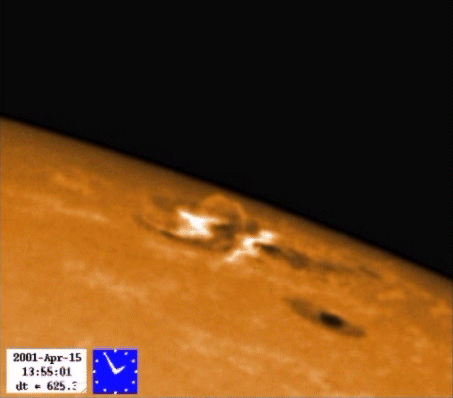
15%20April%202001%20WL.gif


I don't know if you recall that white light image discussion, but the base of the coronal loops penetrate up and through the photosphere as the bright areas around the bases of the loops demonstrates. They will *EVENTUALLY* figure that out, but I guess they haven't done that yet. :)
 
Last edited:
I don't know if you recall that white light image discussion, but the base of the coronal loops penetrate up and through the photosphere as the bright areas around the bases of the loops demonstrates. They will *EVENTUALLY* figure that out, but I guess they haven't done that yet. :)
I recall the white light image discussion quite well. It boggles my mind that you still don't understand what the photosphere is.
 
Not really. Unless one is attempting to suggest that it is physically impossible to suddenly release additional energy into a plasma simply because it's a "plasma", what's the problem with Peratt's definition of an electrical discharge in a plasma? Thanks for the references by the way.

The problem is, as I think I made quite clear, that various people define discharge differently, therefore the list of the various versions.

So, you cannot read an Alfvén paper, with Peratt's definition of a discharge, as Alfvén just says that it is a current through a gas, whereas Peratt says it is a fast release of E or B stored energy, with a breakdown of the medium.

I don't think anyone is attempting to suggest anything, that's just your reading into it.
 
Well, in terms of coronal loops, we're talking about structures that last for hours and iron ionization states inside those filaments of +20. I'd say they fall into the self-sustained category, wouldn't you?

I would say it falls in neither category as the plasma is already there from the sun and does not need to be sustained. And that has nothing to do with whether there is +20 or not. The ionization is not because of the discharge, if you want to call it that, that may just increase the ionization state of some ions present. Also the time that they last is of no consequence here.
 
I would say it falls in neither category as the plasma is already there from the sun and does not need to be sustained.

The ion temp of the plasma at the photosphere is measured in the thousands. Something needs to sustain *million* degree temps and keep the iron ionized to a +20 state. That's going to take quite a bit more energy than exists at the photosphere surface. What is sustaining million degree temps *INSIDE A SINGLE LOOP* if not "current flow/discharge currents"?

And that has nothing to do with whether there is +20 or not. The ionization is not because of the discharge, if you want to call it that, that may just increase the ionization state of some ions present. Also the time that they last is of no consequence here.

Something besides the heat from the photosphere is going to be required to sustain that +20 ionization state for several hours inside a stable "pinch".
 
A "mistake" is something one makes innocently and is willing to admit is a mistake. A lie is a mistake that one refuses to admit was a mistake even after seeing the evidence that it is a mistake.
By those definitions, you'd be a liar. Adding blue text to fix that for you:

A "mistake" is something one makes innocently and is willing to admit is a mistake after one understands that it was a mistake. A lie is a mistake that one refuses to admit was a mistake even after seeing the evidence that it is a mistake and understanding that evidence.
​
 
Understanding it, and agreeing with it are two entirely different issues.
If you are still claiming that the photosphere is in fact transparent, then you plainly do not understand what the photosphere is.
 
Status
Not open for further replies.

ISF - Join now!

Every member here is approved by hand. No bots, no spam, just people who care about evidence and honest debate.

Membership is free!

Create your free account

Back
Top Bottom