Deeper than primes

Status
Not open for further replies.
HatRack, if you are non-constructivist you do not need any index to assume that there is a set of all infinitely many distinct irrational members.

Wow Doron, you are so confused about something so simple. Being a non-constructivist does not mean that you can assume the existence of whatever you like. It means that you do not have to explicitly construct something to show that it exists.

I am perfectly fine with proofs of the form "Assume A doesn't exist -> Proposition -> Proposition -> ... -> Contradiction -> Therefore A exists", and so I am a non-constructivist. That's all it means, stop reinventing terminology that you don't understand.

That being said, the fact that the set of irrational numbers exists and is infinite is true, but it follows from more basic assumptions, it is not an assumption itself. The problem is that you cannot construct a sequence of irrational numbers without using the natural numbers implicitly as indexes.

If you don't understand sequences in mathematics and how they are defined rigorously, then you cannot possibly comprehend what Cantor's Diagonal Argument is really saying.

By using the diagonal method it is proved that such a set is incomplete (the set of all irrational numbers does not exist).

Nonsense. No one has shown any such thing. Cantor's diagonal argument starts out with the assumption that a bijection between the natural numbers and the interval (0,1) exists. Nothing can be concluded with a proof that starts out with "Assume A" unless you reach a contradiction, at which point you can conclude "Not A". This is exactly the form of Cantor's Diagonal Argument, and the fact that you try to conclude something that is in no way related to the original proposition A is just plain dumb and wrong.
 
Last edited:
I see that it's been 7 long years and you still don't understand Cantor's Diagonal Argument. Here (http://www.physicsforums.com/showthread.php?t=10076), you foolishly tried to apply it to the rationals. It's funny how many cranks don't understand this basic argument that most undergraduate math majors can understand.

Thank you for this link.

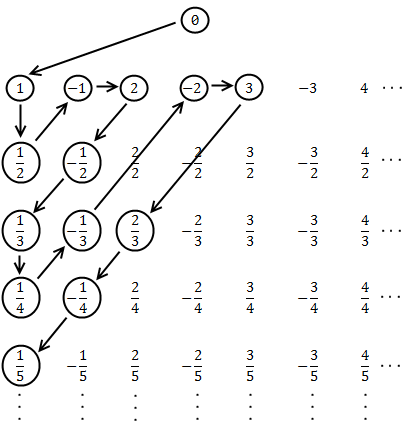
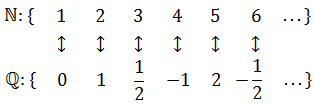
By using an ordered matrix of rational numbers, we simply show that for each natural number there is a bijection with some rational number:
countingRationals.png


nqPairings.png

( http://duartes.org/gustavo/blog/category/compsci )

It does not mean that these sets are complete, and Cantor's diagonal method proves it in the case of rational numbers, as follows:

0 . 1 7 1 1 3 1 7 1 1 3 1 7 ...
1 . 0 0 0 0 0 0 0 0 0 0 0 0 ...
0 . 4 2 1 3 4 2 1 3 4 2 1 3 ...
0 . 1 0 1 0 1 0 1 0 1 0 1 0 ...
0 . 3 3 3 3 3 3 3 3 3 3 3 3 ...
2 . 0 0 0 0 0 0 0 0 0 0 0 0 ...
0 . 3 5 4 9 5 5 1 3 5 4 9 5 ...
3 . 0 0 0 0 0 0 0 0 0 0 0 0 ...
0 . 6 4 1 6 4 1 6 4 1 6 4 1 ...
0 . 3 0 2 0 3 0 2 0 3 0 2 0 ...
0 . 6 1 3 6 1 3 6 1 3 6 1 3 ...
0 . 2 7 1 0 2 7 1 0 2 7 1 0 ...
...

Here is an ordered set of all rational numbers, which is ordered in such a way that a new rational number (which is not in the set) is shown according to this order (for example:0.010101010101... is not a member of the set of rational numbers, according to the diagonal method). It is obvious that the order of the members of the rational numbers does not change the number of the members of this set, but by using some order (exactly as we used in the case of the matrix), we can get valid conclusions, and in this case we test the validity of the assumption that the set of rational numbers is complete, and according to the test of the diagonal method, these assumption is false.

Furthermore, the set of natural numbers is also incomplete exactly because there is a bijection between the set of rational numbers and the set of natural numbers.
 
Last edited:
0 . 1 7 1 1 3 1 7 1 1 3 1 7 ...
1 . 0 0 0 0 0 0 0 0 0 0 0 0 ...
0 . 4 2 1 3 4 2 1 3 4 2 1 3 ...
0 . 1 0 1 0 1 0 1 0 1 0 1 0 ...
0 . 3 3 3 3 3 3 3 3 3 3 3 3 ...
2 . 0 0 0 0 0 0 0 0 0 0 0 0 ...
0 . 3 5 4 9 5 5 1 3 5 4 9 5 ...
3 . 0 0 0 0 0 0 0 0 0 0 0 0 ...
0 . 6 4 1 6 4 1 6 4 1 6 4 1 ...
0 . 3 0 2 0 3 0 2 0 3 0 2 0 ...
0 . 6 1 3 6 1 3 6 1 3 6 1 3 ...
0 . 2 7 1 0 2 7 1 0 2 7 1 0 ...
...

Here is an ordered set of all rational numbers, which is ordered in such a way that a new rational number (which is not in the set) is shown according to this order (for example:0.010101010101... is not a member of the set of rational numbers, according to the diagonal method).

All you've shown here is that the number 0.01010101... is not an element of the finite list of rationals that you've given. If you wish to specify a sequence, you have to specify every element of that sequence, so that I could check that the nth digit of 0.0101010101... if I wanted to.

But that's not the worst of your problems. Even if you did specify a sequence of rationals such that 0.0101010101... is not a member, then all you've shown is that 0.0101010101... is not a member of that particular infinite sequence. Congratulations.
:bigclap


This shouldn't come as a surprise, considering I can readily construct a sequence of rationals such that another rational is not in that particular sequence. Take (1/2, 1/4, 1/8, ...) for example, the rational 1 is not in this sequence.

If you wish to make a statement about all sequences of rational numbers, then you have to assume you are working with any sequence, not a specific one.

ETA: And there's also the fact that 0.0101010101... is already a known member of the rationals (since it is a repeating decimal). You are assuming that your sequence contains all rationals and you come to the conclusion that 0.0101010101... is not a rational. Even if you carried out the proof properly (which you didn't), all this proves is that your assumption was wrong.
 
Last edited:
1) The set of all irrational numbers does not exist.
If it doesn't exist, but irrational numbers do, then in what structure are they organized? We know that for every irrational number s there is irrational number t, such as s<t.
 
0 . 1 7 1 1 3 1 7 1 1 3 1 7 ...
1 . 0 0 0 0 0 0 0 0 0 0 0 0 ...
0 . 4 2 1 3 4 2 1 3 4 2 1 3 ...
0 . 1 0 1 0 1 0 1 0 1 0 1 0 ...
0 . 3 3 3 3 3 3 3 3 3 3 3 3 ...
2 . 0 0 0 0 0 0 0 0 0 0 0 0 ...
0 . 3 5 4 9 5 5 1 3 5 4 9 5 ...
3 . 0 0 0 0 0 0 0 0 0 0 0 0 ...
0 . 6 4 1 6 4 1 6 4 1 6 4 1 ...
0 . 3 0 2 0 3 0 2 0 3 0 2 0 ...
0 . 6 1 3 6 1 3 6 1 3 6 1 3 ...
0 . 2 7 1 0 2 7 1 0 2 7 1 0 ...
...

Here is an ordered set of all rational numbers...
I don't understand it. How did you chose the numbers, which are in their fractional form bellow.

17113/99999
1
383/909
10/99
1/3
2
3549551/9999999
3
641/999
3020/9999
613/999
2710/9999

It kind of fails to ring the bell at the door with the name Ordered Set on it.
 
All you've shown here is that the number 0.01010101... is not an element of the finite list of rationals that you've given.

But that's not the worst of your problems. Even if you did specify a sequence of rationals such that 0.0101010101... is not a member, then all you've shown is that 0.0101010101... is not a member of that particular infinite sequence.

No, it is an infinite set with a particular order that has no influence on the number of members of that set (exactly as the order of the matrix of rational numbers, does not have any influence on the number of the members of the set of rational numbers. Again your constructivist reasoning airs its view.

The particular order and the use of the diagonal method simply exposes the existence of more rational numbers that are not included in the set of rational numbers, exactly as Godel's first incompleteness theorem shows.

If you wish to make a statement about all sequences of rational numbers, then you have to assume you are working with any sequence, not a specific one.
The number of distinct objects of a given infinite set is not changed by any particular order. The particular order that was used by me simply exposes more rational numbers that are not members of the set of rational numbers, if the diagonal method is accepted as a valid mathematical tool.

By using an arbitrary order between the members of the set of rational numbers, we generally get irrational numbers, but then that cases of rational numbers that are not in the set, are not exposed.

ETA: And there's also the fact that 0.0101010101... is already a known member of the rationals (since it is a repeating decimal). You are assuming that your sequence contains all rationals and you come to the conclusion that 0.0101010101... is not a rational. Even if you carried out the proof properly (which you didn't), all this proves is that your assumption was wrong.
Once again you miss Godel's first incompleteness theorem. Congratulations.

:bigclap

Godel's first incompleteness theorem demonstrates the validity of a thing according to the rules of a given framework, which can't be proved within the given framework.

By using the diagonal method (without using any bijection) on the set of rational numbers, we define an object that has the properties of that set (it obeys the rules of a give framework) but it is not a member of that set (but can't be proved within this framework).
 
Last edited:
If it doesn't exist, but irrational numbers do, then in what structure are they organized? We know that for every irrational number s there is irrational number t, such as s<t.
So what? it says nothing about the completeness of that set.
 
Doron, thy name is Contradiction.
By your local-only reasoning.

The Axiom of Empty Set is not a definition for empty set.
Yes I know GOD-jsfisher ,the empty set exists because you declare that it exists. You just forgot the fact that X is empty because empty X is not a member of empty X (known as circular reasoning).
 
Last edited:
That being said, the fact that the set of irrational numbers exists and is infinite is true, but it follows from more basic assumptions, it is not an assumption itself. The problem is that you cannot construct a sequence of irrational numbers without using the natural numbers implicitly as indexes.
The index of the set of irrational numbers is the inherent property of any collection of distinct objects (the distinction is the index).

If you don't understand sequences in mathematics and how they are defined rigorously,
All is needed is the inherent property of indexing that any collection of distinct objects has. No bijection is needed.


Nonsense. No one has shown any such thing. Cantor's diagonal argument starts out with the assumption that a bijection between the natural numbers and the interval (0,1) exists.
You are talking about Cantor's non-elementary use of the diagonal method.

I am talking about elementary use of the diagonal method, which uses the inherent property of indexing that any collection of
distinct objects has.

Again, no bijection is needed.

In order to get it you have to move beyond traditional mathematics' books.
 
Last edited:
So what? it says nothing about the completeness of that set.

Which set?

1) The set of all irrational numbers does not exist.

The set that doesn't exist?

Set theorists say that the set of irrational numbers is uncountable. So that should cancel any question regarding its completeness. How can the dentist find out whether the patient has a complete set of teeth, when the patient wouldn't open his mouth at the sight of the drill no matter what, and the dentist can't count?
 
Last edited:
Which set?
k or k-1


The set that doesn't exist?
It exists, but not as the set of all irrational numbers.

Set theorists say that the set of irrational numbers is uncountable. So that should cancel any question regarding its completeness. How can the dentist find out whether the patient has a complete set of teeth, when the patient wouldn't open his mouth at the sight of the drill no matter what, and the dentist can't count?

By using the diagonal method on the X-Ray picture of the set of the patient's teeth.:)
 
Last edited:
I am perfectly fine with proofs of the form "Assume A doesn't exist -> Proposition -> Proposition -> ... -> Contradiction -> Therefore A exists", and so I am a non-constructivist. That's all it means, stop reinventing terminology that you don't understand.
You choose to be a constructivist when it fits to your purpose, for example:

So, let's see in details how all of the irrationals can be listed in a sequence so that diagonalization can be applied to them. Go ahead and try, it will be fun to watch considering it's been proven that you can't do so.
 
Still can't get past your need to enumerate every member of a set? The set of all irrational numbers exists, whether you list every member or not.
Wong.

By using the elementary case of the diagonal method (the elementary case is done without bijection, by using the fact that the members of the set of irrational numbers are distinct, and this fact is used as the index of the diagonal method).

Code:
{    
 0.1011...
 ,   
 0.1101...
 ,   
 0.1001...
 , 
 0.0010...
 ,  
 ... 
}
For example: number 0.0011... is not a member of {0.1011..., 0.1101..., 0.1001..., 0.0010..., ...}, which is assumed to be the set of all distinct irrational numbers.

Godel's first incompleteness theorem demonstrates the validity of a thing according to the rules of a given framework, which can't be proved within the given framework.

By using the diagonal method (without using any bijection) on the set of irrational numbers, we define an object that has the properties of that set (it obeys the rules of a give framework) but it is not a member of that set (but can't be proved within this framework).
 
Last edited:
HatRack, if you are non-constructivist you do not need any index to assume that there is a set of all infinitely many distinct irrational members.

Doron, you once again substitute misrepresentation to cover your misunderstanding. The proposition was never simply to construct a set of all irrational numbers. It was to place the irrationals into one-to-one correspondence with the integers. Is that so hard to understand?

By using the diagonal method it is proved that such a set is incomplete (the set of all irrational numbers does not exist).

See what happens when you misunderstand then misrepresent something? You leap to an illogical and incorrect conclusion. The diagonal proof shows that their are more irrational numbers than there are integers.
 
Yes I know GOD-jsfisher ,the empty set exists because you declare that it exists. You just forgot the fact that X is empty because empty X is not a member of empty X (known as circular reasoning).


Nope, that is not circular reasoning, but since you don't understand what circular reasoning is, it is no surprise you would just make something up.
 
-1 is simply the existing mirror of +1.

What "mirror"? Negation requires no "mirror" ("existing" or otherwise) and no one asked what you think “-1 is”. You seem to be confusing, again perhaps deliberately, the reversal of ordering that happens in a reflected or mirrored image as being the negation (in this case meaning oposite) of something other than just the, well, ordering. You seem to have a great deal of difficultly with the concepts of ordering as well as negation (just to name a couple). As already explained to you many times before, ontologically negation is specifically the denial of existence. So the negation of 1 (represented as -1) is the denial of the existence of the value 1. A mirror does not deny the existence of that which it reflects it simply reverses the ordering of the coordinates along an axis normal to its surface.


Again the question was specifically…

So now your “magnitude of existence” can have a negative value?

Would you care to actually address the question that was asked as opposed to whatever questions in you head that you continue to address instead?
 
By using the diagonal method on the X-Ray picture of the set of the patient's teeth.:)
Aha. I didn't think of it. That's why the X-Ray picture is using two diagonals:
/ for the upper and \ for the lower teeth. Or is it vice versa? Anyway... never get your dentist extract your wisdom teeth before a math exam.
 
Last edited:
No, it is an infinite set with a particular order that has no influence on the number of members of that set (exactly as the order of the matrix of rational numbers, does not have any influence on the number of the members of the set of rational numbers. Again your constructivist reasoning airs its view.

The particular order and the use of the diagonal method simply exposes the existence of more rational numbers that are not included in the set of rational numbers, exactly as Godel's first incompleteness theorem shows.

Wrong. Please read http://www.internationalskeptics.com/forums/showthread.php?postid=6699220 again in details until you understand it.

By using the diagonal method (without using any bijection) on the set of rational numbers, we define an object that has the properties of that set (it obeys the rules of a give framework) but it is not a member of that set (but can't be proved within this framework).

Wrong again. Please read http://www.internationalskeptics.com/forums/showthread.php?postid=6699244 and http://en.wikipedia.org/wiki/Cantor's_diagonal_argument in details until you understand it.
 
Status
Not open for further replies.

Back
Top Bottom