Moderated Iron sun with Aether batteries...

Status
Not open for further replies.
I am asking the real questions - why are you under the impression that your physcially impossible solid iron surface on the Sun exists?

Because I think the standard solar model has failed. Ok. Just think about what I am saying for a minute. If you could suspend disbelief, just for a minute, my model fits every parameter for the sun. Just look at it.

It explains the structure of the sun perfectly. Why there is a temperature gradient from <5000K to >2MK. Why there is a "convection" layer. The metals problem. Helioseismologically why the sun is more like a bounded sphere than a decreasing density plasma ball. X-rays, gammas, neutrinos.
The change is a real description of the field and its functioning. It doesnt change the way physics work, it only modify''s some of the math, introduces new experimental data and methodology's as well as completing the description of "energy" in the most basic sense.

Does an ice skater do work on herself pushing off from a railing and sliding across the skating rink???

P.S.
First asked 19 September 2010
What magical thing happens in constructing running difference images of light emitted from Fe IX ions in the corona that reveals light relected from your physically impossible surface?

I dont believe in magic. Only in science. However, I do think that there is an quantum explanation for levitation.

And lets throw in yet another question
First asked 21 September 2010
brantc
Stellar formation is well understood.
FYI: Basically a cloud of gas clumps together under gravity until it gets dense enough for fusion to start and you have a star.

How did a gloud of gas form your physcially impossible solid iron surface on the Sun?

The answer lies in supernova. Supernovae are known to have iron cores and iron rich plasma. The hypothesis is the supernova are large plasma pinches that nucleosynthesize iron cores that get ejected.
Plasma pinches are not only hot enough(2 billion+ K) but also use Marklund convection to synthesize new metals.
 
I dont know what to make of this. But it is an unexpected observation.
Does it mean that once a flux tube forms from the sun to the earth the fossil remnant stays? Amazing. And electrical.


Flux tube texture of the solar wind: Strands of the magnetic carpet at 1 AU?

Joseph E. Borovsky

Los Alamos National Laboratory, Space Science and Applications (ISR-1), Los Alamos, New Mexico, USA

It is argued here that the inner heliosphere is filled with a network of entangled magnetic flux tubes and that the flux tubes are fossil structures that originate at the solar surface. 65,860 flux tubes are collected from seven years of measurements with the ACE spacecraft at 1 AU by spotting the flux tube walls with large changes in the magnetic field direction and the vector flow velocity. The tube walls are associated with large changes in the ion entropy density and the alpha-to-proton ratio. The median size of the flux tubes at 1 AU is 4.4 × 10⁵ km. The tubes are larger in slow wind than in fast wind. The tubes are on-average aligned with the Parker spiral, with a large spread in orientations. This large spread may be caused by slight misalignments of tubes in the corona. The flux tubes map to granule and supergranule sizes on the Sun. The amounts of magnetic flux in the tubes at 1 AU correspond to the amounts of magnetic flux in field concentrations in the magnetic carpet. It is argued that the flux tubes do not reconnect during the ∼100-h advection to 1 AU owing to the expansion of the solar wind. The flux tube texture impacts the flow properties of the solar wind, turbulence in the solar wind, energetic-particle propagation in the inner heliosphere, and the driving of the Earth's magnetosphere. A method for using measurements of the flux tube walls for the remote sensing of magnetic field dynamics in the magnetic carpet is suggested.
http://www.agu.org/pubs/crossref/2008/2007JA012684.shtml
 
Because I think the standard solar model has failed. Ok. Just think about what I am saying for a minute. If you could suspend disbelief, just for a minute, my model fits every parameter for the sun. Just look at it.

No. Your "model" doesn't fit any parameter for the sun, because your "model" is not a model at all. It has zero quiantitative predictive power.

Why there is a temperature gradient from <5000K to >2MK. Why there is a "convection" layer.

You think that's a problem for the conventional model? Hardly. That's exactly what you should expect when huge amounts of heat are being generated in the core, as they are through fusion.

X-rays, gammas, neutrinos.

What about them? Can you predict the expected flux from any of these? No, you can't.

The change is a real description of the field and its functioning. It doesnt change the way physics work, it only modify''s some of the math

Let's see this modified math, then.

introduces new experimental data

You have introduced no new experimental data.

as well as completing the description of "energy" in the most basic sense.

"Completing" the definition of energy? Hardly. What you're asking us to do is throw the definition out the window completely, for an alternative that you can't actually define at all.

Does an ice skater do work on herself pushing off from a railing and sliding across the skating rink???

Yes. Work = force x distance. She moves as she pushes, so her arms do work on her body.

I dont believe in magic. Only in science.

You haven't convinced us that you can tell the difference.

However, I do think that there is an quantum explanation for levitation.

Yes, there is. You're late to the party, your orgone friend wasn't invited, and this one has nothing to do with the sun.
 
Because I think the standard solar model has failed. Ok. Just think about what I am saying for a minute. If you could suspend disbelief, just for a minute, my model fits every parameter for the sun. Just look at it.
I looked at it and it explains nothing because all you have is the debunked assertion that the solid iron surface exists, a link to a crackpot web site for you "aether battery" and a list of unsupported assertions about it.
You have no predictions.
The answer lies in supernova. Supernovae are known to have iron cores and iron rich plasma. ...snipped hypothesis...
You need to learn about stellar formation and maybe read the question again:
First asked 21 September 2010
brantc
Stellar formation is well understood.
FYI: Basically a cloud of gas clumps together under gravity until it gets dense enough for fusion to start and you have a star.

How did a gloud of gas form your physcially impossible solid iron surface on the Sun?
IOW: Given that the clouds of gas from which stars are formed have small % of iron (maybe 0.2%) and are cloud of gas, how did a gloud of gas form your physcially impossible solid iron surface on the Sun?
What was the mechanism that separated just iron from the cloud?
Why did the same mechanism not separate all other elements from the cloud?
What was the mechanism that created a single hollow sphere per star from that iron?
Why did the same mechanism not create lots of hollow spheres of diffent elements?
 
I dont know what to make of this. But it is an unexpected observation.
Does it mean that once a flux tube forms from the sun to the earth the fossil remnant stays? Amazing. And electrical.
Amazing. And magnetic (magnetic flux tube). And electrical due to the laws of physics (flux tubes on the solar surface are created by magnetic fields that are created by currents flowing in the plasma inside the sun).

My guess is that the magnetic flux tubes are flux tubes that were at the solar surface and then moved away, i.e. are "fossils" of the original magnetic activity.
 
Because I think the standard solar model has failed.


That is called an argument from incredulity.

Ok. Just think about what I am saying for a minute. If you could suspend disbelief, just for a minute, my model fits every parameter for the sun. Just look at it.


In other words, if we would only forget about all those pesky laws of physics that show your impossible claim to be impossible, and buy into the same arguments from incredulity and ignorance that seem to have you convinced, we might actually believe in that impossible solid surfaced Sun, too.

It explains the structure of the sun perfectly.


So perfectly that your paper is due to be published... okay... that would be too much to expect.

Why there is a temperature gradient from <5000K to >2MK. Why there is a "convection" layer. The metals problem.


Those are called arguments from ignorance.

Helioseismologically why the sun is more like a bounded sphere than a decreasing density plasma ball.


The science of helioseismology is well enough developed that it can be used to locate sunspot activity on the far side of the Sun. The folks who actually understand that science don't have enough of a concern about its reliability to believe there might be some huge discrepancy that would allow for a solid surface on the Sun. And what helioseismology shows us is that there is moving mass, moving at thousands of kilometers per hour up, down, and laterally directly through the region where you seem to believe a solid surface exists. So that is another argument from ignorance.

X-rays, gammas, neutrinos.


Those are called arguments from ignorance, too.

The change is a real description of the field and its functioning. It doesnt change the way physics work, it only modify''s some of the math, introduces new experimental data and methodology's as well as completing the description of "energy" in the most basic sense.


Yet you haven't shown that you have the qualifications to understand math or physics at a level necessary to modify anything to make it fit, well, anything relevant to your claim. But to go to the heart of your comment above, it's gibberish, a handful of sciency sounding words strung together and poured out onto the page, but lacking in any real relevant meaning whatsoever.

I dont believe in magic. Only in science. However, I do think that there is an quantum explanation for levitation.


That is sort of a combination between an argument from incredulity and an argument from ignorance.

The answer lies in supernova. Supernovae are known to have iron cores and iron rich plasma.


And even if so it doesn't in any way support your claim that the Sun has a solid surface, iron surface, solid iron surface, rigid surface, or any of the other ways that you or Michael have tried to describe your physically impossible conjecture. So no, the answer doesn't lie there at all.
 
I dont know what to make of this. But it is an unexpected observation.
Does it mean that once a flux tube forms from the sun to the earth the fossil remnant stays? Amazing. And electrical.

Ah, it's Joe Borovski, you're not supposed to understand.
The flux tubes do not get formed "from the sun to the Earth" they are, in the words of Joe:

A working hypothesis is that the flux tubes are seeded into the solar wind at the top of the magnetic carpet, wherein they survive intact the ~100-h advection time to 1 AU.

He basically looks at changes in field direction near the Earth, as compared to the Parker spiral direction and look at the sizes of the regions with these directions and decides that it's all intertwined flux tubes.

Nothing electrical about it actually, indeed the word electrical is never used in the whole paper (except in the title of a reference), there are current sheets, but those are there because of bordering otherly directed magnetic fields.

For those interested I (naturally) have a copy of this paper.
 
Michael Mozina, sorry to butt in, I think there are a few lurkers also wondering about the difference images you're making with the SDO data. Have you given up on that idea?

Not at all. I have however been rather preoccupied at work. We're about (next month) to release a new module for our program and I had to first upgrade the base language of our program and replace a number of DLL's to facilitate that process. It's been pretty time consuming frankly, and my "hobbies" have had to take a back seat for a bit while I work on improving my real source of income now that my oldest daughter is in college. :)

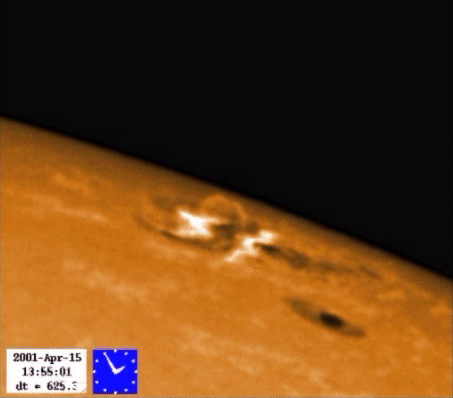
All of the 1600A and 1700A SDO images make it very clear that the discharge loops originate *FAR BELOW* the surface of the photosphere and have a direct effect on the light output at the surface of the photosphere as they traverse that surface. They completely support that white light image we were discussing awhile back. LMSAL blew it big time on the issue of where the "footprints" of the loops are located whereas NASA got it right.

15%20April%202001%20WL.gif


Just as with this white light image we discussed earlier, the loops have a direct physical effect on the surface of the photosphere. They "light it up", not only in white light, but in 1600A, and sometimes even 1700A. These 1600A images show the loops coming up and through the photosphere and the flare "light up" the photosphere too.

http://sdo.gsfc.nasa.gov/assets/img/dailymov/2010/09/20/20100920_1024_1600.mpg
http://sdo.gsfc.nasa.gov/assets/img/dailymov/2010/09/21/20100921_1024_1600.mpg

What is still "in debate" is whether or not the iron line emissions can be seen *below* the surface seen in 1600A, or just as they leave the surface seen in 1600A. That is going to take some time to demonstrate. I still need to download the SOLARSOFT libs for SDO to even begin that process so I can create accurate RD images. Those libraries look to be *HUGE*.

Once I get my new reoccurring revenue going, I'll have time to work on it in earnest. At the moment however, it simply has to wait. By the end of next month however, things should start to slow down for me at work and I'll have more time to put into that process.
 
Because I think the standard solar model has failed. Ok. Just think about what I am saying for a minute. If you could suspend disbelief, just for a minute, my model fits every parameter for the sun. Just look at it.
No it doesn't. Not in the slightest. It violates basic physics.

It explains the structure of the sun perfectly. Why there is a temperature gradient from <5000K to >2MK.
You won't mind showing us that maths to prove this then.

Why there is a "convection" layer.
Really?

The metals problem.
What metals problem?

Helioseismologically why the sun is more like a bounded sphere than a decreasing density plasma ball.
It's in complete contradiction to helioseismology data.

X-rays, gammas, neutrinos.
I suppose you have your calculations for this too.

The change is a real description of the field and its functioning. It doesnt change the way physics work, it only modify''s some of the math, introduces new experimental data and methodology's as well as completing the description of "energy" in the most basic sense.
Nonesense. You've basically been claiming that all of physics is wrong. You may not realise it but that would have to be the case if your "model" was correct.

Does an ice skater do work on herself pushing off from a railing and sliding across the skating rink???
Pardon?

I dont believe in magic. Only in science. However, I do think that there is an quantum explanation for levitation.
Huh?

The answer lies in supernova. Supernovae are known to have iron cores and iron rich plasma. The hypothesis is the supernova are large plasma pinches that nucleosynthesize iron cores that get ejected.
Plasma pinches are not only hot enough(2 billion+ K) but also use Marklund convection to synthesize new metals.
Only type II supernovae have iron cores.
 
All of the 1600A and 1700A SDO images make it very clear that the discharge loops originate *FAR BELOW* the surface of the photosphere and have a direct effect on the light output at the surface of the photosphere as they traverse that surface. They completely support that white light image we were discussing awhile back. LMSAL blew it big time on the issue of where the "footprints" of the loops are located whereas NASA got it right.

[qimg]http://www.thesurfaceofthesun.com/images/15%20April%202001%20WL.gif[/qimg]

Just as with this white light image we discussed earlier, the loops have a direct physical effect on the surface of the photosphere. They "light it up", not only in white light, but in 1600A, and sometimes even 1700A. These 1600A images show the loops coming up and through the photosphere and the flare "light up" the photosphere too.

http://sdo.gsfc.nasa.gov/assets/img/dailymov/2010/09/20/20100920_1024_1600.mpg
http://sdo.gsfc.nasa.gov/assets/img/dailymov/2010/09/21/20100921_1024_1600.mpg

What is still "in debate" is whether or not the iron line emissions can be seen *below* the surface seen in 1600A, or just as they leave the surface seen in 1600A. That is going to take some time to demonstrate. I still need to download the SOLARSOFT libs for SDO to even begin that process so I can create accurate RD images. Those libraries look to be *HUGE*.

Once I get my new reoccurring revenue going, I'll have time to work on it in earnest. At the moment however, it simply has to wait. By the end of next month however, things should start to slow down for me at work and I'll have more time to put into that process.


Once again, your qualifications to understand solar imagery of any sort have been challenged, and you have repeatedly shown that you do not possess any such qualifications. On the other hand, the people at NASA and LMSAL and Stanford who are primarily responsible for planning and executing the solar research programs you always misunderstand, the people who are responsible for acquiring and analyzing the data from those satellite projects, those people who are eminently qualified to understand solar imagery, wholly disagree with your position. Your qualifications are as nonexistent as your solid surface. Your argument has failed.
 
Because I think the standard solar model has failed. Ok. Just think about what I am saying for a minute. If you could suspend disbelief, just for a minute, my model fits every parameter for the sun. Just look at it.

But for your model to even start to be valid we'd need to throw out all observations made on both iron and gravity ever made on earth. Physics (backed by untold amounts of empirical data in working with iron) shows that under no condition could your hollow iron shell be stable. Even without becoming a sun. A shell that size will collapse in on itself. Gaseous/molecular iron will not spontaneously from a shell, but rather a solid ball. No interstellar gas cloud or solar material has anywhere near the amount of iron needed for your model

It explains the structure of the sun perfectly. Why there is a temperature gradient from <5000K to >2MK. Why there is a "convection" layer. The metals problem. Helioseismologically why the sun is more like a bounded sphere than a decreasing density plasma ball. X-rays, gammas, neutrinos.
The change is a real description of the field and its functioning. It doesnt change the way physics work, it only modify''s some of the math, introduces new experimental data and methodology's as well as completing the description of "energy" in the most basic sense.

Yes, your model DOES require physics to be extremely different from what we find on earth

Does an ice skater do work on herself pushing off from a railing and sliding across the skating rink???

Yes. Pushing off is work. Keeping balance is work. Both are done upon herself.


I dont believe in magic. Only in science. However, I do think that there is an quantum explanation for levitation.

But you do believe in magic. You call it aether. It makes physical laws be different in the sun than on earth. It can create energy out of nothing. And it cannot be demonstrated except to those that believe in it.


The answer lies in supernova. Supernovae are known to have iron cores and iron rich plasma. The hypothesis is the supernova are large plasma pinches that nucleosynthesize iron cores that get ejected.
Plasma pinches are not only hot enough(2 billion+ K) but also use Marklund convection to synthesize new metals.

Yes, supernova create some iron. Using nuclear fusion which starts with hydrogen. The very nuclear fusion you claim doesn't drive the sun. And said iron is nowhere near enough to form a shell the size of a sun and also does not come in handy IKEA like puzzle blocks ready to form a shell. So more magic aether will also fix this problem in your theory.
You do realize that your theories solve minor to imaginary problems in the standard model by introducing far larger problems and then saying 'aether' to make it go away?
 
One other question set for Brantc. You have mentioned supernova's as the source of the material for the shell you propose.
How did the first starts work in your theory, when the universe was mainly composed of hydrogen?
And how, in your model, are (super)nova's even possible? The iron shell gathers aether and makes light. We see no massive iron ejection from the sun, so the shell is probably stable. And even if it isn't, when it degrades it will just stop working. So your own model at the moment lacks the ability to produce the materials needed in your model.
Or does iron spontaneously appear through 'aether'?
 
Photons and aether theory II

Third question(s): We are now quite adept at detecting individual photons. CCD detectors, and similar solid state technologies, are extensively used in astronomy, and in other branches of science, for the explicit detection of photons (which can be individually counted). So, if there are no photons propagating, say from the sun to Earth, then where do the photons that we do detect come from? Where along the sun-Earth path are they created? And what are they created from? How do we observationally detect the parent entities from which photons are created?
Think of it as the same energy that the "field" imparts to things. Aetherometry has identified just what the "field" is. Not virtual photons or whatever. Massfree charges. The lowest form of energy in Aetherometry is massfree energy. No charge, no inertia.

The field transmits the energy causing the particle to move and the particle responds by emitting a photon that is generated in the particle(locally) from the energy imparted by the field.

From Aetherometry.
"claims that solar radiation is electrical, not because it is composed of photons, but because it consists of propagating massfree charges. Unlike massbound charges, massfree charges have no fixed spin orientation with respect to forward propagation."
The answer given here by brantc does not answer the question I asked (which I have bolded here for emphasis). Not only do we see & count individual photons coming from the sun (and other astronomical sources), but we can determine the direction from which the photons enter the detector. According to this aether hypothesis, there are no photons generated at the source, so they must be generated somewhere along the line of sight between the source and the detector, and with directionality consistent with that line of sight.

And so I ask again: Where along the sun-Earth path are they created? Are photons mostly created in close proximity to the sun? In close proximity to the detector? Evenly distributed along the line of sight? Or maybe in some other distribution that is somehow re-oriented to the line of sight?
 
Iron Sun Surface Thermodynamically Impossible IX

You question was:
Why isnt the photosphere at a higher temperature from this surface sublimating UV flux, or am I misunderstanding the question.
More precisely, my question is: How do you maintain a solid iron surface in the presence of a thermal bath that exceeds the vaporization temperature/energy of solid iron?

You provide an answer:
My surface is 400km below the photosphere visible surface. 90% of the solar UV comes from above it. Thats why my surface does not sublimate.
That source of UV will radiate the same flux upwards as it does downwards, if it is isothermal. If it is hotter towards the bottom than towards the top, then it will actually radiate more UV downwards towards the iron surface, which does not bode well for its solidity. Now, I will assume that photosphere visible surface is the photospheric layer with optical depth = 1 for visible light (in fact the photosphere has a visible volume not a visible surface). We can see about 100 km below that layer and combine our observations with our knowledge of the laws of physics, and determine a temperature of 9400 kelvins (e.g., Solar Astrophysics, Foukal, page 153; adopted from the photosphere reference model in Maltby, et al., 1986). This is where the high resolution models stop, but a linear extrapolation down to -400 km shows an expected temperature ~18,400 Kelvins. I simply note that all of these temperatures are significantly higher than the boiling point for iron, 3134 Kelvins. Now, the boiling point in-situ in the sun might be higher due to higher pressure, but it's not going to be that much higher (no doubt this can be quantified by someone with more expertise and greater industry than myself).

Furthermore, see my earlier post Iron Sun Surface Thermodynamically Impossible VII ...
The relevant number here is the bolometric flux, since we only need to overcome the weak Fe-Fe bond, and that is what the enthalpy of atomization represents, the total binding energy of one mole or 7.09 cm3 of iron. That's 414.2 KJ/mole = 4.142x10⁵ J/mole. Now, at about 6x10¹⁰ erg cm-2 sec-1 x 3.690 cm2 we get 2.214x10¹¹ erg sec-1 = 2.214x10⁴ Joules sec-1 deposited on the one exposed face of a molar volume at the surface. So it will take only 18.7 seconds to present enough energy to that exposed molar cube face to vaporize the entire molar cube. The actual time it takes to vaporize it depends on the efficiency with which the energy is absorbed, but that will certainly be very high; the optical reflectivity of iron is 65% at room temperature, but will drop fast with a non-specular surface, so the absorption must be nearly 100%. But even if we give you every benefit of chance and pretend the reflectivity is 65%, and absorption therefore 35%, then the vaporization of that mole of iron will take about 53.4 seconds.

So if you have an iron crust 100 km thick (that's 107 cm) and we get rid of 1.921 cm every 53.4 seconds, then all 100 km will be gone in 2.780x10⁸ seconds. Now, with 3.1557600x10⁷ seconds in one year, you can see that in just under 10 years your entire iron edifice will be destroyed. Make the layer 1000 km thick, and it takes just under a century. So even if you could dream up some way to get the iron there in the first place, you would then have to dream up a way to keep it from vanishing altogether in a really short time (which in fact we seriously over-estimate here because we are assuming an unrealistic 65% reflectivity, when the real reflectivity will br far less than that; double the absorption efficiency and you cut the iron layer lifetime in half).

Physics indicates that an iron surface for the sun is not thermodynamically acceptable.
So aside from the temperature, I have also examined the energy density and shown that an iron surface simply cannot continue to exist more that a few years after it appears (however that happens). Bottom line for me: Your answer, that 90% of the solar UV comes from above the layer, is vastly inadequate to address the serious physical problem. No matter high you try to look at it, unless you want to deny the validity of thermodynamics (be my guest if you do), then you have a layer of solid iron sitting in a thermal energy bath far beyond anything required to vaporize that iron.

So how do you propose to avoid this thermodynamic problem? Can you provide an answer with some content relevant to physics?
 
Physics and Solar Models I

Just think about what I am saying for a minute. If you could suspend disbelief, just for a minute, my model fits every parameter for the sun. Just look at it.
Let us suppose that you model indeed does fit every parameter for the sun. However, I think we have already convincingly demonstrated that your model is also inconsistent with the known laws of physics. Which takes precedence? If your model fits the sun perfectly, but at the expense of not fitting the laws of physics, should we accept it anyway, because of its explanatory powers regarding the sun? Or should we reject it because it is inconsistent with known physics, and seek a better model?
 
Is There a Coronal Heating Problem?

It explains the structure of the sun perfectly. Why there is a temperature gradient from <5000K to >2MK.
How does a solid iron surface do that? The alleged solid iron surface sits, as you say, 400 km below the "visible surface" of the photosphere. But the temperature gradient you speak of is not smooth, being concentrated in the transition region between the chromosphere & corona. In the transition region the plasma temperature rises from about 6,000 Kelvins (K) to 600,000 K, a factor of 100, over a distance of about 1,000 km. The base of the 1,000 km region is about 1500 km above your iron surface, and between your iron surface and the base of the transition region, the temperature actually drops, from about 10,000 K to about 4,000 K, before rising once again to about 6,000 K over a distance of about 1,000 km before the base of the transition region. So the temperature rises from 4,000 K to 6,000 K over 1,000 km, and then rises from about 6,000 K to 600,000 K over the next 1,000 km (see figure 9-17, page 310, and the attendant text, in the book Solar Astrophysics, Peter Foukal, Wiley-VCH, 2004). A solid iron layer can under no circumstances exceed about 2,000 K under the most optimistic & favorable circumstances we can imagine. And since it is solid, it has no moving parts. So there must be some unexplained remote control mechanism it can use to cause the plasma 1500 km away to skyrocket in temperature, while the intervening plasma actually cools. It will not be sufficient to explain this by simply waving your hands around and appealing to the vague generalities of electricity, aether or orgone power. Specific physics is required. Do you have any?

The standard solar model, on the other hand, can explain this temperature gradient fairly easily, at least in principle. It is due to magnetic or magneto acoustic waves, which steepen into shocks at the transition region. That's an oversimplification but it gets the idea across. Most of the chromospheric heating, in the 1,000 km below the transition region, can be explained by compressional waves associated with the 5-minute oscillations in photospheric granules (it is far easier for things that move around to generate waves than it is for a static iron layer to do it). Coronal heating is probably due to several simultaneous processes happening at once, including magnetic Alfven waves, and energy released by microflares & spicules at the top of the chromosphere. This is all extensively reviewed in the literature, though usually dismissed without comment by critics of the standard model, who usually prefer to avoid physics whenever possible; see for instance, my earlier post Coronal Heating & Solar Wind I (17 April 2010) and references therein.
 
Is There a Solar Convection Problem?

Why there is a "convection" layer.
Convection is nothing more than the mechanical transport of matter in the general direction of warmer towards cooler. There is certainly no need to invoke any kind of surface. Standard physics answers this question very easily. If the temperature gradient in the plasma is less steep than the adiabatic gradient, then energy transport is most efficient by purely radiative transfer and there is little or no convection (this is the case for the inner radiative zone of the sun). If the temperature gradient becomes steeper than the adiabatic gradient, then energy transport is more efficient by mass motion than by radiative transfer, and convection sets in (this is the case for the convective zone of the solar interior, that includes the last 25% or so of the solar radius). This is general physics that must be true for all atmospheres; it works quite the same on Earth as it does for the sun. See, for instance, section 6.1.2 "Energy Transport" (pages 169-170) in Foukal's book Solar Astrophysics. But this too is a bit of simplification, so if you want to leave no stone of physics unturned in your quest to understand convection, see chapter 4 ("Radiative and Conductive Heat Transfer") and chapter 5 ("Heat Transfer by Convection") in the book Stellar Interiors by Hansen, Kawaler & Trimble, Springer 2004 (2nd edition), or see the various relevant topics in the books Stellar Astrophysical Fluid Dynamics, Thompson (no relation) and Christensen-Dalsgaard, Cambridge University Press 2003 or Fluid Dynamics and Dynamos in Astrophysics and Geophysics, Andrew Soward, et al., editors, CRC Press 2005.
 
Is There a Solar Metals Problem?

The metals problem.
I don't know what the "metals problem" is supposed to be. But even if I did, how would a solid iron layer solve it? Solid iron is, after all, a metal (singular) and the problem you allege is metals (plural). A solid iron layer might conceivably help resolve the iron part of this problem, depending of course on what the problem is really supposed to be, but what about all those other metals? Is there also an aluminum layer? Tin? Lead?
 
Does Helioseismology Require a Solid Solar Surface?

Helioseismologically why the sun is more like a bounded sphere than a decreasing density plasma ball.
Wrong. Helioseismologically the sun is in fact exactly like a decreasing density plasma ball, and is remarkably not like anything with a solid boundary. You made this claim once before, and I refuted it once before (3 April 2010):
Actually the measurements(harmonics) support a bounded sphere as opposed to a decreasing density "plasma ball" of fusion.
Actually, GeeMack is quite correct, and you are way wrong. Helioseismology is extremely supportive of the standard model. This is extensively documented in the literature; e.g., Helioseismology, Jorgen Christensen-Dalsgaard, Reviews of Modern Physics 74(4): 1073-1129, November 2002; The Internal Rotation of the Sun, M.J. Thompson, et al., (not me & no relation that I know of), Annual Review of Astronomy and Astrophysics 41: 599-643 (2003), and the many citations to both. More recently, see M.J. Thompson, 2010; Gizon, Birch & Spriut, 2010; Solar Interior Rotation and its Variation, Rachel Howe, Living Reviews in Solar Physics 6(1), February 2009 (free access online); Zhao, et al., 2009; Chaplin & Basu, 2008; Christensen-Dalsgaard, 2007; Gough, 2006 & etc. Finally, see the book Stellar Astrophysical Fluid Dynamics, edited by M.J. Thompson & Jorgen Christensen-Dalsgaard, Cambridge University Press 2003.

The idea that a bounded sphere is implied by helioseismological data is unacceptable, and very much contradicted by the weight of scientific study of the topic.
 
Status
Not open for further replies.

Back
Top Bottom