• Quick note - the problem with Youtube videos not embedding on the forum appears to have been fixed, thanks to ZiprHead. If you do still see problems let me know.

Invitation to Derek Johnson to discuss his ideas

Guys;

I have noticed a yellow card or two, as well as moderator editing in this thread. Yesterday many posts were moved to AAH.

Do not let Derek's juvenile, PDoh like behavior get you suspended or banned from this forum. With his behavior, he will do that to himself in a matter of time. Remember, even engineers can behave like kindegarteners.

TAM:)

TAM,
I think you're being a bit unfair here. I don't see any indication that Derek is acting childish or trollish. I think his thorough analysis and specific questions are frustrating your cohorts, that's all. He's actually been quite civil and friendly.
 
TAM,
I think you're being a bit unfair here. I don't see any indication that Derek is acting childish or trollish. I think his thorough analysis and specific questions are frustrating your cohorts, that's all. He's actually been quite civil and friendly.

What analysis? All I see are incredulity and buzz words. Not a calculation in sight.
 
TAM,
I think you're being a bit unfair here. I don't see any indication that Derek is acting childish or trollish. I think his thorough analysis and specific questions are frustrating your cohorts, that's all. He's actually been quite civil and friendly.
That is his job, to fool those who are not engineers. He is full of BS.

He gives presentations filled with lies and will not discuss his them, he is here to pretend he has engineering claims NIST is wrong, so his delusion of CD, Thermite, will have a chance with the gullible. Is that you, or him?

He is trying to back in his CD delusion and has failed to explain why he lies about "pull it", and said Robertson said "molten steel was still running". These are lies, Derek will not discuss. His presentation is a collection of false information. He can't support any of his claims with evidence.

There is no need to attack NIST - real engineers would do their paper and prove their Claims. That is reality, this is a 911 truther with no real engineering skills in this area, failing.
 
Last edited:
TAM,
I think you're being a bit unfair here. I don't see any indications that Derek is acting childish or trollish. I think his lack of thorough analysis and dodging specific questions are frustrating your cohorts, that's all. He's actually been quite civil boorish and friendly confrontational.

FYP
 
Derek,

Your English is as bad as your engineering...

["Specifically says"] has meaning, or did you make another mistake?

Yes, it does have a specific meaning. One that you've gotten wrong.

specific: (adj) detailed, explicit, express, clear-cut, unequivocal, precise, exact, meticulous. antonym vague.

Not one of the dictionaries or thesauruses that I consulted defined "specifically" as synonymous with "quoted".

By example:

If Suzy tells me that she went to the bank, and then the dry cleaners and then to work, & I ask her if she's certain of that order, and she says "yes"...

Did she say "I went to the bank before I went to work"? No. That is a quote that she never uttered.

Did she specifically say that she went to the bank before she went to work? Yes, she did. But only if one is capable of trivial logic.

Quotations are easy. Any twoofer who can manage a Control-C & Control-V key sequence can produce one. So can you, it seems.

To deduce an accurate "specifically says" (like the "Suzy example" above) takes a minimum of about 250 working brain cells tho. This seems to be above the average twoofer's capacity.

And yours, in this instance.
___

Now, as to my comment, that you quote-mined...

NIST specifically says that the external north wall fell, for approximately 100' at "approximately g".

Where did NIST specifically say this?

Gather up all your working brain cells, and let's go on a little trip thru NIST-land. All of the excerpts below are direct cut & pastes from NCSTAR1-9, on the pages noted. So they are exact quotes.

We'll take it a piece at a time.

"... the external north wall fell ..."
NIST said:
Initial downward motion of the north face roofline at the eastern section of building
(Table 12-2, pg 599)

and

NIST said:
After the exterior facade began to fall downward at 6.9 s, the north face developed a line or “kink” near the end of the core at Column 76.
(pg. 600)

___

"... for approximately 100 feet ..."

NIST said:
This free fall drop continued for approximately 8 stories (105 ft),
pg. 602.

My conversational "approximately 100 feet" is substantially equivalent to NIST's "approximately 8 stories (105 ft)"
___

"... at 'approximately g'."


NIST said:
Velocity data points (solid circles) were also determined from the displacement data using a central difference approximation.

The slope of the velocity curve is approximately constant between about 1.75 s and 4.0 s.

To estimate the downward acceleration during this stage, a straight line was fit to the open-circled velocity data points using linear regression

The slope of the straight line, which represents a constant acceleration, was found to be 32.2 ft/s2 (with a coefficient of regression R2 = 0.991), equivalent to the acceleration of gravity g.

[All from pg. 602. All emphasis added]

Note that, as stated above, the velocity data is AN APPROXIMATION of the real velocity, based on a central difference calculation.

Note that the acceleration was ESTIMATED from a least squares fit of the APPROXIMATE velocity data. A least squares fit is, itself, only AN APPROXIMATION to the actual data.

Now, while it may elude poets & below average baby engineers, every competent engineer (& scientist & mathematician & anyone with common sense) would immediately realize that an APPROXIMATION ("least squares fit") to APPROXIMATE calculations ("central difference calculated velocity") from raw data can NOT be considered an exact value.

But can be considered, at best, AN APPROXIMATION to the exact value.

Ergo, regardless of the any statement of the precision OF THE MATH MODEL, the best, most accurate, and only defensible statement that can be made about the acceleration of THE MEASURED POINT on the roof line of THE ACTUAL BUILDING is that it is "approximately g".

So, Derek, did NIST specifically say that "the external north wall fell, for approximately 100' at 'approximately g'?"

You bet they did.

QED.

PS. Subsequent info, which you have clumsily & obviously ignored, shows that this approximation is, at best, merely a gross average. And that, when examined at higher time resolution, the acceleration was never really ANY constant value. (Much less a constant value of 32.2 ft/sec^2)

___


Finally, let's show that your honesty is as abysmal as your English and engineering skills.

Let's pull up my ENTIRE quote about which you are obsessing. About which you are being both deceptive & intentionally, dishonestly evasive.

To be precise:

NIST specifically says that the building did NOT fall at "near G" acceleration. NIST makes no statement regarding at what acceleration the building fell, because nobody could see the building, because it was behind an opaque external wall.

Plus, it didn't fall as a unit. It fell piecemeal.

NIST specifically says that the external north wall fell, for approximately 100' at "approximately g".

That is NIST's precise statement. You KNOW that this is NIST's precise statement.

And yet you chose to intentionally misstate it, implying that NIST attributed that acceleration to the building.

Does Jesus tell you to be intentionally deceptive? Or did he suggest that simple honesty has some intrinsic ethical value?

[All emphasis in original text]

It is blatantly obvious that my focus is the distinction between the building and the external north wall of the building.

Or are you too oblivious to discern this, even assisted with bold text?

This is exactly the point that you REFUSE to address. Because you know full well that, as soon as you acknowledge it, all of your energy "gotcha's" (even the LoL "Lagrangian" ones) go flying right out the window.

Because there is no "missing energy" if the building took 10 to 19 seconds to fall. As it REALLY did.

Feel free to answer that "Jesus question" now...
___

So thanks, Derek. For a superb example of "the Twoofer Six-Step".

1. Quote mine.

2. Intentionally strip away context & substance. (In this case, the difference between the north wall & the whole building.)

3. Incompetently interpret quote mine. (in your case, your own private definition of the word "specifically".)

4. Repeat, and repeat, and repeat your turd of a "gotcha" like it was a jewel. (As you have done here.)

5. Evade, evade, evade. Adamantly refuse to address the substance of the original statement. (As you have done here.)

6. Stupidly proclaim your victory.

Twooferism in a nutshell ...
___

Now, to break this silly impasse, ANSWER THE FARKIN' QUESTION, Derek.

Did NIST specifically say that the insides of the building fell at the same time and at the same accelerations as the external north wall? Or does NIST specifically say that the insides started to fall approximately 13 seconds before the external north wall began to descend?

[Note that there are no quotation marks, Derek. At least 250 functioning brain cells are required. Let's see if you are up to the challenge.]


tom

 
Last edited:
TAM,
I think you're being a bit unfair here. I don't see any indication that Derek is acting childish or trollish. I think his thorough analysis and specific questions are frustrating your cohorts, that's all. He's actually been quite civil and friendly.

Most of it was moved to AAH. Go look there, under this thread, and see for yourself. At one point his posting consisted of a number, or just calling me a coward). What is left is not much better, but I will agree he is acting a little more civil since a lot of the posts were removed.

http://www.internationalskeptics.com/forums/showthread.php?t=185779

He is also baiting, which is something I dislike in truther or debunker (I have reported debunker threads that are obvious call outs or baiting, as well as truthers).

He may be on the side you defend, but there is no defense for his behavior (go look at the AAH thread I linked to, and HONESTLY tell me he was not behaving childish).

TAM:)
 
Last edited:
It is blatantly obvious that my focus is the distinction between the building and the external north wall of the building.

Twooferism in a nutshell ...

I explained that to him two days ago, I was stunned he brought it up later.

Here is what I wrote:

"The reference to "specifically" was to the NORTH WALL. The approximately reference was to the acceleration."
 
Last edited:
Most of it was moved to AAH. Go look there, under this thread, and see for yourself. At one point his posting consisted of a number, or just calling me a coward). What is left is not much better, but I will agree he is acting a little more civil since a lot of the posts were removed.

http://www.internationalskeptics.com/forums/showthread.php?t=185779

He is also baiting, which is something I dislike in truther or debunker (I have reported debunker threads that are obvious call outs or baiting, as well as truthers).

He may be on the side you defend, but there is no defense for his behavior (go look at the AAH thread I linked to, and HONESTLY tell me he was not behaving childish).

TAM:)

Fair enough. The coward thing is definitely unnecessary, and you're right I didn't see it before it got sent to AAH. I also appreciate and believe you that you do monitor baiting amongst debunkers, as well, but you are in a very small minority. I don't see his behavior all that much worse than the majority of what passes as discussion in this forum.

He doesn't need to do any of that because his questions are specific and legitimate and I suspect this is the source of so much frustration for debunkers.
 
Derek,

Regarding your "gotcha" questions...

Were all the non-engineers at your Truth Conference as impressed with you as you are with yourself? Are you proud of being able to BS the clueless?

Have you discussed ANY of your crappola with any other competent, experienced structural engineers who are not ae911t idjits?

Why not?

Too lazy?
Totally unconcerned about calling respected, successful & far senior engineers "incompetents & liars"?
Or just afraid that you'll lose your 15 minutes of public self-humiliation?


Since it is obvious that you have neither the integrity nor the ability to address the issues that I've already answered, I'll take a crack at your new gotcha's now.

Derek Johnson said:
2a. How did no energy dissipate from the WTC 7 columns? Explain this in terms of the Lagrangian energy theory. Tell me all about the dissipation term, please don't forget that ol' serpent in the garden.

Your premise is incorrect.

After the start of collapse, very little energy was dissipated in the buckling of the columns because very few of the columns buckled. You've got the wrong failure mode. Just as in the towers, the principle failure mode was "fracture of the connections & welds". Not buckling of the columns.

Proof of this can be seen here: http://911research.wtc7.net/wtc/evidence/photos/wtc7pile3.html

There are other, hi resolution images of WTC7 debris pile here:
http://911research.wtc7.net/wtc/evidence/

Count the percent of "buckled columns" in this photo. My estimate is <5%. (Surely there are a few under the pile.)

Count the percent of "slightly bent columns". With the type and extent of bending that you'd expect to see as a result of a collapse. Bending that absorbs far less energy than compressive buckling of those same columns. My estimate is around 10%. Maybe as high as 20%. All of them absorbing (my guesstimate) about 1 to 10% of the energy required to buckle them under compression.

Count the percent of relatively straight columns that have clearly separated from their neighboring columns & horizontal support beams [ETA] at the bolt & weld connection points. My estimate is 80 - 90%.

I also see large segments of the building that separated as intact units, again at their connections, therefore absorbing almost zero energy from the building's fall.

Derek Johnson said:
2b. What were the critical buckling loads of the 24 interior WTC 7 columns? Assume w14x730 without built up, and then with the built up sections.

Irrelevant. For the most part, they did not buckle. They disassembled at their connections. Due to being pulled to the side by adjacent structural collapse. This failure mechanism is NOT equivalent to "compression buckling", and does not absorb anywhere near the energy that sum of the compressive buckling of the individual members would absorb.

My old fart's estimate would be that even the "collapse-initiating columns" that were identified by NIST as "buckled" (79, 80, 81) only buckled as structural ASSEMBLIES. That, once they deflected sufficiently in the middle, the bolts & welds snapped far before the individual columns themselves deformed significantly.

Again, the snapping of bolts & welds absorbs far, far less energy than buckling of the columns would have.

Derek Johnson said:
2c. Will this handle with the 8th floor gravity loads? Answer with and without respect to the built up sections, please.

Irrelevant. Because that was NOT the failure mode of the vast majority of the internal core columns.

Clearly they could NOT handle the lateral loads imparted on them (mostly down on the lower floors) due to the collapse of adjacent structures.

Derek Johnson said:
2d. What were the critical buckling loads of the 57 exterior WTC 7 columns?

Irrelevant.

For the most part, their bolts & welds snapped (ergo the assemblies buckled, not the individual columns), not due to compression buckling, but due to lateral impacts and motion from collapsing structures in the core.

The proper question would be "how much lateral load could a thin, 47 story tall wall, held together with small welds & 7/8th inch diameter bolts, withstand, if it a 1 square acre mass of XX hundred thousand tons of scrap metal & debris were dropped adjacent to its base?"

The evident answer is "not enough to prevent its collapse by buckling (of the assemblies) near the base".

Derek Johnson said:
2e. Will this handle with the 8th floor gravity loads?

Irrelevant, as explained above.

Derek Johnson said:
3. ...How did those WTC 7 floor 13 framing beams both buckle and push the intersecting 79 to 44 girder (with or without shear studs, depending on which NIST report you read) off its seat @ column 79? How exactly?

Already explained in post 1427 above.

What else ya got?


tom
 
Last edited:
...
He doesn't need to do any of that because his questions are specific and legitimate and I suspect this is the source of so much frustration for debunkers.
He has the answers to his questions; why does he ask them. He has fooled you.

His questions have nothing to do with the lies he presents in his talks. The only purpose of his question in reality is to expose his lack of engineering skills, trying to fool people and discredit JREF posters; he failed. I am waiting for his Lagrangian equations of motions filled in which support his failed ideas. He can't do it, he was using the big words to fool you and others who are gullible enough to think his questions have something to do with his claims.

He thinks thermite did it, and he presents lies in his presentations. I would like to discuss his presentations, which are full of nonsense.
 
He doesn't need to do any of that because his questions are specific and legitimate and I suspect this is the source of so much frustration for debunkers.

I offered to help the boy, & devoted several hours to explaining some of his trivial errors. In private.

I gave him sound advice regarding big picture engineering epistemology.

I gave him invaluable advice against getting up on a stage in public & accusing far-more-competent & honorable engineers than himself of all manner of despicable behavior.

He ignored all of that advice. Which is his choice.

His subsequent ingratitude & public insults directed my way are annoying.

His questions are specific. The answers to them are also specific & trivially obvious.

Except that he refuses to respond when his idiocy is exposed.

He refuses to debate honestly or honorably.

He seems incapable of providing any answers to any questions. Ergo, he has displayed zero engineering competence.

His lack of responsiveness, his lack of honest discussion, his use of techno-babble, and his punkish attitude are annoying.

Not his questions.

His questions are merely uninformed, baseless, & poorly thought out. They are the sort of questions one would expect from an engineering undergrad.

His refusal to state simply & clearly what he thinks that his questions imply is facile, calculating & deceptive.

His constant innuendo - that he's uncovered some giant incompetence or insidious plot on the part of the NIST, academia & industry engineering community - is galling.

His belief that he is CAPABLE of catching those accomplished engineers in an incompetence at this embryonic point in his career is, well, amusing.

JMOs.


tom
 
...his questions are specific and legitimate...

No, RedIbis. They are very far from specific. And they sure as hell are not legitimate. On the contrary: His questions are vague and intentionally deceptive.

Be honest, RedIbis: Do you agree or disagree with tfk's analysis in post , which comes to the following conclusions?


Derek,

Your English is as bad as your engineering...
...
So, Derek, did NIST specifically say that "the external north wall fell, for approximately 100' at 'approximately g'?"

You bet they did.

QED.

___

Finally, let's show that your honesty is as abysmal as your English and engineering skills.
...
It is blatantly obvious that my focus is the distinction between the building and the external north wall of the building.

Or are you too oblivious to discern this, even assisted with bold text?

This is exactly the point that you REFUSE to address. Because you know full well that, as soon as you acknowledge it, all of your energy "gotcha's" (even the LoL "Lagrangian" ones) go flying right out the window.
...
tom
 
This is exactly why the "buckling-expanding" beam initiated is easily debunked. You can't have this both ways. If the floor beams buckle due to any one of or combined effects of lateral restraint, increased axial loads etc., their ability to push for a "walk off" of the girder to column 79 (2 above, 2 below) 4 x 7/8" A490 bolt connection just does not exist. If so how? The intersecting girder wins if the beams buckle. Please explain in detail if you disagree. If not, I'll assume you do agree.


The floor beams pushed the girder first and buckled after (due a combination of effects).


Reasons listed for the loss of lateral support to columns 79 through 81 include:

"The buckling failure of the east floor beams and exterior columns was caused by restrained thermal expansion and failure of the shear studs along the beam length." NCSTAR 1-9, p. 537.

What exterior columns? It is not clear what buckling failure of exterior columns is referred to in the preceding statement. I thought the interior columns failed well before the exterior...but whatever. And NIST previously stated "…the beam displaced the girder at the interior end of the floor beam but did not displace the exterior frame at the other end of the floor beam." NCSTAR 1-9, p. 526.


I guess the failure of the exterior columns has occurred after the buckling of the beams, due thermal expansion and loss of lateral support (garanteed by the floors).


If thermal expansion of the floor beams did not displace the exterior frame, then how would buckling of exterior columns occur?


Buckling of columns depends on the compression force, the boundary conditions and columns properties like the lenght, the material and the moment of inertia.

It's not necessary to displace to cause a buckling.
 
"A control element (COMBIN37), a unidirectional linear spring element with the capability of turning on and off during an analysis, was used to model walk-off." NCSTAR 1-9, p. 480.

"The travel distance for walk off was 6.25 in. along the axis of the beam and 5.5 in. lateral to the beam." NCSTAR 1-9, p. 482.

Since the COMBIN37 element could only account for displacement in one direction (axially), what accounted for displacement in the lateral direction?


From what I understand, you can use this element in the direction you want. If you use COMBIN37 elements in x-axis direction you'll have x-axis direction displacement. If you use COMBIN37 elements in y-axis direction you'll have y-axis direction displacement. In this case, COMBIN37 elements were used in both directions.

NIST summarized the floor framing failures that led to collapse initiation, and lateral girder walk off at columns 79 and 81 was the failure mode allegedly responsible for the start of collapse. (NCSTAR 1-9, p. 536.) Where are the analytical results that substantiate walk-off failures at columns 79 and 81? Where is the output data from the ANSYS analysis that confirms the lateral walk-off failures?


Analytical results are not necessary when you have a complex computational model using finite elements.

"The boundary conditions and temperatures were selected to create maximum shear forces on the stud connectors and beam and girder connections." NCSTAR 1-9, p. 349.

Please justify this. Thanks.


Maximum shear forces on the stud connectors and the beam means total interaction beam-slab, in other words, slab and beams acting together as if they were only one member (in favor of safety).

In comparison, an nonexistent or a partial interaction between those members means a major probability of buckling (a situation against of safety).
 
Derek,

Regarding your "gotcha" questions...

Were all the non-engineers at your Truth Conference as impressed with you as you are with yourself? Are you proud of being able to BS the clueless?

Have you discussed ANY of your crappola with any other competent, experienced structural engineers who are not ae911t idjits?

Why not?

Too lazy?
Totally unconcerned about calling respected, successful & far senior engineers "incompetents & liars"?
Or just afraid that you'll lose your 15 minutes of public self-humiliation?


Since it is obvious that you have neither the integrity nor the ability to address the issues that I've already answered, I'll take a crack at your new gotcha's now.


Your premise is incorrect.

After the start of collapse, very little energy was dissipated in the buckling of the columns because very few of the columns buckled. You've got the wrong failure mode. Just as in the towers, the principle failure mode was "fracture of the connections & welds". Not buckling of the columns.

Proof of this can be seen here: http://911research.wtc7.net/wtc/evidence/photos/wtc7pile3.html

There are other, hi resolution images of WTC7 debris pile here:
http://911research.wtc7.net/wtc/evidence/

Count the percent of "buckled columns" in this photo. My estimate is <5%. (Surely there are a few under the pile.)

Count the percent of "slightly bent columns". With the type and extent of bending that you'd expect to see as a result of a collapse. Bending that absorbs far less energy than compressive buckling of those same columns. My estimate is around 10%. Maybe as high as 20%. All of them absorbing (my guesstimate) about 1 to 10% of the energy required to buckle them under compression.

Count the percent of relatively straight columns that have clearly separated from their neighboring columns & horizontal support beams [ETA] at the bolt & weld connection points. My estimate is 80 - 90%.

I also see large segments of the building that separated as intact units, again at their connections, therefore absorbing almost zero energy from the building's fall.


Irrelevant. For the most part, they did not buckle. They disassembled at their connections. Due to being pulled to the side by adjacent structural collapse. This failure mechanism is NOT equivalent to "compression buckling", and does not absorb anywhere near the energy that sum of the compressive buckling of the individual members would absorb.

My old fart's estimate would be that even the "collapse-initiating columns" that were identified by NIST as "buckled" (79, 80, 81) only buckled as structural ASSEMBLIES. That, once they deflected sufficiently in the middle, the bolts & welds snapped far before the individual columns themselves deformed significantly.

Again, the snapping of bolts & welds absorbs far, far less energy than buckling of the columns would have.


Irrelevant. Because that was NOT the failure mode of the vast majority of the internal core columns.

Clearly they could NOT handle the lateral loads imparted on them (mostly down on the lower floors) due to the collapse of adjacent structures.


Irrelevant.

For the most part, their bolts & welds snapped (ergo the assemblies buckled, not the individual columns), not due to compression buckling, but due to lateral impacts and motion from collapsing structures in the core.

The proper question would be "how much lateral load could a thin, 47 story tall wall, held together with small welds & 7/8th inch diameter bolts, withstand, if it a 1 square acre mass of XX hundred thousand tons of scrap metal & debris were dropped adjacent to its base?"

The evident answer is "not enough to prevent its collapse by buckling (of the assemblies) near the base".


Irrelevant, as explained above.


Already explained in post 1427 above.

What else ya got?


tom

That's funny Tom. At least 3rd parties surfing here can see your pathetic ducking answers. You've lowered yourself by making this statement.

"very little energy was dissipated in the buckling of the columns because very few of the columns buckled. You've got the wrong failure mode. Just as in the towers, the principle failure mode was "fracture of the connections & welds". Not buckling of the columns."

"fracture of the connections & welds".

In January is was buckling according to you and NIST, in September Tom departs and strikes up a new theory. Amazing. What changed Tom?

There is a fly in the ointment Tom, does NIST agree with your embarrassment, statement, new thoery? NIST states that the columns buckled, you might want to revisit your strategy Tom, as you are caught, once again, grasping at straws and ignoring basic science.

The questions still stand Tom, and you don't seem compentent enough to answer them, let alone give us a detailed analysis of their load carrying capacity at floor 8.

Try again Tom.
 
That's funny Tom. ...

"very little energy was dissipated in the buckling of the columns because very few of the columns buckled. You've got the wrong failure mode. Just as in the towers, the principle failure mode was "fracture of the connections & welds". Not buckling of the columns."

"fracture of the connections & welds".

...
The questions still stand Tom, and you don't seem compentent enough to answer them, let alone give us a detailed analysis of their load carrying capacity at floor 8.

Try again Tom.
You are telling more lies; your engineering skills are zero. Never will you provide filled out Lagrangian equations of motion.

Derek's engineering questions are a smoke screen to hide the fact he has no evidence to support his thermite CD claims.

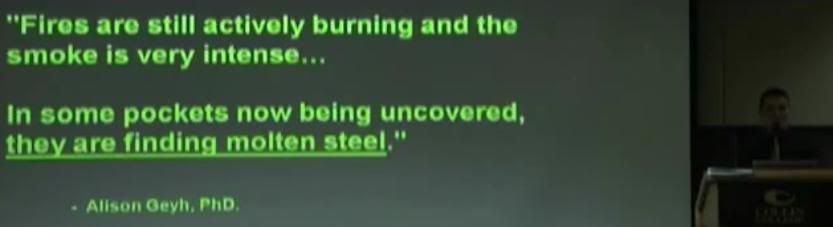
In his presentations he uses zero engineering and talks woo. This is a slide and Derek is essentailly saying hearsay is evidence of rivers of steel flowing in the WTC. Like to see his numbers on thermite.

lie10232.jpg


http://i286.photobucket.com/albums/ll116/tjkb/lie10232.jpg
Derek leaves out the source; WHY?

http://www.jhsph.edu/Publications/Special/Welch.htm

And here is the original.
"Fires are still actively burning and the smoke is very intense," reports Alison Geyh, PhD. "In some pockets now being uncovered, they are finding molten steel." Good cut and paste job...

Called hearsay Derek. Good job.

She never said she saw molten steel. Not a witness, not a source, it is hearsay.

... a real researcher asks her to explain her quote. Wow, you mean ask the source?
http://www.911myths.com/html/dr_alison_geyh.html
She says.
"I personally saw open fires, glowing and twisted I-beams. I was told, but do not remember by whom, that the workers were finding molten steel."

Derek uses hearsay and lies to support his failed thermite CD delusion.

Derek please discuss why you make up this stuff. You are misleading people. Robertson never saw melted steel, another lie already presented.
 
NCSTAR 1-9 Section 8.8 describes the finite-element analysis of a partial singlefloor framing system bounded by interior column 79 and exterior columns 44, 42 and 38. This is the area blamed for the collapse initiation; this is the subsystem model that predicted failure of shear-studs and girder connections, beam buckling and excessive lateral displacement of a girder at column 79—all triggering collapse initiation.

The purpose of this subsystem analysis was to demonstrate ''possible failure mechanisms that were used to develop the leading collapse hypothesis further." (NCSTAR 1-9, p. 353.) Girder and beam temperatures were assumed to be 500 degrees and 600 degrees Centigrade respectively, and the slab was assumed to remain unheated. NCSTAR 1-9, p. 349.

"No thermal expansion or material degradation was considered for the slab, as the slab was not heated in this analysis." NCSTAR 1-9, p. 352.

Why not? The concrete floor slab could not possibly remain unheated in an atmosphere where steel beams supporting the slab were heated to 600 degrees. The beams were coated with thermal insulation, so the air temperature would have been even hotter than 600 degrees. The duration would also have to be longer than what photos indicated.

"The boundary conditions and temperatures were selected to create maximum shear forces on the stud connectors and beam and girder connections." NCSTAR 1-9, p. 349.

*scratches hair under tin foil hat*

Huh?

The NIST partial-floor model did not allow the slab to expand thermally with the steel beams, and neglecting thermal expansion of the slab has the effect of imposing additional relative displacement on the shear studs connecting the concrete to the steel. This subsystem analysis formed the basis for special connection elements used in the global analyses as described in the following passages.

"The failure modes in this model [the partial floor] were incorporated into the 16 story ANSYS and 47 story LS-DYNA analyses." NCSTAR 1-9, p. 353.

"These results helped to guide the development of special connection elements…that captured the salient features and failure modes of the various types of connections used in the floor system of WTC 7." NCSTAR 1-9, p. 359.

NIST states that ''even though steel and concrete have similar coefficients of thermal expansion, differential thermal expansion occurred between the steel floor beams and concrete slab when the composite floor was subjected to fire." (NCSTAR 1-9, p. 490.) This relative displacement occurred in the ANSYS model, and no physical testing was done to verify its magnitude in the steel-and-concrete structure.


The right context.

Chapter 8 - Initiating evente Hypotheses (NCSTAR 1-9 - pg. 323)

8.1 Introduction


This chapter addresses the initiating event and collapse propagation hypotheses that formed the basis of the technical approach to determine why and how the 47 story WTC 7 building collapsed on September 11, 2001.

(...)

The leading collapse hypothesis will be presented first, followed by supporting evidence and calculations that led to the hypotesis. Prediction of the growth and spread of fires from fire simulation models, analysis of heating of the structural elements due thes fires, and structural analysis of the initiating events hypothesis and global response are presented in subsequent chapters

_______________________________


8.7.4 - Absence of Shear Studs on Girders (NCSTAR 1-9 - pg. 346)

(...)

"Consider a simple floor beam-to-girder arrangement as found" in the northeast corner of WTC7

In-plane restraint of the floor slab restrained expansion. This boundary condition is assumed for illustrative purposes and to produce a maximum force in the shear studs. This simple analysis helped to determine whether or not the failure of shear studs needs to be accounted for in the detailed ANSYS analysis of the lower 16 stories of WTC 7 (Chapter 11). In the detailed finite element analysis, the floor slabs were not restrained and the heating of the concrete slab and steel beams was determined by thermal analysis (Chapter 10).
 
That's funny Tom. At least 3rd parties surfing here can see your pathetic ducking answers. You've lowered yourself by making this statement.

"very little energy was dissipated in the buckling of the columns because very few of the columns buckled. You've got the wrong failure mode. Just as in the towers, the principle failure mode was "fracture of the connections & welds". Not buckling of the columns."

"fracture of the connections & welds".

In January is was buckling according to you and NIST, in September Tom departs and strikes up a new theory. Amazing. What changed Tom?

There is a fly in the ointment Tom, does NIST agree with your embarrassment, statement, new thoery? NIST states that the columns buckled, you might want to revisit your strategy Tom, as you are caught, once again, grasping at straws and ignoring basic science.

The questions still stand Tom, and you don't seem compentent enough to answer them, let alone give us a detailed analysis of their load carrying capacity at floor 8.

Try again Tom.


LMAO ...

First off, my beliefs about the ratio of fractured connections to buckled columns hasn't changed since about September 12, 2001, when I first started thinking about collapse mechanisms.

The fact that you've jumped to the latest in a long, long line of erroneous interpretations of what I said is utterly unsurprising. Thus far, you've demonstrated precisely zero ability to accurately interpret or recount NIST's explanations. There's no reason that I can see that you'd do any better with mine.

I invite you to publish here the any of my writings that you feel shows that I thought that column buckling was prevalent or a significant sink of collapse energy.

After you do that, perhaps we can discuss this post of mine from December, 2008. (Long before I'd ever heard your name.)

HI Mark,
Here is a great catalog of pictures from Ground Zero.
http://911research.wtc7.net/wtc/evidence/photos/groundzero.html

Tell me the percent of columns that are still virtually straight. My guess: 98% or so.

Ergo, the vast majority of columns did NOT buckle.

My guess is that zero of them buckled as a failure mode. That, in every case, the fasteners & welds gave way long before the beam itself buckled.

My only conclusion, from looking at the rubble pile, is that "beam buckling" was not the predominant failure mode.
...

My judgment is that snapping these constraints is going to take a tiny amount of force (and energy) compared to what it would take to cause the beams to buckle.

Gee, Derek. Does that sound somewhat familiar??

Now, tell me again how I've changed my mind since January 2010... LoL.

Just more of your lack of comprehension, I'm afraid, Derek. It's something of a consistent pattern with you.

Now, here's the best part.

You've not been listening. Again. I've told you about 2 dozen times, now. It only matters what the experts within the field think.

It doesn't matter what I think. It matters what the NIST engineers think.

Ergo, there's no fly in any ointment.

If, thru some wildly improbable reversal of style you actually started to discuss NIST's report competently, and convinced me that I'd misinterpreted something that NIST has written, I already know my exact course of action.

First, I would provisionally assume that NIST is right & I am wrong on that issue. You see, I follow my own advice & listen to the experts.

Then, if it appeared to me that the issue was significant enough to make a significant alteration in my assessment of the perpetrators of 9/11 (virtually impossible to imagine), then I'd do exactly what I suggest that you should have done before you delivered that humiliating lecture of yours.

Organize my thoughts, contact the NIST authors, review everything with as many of the highest caliber experts as I could find, and write a respectful paper for publication.

Again, all the things that I suggested to you, I do myself.

So, tell me again, Derek. To how many non-ae911t, experienced structural engineers have you brought your pablum?

What was that number again? Speak up, I can't hear you... "Zero"?

How, uh, incompetent of you.

But not surprising in the slightest.

tom

PS. Someday you ought to try actually, you know, thinking & writing "mechanical engineering". Instead of brainless parroting of Box-boy Gage & his associated incompetents.
 

Back
Top Bottom