• Quick note - the problem with Youtube videos not embedding on the forum appears to have been fixed, thanks to ZiprHead. If you do still see problems let me know.

Bigfoot: The Patterson Gimlin Film - Part 3

Status
Not open for further replies.
This is Titmus explaining why there are no arrival tracks, Sweaty. It's not a description of what Patty did. It's not Titmus describing tracks that he saw or signs he saw of Patty's arrival.

It's an explanation of how she could have left no tracks coming in.


I agree with that. But I think Bob Titmus may have actually thought that was one possible scenario.


I'm surprised the explanation isn't that Patty walked up the creek itself to hide her tracks...but that's another argument altogether, I think.


That would be another possible scenario. Why couldn't Patty have been walking in the creek, itself, for a ways...just before stepping out, onto the sandbar?


Now, one could say that if P/G were going to hoax this, they wouldn't have been dumb enough to make that error. They would have had tracks coming in.


Yup....that's basically what I was saying...in my earlier post...

And what is not a plausible scenario.....is Roger starting Patty's trackway in a way that the first tracks appear, suspiciously, "out of nowhere"...and then ending the trackway by going through the unnecessary back-breaking effort to continue it for a few hundred feet after the spot where the filming stopped.

That scenario is total non-sense.


A "suspicious"/'short' start of the trackway doesn't wash/mix with an unnecssarily long, extended end to the trackway.


I can just imagine some of the conversation...under that scenario...


Gimlin:

"What the HECK are you doin' Roger...making all these extra tracks at the end....don't you think you should add a few more back at the beginning....since you've got Patty, like, appearing out of nowhere??! :boggled:


Roger:

"OH....ummm....yeah...good point, Bob." :o Thanks....maybe I'll pay you, after all. ;)


I find it interesting that Titmus glosses over the arrival anomaly with a terse explanation, but claims to have followed Patty up the mountain to where she sat and watched proceedings at the creek.


I don't know that the arrival point actually was 'anomalous'.


I know that Jim McClarin went to the filmsite shortly after the filming, and he believed the film was legitimate, after his visit.

I'm sure he would have looked over the complete trackway, while he was there. It's not a quick, easy trip in....so, a person would be very likely to stay a while, once they got there.
 
Maybe you can show me, instead of whatever it is you do.

I convinced myself with math since I have no dolls.

Use the vector (1,1,1) then project it on the x,y plan. Then rotate 10 degree in the x,z plan and 10 degree on the y,z plan. Then project again on the x,y plan. If you bother to
do the mathematical calculation you will find a difference in length.

If three dimension is complicated then use two dimension to convince yourself.
Use a vector (1,1) that is, z=sqrt(2).exp(i.pi/4). You look vertically from positive Y toward 0. Projection onto X is a length of 1. Then rotate the stuff by PI/4. Projection on X will be a point, but the length did not change. Rotate from the initial position by -pi/4 and now it is longer, a length of SQRT(2).

Really it is only a perspective trick.

Now whether that can be applied to the PGF, I am not 100% sure as I don't think the camera is changing vertically that much, but I don't know enough on the PGF, and really a few degree combined over two axe can make a difference.
 
Last edited:
Well, I'm not convinced that I bent the doll's hand. You probably could bend one with a pair of pliers, but I suspect that rather than bend, the finger section (they are all molded together) would break off.

Once again, I didn't bend the hand physically; I didn't manipulate the image with Photoshop tranformations (didn't have that capacity on my computer at the time). Took the pictures, transferred them to the computer, used Photoshop to crop and rotate the whole second photo to align it better with the first, and that was it.

Years ago, some poster when confronted with the cube-chessboard-shadow illusion (in which the mind reads the shadow of the cube as darker than it actually is) insisted that the shadow was darker. Even when shown by measurement and by overlays that it wasn't, the poster essentially said, "If I think it's darker, it's darker." What do you do?


And for what it's worth, the whole brouhaha was not meant to show that the same illusion takes place in the Patterson film--just that such an illusion was one of many possible explanations for a "finger bend": it could be caused by a human hand in a well-fitting glove; it could be caused by a hand in an oversized glove, with just the last joints of the fingers in the glove fingers; it could be caused by a hand extension; it could be caused by the poor resolution of the film, when we can't always be sure we're even seeing "fingers" or background elements; it could be partly an illusion of perspective in two discrete photos; and so on and so on.....
 
I convinced myself with math since I have no dolls.

Use the vector (1,1,1) then project it on the x,y plan. Then rotate 10 degree in the x,z plan and 10 degree on the y,z plan. Then project again on the x,y plan. If you bother to
do the mathematical calculation you will find a difference in length.

If three dimension is complicated then use two dimension to convince yourself.
Use a vector (1,1) that is, z=sqrt(2).exp(i.pi/4). You look vertically from positive Y toward 0. Projection onto X is a length of 1. Then rotate the stuff by PI/4. Projection on X will be a point, but the length did not change. Rotate from the initial position by -pi/4 and now it is longer, a length of SQRT(2).

Really it is only a perspective trick.

Now whether that can be applied to the PGF, I am not 100% sure as I don't think the camera is changing vertically that much, but I don't know enough on the PGF, and really a few degree combined over two axe can make a difference.

Yes, you've described the effects of foreshortening, but the doll hand hasn't changed its tilt between photos. It was hanging against a wall. It could only spin on its Z axis (if we let the Z axis be vertical). The only way to foreshorten the length of the doll hand can come from a change in the camera position/orientation. But the camera appears to be at the same approx height in both photos. So to put this one to bed, Spektator need only describe the camera positions that created this perspective trick.
 
A very slight change can make a big difference when the subject is 60+ feet away ( How far in 62 - 67 (?), Óðinn? )

But of course Óðinn knows that too..

Actually it's just the opposite. The farther away an object is the less of a difference a slight change makes.
 
Spektator,
While I appreciate you taking the time to explain, no one ( who matters ) seems to need an explanation besides Óðinn , and he really has the tools ( mentaly and physically ) to understand what's happening..

I just remain a bit miffed, that he called you a liar and now says it's no big deal ..

I realize you are the one who was insulted, and can handle it, but was grandstanding for the Bill Munns appreciation society over at BFF, and had a much better target than you, close by ...
 
Last edited:
LOL, so being skeptical of the doll hand makes me a close-minded believer?

Are you skeptical, of the idea, that the doll hand is one of the possible explanations for fingers bending? or are you just skeptical that the rotation of the doll effected the illusion of fingers bending?
 
Well, I'm not convinced that I bent the doll's hand. You probably could bend one with a pair of pliers, but I suspect that rather than bend, the finger section (they are all molded together) would break off.

Once again, I didn't bend the hand physically; I didn't manipulate the image with Photoshop tranformations (didn't have that capacity on my computer at the time). Took the pictures, transferred them to the computer, used Photoshop to crop and rotate the whole second photo to align it better with the first, and that was it.

Years ago, some poster when confronted with the cube-chessboard-shadow illusion (in which the mind reads the shadow of the cube as darker than it actually is) insisted that the shadow was darker. Even when shown by measurement and by overlays that it wasn't, the poster essentially said, "If I think it's darker, it's darker." What do you do?


And for what it's worth, the whole brouhaha was not meant to show that the same illusion takes place in the Patterson film--just that such an illusion was one of many possible explanations for a "finger bend": it could be caused by a human hand in a well-fitting glove; it could be caused by a hand in an oversized glove, with just the last joints of the fingers in the glove fingers; it could be caused by a hand extension; it could be caused by the poor resolution of the film, when we can't always be sure we're even seeing "fingers" or background elements; it could be partly an illusion of perspective in two discrete photos; and so on and so on.....

Spektator, I never intended to call you a liar and I never actually called you one, but referring to your animation as a fraud was essentially the same thing. When I first called you on it (2 years ago) you missed my post and I assumed you were being suspiciously silent. Sorry if that was not the case.

My work involves rectifying aerial photos (removing the camera tilt) so I can measure objects in the photo. But in the case of your doll hand photos, something was wrong. The distortive effects were too exaggerated to be rectified. At least this is the case if you applied a simple rotation between photos.

However, you mentioned that you rotated one of the photos in photoshop to match the orientation of the other photo. But I assumed that the doll hand was hanging from a towel rack. How come you needed to rotate the photo? You must have been doing something fancy with the camera orientation to make this work. Do you recall how you did it?
 
I don't understand Aepervius' math, but as an illustrator I "get" foreshortening and I also have the ability to compare two images and spot the differences. And in the GIF which Odinn has recently supplied, the length of the hand appears to be greater in the right image than it is in the left -- all while Odinn is insisting "the lowest point never changes. The distance from the ground remains the same over 360 degrees." In the very image he has provided as proof of this claim, the lowest point does change, the vertical distance does not remain the same.

So, color me bewildered as to how Odinn believes this supports his assertions.
 

Attachments

  • dollhand2.jpg
    dollhand2.jpg
    5.6 KB · Views: 130
Are you skeptical, of the idea, that the doll hand is one of the possible explanations for fingers bending? or are you just skeptical that the rotation of the doll effected the illusion of fingers bending?

Both. If I'm understanding your questions.
 
I don't understand Aepervius' math, but as an illustrator I "get" foreshortening and I also have the ability to compare two images and spot the differences. And in the GIF which Odinn has recently supplied, the length of the hand appears to be greater in the right image than it is in the left -- all while Odinn is insisting "the lowest point never changes. The distance from the ground remains the same over 360 degrees." In the very image he has provided as proof of this claim, the lowest point does change, the vertical distance does not remain the same.

So, color me bewildered as to how Odinn believes this supports his assertions.

That's my whole point Vort. If the doll hand is hanging from something at a fixed length and the camera is at the same height, then the doll hand SHOULD be the same length in both photos. But it isn't.
 
Ah. I thought these were new pictures of another doll hand which you yourself (Odinn) had taken, in an effort to support your statements. But these are the very Spektator pics under discussion. Okay, thanks for the correction.
 
I don't recall, where Spektator said whether the camera moved at all, but the orientation of the sleeve indicates that the doll was definitely moved, and the difference in the apparent length of the hand indicates the hand, the camera or both, moved on the y axis.

The point still being, the fingers appear to bend, when in fact they don't.. Illustrating that subject and camera movement can account for the apparent bending of the fingers in the film ..
 

Attachments

  • dollhand2.jpg
    dollhand2.jpg
    5.6 KB · Views: 127
I don't recall, where Spektator said whether the camera moved at all, but the orientation of the sleeve indicates that the doll was definitely moved, and the difference in the apparent length of the hand indicates the hand, the camera or both, moved on the y axis.

The point still being, the fingers appear to bend, when in fact they don't.. Illustrating that subject and camera movement can account for the apparent bending of the fingers in the film ..
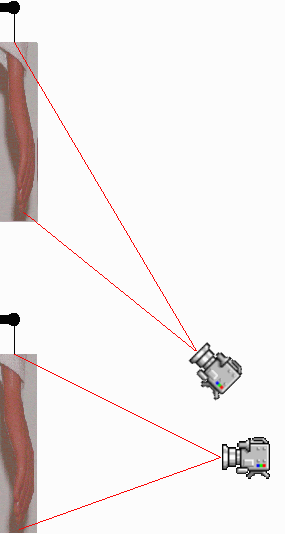
How do you know that (bolded)? If the doll hand was hanging against the wall and only rotated between photos, then the only way to foreshorten its length is to angle the camera as shown below. But then the shadows against the wall (from the flash) would appear to be at different heights, but they aren't.

dollhand3.gif


Gotta get back to work. I spend way too much time on this stuff. :D
 
...the shadows against the wall (from the flash) would appear to be at different heights, but they aren't.
What do you mean ' different height ' ?
The dimensions of the shadows are clearly different..
 

Attachments

  • dollhand2.jpg
    dollhand2.jpg
    5.6 KB · Views: 121
Last edited:
Yes, you've described the effects of foreshortening, but the doll hand hasn't changed its tilt between photos. It was hanging against a wall. It could only spin on its Z axis (if we let the Z axis be vertical). The only way to foreshorten the length of the doll hand can come from a change in the camera position/orientation. But the camera appears to be at the same approx height in both photos. So to put this one to bed, Spektator need only describe the camera positions that created this perspective trick.

You have exactly ZERO reference in those photo to both angle. You only see one plan behind (call it the x,y plan) and you have exactly ZERO reference to say whether Y,Z or X,Y rotated. The HEIGHT does not change. Rotation occurs !

Which is why I tried to check how it could be done and came with the vector idea. The vector are coming from the center of the hand. Go to each finger. And then rotating both perpandicular plan, you get the same effect.

Heck, just use a few vector, project them and do the angle change as I told you. You will see the effect.

Why don't you try the vector things ? With a photo people will alwqays be yelling foul or finger bending no matter how much you demonsztrate them the effect. Use Math. You will definitively see the effect, and it is a definitive proof that nobody can accuse of bending.

And after you have done the math and see it is possible, you revisit the photo with an open mind.

And then the last step is to admit you were wrong.
 
That's my whole point Vort. If the doll hand is hanging from something at a fixed length and the camera is at the same height, then the doll hand SHOULD be the same length in both photos. But it isn't.

Assuming the X,Y plan is the wall behind the doll, that would be true ONLY if there was a X,Y rotation, that is the camera stayed in a vertical plan to the wall, roughly cutting the wall along the horizontal axe.

But what happens is that there is a component of rotation in the Y,Z plan, that is, a vertical plan to the wall, but cutting the wall vertically too.

In other word not only the camera is rotating to the right, but also a bit up pointing down.

In such a case, the hand length by projection get increased.

The effect is at its maximum, when you take a vector and on the left photo it is at less than pi/2 radian, then rotate a bit along that vertical axe on the photo to put it at pi/2 radian. You suddenly get a LONGER vector.

In other word, in the left phioto the hand was slightly forshortened due to perspective, then the camera move to a more right angle position, and the hand get longer.

Try it.

Vector length of 10 cm. Initial vertical angle 16pi/36 projection over the plan = 9,8 then shift it more vertically to pi/2 , then the vector is 10cm.

Going in even more pronunced way, from pi/4 (middle angle) to pi/2 => 10cm to 7cm. 3 cm difference or nearly a loss of 30% size, or going from small to big 40% more size about.

Naturally this cannot prove that the hand was not bent. But this certainly shows that with perspective effect, it isn't implausible as you push it. It is actually demonstrable to happen with vector and projection.
 
Status
Not open for further replies.

Back
Top Bottom