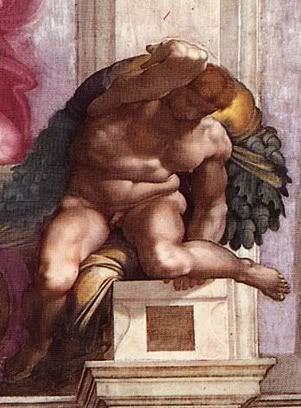
Ah, it seems I was not quite clear. I meant that muscly figures in general are typical of Michelangelo, not that that neck in particular was a typical neck. The angle of the picture is unusual, as it shows the full area under the chin, and the figure's head is tilted back.
Sure, we're seeing more of the sternohyoid and thyroid processes in "God's neck", and in more direct lighting, than in other Michelangelo paintings because of that tilt. That was the first response that occurred to me, as well, when I read the article and examined the images.
But if you will examine the series of images in my post, five posts above this one, you'll see there are several Michelangelo-painted poses which at least approximate the "God's neck" tilt. We're not seeing as much of the area, or as well-lit, but we are seeing it, and the features which the artist included in "God's neck" are demonstrably unique to that painting.
What are we to make of this? I am not convinced that Tamargo and Suk have the right of it, but I do find it unusual that of all the necks Michelangelo painted, including those which show the same sternohyoid/thyroid area, these brain-stem-like features are unique to "God's neck". As a longtime fan and devotee of Muchelangelo's work, I'd like to understand why.
The shaded area above the pons is debatable as to whether it should be part of the pons or a shadow of a smaller pons. I tend towards the latter (although I'm not 100% sure), as the light source
is coming from below.
I'd like to see some better pictures other than the ones I've seen on the web.
This one, for instance, has almost none of the shapes the image above has, and supports the 'coincidence' theory:
http://www.thinkworks.com/genesis/art/genesis/g320/dark320.jpg
That image is washed out/overexposed, and a lot of detail has been lost or degraded. I have four books reproducing Michelangelo's paintings, and the image quality varies from book to book; here darker, there lighter. None of them is as washed-out as the above-linked image. The area under review ("God's neck") has lost too much detail in terms of pigment and brushstroke for it to be of much use in this discussion. It supports the "coincidence" theory only by
omission of the exact details under review.
The scientists do seem to ignore the fact that the Michelangelo does not detain the Crus cerebri of cerebral peduncles (midbrain) as shown in the diagram of the brain stem I showed. If it was a brain stem, there should be a section between the pons and the thalamus.
Yes, I see what you mean. Their cherry-picking the data undermines their case. There are features which exist in any diagram of a brain stem which "God's neck" does not show (did Michelangelo omit these? To what purpose?), and there are features of "God's neck" which do not correspond with any diagram of a brain stem that I can find.
I think I'm beginning to see the light, here. The shapes in "God's neck" might coincidentally resemble certain features of a brain stem, but as it happens they also resemble the anatomy of the neck when illuminated from below. That is the main distinction: in the other examples, the light source is from above or from the side; in "God's neck", the unique lighting reveals features of the neck which are normally relegated to shadow.
I didn't mean to be obtuse, but I had to reason this out for myself based on the available data. I'm now in general agreement with the consensus, namely that pareidolia and coincidence of anatomical form are at work (or play!) here.
Thanks for an
illuminating discussion.