Michelangelo Hid Brain Image In Sistine Chapel Ceiling?

Isn't the neck basically a brain stem anyway? Of course there's a similarity. I just don't think it's meant to symbolise the interior brain stem. It just looks like a neck to me, and I'm an artist of sorts, so I should be able to imagine all sorts of weird things. It looks like a muscly neck, typical of Michelangelo.

The thing I do find odd is that his God has boobs. :)

Do you think you could post a pic of another brain-stem-looking neck? One that contains the various features indicated in the marked-up pic in the article linked in the OP? Because while I can see many bulging sternomastoid muscles as I flip through my Michelangelo books, I cannot find one other instance of a bifurcated sternohyoid or pronounced, bulbous thyroid processes, as we see in the painting of God separating light from darkness.
 
I agree with [Orphia Ney] - just been looking at a few of his other works in which he has painted exposed and stretching necks and they are all ropey looking necks with plenty of texture.

Okay, but "ropey looking necks with plenty of texture" do not necessarily contain the brain-stem-like features we see specifically in the painting of God separating light from darkness. Can you post a pic of another such neck? Or if not, can you describe the figure and the painting so that I can seek it out in one my books? I have his complete painted works.
 
Do you think you could post a pic of another brain-stem-looking neck? One that contains the various features indicated in the marked-up pic in the article linked in the OP? Because while I can see many bulging sternomastoid muscles as I flip through my Michelangelo books, I cannot find one other instance of a bifurcated sternohyoid or pronounced, bulbous thyroid processes, as we see in the painting of God separating light from darkness.

Hi Vortigern,

Why does there have to be another brain-stem looking neck?

These scientists have drawn in details over Michelangelo's neck that aren't there. Look at the "pons" - it's huge compared to the painting, and there are shadows on that section of the painting that they've ignored.

Furthermore, the scientists' brain stem looks very different to this drawing:
http://faculty.irsc.edu/FACULTY/TFischer/AP1/brain stem.jpg

Kind regards,
Orph.
 
It does correspond with known neck anatomy, but only if exaggerated and stylized, which the artist did not typically do, preferring a heightened realism in his human figure art.

This is precisely what makes me the most skeptical, as human necks don't have brain stems sticking out of them. If Michelangelo's preference for heightened realism wasn't so strong as to prevent him from doing things like adding in images of other objects where just a neck ought to be, then it ceases to be a factor IMO.
 
Hi Vortigern,

Why does there have to be another brain-stem looking neck?

Well, there doesn't. Allow me to clarify my request.

You [Orphia Nay] wrote: "It looks like a muscly neck, typical of Michelangelo." What I'm asking is that you, or anyone, indicate another neck painted (or sculpted) by Michelangelo which approximates the unique features of "God's neck", and substantiates your assertion that same "looks like a muscly neck, typical of Michelangelo".

IMO, even if "God's neck" does not approximate a brain-stem, it is nonetheless unique among the necks that Michelangelo painted, and I request that you produce a similar one to back up your stated opinion.

These scientists have drawn in details over Michelangelo's neck that aren't there. Look at the "pons" - it's huge compared to the painting, and there are shadows on that section of the painting that they've ignored.

Furthermore, the scientists' brain stem looks very different to this drawing:
http://faculty.irsc.edu/FACULTY/TFischer/AP1/brain stem.jpg

I agree that Tamargo and Suk appear to be highlighting features which corroborate their hypothesis, while ignoring those which do not. This of course is "cherry picking" data, which undermines rather than supports their case.

I disagree, however, that the pons in the diagram you've supplied is bigger than the one in the "God's neck" image. To my eye they appear to match, proportionally. (See attached images, below, for a closer comparison.)
 

Attachments

  • God's_neck.jpg
    God's_neck.jpg
    67.3 KB · Views: 14
  • brain stem.jpg
    brain stem.jpg
    103.9 KB · Views: 5
Attached is another image from the article, this one comparing various Michelangelo necks (along with one by Leonardo, E, and one by Raphael, F) which clearly do not show the same unique features as "God's neck".

This suggests that Michelangelo wasn't "just having a bad day," Tamargo said.
 

Attachments

  • Mich_necks.jpg
    Mich_necks.jpg
    21.2 KB · Views: 204
Well, there doesn't. Allow me to clarify my request.

You [Orphia Nay] wrote: "It looks like a muscly neck, typical of Michelangelo." What I'm asking is that you, or anyone, indicate another neck painted (or sculpted) by Michelangelo which approximates the unique features of "God's neck", and substantiates your assertion that same "looks like a muscly neck, typical of Michelangelo".

IMO, even if "God's neck" does not approximate a brain-stem, it is nonetheless unique among the necks that Michelangelo painted, and I request that you produce a similar one to back up your stated opinion.

Ah, it seems I was not quite clear. I meant that muscly figures in general are typical of Michelangelo, not that that neck in particular was a typical neck. The angle of the picture is unusual, as it shows the full area under the chin, and the figure's head is tilted back.

I agree that Tamargo and Suk appear to be highlighting features which corroborate their hypothesis, while ignoring those which do not. This of course is "cherry picking" data, which undermines rather than supports their case.

Well said.

I disagree, however, that the pons in the diagram you've supplied is bigger than the one in the "God's neck" image. To my eye they appear to match, proportionally. (See attached images, below, for a closer comparison.)

The shaded area above the pons is debatable as to whether it should be part of the pons or a shadow of a smaller pons. I tend towards the latter (although I'm not 100% sure), as the light source is coming from below.

I'd like to see some better pictures other than the ones I've seen on the web.

This one, for instance, has almost none of the shapes the image above has, and supports the 'coincidence' theory:
http://www.thinkworks.com/genesis/art/genesis/g320/dark320.jpg

The scientists do seem to ignore the fact that the Michelangelo does not detain the Crus cerebri of cerebral peduncles (midbrain) as shown in the diagram of the brain stem I showed. If it was a brain stem, there should be a section between the pons and the thalamus.
 
Okay, but "ropey looking necks with plenty of texture" do not necessarily contain the brain-stem-like features we see specifically in the painting of God separating light from darkness. Can you post a pic of another such neck? Or if not, can you describe the figure and the painting so that I can seek it out in one my books? I have his complete painted works.

Sorry but why would he have painted each of his necks the same? I should add that I do not see the "brain stem like" features in his painting of God, or rather no more than I see the naked buttocks in Orphia Nay's post.
 
Ah, it seems I was not quite clear. I meant that muscly figures in general are typical of Michelangelo, not that that neck in particular was a typical neck. The angle of the picture is unusual, as it shows the full area under the chin, and the figure's head is tilted back.

Sure, we're seeing more of the sternohyoid and thyroid processes in "God's neck", and in more direct lighting, than in other Michelangelo paintings because of that tilt. That was the first response that occurred to me, as well, when I read the article and examined the images.

But if you will examine the series of images in my post, five posts above this one, you'll see there are several Michelangelo-painted poses which at least approximate the "God's neck" tilt. We're not seeing as much of the area, or as well-lit, but we are seeing it, and the features which the artist included in "God's neck" are demonstrably unique to that painting.

What are we to make of this? I am not convinced that Tamargo and Suk have the right of it, but I do find it unusual that of all the necks Michelangelo painted, including those which show the same sternohyoid/thyroid area, these brain-stem-like features are unique to "God's neck". As a longtime fan and devotee of Muchelangelo's work, I'd like to understand why.

The shaded area above the pons is debatable as to whether it should be part of the pons or a shadow of a smaller pons. I tend towards the latter (although I'm not 100% sure), as the light source is coming from below.

I'd like to see some better pictures other than the ones I've seen on the web.

This one, for instance, has almost none of the shapes the image above has, and supports the 'coincidence' theory:
http://www.thinkworks.com/genesis/art/genesis/g320/dark320.jpg

That image is washed out/overexposed, and a lot of detail has been lost or degraded. I have four books reproducing Michelangelo's paintings, and the image quality varies from book to book; here darker, there lighter. None of them is as washed-out as the above-linked image. The area under review ("God's neck") has lost too much detail in terms of pigment and brushstroke for it to be of much use in this discussion. It supports the "coincidence" theory only by omission of the exact details under review.

The scientists do seem to ignore the fact that the Michelangelo does not detain the Crus cerebri of cerebral peduncles (midbrain) as shown in the diagram of the brain stem I showed. If it was a brain stem, there should be a section between the pons and the thalamus.

Yes, I see what you mean. Their cherry-picking the data undermines their case. There are features which exist in any diagram of a brain stem which "God's neck" does not show (did Michelangelo omit these? To what purpose?), and there are features of "God's neck" which do not correspond with any diagram of a brain stem that I can find.

I think I'm beginning to see the light, here. The shapes in "God's neck" might coincidentally resemble certain features of a brain stem, but as it happens they also resemble the anatomy of the neck when illuminated from below. That is the main distinction: in the other examples, the light source is from above or from the side; in "God's neck", the unique lighting reveals features of the neck which are normally relegated to shadow.

I didn't mean to be obtuse, but I had to reason this out for myself based on the available data. I'm now in general agreement with the consensus, namely that pareidolia and coincidence of anatomical form are at work (or play!) here.

Thanks for an illuminating discussion. ;)
 
The musculature of God's neck in the Separation of Light from Darkness fresco looks very unusual, especially compared with Michelangelo's other paintings of the same anatomical area. It does correspond with known neck anatomy, but only if exaggerated and stylized, which the artist did not typically do, preferring a heightened realism in his human figure art.
The whole positioning of God is very unusual, as are some of the other figures around him. The neck and face look very odd when turned to make an upright portrait. The figure of God is meant to be seen looking straight up. In that context, the neck looks much more natural, even though the figure is fairly contorted.

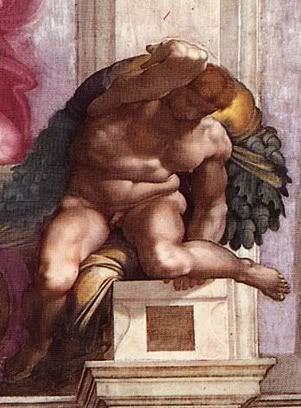
I think Mike was stretching his ability to paint figures in strange positions and to be viewed from very dramatic and exaggerated perspectives. Right next to the image of God, we can see this contorted and “perspectivized” (exaggerated and stylized) figure:

SeparationofLight1.jpg


Looking at the image of God in perspective, the brain stem image is hardly even recognizable, even in comparison to its only very vaguely recognizable shape when the painting is twisted, turned, and outlined with the brain stem shape.

I see pareidolia. I don’t see any clues that would indicate that Michelangelo was trying to work in a brain stem image.
 
DA, as you probably know, after some analysis and some excellent points raised by others, I now agree with the consensus here that pareidolia and coincidence of form explain Tamargo and Suk's reputed "brain stem" image in Michelangelo's painting of "God's neck".

Apart from your assertion that Michelangelo painted "exaggerated and stylized" figures -- he didn't; he painted realistically with regard to proportion, pose, lighting, and all other formal aspects -- I agree with your observations.
 
Knowing Michelangelo, I cannot believe that it would have been accidental or subconscious. He was extremely meticulous in his planning and careful in his execution.

Nobody is immune to mistakes. Michaelangelo misdrew that throat, he let that one slip. It happens even to geniuses.

Take for example Stanley Kubrick, who was also meticulous and a perfectionnist, and he still couldn't avoid a few mistakes and inaccuracies to slip through in his movies (you really have to look for them, but there are some).
 
Nobody is immune to mistakes. Michaelangelo misdrew that throat, he let that one slip. It happens even to geniuses.

While it would be ridiculous for me to disagree with your assertion that "Nobody is immune to mistakes", in this specific case, no, M. did not "misdraw that throat".

The painting of "God's neck" conforms to actual human anatomy, but the features are more pronounced than in an average person. This is partly because of the unusual lighting -- from below -- and partly because of the massive muscular quality with which M. was wont to imbue his figures.

As I now agree, it's probably simple coincidence that the sternohyoid and thyroid process happen to resemble or approximate certain features of the brain stem. But the neck is not "misdrawn" or inaccurately rendered.
 

Back
Top Bottom