....some interesting tidbits on the NASI report. The next page is also worth a read.
I think that Bill Munns and the NASI report are both half correct:
Patty was 4'6" tall and weighed 1900 lbs. oh, wait...that's my old VW.

....some interesting tidbits on the NASI report. The next page is also worth a read.
kitakaze said:BTW, here's something Philip Morris said to me...
He asked me to consider why Patterson hadn't just taken his 16mm film he just took of Bigfoot to a nearby television studio for processing. He said that back in those days most major tv studios that did news coverage had to have their own processing rigs for 16mm. I thought it seemed a interesting, but it didn't quite make sense to me.
parnassus said:So I guess "the author" didn't go to the papers and tv stations about the gorilla/Bigfoot costume, now did he? Certainly had the opportunity for the first oh, 36 years. Instead, he finally talks to a minor journalist and makes it into an add on chapter in a book that sells badly. Nice try.
Abraham Zapruder tried to get his super 8 Kodachrome developed 4 years earlier in Dallas at TV stations. Fail. x 2 TV stations. Finally took it to the Dallas Kodak Plant.
YOU COULDN'T GET 16mm (or Super8, basically same developing thing) KODACHROME II DEVELOPED OUTSIDE OF REGIONAL KODAK PLANTS. You should read the book by Greg Short, no...no...Greg Long, yeah, that's it. Greg Long.
Óðinn said:That said, Morris supposedly did recognize "his" suit in the PGF. But he never made a bigfoot suit in 67, so he must have thought he saw one of his gorilla suits..that someone modified into a bigfoot suit.
So what part of the suit did he recognize? Not the head, not the t & a, not the legs, not the feet...which part(s)?
So exactly what is it that the 'footers think makes the reproduction on the right such a poor match for "Patty?"
parnassus said:Another fallacy from the footers: that some lab would bootleg the process; yeah, that's a good thing to do, mess with Kodak and you go out of business.There were no leftover chemicals; other labs never had the process at that time. And why would a private business man jeopardize his livelihood to accommodate Al DeAtley, who really wasn't in that big a hurry anyway. "Footers think it must have been so urgent that people were flying it out of the two bit airports at nine oclock at night, getting rush developing, opening plants on the weekends. Baloney. There was no deadline, remember that. it was just Roger and Bob hangin out down at Louse Creek, riding Peanuts and Chico around every day, waiting for the go ahead from Al, so they could trumpet it to the world.I'm not sure if this is the best argument. I know of plenty video companies that release stuff (into retailers no less) that you'd swear would get them sued out of existence. Here's one such example.
They had no jobs to go back to, and they weren't on salary, at least we know Bob Gimlin wasn't. and Patterson was living off Gimlin, so no problemo if it took another week to process and edit the film.

Where in the film could Morris have seen the feet in any detail? Especially if he watched the PGF on TV. And bodysuit proportions? Riiiight. More like an opportunist looking for some free publicity. In which case, how reliable are his recollections re dealings with Patterson?Based on his comments and notes by kit, it sounds like he recognized the feet and bodysuit portions.


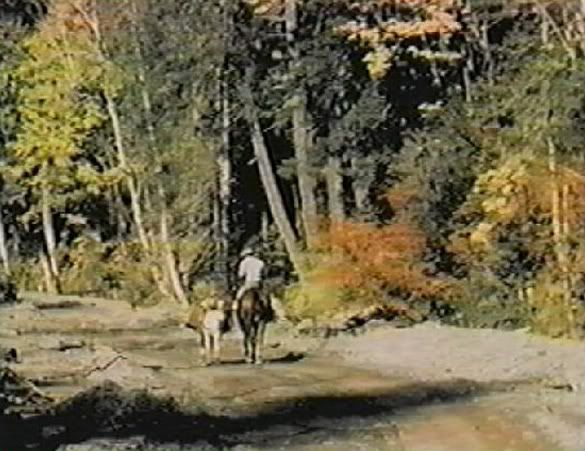
kitakaze @ BFF said:Those photos and stills are from the South Fork of the Ahtanum Valley in Yakima. The cowboy photo shows left to right: Roger Patterson, John Ballard, Jerry Merritt, Howard Heironimus, Bob Gimlin and Bob Heironimus. On pp. 229 of the Making of Bigfoot John Ballard says when show the photo by Long, "Roger is sitting on Peanuts. Merritt is sitting on one of my horses, Taffy. I'm sure Bob and Howard are on their own horses." Peanuts was originally Ballard's son's horse. Ballard sold him the horse for a sum of money and a black Shetland pony.
John Ballard supplied three horse for the filming - Tonka, Taffy and Princess. "There were pack horses and riding horses and camp gear and everything you can think of. I don't know where all this stuff came from. It was all there." Ballard rode Tonka up a steep and dangerous incline in one take for Patterson. Ballard recounts some trouble they experienced on one of the other filming days when Roger led the men onto a neighbour's property without permission...
"Roger got in sort of a lawsuit over that. He shot a portion of a film of some guy who was supposed to be a prospector, and he was leading his jackass about this big pond. And it was another guy's property, and he found out about it. He didn't want him shooting the film on his place. Patterson took that part out of the film."
This film was not Patterson farting around in the mountains shooting some home movies. This was a major effort by him after his book in '66 that was accompanied by a rash of Bigfoot sightings in the Yakima area. He required serious help and funding to shoot this.
Incidentally, John Ballard to Greg Long on Bob Gimlin (MoB: pp. 236)...
GL: "Does Bob Gimlin strike you as a truthful and honest man?"
JB: "I'd rather not say. He's a very likable guy, he's a very likable guy. Real smooth-talking fellow. He has a nice voice."
GL: "So you won't answer the question if he's truthful or honest?"
JB: "No. I won't answer that question."
That is very bizarre. Remember, John Ballard is Roger's friend.
Jerry Lee Merritt on the South Fork documentary to Greg Long in 1999 (MoB: pp. 109)...
"We started makin' that documentary film before he ever shot that Bigfoot film. That's why I thought it was phony. KIMA TV, the biggest station in Yakima, let us borrow a 16mm camera. I forget how many of us guys would ride. I rode a horse down a bluff in the movie. And I did a whole lot of different things."
That scene riding down the bluff is the same as the one where the image of Bob Heironimus doing the same is seen in the BH on Patterson footage collage I posted. Greg asks Merritt who else was supposed to be in the documentary...
"Bob Gimlin. He was supposed to be an Apache tracker. And Stewart Clark, an old cowboy. And then two brothers. Can't remember their names. Lived down in Ahtanum." Greg asks, "Heironimus?" and Merrit looks at him sharply...
"How'd you know that?" Long says Les Johnson mentioned them. "Well, Bob and his brother Bill Heironimus. They had the pack horses they was leadin'. And they rode all the time, some of them team roped."
(Note that Jerry mixes up Bill for Howard Heironimus. Later, in Greg's second interview with Jerry, Jerry correctly identifies all riders in the cowboy photo, including Howard - MoB: pp.115.) Jerry mentions Bob being a skilled rider. Bob Heironimus expressed disdain to me for the idea that Gimlin was breaking Chico in for him. This was when he told me Gimlin lied about that, and that he didn't have Chico for weeks, but rather eight days.
Jerry continues...
"Let's see, who else rode? Richard Bailey played the prospector. He rode on a donkey. Curt Hayes. He died not too long ago. he was a Jehovah's Witness, a friend of mine. Curt had these blue-tick bear hounds in the movie, too. Hounds, like they were trackin' Bigfoot. And they did run into a bear up there. They treed one up there way back in the South Fork where we seen wild horses." Greg asks Jerry who the camera man was. "A guy named Fred Smith from KIMA. He shot everything from a horse, most of it." Greg asks who directed the scenes. "Roger. Roger was somethin' else!" Jerry said the film was shot over a three day period. (MoB: pp. 110)
Jerry on the film documentary running out of money...
"We ran out of money. We had $700. Well, Roger and I went down to Hollywood to try to get some money. We went to Newty Cohen. Newty made these sequin suits for all these big country western stars. He was a Jewish guy. He had this old store. I'll never forget the place, 'cause he had all these 'ol sewing machines goin', these women sewing suits, and that ol' wood floor, like a warehouse floor. He had these suits that may cost $10,000 a piece, some of 'em, you know the big movie stars, cowboy guys, you know, Tex Ritter and all of 'em. And out back in the lot, he wanted to show us these cars. He had two cars, had guns on 'em, steer horns, and all that stuff, you know. And so we went over there and tried to get him to join, but he wouldn't invest a dime. He didn't want to mess with it. We tried to get $5000. Roger took out a briefcase of stuff to convince Newty."
(Please keep in mind that running out of money also means losing the 16mm camera from KIMA TV and Fred Smith to shoot with it.)
This was Roger's technique when he was working his pitch. This is the exact same thing he did to Bob Swanson when he was trying to get him of Chinook Press when he was trying to get him to print his book (that he never paid for when it was). Patterson first came into the Chinook shop in 1966 wanting to do a small flyer for a children's hoop toy he had invented and travelled to Hollywood to promote the same year. After the flyer was printed he returned two weeks later...
Bob Swanson (MoB, pp. 218) "And, oh, maybe two or three weeks later, he brought in this suitcase in. Patterson said, 'I know you're busy. You haven't got time to look at it now. But I'm going to leave this. I want you to look at it, and I'll be back.' Well, naturally, the minute he went out the door, we had to open the briefcase. And here was this big, 18" plaster foot and an Argosy magazine. And... And something about True Adventures or something. And Boy's Life. And they all had articles about Bigfoot. I could hardly wait for him to come back... because I was sold!"
Philip Morris in my interview with him told me that he had spoken with Bob Swanson personally, and the way that Patterson had gotten the books without paying was to show up at Chinook Press late at night after Swanson had gone home and told the night staff that he had already given Swanson a cheque. He the stole the books and loaded them into his Volkswagen bus.
Harvey Anderson of Anderson's camera describe Patterson approaching him the same way when first bring him the plaster foot that he was using for hoaxing. Everything that Patterson said to Duane and Harvey Anderson about encountering Bigfoot, and about telling Harvey about the suit he rented and the tracks he hoaxed with stilts fits perfectly with what we know of Patterson's behaviour at the time.
The briefcase pitch was what he did to George and Vilma Radford when he came after her for money, and she gave him $700. Her recounting of Jerry Merritt bring Roger to the upholstery shop they had attached to her and George's house (MoB, pp. 299)... "Well, Jerry Merritt brings Roger down to the shop and introduces him. Merritt said, 'This is the guy I've been telling you about, George. You guys talk, and I'll be back.'ThenMerritt left. He was talking about where they'd seen Bigfoot and how many people were after Bigfoot. He didn't ask for money outright when he started. He wanted to get a feel first. He had his book, of course, and all these prints - actual casts of Bigfoot." Patterson then autographed Vilma a copy of his book. This was when Patterson told her that he needed money and was going to try and film a Bigfoot at Bluff Creek...
Vilma Radford (MoB, pp. 299) "He didn't ask for money until the end. He said there were sightings in California and that he needed money. That was his spiel. He said he needed money. He said, 'I need to make a trip down there.' He didn't tell me he was renting a camera."
But that is exactly what he needed from Vilma - money for a camera. They had lost the 16mm camera they had when they ran out of money and Fred Smith took his camera back to KIMA TV. Roger told her that the money he needed was for a camera so that he could film a Bigfoot and prove what he had been claiming about seeing the creature so many times. She gave him $700. The $700 was for the camera only...
Vilma Radford (MoB, pp. 303) "I gave him just enough money to rent a camera. He immediately went down and found a Bigfoot."
That is exactly the same amount of money Jerry said Roger had when they went down to California to get more money for the film! And we know that Roger never actually paid for that camera, but rather rented it, never paid the rent, and was eventually arrested for it. Now remember, Jerry said that he went with Roger down to California and that he hated the trip because they had no other food than a large bag of sunflower seeds that Roger had brought.
Jerry Merritt on going to Hollywood with Roger Patterson... (MoB: pp.123) "Yeah, we took that Volkswagen rig of his, his old Volkswagen, and I like to starved to death. We didn't have any money, and Roger was on a health kick, and he took a big ol' package of sunflower seeds. It was like eating bird food. I said, 'Man!' He said, 'You don't need this meat, it'll kill you' I wanted a hamburger, something good. He stayed with Ross Hagen. Ross produced one of my records. I stayed with Gene Vincent. We stayed in Hollywood four days."
I believe that the scans Bill Munns post in his Patterson Documentary Footage Film Analysis is the film from that trip. I believe that that footage and the documentary itself are part of the key to the PGF hoax. I believe Bill's scans show Roger and Jerry going to California in 1967 before October. That is "Bigfoot Expedition 1967." What happened on that trip was why Jerry Merritt didn't return to California as he had promised. When Roger and Bob showed up at 4:00 at Jerry's home, Jerry backed out of his promise.
Jerry Merritt (MoB: pp. 108) "Roger was trying to make a documentary of his search for sasquatch. I worked with him on it. I was working with him on speculation stuff, to make money. I was supposed to go down to Northern California when he filmed Bigfoot. I didn't go. I was busy. I was working on the town at the time. I didn't want to go, because I went to Hollywood with him, and we had been doing this and that, doing different things, you know. He was really mad because I wouldn't go with him. Early in the morning. Horses in the rig, wantin' me to go with 'em. And I already told - I said, 'Roger, Im not goin' to go.' It was bad weather, really bad down there. Mud slides and all that rain, and everything. So I didn't go. And that's when they got the film."
Jerry was leaving something out. The weather had nothing to do with it. The weather was beautiful when they went down. Bob Heironimus had said it was the first or second week of October. The film they took of Bluff Creek shows the creek low. There is no way there had been mud slides and torrential rain. That happened after the film. Why did Merrit say "already told"? Was Patterson pressuring Jerry to come before? Yes, he was, and Jerry had agreed...
Jerry Merritt to Greg Long (MoB: pp. 127)
GL: "He asked you to go down to Bluff Creek, and you didn't go?"
JM: "Yeah."
GL: "Roger was really mad?"
JM: "Well, he wasn't really mad, but he was aggravated. He really got upset about it."
GL: "Why do you think he was angry?"
JM: "'Cause I hate to say this, but I think I told him the night before I'd go down with him. The more I think about what happened, I think I did tell him I'd go down there, and I backed out. And I usually never back out on anything, and I think that's what it was."
GL: "And why did you back out?"
JM: "My wife at the time (Florence Showman) and I were into it over me goin' and stuff. Because I had already went that other trip with Roger, and she was disappointed."
GL: "The copyright thing?" They were going to copyright the title "Bigfoot" for the documentary film's name Bigfoot: America's Abominable Snowman. Shouldn't a film that has had that title since at least May, 1967 that they are promoting in Hollywood at the very least have a depiction of Bigfoot?
JM: "Yeah, yeah." Jerry then explains that Roger came to pick him up at 4:00. He met Roger at the door with his wife Florence... "When he came in, he just kept saying, 'You gotta come down!' I says, 'I'm not goin', Roger, I just don't want to go.' And he'd say, 'You promised this and that.'"
GL: "He was upset with you?"
JM: "Yeah, he did and her, too."
Now, why would Roger be so adamant about Jerry coming with him and Bob, and Jerry be so adamant about not going? Was it simply how lame the last trip was, or was there something more? What are we to make of the Bigfoot tracks showing up at Jerry's house and the Bigfoot peering in the window at Florence. Or what about the Bigfoot that Jerry saw being bitten in the groin that escaped down his driveway? Jerry's wife's protest is easy to understand. She surely must have been sick of Roger bringing his Bigfoot obsession to their home, leaving them with $350 phone bills to pay, and dragging her husband around on Bigfoot escapades.
I think the impetus now is to investigate Patterson's 1967 trip to California before the one he made in October. Bill, I hope, will be able to assist me with this.
Kit, what technical details did Morris give you about how he made suits?
The *** doesn't droop.
WTH is the "South Fork Documentary"?
Didn't they arrange for Sanderson and co. to come see it that Sunday? Granted, I think that was done as a cover story, but...
Are you sure? I thought Gimlin had a job and Patterson was mooching off DeAtley. Then again, the lack of a job would explain why Gimlin could stay out there for so long.
btw, thanks for the dry cleaning facts! I never knew they just shipped stuff to plants until now.
Completely different scenario and different era. Bootlegging requires only a videorecorder and generic media, and filing suits is cumbersome, slow and inefficient. Its like shooting mosquitos with a shotgun.I'm not sure if this is the best argument. I know of plenty video companies that release stuff (into retailers no less) that you'd swear would get them sued out of existence.
It's how I refer to Roger's film Bigfoot: America's Abominable Snowman. Filming started early in 1967 the year after Patterson's book Do Abominable Snowmen of America Really Exist?, which was preceded and accompanied by a rash of Bigfoot sightings in Yakima. Patterson's running out of money for the film and his subsequent trip to LA with Jerry Merritt for the purpose of acquiring funding and securing copyrights was I believe the nexus for what caused the PGF to be created. The South Fork film should not rightly be called a documentary. It was a film depicting fictitious characters searching for Bigfoot. I think it is quite reasonable that Patterson having such a film that from at least May 1967 had the title Bigfoot could be expected at some point of the filming to undertake a depiction of Bigfoot.
I think that that depiction attempt is what led to the PGF hoax.
Conclusions and Questions:
We can conclude from this
1. Roger used more than one camera for his documentary. Aside from the K-100, he used a different type of camera for some footage. Camera type still unidentified.
2. On both cameras, Roger had a zoom lens for some filming, including on the K-100. So assumptions that he used nothing but a 25mm lens are clearly not valid.
It's how I refer to Roger's film Bigfoot: America's Abominable Snowman. Filming started early in 1967 the year after Patterson's book Do Abominable Snowmen of America Really Exist?, which was preceded and accompanied by a rash of Bigfoot sightings in Yakima. Patterson's running out of money for the film and his subsequent trip to LA with Jerry Merritt for the purpose of acquiring funding and securing copyrights was I believe the nexus for what caused the PGF to be created. The South Fork film should not rightly be called a documentary. It was a film depicting fictitious characters searching for Bigfoot. I think it is quite reasonable that Patterson having such a film that from at least May 1967 had the title Bigfoot could be expected at some point of the filming to undertake a depiction of Bigfoot.
I think that that depiction attempt is what led to the PGF hoax.

I have hinted at this more than once over at BFF .....................
I think that that depiction attempt is what led to the PGF hoax.
I, personally don't think Patterson was planning a hoax when he made ( if he made.. ) the costume.
He made it to include it in his documentary .. ( IMO )
You are assuming I believe the PGF was originally conceived as a hoax. I don't assume that .
I see it more likely that in making his documentary ( which Patterson claims, and the evidence shows ), Patterson reviewed the ' Patty ' footage, and decided to try to float it as a real encounter..
The resulting reaction he got was self perpetuating, and the original documentary effort was lost in the shuffle..


[qimg]http://i755.photobucket.com/albums/xx200/JamesChristopher_photos/TheHuckster.jpg[/qimg]
ETA: Roger Patterson - I'm probably the worst guy to have found one.
