
Merged Relativity+ / Farsight

No it does not it conclusively shows a photon can (under the right conditions) produce a pair of oppositely charged particles, not just an electron. You are erroneously taking pair production from a photon and claiming it as evidence of just electron production from a photon.
No I'm not. I've repeatedly talked of low-energy proton-antiproton annihilation to neutral pions thence gamma photons. You can run this backwards no problem. The difference between the electron and proton is in the topology. The electron is a trivial knot, the proton is the next knot in the series, the trefoil. See post #353 where I described the crossing points and the bag model.

You have to show how your single self-bound photon state results in just the change of the electron and pair production simply does not result in just the charge of an electron.
Please restate.

It always amuses me to see people claiming evidence for their assertion that actually refute their assertions.
Pair production and electron angular momentum and magnetic dipole moment along with annihilation is the evidence. In no way does this refute what I've said here.

Huh? What? It is your claim that an electron is some self-bound state of a photon, so support your claim. Pair production is, well, a pair, not just an electron.
Yes, pair production creates two particles with opposite spin. Angular momentum is conserved. Let's not have that single-particle straw man again.

Since when is making testable and quantitative predictions “pseudoscience”?
LOL! String theory doesn't make any. If you beg to differ, let's go round the loop again: list 'em.

The critical word you seem to keep ignoring is “pair”.
Not me.

“split”? Please explain exactly how this splitting occurs and specifically how such a “split” photon results in the charge of just an electron. It would seem now that your claim is not that the electron is some self-bound state of a photon, but some self-bound state of just ½ a photon. Looks like QM and QED just went out the window as well.
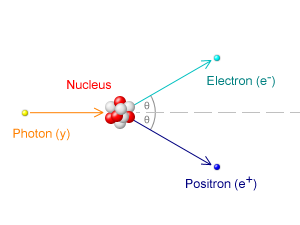
One photon, two resultant fermions:

Pairproduction.png


Annihilate them and you get two photons. What part of "split" don't you understand?

Where is the evidence of just an electron becoming a photon? That would support your claim. Again annihilation is not evidence of your claim either. The contradiction you keep missing is that a photon is charge neutral, a proton-electron pair (in production or annihilation) is charge neutral. An electron is not charge neutral. Are you now claiming that your ½ photon from whatever way you imagine it being split is not charge neutral? Once again you are going to have to explain exactly how that works and how it is consistent with current evidence.
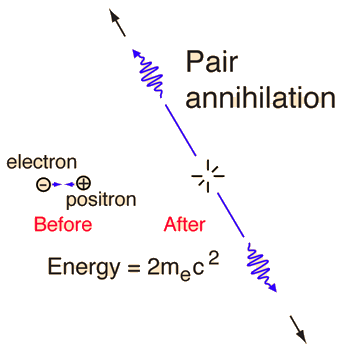
Incredible. Here:

annih.gif


One electron annihilates with one positron. Result: two photons. Now stop wasting my time with quasi-religious denial of scientific evidence.
 
And can you show that you're "electron is a bit like a whirlpool" hypothesis makes predictions which match experiments to at least the same precision as QED.
Not right now, but it'll come. Only I suspect it won't be much different to QED.

Or can you show that get the result of an experiment right that QED gets wrong.
I don't think so. QED is a good crisp theory, it's just lacking in physical meaning. This, in case you hadn't noticed, is what's coming.

Because if it can't then its scientific value is worth this: 0.
Just give it time. And don't forget that this is just a discussion forum.
 
Not right now, but it'll come. Only I suspect it won't be much different to QED.
So you admit that there is no actual evidence for your theory. Good.
Just give it time. And don't forget that this is just a discussion forum.
But you aren't discussing: you are ignoring the actual content of scientific papers and simply saying that you have a complete theory.
 
Not right now, but it'll come. Only I suspect it won't be much different to QED.

Wow. Imagine buying a car with those specs. What's the crash test rating? "I haven't done any crash tests---in fact, I've never participated in any successful automotive engineering in my life. What do you want the crash test rating to be? I hear 5-star is pretty good. Well, when I do the test I suspect it won't be much different than that."
 
No I'm not. I've repeatedly talked of low-energy proton-antiproton annihilation to neutral pions thence gamma photons. You can run this backwards no problem. The difference between the electron and proton is in the topology. The electron is a trivial knot, the proton is the next knot in the series, the trefoil. See post #353 where I described the crossing points and the bag model.

Hi, are you saying that a proton is a photon in a mobius strip or three photons in a mobius strip?

Post 353, seems to say, one photon.
 
Last edited:
Because it's stress-energy. It's a pressure pulse blitzing along at c. Pressure makes volume increase, and when this is happening, what we see is action.

I didn't say a neutrino didn't. A neutrino conveys energy, it's doing this too. But the action is different. It's rotational.

It doesn't. It's like going over a bump. You go up, then down, or down then up, there a symmetry that means your path doesn't change. A charged particle is a pulse of this stuff going through itself with two rotations. A positive particle has one chirality, a negative particle has the other. A non-charged particle is a combination of both. That's why the neutron has a magnetic moment. A charged particle frame-drags the surrounding space, altering the motion of another charged particle like one whirlpool affects another.

"it's a pressure", "it's like", "you go", "this stuff", "like one", etc, etc, etc. You respond with more analogies. Analogies don't allow one to calculate or predict anything. They are used by physicists attempting to explain things to laypeople. They can't be used to do any actual work or design, they actually very often make things worse, see "didaskalogenic".

Not me. You're the one dishing insults.

Rather than responding to questions, you give answers like:

"No, you have no idea. And I doubt if anybody here will put you straight. I'll tell you, but you'll only say blah blah, so forget it."

Yes, that is the path that most professionals take. Not childish at all.

Every picture of the electromagnetic spectrum shows a common amplitude.

Please, enlighten us. I can't find any such diagrams mentioning a "common amplitude". In fact, a google search shows that 5 out of the 10 first results are all you. The other 5 are using "common amplitude" and "electromagnetic spectrum", but no together.

http://www.google.com/search?q="common+amplitude"+"electromagnetic+spectrum"

The electromagnetic wave propagates through space this way → at c. There's a field variation, but no charge. The electromagnetic field variation goes this way ↑ and this way ↓ at a rate related to wavelength. I said it's like displacement current, and the sinusoidal waveform tells you a slope. That means there's a real physical displacement. And that displacement is always the same.

You are making no sense, your arrows seem to indicate a form of didaskalogenic, the arrows indicate magnitude, not displacement.
 
Last edited:
A macroscopic point has a surface.
And an electron isn't one.

No, a particle in QM is both a point particle and a "field excitation": wave/particle duality.
Sorry RC, they aren't point particles. Really. The distinction between a wave and a particle depends on relative motion. Come on now, take a reality check. Think about that oceanic swell wave. If it moves past you it's a wave. If you pace it in a helicopter it's a bump. If it goes round and round it's still a bump. Only a wave in space isn't like a wave on the ocean. There is no surface.

Showing your ignorance of scientific education there, Farsight. Third year mathematics was a required course for my physics degree. I believe that this would be the same in many universities.
No ignorance. You sounded like a mathematician or a mathematical theoretical physicist. Some of whom sneer at experimental physicists.

In case you are interested, the next year my Honors thesis was a study of the properties of surfactants. I spent many hours in a lab measuring the power spectrum of lasers passing through many different oil/surfactant/water mixtures in test tubes.
I'm pleased to hear it. I'm keen on experimental physics.

And underlying a spin space is no space at all. It is a mathematical object in its own right.
Reality check: underlying spin space is a real rotation.

Of course what you are really confused about seems to be the word "spin". Spin in QM is not classical spin. It just happens to have the same effects, i.e. it produces angular momentum and magnetic moments.
I'm not confused, you're convictional. You're resorting to mysticism.

No you do not. You seem to think that it starts with preparing the silver atoms somehow so that all the atoms have spins with the same orientation, half spinning one way and half the other way. This seems to be your "two orientations of spin". This is the only way to explain the results classically.
No I don't think that at all. That's a ridiculous straw-man assertion. Now pay attention, read my post about spinning the spin axis, and think it through.

You forgot about the quarks making up protons and neutrons.
No, I didn't. And you've never seen a free quark.

It is all the same "kind of spin" - quantum mechanical spin.
Yep, and it concerns wave mechanics, and quantum means "how much". It isn't mysticism.

It isn't a classical spinning sphere, but it's non-classical rotation in terms of wave mechanics (quantum mechanics). There's no mysticism to it. Not any one with some education in physics.
So it's a real rotation then. Causing a real angular momentum, and a real magnetic dipole moment. Or are they magical and mysterious surpasseth all understand things too?

Wrong. The silver atoms travel through one slit and then another. This is to produce a beam of silver atoms.
There is no "scattering" which is a term better applied to collisions. There is the standard deflection of a dipole interacting with a nonhomogenous magnetic field.
Sigh. The electron travels through both slits in the dual slit experiment. It isn't a point particle.

Bedtime.
 
KKid was right in that these guys are not tying up photons themselves. I think I posted it thinking they did, after coming across this article in the "library." After a closer reading (another "library" trip), it looks like they are creating fancy 3-D interference patterns with holograms. I don't think they use more than classical EM theory for what they do.

What caught my attention, and why I thought it might apply, is that the beginning of the article talked about Thomson's vortex atom model, and how Peter Guthrie Tait "came to believe that one could account for the rich variety of atoms in the periodic table by systematically building a classification system for all types of knots." The article had pictures of trefoil knots, too, being constructed from a helix mapped onto a torus.

Of course, Thomson eventually figured out he was on a dead-end path when he could not "analytically prove the temporal stability of a vortex knot."

Smart guy, Thomson was.
 
Please give a complete and understandable explanation of "spinning the spin axis"

And an electron isn't one.
That is right - an electron is not a macroscopic particle.
Treating it as a point particle fits with what the universe tells us.

Sorry RC, they aren't point particles. Really.
Sorry Farsight, they are point particles. Really. Science tells us that treating electrons as point particles matches the physical properties of electrons.

The distinction between a wave and a particle depends on relative motion. Come on now, take a reality check. Think about that oceanic swell wave. If it moves past you it's a wave. If you pace it in a helicopter it's a bump. If it goes round and round it's still a bump. Only a wave in space isn't like a wave on the ocean. There is no surface.
Now take a reality check: An ocean wave is not a QM wave.
A wave in space has no surface. A macroscopic particle does.

No ignorance. You sounded like a mathematician or a mathematical theoretical physicist. Some of whom sneer at experimental physicists.
All scientists sound like "mathematician or a mathematical theoretical physicist". That is because science is based on mathematics which even experimental physicists know.

I'm pleased to hear it. I'm keen on experimental physics.
It is a pity that you cannot understand the Stern-Gerlach experiment then.

Reality check: underlying spin space is a real rotation.
Farsight: underlying spin space is a nothing. It is a mathematical space.
Spin space is used to describe QM sin which is also not a "real" as in classical spin.

I'm not confused, you're convictional. You're resorting to mysticism.
You are confused. I an resorting to science: QM spin is not classical spin.

No I don't think that at all. That's a ridiculous straw-man assertion. Now pay attention, read my post about spinning the spin axis, and think it through.
I read your post and it is not understandable. So lets turn this into a question:
First asked 20 April 2010
Farsight,
Please give a complete and understandable explanation of "spinning the spin axis".

You may be able to use your great knowldege of science to express this mathematically :D .

Classical spins can have an axis that points an any direction. There are not 2 separate orientations of spin. You can have positive and negative spin around a specific axis.

And back to the Stern-Gerlach experiment :
  • Classically a collection of silver atoms in a furnace will have a random distribution of spin orientations and so a random distribution of spin angular momentum vectors.
  • Pass this collection of silver atoms through an inhomogeneous magnetic field then the atoms will deflected by random amounts.
  • The result expected is that there will be a band of atoms detected.
  • The actual result is 2 bands.
No, I didn't. And you've never seen a free quark.
Yes you did. And I have never seen a free quark.

Yep, and it concerns wave mechanics, and quantum means "how much". It isn't mysticism.
I agree - wave (quantum) mechanics is not mysticism. It is science. You thinking that I think it is mysticism is totally weird.

But quantum does not mean "how much". It means
In physics, a quantum (plural: quanta) is the minimum unit of any physical entity involved in an interaction.
It is derived from the Latin quantus which does mean "how much".

So it's a real rotation then. Causing a real angular momentum, and a real magnetic dipole moment. Or are they magical and mysterious surpasseth all understand things too?
So it is not a a real rotation then bacause it does not act like a real rotation. It is a QM rotation that gives a QM angular momentum
It has real effects: a measurable magnetic dipole moment.

These are real and clear, within the understanding of any one with an average intelligence, things.

Sigh. The electron travels through both slits in the dual slit experiment. It isn't a point particle.
Sigh. You and I were not and never have been talking about the dual slit experiment. That isnot the Stern-Gerlach experiment which we have been talking about.

An electron is a treated as a point particle in QM. This leads to a theory that matches the real universe very accurately.

If you are going all mystical then you can fantasize about the electron not being a point particle, e.g. it could be really small angels dancing on a really, really small pin head.
 
No, it's a breakthrough that you've conceded that something you took for granted isn't true.

Go ahead, Farsight - quote the post of mine where I said "electron spin has nothing to do with rotation". If you can't, you're a liar as well as a crank.

Are you a liar, Farsight?

I know very well what electron spin is and where it comes from, and it does have something to do with rotation. Anyone educated in particle physics or quantum field theory would know that. The wiki is wrong, it was obviously written by people with little knowledge of the topic.
 
Sorry RC, they aren't point particles. Really. The distinction between a wave and a particle depends on relative motion. Come on now, take a reality check. Think about that oceanic swell wave. If it moves past you it's a wave. If you pace it in a helicopter it's a bump. If it goes round and round it's still a bump. Only a wave in space isn't like a wave on the ocean. There is no surface.

a) Hey, look, another vague analogy with no reference to Maxwell's Equations or QED!

b) Your analogy strongly suggests that you've misunderstood the quantum wave-particle duality entirely. It has nothing to do with the relative speed of the observer and the wave phases. It has nothing to do with identifying the "bumps" as particles.

No ignorance. You sounded like a mathematician or a mathematical theoretical physicist. Some of whom sneer at experimental physicists.

What utter baloney. You just made that up; I've known hundreds of theorists and I've never met one who "sneers at" experimentalists.

I'm pleased to hear it. I'm keen on experimental physics.

Again, Farsight, if you someday meet an experimental physicist, ask them how often they use equations to test their ideas. (All the time. Every day.) Ask them if they've ever had an intuitive or analogy-based idea which turned out to be wrong. (Fairly often.) Ask them how does one find out that one's intuitions and analogies are wrong. (Answer: because you work through the math and the math tells you you're wrong.)
 
Regarding the analogies thing: I've got all sorts of analogies and diagrams and thought experiments that I use in the classroom. What's different about my analogies vs. Farsight's?

Well, first of all, there's no point in elaborating on analogies on a system that you can't do any math on. The math tells you whether the analogy is appropriate or not. The reason we don't say "A spiral galaxy is sort of like a whirlpool"---sounds good at a glance, doesn't it?---is that the math underlying a whirlpool is totally different than the math underlying a spiral galaxy. If you assume they're similar, you will get essentially all of spiral galaxy physics wrong.

Secondly, suppose that I have a good analogy---"a grandfather clock's pendulum is very similar to the coil spring in a watch"---the only reason to use it is if it actually teaches somebody something. If I toss out that analogy in the classroom, and it doesn't stick (if, say, that week's problem sets come in full of errors) I will discard it as pedagogically useless. I won't repeat it quarter after quarter and insult anyone who doesn't like it. I'll find another analogy, or I'll stick to the math.

Farsight, you've spent how many years throwing these analogies around on Web forums? And they've convinced how many people? This should tell you something. If you have something you want to convey, you are utterly failing to convey it. If there's anything interesting in your hypothesis, you have utterly failed to interest anyone in it. Do you want to keep failing for three or four more years? If not, I would suggest that you change the way you're presenting your evidence. You have the power to do this: go to college, get a physics degree, and learn enough math to take a couple of steps. Alternatively, you have the power to be a crackpot whose hypothesis is born, turned over a few times, and dies entirely in your head without having (a) interested one other person or (b) generated one prediction or (c) passed one mathematical or experimental test. Which of those do you want? You're on-track for the latter (as your years of experience should show) and show no signs of deviating (since you're ignoring all advice and expertise)
 
Last edited:
No I'm not. I've repeatedly talked of low-energy proton-antiproton annihilation to neutral pions thence gamma photons. You can run this backwards no problem. The difference between the electron and proton is in the topology. The electron is a trivial knot, the proton is the next knot in the series, the trefoil. See post #353 where I described the crossing points and the bag model.

So then explain that topology and siad difference (which would include more than just charge). This time try some math and not just anoligiees, quote mining and pictures.

From your referenced post..

…that 511keV photon energy/momentum isn't travelling at c. It's moving at c…

A lack of self-contradiction might also be a benefit in such an explanation.

Please restate.

Ok, piar production not just electron production. You need to explain how your “split occurs and how your “split” self-bound photonic state topology results in just an electron. Pair production does not support such a claim since it produce, well, a pair. Even if you do just want to “split” that pair or pair production without explaning your “spit”. Again some math would help (and a lack of self-contradiction).

Pair production and electron angular momentum and magnetic dipole moment along with annihilation is the evidence. In no way does this refute what I've said here.

Again you are missing that critical term “pair” in “pair production”

Yes, pair production creates two particles with opposite spin. Angular momentum is conserved. Let's not have that single-particle straw man again.

Strawman? It is your claim that an electron is the result of some “split” self-bound photonic state, support your claim. Pair production doesn’t cut it, even if you just want to cut (or “split”) that production in half.


LOL! String theory doesn't make any. If you beg to differ, let's go round the loop again: list 'em.

No begging on my part, other than that you try to research some of those predictions already listed.


So show how your “split” occurs and how your “split” self-bound photonic state topology results in just an electron.

One photon, two resultant fermions:

[qimg]http://upload.wikimedia.org/wikipedia/commons/8/84/Pairproduction.png[/qimg]

I think it might also have something to do with the virtual photons around the nucleus in pair production (and QED). Resulting in the change in momentum of that nucleus as a result of the pair production. Someone please correct me if I am wrong.


Annihilate them and you get two photons. What part of "split" don't you understand?

Exactly how your “split” occurs in pair production.

Incredible. Here:

[qimg]http://hyperphysics.phy-astr.gsu.edu/hbase/Particles/imgpar/annih.gif[/qimg]

Nope, that is just and electron and positron resulting in two photons. You need a single electron degenerating in to photon to support your claim. Can you give some quantitative prediction for how long a “split” self-bound photonic state may remain so bound or why said state must be infinite on its own? Please remember your “split” self-bound photonic state has all the characteristics of just an electron so evoking conservation does not help you. As such conservation is exactly what you’re seemingly claiming to be, well, “split”.

Perhaps your “split” self-bound photonic state is simply virtual. Can you provide any quantitative predictions, interactions, suppressed interactions, or perhaps adjustments to say perhaps the magnetic moment of the electron that differ from the current understanding of QED, based on the inclusion of such a virtual “split” self-bound photonic state? Again if such inclusion does not change said predictions to any measurable degree, than it need not be included.

One electron annihilates with one positron. Result: two photons. Now stop wasting my time with quasi-religious denial of scientific evidence.

Ah, the “quasi-religious denial of scientific evidence” failsafe of crank notions. Get off your keister and start doing that hard part. Make some testable quantitative predictions for these notions you want to support or to be supported. If those notions make no testable quantitative predictions other than those already tested from current theories, than said notions provide no advantage over those already tested and verified theories (other than to you).
 
Last edited:
No begging on my part, other than that you try to research some of those predictions already listed.
Look, the claim of Farsight to not know any predictions of string theory is just a straight-up lie. He has been saying the same thing about string theory for at least three years and ample evidence can be found on the internet that from the start many people have provided him very specific and thorough lists and references about the predictions of string theory. Why he persists in so obvious a lie is beyond me, but it is indicative of the quality of his knowledge and reasoning. (Heck, once it appears that Farsight even claimed that string theory was wrong because it predicted the existence of the Higgs particle!)
 
So you admit that there is no actual evidence for your theory. Good.

But you aren't discussing: you are ignoring the actual content of scientific papers and simply saying that you have a complete theory.

We should get Farsight and Michael Mozina together. They both prefer looking at pretty pictures and imagining what they might look like over actual maths, science and predictions. I'm sure we could use Farsight's pictures of whirly photons to back up Michael's pictures of solid iron stars.
 
I think that someone should actually use his theory in a defence of homeopathy. Because all particles are made of photons, the photons that make up water can take on, or imprint, the electromagnetic properties of the photons in solution. Dilution heightens this effect because it transforms more photons into the new twist of the solution. Drinking the solution makes the photons in your body twist in response, thus working opposite to the particles used in making the solution.

Am I on to something?
 
I think that someone should actually use his theory in a defence of homeopathy. Because all particles are made of photons, the photons that make up water can take on, or imprint, the electromagnetic properties of the photons in solution. Dilution heightens this effect because it transforms more photons into the new twist of the solution. Drinking the solution makes the photons in your body twist in response, thus working opposite to the particles used in making the solution.

Am I on to something?

Isn't it true in mathematics that "If you take any one falsity as an axiom, you can derive any other falsity?"
 
I think that someone should actually use his theory in a defence of homeopathy. Because all particles are made of photons, the photons that make up water can take on, or imprint, the electromagnetic properties of the photons in solution. Dilution heightens this effect because it transforms more photons into the new twist of the solution. Drinking the solution makes the photons in your body twist in response, thus working opposite to the particles used in making the solution.

Am I on to something?

Or just on something, but it does sound like a fun trip.

Homeopathic Hallucinogens, anyone?
 
Hi, are you saying that a proton is a photon in a mobius strip or three photons in a mobius strip? Post 353, seems to say, one photon.
I'm saying the electron is the moebius configuration, and the proton is the next knot, a trefoil. I'm also saying it's one photon, not three.
 
"it's a pressure", "it's like", "you go", "this stuff", "like one", etc, etc, etc. You respond with more analogies. Analogies don't allow one to calculate or predict anything. They are used by physicists attempting to explain things to laypeople. They can't be used to do any actual work or design, they actually very often make things worse, see "didaskalogenic".
Analogies can offer understanding. That's why we use them. You don't throw the baby out with the bathwater and throw away this tool because somebody uses a misleading analogy.

Rather than responding to questions, you give answers like: "No, you have no idea. And I doubt if anybody here will put you straight. I'll tell you, but you'll only say blah blah, so forget it." Yes, that is the path that most professionals take. Not childish at all.
Come off it Russ. I've answered piles of questions. And my blah blah was in response to yours.

Please, enlighten us. I can't find any such diagrams mentioning a "common amplitude". In fact, a google search shows that 5 out of the 10 first results are all you. The other 5 are using "common amplitude" and "electromagnetic spectrum", but no together.
Just look at the images for electromagnetic spectrum. Pick any one at random. Look at the sinusoidal waveform. Look at the wave height. That's the amplitude. It's always the same regardless of frequency.

em_spectrum.jpg


You are making no sense, your arrows seem to indicate a form of didaskalogenic, the arrows indicate magnitude, not displacement.
It won't make sense if you don't pay attention.
 

Back
Top Bottom