• Quick note - the problem with Youtube videos not embedding on the forum appears to have been fixed, thanks to ZiprHead. If you do still see problems let me know.

Merged Relativity+ / Farsight

1) Yep and 2) because you're a timewaster.

In other words you cite an article but can not show that it is relevant to your claim, so this will probably end poorly with you not able to demonstrate your claim, then you will move on to something else.

Pretty standard for someone who makes unsupported claims.
 
No, not abandon it, understand it.

LOL, here comes the foam-flecked outrage. Isn't it sad that people who can't face up to the evidence and can't respond to the logic resort to abuse when they've lost the argument?

No the point is that you haven't shown the evidence of that it supports you beliefs. And believe me, Sol I is not foam flecked, however much your spiining may protect your ego from teh facts that you have not supported your claims.

Now comes the infamous 'Gish Gallop'.

1. Pretending that others don't understand, whne in fact they do.
2. Not presenting evidence.
3. Claiming the evidence is there.
4. Statements about 'it is really about something else', when your claim is shown to be unsupported by the evidence you do show.
5. Reporting posts.
6. Name calling.
7. Refusing to present the actual citations that 'support' the 'evidence'

Time to saddle up your pony and run away.
 
It doesn't. It varies with gravitational potential. The gravitational field strength at a given location is the rate of change of gravitational potential. Sure, the links don't say this, but look for example at the presentation that comes up first in the google search. It's entitled Evidence of Correlations Between Nuclear Decay Rates and Solar Activity and on slide 42 says Possible Mechanisms • Spatial Variation of the Fine Structure Constant α.

I tried to view the slideshow at work, but for obvious reasons I couldn't watch the entire thing. Since I also won't be able to look at it at home (no internet except on my feeble phone at the moment :(), I looked up the slideshow's main reference, which is Evidence for Correlations Between Nuclear Decay Rates and Earth-Sun Distance.

Interestingly, I immediately stumbled across another paper, submitted a few months later, called Evidence against correlations between nuclear decay rates and Earth-Sun distance.

Maybe if I bring the two papers together, they'll annihilate?

Anyway, it seems neither paper has received very much attention so far. Could anyone reading this thread can suggest some further reading?
 
As a moderator you're speaking with the authority of this forum, and this is the sort of nonsense that led Dawkins to close down his. So I'm reporting your post. This is the arXiv search for Qiu-Hong Hu: http://arxiv.org/find/grp_physics/1/au:+hu_qiu_hong/0/1/0/all/0/1 . These are his patents http://www.faqs.org/patents/inv/522164 and here's a bit more on the guy: http://www.lightlab.se/en/about_lightlab/management_team.aspx.

So you're confirming that I was in fact exactly correct. He's an engineer who works on LEDs. His work has enough cross-over into the physics side of how LEDs work that some of his university work was counted as physics rather than engineering. At the time the "paper" you are so fond of was published, he was, as I said, a student, and he has not published anything since then, instead continuing his engineering work.

Given that you agree with everything I have pointed out about this guy, I'm not sure why you're getting so upset about it.
 
Watch out---Farsight seems to be in the UK where the libel laws are a bit different.

Seriously though, Farsight, you showed up voluntarily on this board and actively asked for comment.
I bumped into this board when I was looking up something to do with time. I was talking to an ISST guy at the time. In essence I was knocking time travel on the head and explaining why it's a load of old cobblers, and got sucked into relativity and electromagnetism, and was then challenged to justify it. So I started this thread.

You got a bunch of comments from people who think your theory is wrong---which, and correct me if I'm wrong, is exactly the reception you've gotten at Sciforums, BAUT, etc.
Pretty much. Though I keep reminding people that this isn't my theory, and that instead it's a synthesis drawn from a variety of papers by professional physicisists.

We call your theory a crackpot theory because it's wrong, and wrong in a sadly familiar fashion; we call you a crackpot because to be a crackpot is no more or less than to espouse a crackpot theory.
Sounds like catch-22. The dualism of the electromagnetic field isn't crackpot, saying charge can be created and destroyed and so isn't fundamental is crackpot. Criticising intrinsic spin and pointing out electron angular momentum and magnetic dipole moment isn't either. The crackpot allegation is merely a defensive smokescreen employed by people who seek to dismiss scientific evidence and can't counter the logic.

A well-known US case, Dilworth vs. Dudley (decided by one of our most respected judges) held that calling someone a "crackpot" was not defamatory... Nonetheless, given your presence in the UK, where the fate of the good Mr. Simon Singh has highlighted the irrationality of the libel laws I see no reason not to take your libel threat seriously. Even an 0.1% chance of your being serious, is worth more than any educational or entertainment value I'm getting out of this thread.
I didn't mean to threaten libel myself. The law is so costly as to be unavailable to normal people. I was thinking of professional physicists and their institutions being impugned, and the sort of response they might take. I was also thinking of the recent Dawkins debacle where moderators were misbehaving, such that when they said something it was with the authority of the forum, regardless of any disclaimers, and indeed with the authority of Dawkins himself. It's just not on to impugn people in an attempt to inhibit free speech and open discussion, and then cry free speech in science! in defence.

So: in whatever language the British legal system would find acceptable, I withdraw any and all potentially libelous claims against Mr. Farsight and any of his aliases. I wish for this withdrawal to be in full effect within the boundaries of the United Kingdom, its overseas territories, embassies, territorial waters, and aboard UK-flagged vessels, and on any electronic cables, broadcasts, or media extending into such boundaries. Within such boundaries and media, I do not call Mr. Farsight a crackpot. He is a fully-respectable and un-libeled citizen of whatever nations he is a citizen of, and the fact that his physics ideas appear to be utterly valueless should not reflect on his dignity as a human being.
Actually, I take umbrage when people impugn the professional scientists whose papers I've referred to. The rest is water off a duck's back, even your snipy little "valueless". I know full well that ad-hominems are the last refuge of a person who has been been comprehensively whupped by another person with a demonstrably superior understanding of physics.

That said, it is not in my legal or financial interest to participate in this conversation.
As you wish.

I suggest that the same is true for everyone else here.
What you really mean is let's studiously ignore the underlying reality of quantum mechanics. Groan. No wonder there's trouble with physics.
 
Spin is not "two dimensional". The axis of spin can point in any direction. Classical particles can have any spin that they like. QM particles can only have specific spins. QM spins obey QM laws not classical ones.
The classical particle you're thinking of is something like a rotating sphere. See the Stern-Gerlach article which says:

"If the particles are classical, "spinning" particles, then the distribution of their spin angular momentum vectors is taken to be truly random and each particle would be deflected up or down by a different amount...

The experiment shows that this doesn't happen, so we know the particles aren't spinning spheres. However the article, which is in line with the current consensus, uses this as a straw-man argument to invoke mystery. It goes on to say:

"Electrons are spin-1⁄2 particles. These have only two possible spin angular momentum values, called spin-up and spin-down. The exact value in the z direction is +ħ/2 or −ħ/2. If this value arises as a result of the particles rotating the way a planet rotates, then the individual particles would have to be spinning impossibly fast."

There's actually nothing wrong with that, but watch carefully, and you can see the sleight-of-hand. A little lower down it repeats the straw-man:

"The speed of rotation would be in excess of the speed of light, 2.998×10⁸ m/s, and is thus impossible".[2]

And here comes the non-sequitur:

Thus, the spin angular momentum has nothing to do with rotation and is a purely quantum mechanical phenomenon. That is why it is sometimes known as the "intrinsic angular momentum."

Whoa! We've established that the particle isn't rotating like a planet, but why can't it be rotating in some other fashion? There is no justification here for asserting that spin angular momentum has nothing to do with rotation.

So exactly how does you "interpretation" differ from the usual one, e.g. how come are spins are not intrinsic because passing a beam of particles in a known spin state through a S-G apparatus does not split them up?
Imagine a whole set of globes, like this:

images


Now give them all an earth-style spin to give yourself a set of classical particles. Next, jumble them around so that the spin axes point in a variety of directions, then throw them through the inhomogeneous magnetic field. You'd see a line on the screen as per the classical prediction:

300px-Stern-Gerlach_experiment.PNG


Now collect all your classical particles together again, and set them down on the table like a bunch of spinning globes. Now give them another spin in another orientation. Spin the spin axis. You have two choices as regards this new spin direction, this way ↓O↑ or that way ↑O↓. Now throw them through the inhomogeneous magnetic field and ask yourself what you'd see.

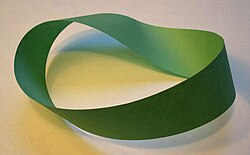
This spheres example doesn't cover the spin 1/2 of course. You need one spin to be twice the rate of the other for that. A moebius strip is an everyday example of this, where two rotations around the strip occur for every rotation of the strip.

250px-M%C3%B6bius_strip.jpg
 
Last edited:
I understand that only one wavelength will yield the correct energy of 511keV. However, assuming that a mechanism exists which lets photons become "self-trapped", this doesn't rule out the possibility of a photon with some other energy from getting into such a state. You'd have the wrong mass for it to be an electron, sure, and the radius of the orbit would need to be adjusted accordingly - but what renders such a state impossible in principle?
Nothing.

Do you posit some fundamental, unique length scale at which "self-trappedness" may occur?
No.

How exactly do you avoid a continuous spectrum of energies (with higher energies corresponding to tighter loops)?
Knot theory, or quantum topological quantum field theory. The first stable configuration is the trivial knot, which is a ring like this O in the ordinary knot chart, and a double ring in the torus-knot chart. The next one is a trefoil, and then they get more and more complicated.

Similar considerations apply to excited states. On the face of it, you could just as well have any integer number of wavelengths going around the loop and still satisfy the constructive interference condition - it's very similar to Bohr's early atomic model in this particular regard. This would give a discrete spectrum of energies for each permitted radius. I still don't see a mechanism which (a) permits the self-trapped states and yet (b) forbids all modes but the lowest frequency one.
Perhaps the problem here is related to the nature of the photon. I described it as a lemon-like pulse, where the archetypal sinusoidal waveform describes the slope of the lemon. Maybe I'm misreading you, but it's sounds like if you contrive two pulses in a chain going round a loop, the ends aren't joined. The electron description describes one pulse travelling entirely through itself. You could contrive a particle where the loop is so much tighter that the pulse travels through itself more than once, but this sounds like the opposite situation to what you're suggesting.
 
... The reality behind that equation is that the electric field is caused by the charge contained in the surface that you integrate over.
That's not enough.

... This sounds like you think that science is about something you call "reality" which looks like some kind of ultimate truth.
This is not the case. Science is about producing models that match what the universe tells us about itself.
We do physics because we want to understand the universe. I'm not satisfied when mystery persists.

What the universe tells us is that electrons act as if they are described by QED, e.g. the most precise result in physics is the match between the QED prediction for the anomalous magnetic moment and that measured for the electron.
I have no issue with QED. I'm a Feynman fan. But he said nobody knows why it works, and I want to know why. I'm not satisfied by "it just is" or "don't even hope to understand it because it isn't classical". You shouldn't be either.

Their maximum size is 10^-20 meters, suggesting that they are point particles (a few more OOM and we are getting to Planck scales)
QED doesn't tell us that. That's an inference from scattering experiments, associated with the interpretation of a wave equation as a description of the probability of finding a point particle. It isn't true to wave mechanics, and isn't in line with what we see. An electromagnetic wave is a wave in space, a radio wave might be 1500m long, there's no point particle there. The quantum nature of light is in the h in E=hf. Light waves can come in a smooth range of frequencies delivering a smooth amount of energy. The quantum is in the nature of the action, the "kick". It's like a pony. It doesn't matter how hard it kicks you, its leg is always the same length.
 
As ben m stated: Pair production and annihilation and Compton wavelength, and electron spin, magnetic dipole moment, anomalous magnetic dipole moment, dual-slit electron interference, and the Aharanov-Bohm effect are all 100% consistent with the electron being a quantum point particle as in QED.
How as a skeptic can you possibly accept that? A point particle can't have angular momentum or a magnetic moment. A point particle can't travel through two slits at once. What's known as the Aharanov-Bohm effect was predicted by Ehrenberg and Siday in 1949 but went unnoticed. See http://en.wikipedia.org/wiki/R._E._Siday and The Refractive Index in Electron Optics and the Principles of Dynamics. And what happened to those rotating arrows? QED is a mathematical treatment, don't ignore what Feynman about nobody knowing why it works and mistake the mathematical convenience of working with points as with the real thing. Check out Evanescent modes are virtual photons instead.
 
I have no issue with QED.
...
QED doesn't tell us that.

Wrong - QED tells us exactly that. In QED, the electron is a quantum of a spin 1/2 Dirac field. It's a point particle in the sense that all such field excitations are. That does not mean that it has zero size - it has a probability cloud the size of which is set by the electron's Compton wavelength, which in turn is a function of its energy. What "point particle" really means is that the electron field interactions are local; that is, one can write the lagrangian density for the model using fields that are all evaluated at the same spacetime point. That's not true in string theory for example, or at least it doesn't seem to be, but it is true in all local quantum field theories.

To put it a little more physically, it means that electrons are as point particle-like as you can get given the quantum uncertainty in their position. The more momentum you give them, the smaller they get.

To see what else is possible, in string theory that doesn't happen (past a certain energy strings get bigger when you give them more energy). A less exotic example is the proton - protons have substructure, which means if you probe them with a very small point particle like a high-energy electron, you can break the proton up into pieces, or observe complex scattering behavior as the electron bounces off the quarks that make up the proton. By contrast electron-electron scattering is much simpler.

That's an inference from scattering experiments

No. It's a theory - QED - which has been confirmed to spectacular accuracy by scattering experiments.

H A point particle can't have angular momentum or a magnetic moment.

Then you don't accept QED. But you said you did. Which is it?

A point particle can't travel through two slits at once.

Then you don't accept QED. But you said you did. Which is it?
 
You claim seems to be that the value of the fine structure constant will change depending on the strength of a gravitational field. You do realize that the probe in question will always be in microgravity (except when firing thrusters), right?
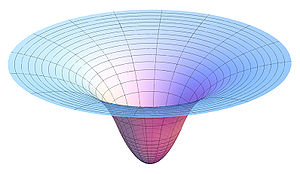
It doesn't depend the strength of the gravitational field. It's the depth of field, not the local gradient.

300px-GravityPotential.jpg


That isn't a ratio, that is a "fraction". Are you suggesting that the ratio between the em force and the strong force is exactly 1/137? Are you trying to say that em force is 137 times greater than the strong force?
Don't be pedantic. It isn't exactly 1/137, to the best of our knowledge it's 1/137.035999679(94), and it varies because alpha is a running constant.

Yes, please to provide the maths. Otherwise, how can you be sure that the math doesn't fall apart, or that it produces results that match current experimental data?
I'll start a thread on gravity.

Please provide a source explaining why interpretation is important to physics. I was only aware of testable results being important to physicists and interpretation being left to philosophers as it isn't testable.
Here's one: http://en.wikipedia.org/wiki/Copenhagen_interpretation. This is what Einstein and Bohr and others argued about at the 1927 Solvay conference. Also have a look at http://www.mathpages.com/rr/s7-02/7-02.htm where the author talks about the "geometric interpretation" (as exemplified by Misner/Thorne/Wheeler's "Gravitation") and the "field interpretation" (as in Weinberg's "Gravitation and Cosmology").

You seriously expect us to believe that your predicted the cryogenic electron emission more than 50 years ago?
No. I'm predicting seasonal variation in line with seasonal solar neutrino flux. It varies because the earth's orbit is elliptical.

Why are you suddenly shifting gears away from cryogenic electron emission over to neutrinos? Are you suggesting that cryogenic electron emission is caused by neutrinos colliding with something?
Yes.

The number of events would be off by huge orders of magnitude unless you can provide some other neutrino interaction that isn't currently known.
Just do the experiment. Don't clutch at reasons not to do it.

Also, what do you mean by "variable neutrino emission", are you just talking about neutrino oscillation?
No. See above. And search google on seasonal neutrino radioactive to look for seasonal variations in radioactive decay rates:

http://www.newscientist.com/article...haunt-earths-radioactive-atoms.html?full=true

"There's a devil in the detail, however. The sample's radioactivity has not been dropping steadily over time, as the textbooks demand. It has fallen, to be sure, but superimposed on that decline is an odd, periodic wobble that seems to follow the seasons. Each year, the decay rate is at its greatest around February and reaches a minimum in August."

And sorry, mathematics is part of what makes science, science. Physics particularly would be useless without it.
No problem, but experiment is important too.

You are actually suggesting an experiment in which charge is not conserved?
Yes. You shouldn't refuse to do experiments that threaten what you think you know.

So...we made theories that do a good job of predict experimental outcome because we don't want to know things?
No. But some theories get trapped by paradigm and don't progress like they should.

A) I don't think its possible for anyone to dismiss your version of pair production because you haven't actually provided one. Just vague handwaving and a picture of a spiral. B) Dismissing your version of pair production isn't dismissing pair production, C) There is a perfectly good model for electrons. D) You certainly are dismissing the SG experiment (or just don't understand the implications)
I'm not dismissing the SG experiment at all, I'm challenging the inferences drawn from it. And come on, there isn't a perfectly good electron model in mainstream physics.

String theory has absolutely no sway in physics. No one is using it to build accelerators, computers, calculate what happens in a nuclear explosion etc. It is within the branch of *theoretical physics* and has been popular there. I fail to see the problem of unproven theories being a part of theoretical physics.
Then what exactly is your problem with what I'm saying?
 
So what studies show a photon generating an electro magnetic field again?
The study of light.

360px-Light-wave.svg.png


It isn't a permanent standing field, it's transient. But nevertheless its still an electromagnetic field and there's no charge there.That's why it says E=amplitude of electric field, M=amplitude of magnetic field.
 
The study of light.

[qimg]http://upload.wikimedia.org/wikipedia/commons/thumb/a/a1/Light-wave.svg/360px-Light-wave.svg.png[/qimg]

It isn't a permanent standing field, it's transient. But nevertheless its still an electromagnetic field and there's no charge there.That's why it says E=amplitude of electric field, M=amplitude of magnetic field.

Just FYI David - yes, EM fields can exist in the absence of charges. However there is a mathematical characteristic of the field which tells you whether there is charge in some region. Imagine drawing a surface that encloses that region - it doesn't matter which surface, so long as it encloses the region of interest and doesn't have any holes - and then integrate (add up) a certain quantity on that surface (the component of the electric field that's perpendicular to it). If you get zero, that means there is zero charge enclosed by that surface - that's a law of physics called Gauss' law.

In the case of a photon, or any EM wave, that integral will give you zero. In the case of an electron, it will not - because electrons are charged, and photons and EM fields aren't. That's one of many ways to see that electrons cannot possibly be composed of photons.
 
Farsight said:
I understand that only one wavelength will yield the correct energy of 511keV. However, assuming that a mechanism exists which lets photons become "self-trapped", this doesn't rule out the possibility of a photon with some other energy from getting into such a state. You'd have the wrong mass for it to be an electron, sure, and the radius of the orbit would need to be adjusted accordingly - but what renders such a state impossible in principle?
Nothing.

Do you posit some fundamental, unique length scale at which "self-trappedness" may occur?
No.
So then we're left with something of a mystery. 511 keV photons can apparently do this dance, going round a loop of approximate size 10-12 m, but so can 5.11 keV photons going round a loop of size 10-10 m, and so on - you end up with a continuous spectrum of rest-masses.

How exactly do you avoid a continuous spectrum of energies (with higher energies corresponding to tighter loops)?
Knot theory, or quantum topological quantum field theory. The first stable configuration is the trivial knot, which is a ring like this O in the ordinary knot chart, and a double ring in the torus-knot chart. The next one is a trefoil, and then they get more and more complicated.
See above. There's nothing to prevent me from considering a knot structure with double the linear dimesions of the electron's purported knot structure, as long as I also double the photon's wavelength (i.e. halve its energy). Without some fundamental length scale, both situations are equally possible (or impossible).

Similar considerations apply to excited states. On the face of it, you could just as well have any integer number of wavelengths going around the loop and still satisfy the constructive interference condition - it's very similar to Bohr's early atomic model in this particular regard. This would give a discrete spectrum of energies for each permitted radius. I still don't see a mechanism which (a) permits the self-trapped states and yet (b) forbids all modes but the lowest frequency one.
Perhaps the problem here is related to the nature of the photon. I described it as a lemon-like pulse, where the archetypal sinusoidal waveform describes the slope of the lemon. Maybe I'm misreading you, but it's sounds like if you contrive two pulses in a chain going round a loop, the ends aren't joined. The electron description describes one pulse travelling entirely through itself. You could contrive a particle where the loop is so much tighter that the pulse travels through itself more than once, but this sounds like the opposite situation to what you're suggesting.
No, I'm just pointing out that if you have waves confined by some mechanism, then there are usually going to be a series of normal modes, rather than just a fundamental mode (the 511 keV mode). Consider the harmonics on a guitar string, or a drum skin. Or indeed, the energy levels of the hydrogen atom, or excited hadron states. It's the same basic phenomenon (mathematically speaking).

See here for some examples of resonant cavities, for example.
 
If there is an actual geometric "distortion" of space, there will be curvature associated with that (we could calculate this from the form of the metric tensor, for example). Using the GR field equations, we could then calculate the stress-energy tensor. It should then be a simple matter to see if this is consistent with the idea of a photon being a distortion of space.
Sounds good to me.

But we can do some order-of-magnitude calculations straight away. As I showed before, if the photon has energy 511 keV, and we (just for a second) idealise it as a point particle, then the curvature produced by it will certainly be insignificant at distances much greater than 10-57 m.
That throws the baby straight out with the bath water and confuses space-time curvature with space curvature. A different approach is required.

Sol invictus then added that due to the spread-out nature of the photon - it is spread out over a distance of about 10-12 m - the curvature would not become significant at any distance. The angular momentum would change the numbers only slightly.
The photon is stress, it pushes the lattice lines out of true, hence curving space, and imparts a pressure gradient that then causes curvilinear motion, which is curved spacetime.

So the geometric distortion (curvature) associated with a photon is extremely tiny - entirely negligible - at all scales, unless GR is wrong.
GR isn't wrong, with respect, you've made an assumption that's wrong.

Therefore, I can only conclude that you must be talking about a purely topological distortion, with no actual curvature. Is this right?
Yes and no. The Riemann curvature in GR is used for the equations of motion, not spatial curvature. There's this extra time axis in there, akin to what Minkowski was saying about the difference between magnetic force and electric force resulting from the electron's electromagnetic field.
 
Since you have this exact figure, can you show us the calculation?
It's the electron Compton wavelength divided by 2pi. "The Compton wavelength of a particle is equivalent to the wavelength of a photon whose energy is the same as the rest-mass energy of the particle... The CODATA 2006 value for the Compton wavelength of the electron is 2.4263102175±33×10−12 meters".
 
Wikipedia is not the dictionary. Regardless, Wikipedia says '"Crank" is a pejorative term used for a person who unshakably holds a belief that most of his or her contemporaries consider to be false.' - I don't think that applies to us.
People never do.

I take it you're going to be retracting that now, given you've described everyone else in this thread as cranks and basically done exactly what you were telling other people to be careful of?
No. I gave a reasoned response to a slur. Here I am putting up the argument and the evidence, and no argument or evidence can ever be sufficient to make a crank abandon his belief. I don't have any beliefs. I have a current best-fit view. Show me some more evidence and I'll change that view. I will not dismiss evidence because it doesn't fit with what I think I know. Now, can we get back to physics please?
 
ctamblyn said photons don't interact directly with photons. He's right. A vertex in a Feynman diagram in QED always has two fermions and one photon.
I'm sorry, but photons do interect with photons. The experimental evidence takes precedence over a diagram here.

There's an inherent problem if you have fermions as a second-class citizen in your theory. QED is a powerful theory that is exceptionally difficult to compete with, you won't convince anyone that your idea works unless you can outdo it.
I'm not trying to compete with QED, I'm trying to describe the physical reality that underlies it.

Also photons aren't spacewarps. The position of 'waves distorting space' has already been filled, and the job didn't go to a spin-1 boson.
That's no argument. If you can accept that a gravitational wave increases a distance in space, you shouldn't have a problem with a photon doing something similar. Look at my opening posts again and grasp that twist and turn, and the curve or curl associated with it. To make space curve, to bend it, you need to change a nearby distance, like pushing outwards on an elastic lattice.
 

Back
Top Bottom