Spin is not "two dimensional". The axis of spin can point in any direction. Classical particles can have any spin that they like. QM particles can only have specific spins. QM spins obey QM laws not classical ones.
The classical particle you're thinking of is something like a rotating sphere. See
the Stern-Gerlach article which says:
"If the particles are classical, "spinning" particles, then the distribution of their spin angular momentum vectors is taken to be truly random and each particle would be deflected up or down by a different amount...
The experiment shows that this doesn't happen, so we know the particles aren't spinning spheres. However the article, which is in line with the current consensus, uses this as a straw-man argument to invoke mystery. It goes on to say:
"Electrons are spin-1⁄2 particles. These have only two possible spin angular momentum values, called spin-up and spin-down. The exact value in the z direction is +ħ/2 or −ħ/2. If this value arises as a result of the particles rotating the way a planet rotates, then the individual particles would have to be spinning impossibly fast."
There's actually nothing wrong with that, but watch carefully, and you can see the sleight-of-hand. A little lower down it repeats the straw-man:
"The speed of rotation would be in excess of the speed of light, 2.998×10⁸ m/s, and is thus impossible".[2]
And here comes the non-sequitur:
Thus, the spin angular momentum has nothing to do with rotation and is a purely quantum mechanical phenomenon. That is why it is sometimes known as the "intrinsic angular momentum."
Whoa! We've established that the particle isn't rotating like a planet, but why can't it be rotating in some other fashion? There is no justification here for asserting that spin angular momentum has nothing to do with rotation.
So exactly how does you "interpretation" differ from the usual one, e.g. how come are spins are not intrinsic because passing a beam of particles in a known spin state through a S-G apparatus does not split them up?
Imagine a whole set of globes, like this:
Now give them all an earth-style spin to give yourself a set of classical particles. Next, jumble them around so that the spin axes point in a variety of directions, then throw them through the inhomogeneous magnetic field. You'd see a line on the screen as per the classical prediction:
Now collect all your classical particles together again, and set them down on the table like a bunch of spinning globes. Now give them another spin in another orientation.
Spin the spin axis. You have two choices as regards this new spin direction, this way ↓O↑ or that way ↑O↓. Now throw them through the inhomogeneous magnetic field and ask yourself what you'd see.
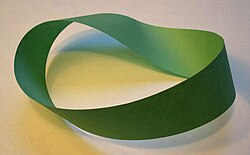
This spheres example doesn't cover the spin 1/2 of course. You need one spin to be twice the rate of the other for that. A moebius strip is an everyday example of this, where two rotations around the strip occur for every rotation of the strip.



 ), I looked up the slideshow's main reference, which is