• Quick note - the problem with Youtube videos not embedding on the forum appears to have been fixed, thanks to ZiprHead. If you do still see problems let me know.

Merged Relativity+ / Farsight

LOL. To put it bluntly, you just dismissed experimental physics.
Er no. I dismissed your theory because you:
"can't even give [us] a decent mathematical description of the electron
Why would I have the slightest bit of interst in your theory. You're trying to replace QED, one of the most phenomenally succesful theories in scientific history with something with no qunatitative basis whatsoever.

It amazes me how people dismiss evidence and Einstein and anything that isn't in the mathematics they know and isn't what they were taught. The parallel with YECs dismissing fossils and strata and continental drift is marked.
Wow, you think YEC "theories" are equivalent to the most precisely tested theory in the history of physics that I prefer to your nonsense? That's absolutely hilarious.

No, I'm familiar with them. They're describing the forces you feel but there's only one causative field, not two. That's why it's the electromagnetic field. Note that "Maxwell's equations" are Heaviside's equations. I've read the original Maxwell. You should too, then you'll appreciate that what I've been saying here comes from Maxwell. He didn't get the vortexes right, he thought they were in the intervening space, but once you understand all this it's amazing how close he was.
So stop complaining that we can't consider an electric field and a magnetic field.
 
ctamblyn said:
You need to expand on this. An e/m wave is not the same thing as an alternating current in the usual sense of the phrase. A current involves a flux of charged particles across a surface. In AC (in the normal sense), the positive flux during the first half-cycle is cancelled by the negative flux in the second half-cycle, but there is still a flow of charged particles. Are you thinking of displacement "current" by any chance?
It's related to displacement current, but not as it's commonly understood. In a photon we see a positive then negative "flux" and no charged particle. We perform pair production, then in the electron we see a magnetic dipole moment.

Farsight: the reason I cited old Mr. Singularitarian is that he was also someone whose major activity on this board was accusing everyone who disagreed with him of not knowing basic physics. It made for some amusing but basically pointless threads. You are in danger of tacking in that direction...
Noted. I'd be grateful if people could chip in to point out where I'm correct and counter dismissal via the hoary old "cherry picking" technique.

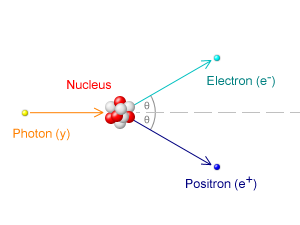
Farsight? Tubby is right. Pair production is less important than either PE or Compton scattering up to maybe 5 MeV.
It's still of crucial importance. We create mass and charge and all those electron/positron properties by doing something to a photon.

a) Ah, the argument from incredulity. You don't find the intrinsic spin of the electron personally satisfying, so therefore it's wrong. Lacking a specific way in which it went wrong you blame it on a textbook learning and a lack of out-of-the-box thinking. Seriously, though: everything in quantum mechanics is compatible with classical physics. The whole shebang is nonclassical. Spins, magnetic moments, CP violation, atoms, diffraction, pi-bonding, bremsstrahlung, quantum dots, superconductors. Don't insist that classical intuition is somehow "privileged" over quantum mechanics---that's an accident of history (Newton was born first) and of size (humans are very large compared to any relevant quantum size scale.)
Sorry ben, but mine is the rational scientific argument here. I don't mean to be impolite, but I'm afraid yours above is "crystal spheres" surpasseth all human understanding argument. And really, the tone of some on this thread is very close to the tone of YECs when faced with the scientific evidence of evolution.

b) We can't consider that it's a Mobius strip---unless you want to get into topological defects, which I don't think you do---because that's a mechanical model and therefore incompatible with the quantum mechanical nature of particles.
I'm happy to talk about topological defects. I'll demonstrate how the mechanical model is compatible with the QM nature of particles.

c) A photon going in a circle doesn't have [to?] generate a magnetic moment.
True.

d) Pair production and annihilation has nothing to do with photons specifically. There's an absolutely-identical process involving two neutrinos (nu nubar -> e+ e- and e+ e- --> nu nubar) or two quarks (e+ e- --> q qbar) or almost anything you like. At low energies the cross section is very small, but at collider energies (200+ GeV) the two processes are very similar. Should we be getting all excited about how the electron is really "made of" a self-trapped neutrino? No, because there is no evidence anywhere in particle physics that this is a productive way of thinking.
That's a catch-22 non-argument. Think about the neutrino and its properties. Forget about its lepton classification. On properties alone, which is it more like? The photon or the electron? Look, I'll cut to the chase: they're all stress-energy configurations. They involve rotations, hence Maxwell's quaternions and the importance of symmetry for the standard model.


Sorry, I have to go. If anybody wants to talk seriously offline, PM me for an email address and I'll dedicate more time.
 
Noted. I'd be grateful if people could chip in to point out where I'm correct and counter dismissal via the hoary old "cherry picking" technique.
Unfortunately there does not seem to be much that you have posted that is correct. The only posts containing correct points are the ones where you mention standard physics. But you generally spoil this by misinterpreting it, e.g. the electromagnetic field is defined as a field consisting of electric and magnetic components. You seem to redefine this as a "dual" field consisting of just electric components sometimes, just magnetic components at other times but never both.

Thus we are forced to just point out your errors.
For example, you just stated "It's related to displacement current, but not as it's commonly understood. In a photon we see a positive then negative "flux" and no charged particle. We perform pair production, then in the electron we see a magnetic dipole moment."

That is not right. There is no negative or positive "flux" in a photon. Thus the only person who can see one is you.
A photon has no electric charge to make a current or a flux. A photon is an electromagnetic wave considered as a particle. An electromagnetic wave has no charges. All it has is electromagnetic fields. An electromagnetic wave is generated by charges, e.g. the moving electrons in a radio antenna, but it does not carry any charge with it.
ETA
There is the displacement current but in an electromagnetic wave it is the rate of change of the flux density of the electric field (not an actual electrical current). The displacement current can be used with Ampere's Law assuming there is no bound or free current density contributing to current to derive the electromagnetic wave equation.
 
Last edited:
Sorry ben, but mine is the rational scientific argument here.

You are astoundingly arrogant. You have not presented a single shred of qualitative evidence and yet we're apparently the ones that act like YECs and your argument is rational and scientific?
 
It's related to displacement current, but not as it's commonly understood. In a photon we see a positive then negative "flux" and no charged particle. We perform pair production, then in the electron we see a magnetic dipole moment.

I have no idea what you are talking about. Why don't you do what my sophomores just did on their midterms: give the electromagnetic field equation for a photon propagating in the z-direction, linearly polarized in x. Then show us what aspect of the displacement current is not "commonly understood".

It's still of crucial importance. We create mass and charge and all those electron/positron properties by doing something to a photon.

I was just pointing out that you incorrectly called Tubby wrong on the very specific point of the threshhold behavior.

Sorry ben, but mine is the rational scientific argument here. I don't mean to be impolite, but I'm afraid yours above is "crystal spheres" surpasseth all human understanding argument.

Which part of it? Quantum mechanics? Yes, there are indeed things in quantum mechanics that seem difficult to understand. If you write a theory which is "easy to understand" (in the standard way that nonexperts want quantum mechanics to be easy, i.e. to make it determinate and/or local), in a very very general sense these alternate theories are inconsistent with experiment in Bell's Inequality tests.

Or---vertices? The fact that Schrodinger's Equation + relativity can be rearranged into Feynman diagrams? No, these things do not surpass understanding, they're really pretty straightforward. The fact that the Compton scattering diagram and the pair-production diagram are the same thing?

That's a catch-22 non-argument. Think about the neutrino and its properties. Forget about its lepton classification.

I don't know what you mean by "forget about its lepton classification". The lepton classification is a consequence of its properties; we look at the list of neutrino properties and see that neutrinos look exactly like an electron minus the electric charge. Both fermions, both massive, both obey the same conservation laws, both couple to everything in exactly the same ways except that the electron also couples to charge.
 
Noted. I'd be grateful if people could chip in to point out where I'm correct and counter dismissal via the hoary old "cherry picking" technique.
You are correct in that Minkowski once wrote about electromagnetism. You are incorrect in anything you have ever said about Minkowski. Those of us that have read Minkowksi can see that immediately.

Claims about cherry-picking may seem hoary to you since you have been flogging your theory for years using the same technique. You should try learning physics: it is a much more reliable route to producing physics.

Regardless, this does nothing to answer any questions about the physics, which seems to be exactly why you were banned from the baut forums.
 
Yes I do get it. That one field is called the electromagnetic field. That field has 2 components. One component is called the electric field. The other component is called the magnetic field.
Noting ct's comment re semantics, I'll say OK.

Nope. It's always an electromagnetic field. When you're an electron without relative motion that one field has only electric components. When you're an electron with relative motion that one field has electric and magnetic component.
Now we're starting to see the problem. It's always an electromagnetic field, so it always has two "components". One of these doesn't disappear just because you have no relative motion. You just can't see it. That's why "aspects" is a better word.

You are wrong. If you have a stationary electron then the electromagnetic field just has electric components. There is only an electric field. There is no magnetic field.
No! There's an electromagnetic field. That's what's there. And it has a disposition, a geometry that causes radial motion if you had no relative motion, and circular motion if you do.

If you have a moving electron the electromagnetic field [has] electric and magnetic components. There is an electric field. There is a magnetic field.
Think of a cylinder. If you look at it end-on, it looks like a circle. If you look at it side-on, it looks like a cuboid. It hasn't changed because you moved. It's the same for the electromagnetic field. You just see it differently.

The motion of the electron relative to the observer has created a magnetic field. That magnetic field did not exist before. It can be removed by moving with the electron.
The electromagnetic field exists. A moving charge doesn't create a magnetic field. That's just how you see the electromagnetic field when in relative motion through it. Think about the right-hand rule, and that vertical stack of electrons. You're motionless with respect to them, and you say they have only an electric field. Now, without changing the electrons, you move vertically down past them. All you've done is moved. You haven't altered the electrons in any way, or their electromagnetic field. You haven't created a magnetic field.
 
Last edited:
I'm perfectly familiar with pair production thanks.
So explain how it works.

But near threshold energies, Compton scattering is more likely by at least an order of magnitude. In high Z materials the photoelectric effect is also more important... Like I said, 1.022 keV photons will very rarely pair produce.
Shrug. Pair production happens.

Pairproduction.png


Its my understanding that the Dirac equation explains the idea of intrinsic spin very nicely. The fact that it doesn't agree with your classical intuition is your problem. Hell, it even predicted the existence of the positron.
You don't understand that either. See http://en.wikipedia.org/wiki/Dirac_equation#History and note "Despite these successes, Dirac's theory is flawed by its neglect of the possibility of creating and destroying particles, one of the basic consequences of relativity."

I can consider it. I can also rule it out as ridiculous.
LOL. A carefully crafted argument.
 
A 1022 keV photon will never pair produce in the vicinity of a stationary nucleus.

Sure, there's enough energy there to produce 2 particles of 511 keV/c^2 mass each, but there's no energy left over (ie they will be stationary), and it can be seen that the total momentum of the system is not conserved.

Total p before: 1022 keV/c

Total p after: 0 keV/c
True. I do talk about a +1022kev photon. Apologies if the shorthand isn't clear or if I missed out the +. There's some energy lost to the nucleus, and you need more still to send the electron and positron flying apart.
 
Well I’m not sure what you are referring to as “shuffling” and I certainly understand the basis for all those terms.
Sorry, I meant to write "shuttling" to indicate an electron moving back and forth.

Yes they are expressing it in terms of energy. You do understand that a force applied through a distance is a change in energy, don’t you?
Yes. Do you understand that gravity does not add energy to a falling body?

So there is nothing inconsistent between that reference and what I stated. One could also refer to it in terms of momentum, charge and even the gravitational attraction of two Planck masses. However since I was specifically referring to the force between two charges it is simply consistent to put that in terms of, well, force. What I don’t see in that reference you cited is “kissing numbers”, your geometric contrivances or a “running” value.
Noted.

I read this thread from the beginning prior to my first post here, so ‘catching up’ is not an issue for me. Perhaps if your geometric contrivances actually got you the correct value it wouldn’t be an issue for you either and your value would not have to be “running” to “catch up” to the actual value.
Again noted. Let's come back to alpha after we've all understood the geometry of the electromagnetic field and have some understanding of pair production.
 
It's still of crucial importance. We create mass and charge and all those electron/positron properties by doing something to a photon.

No! How many times do you have to be told this: charge cannot be created or destroyed. Pair production does not create charge; it creates a charge and an anti-charge, with the net charge equal to zero as it was before.

This is very very important, because it proves that the electron cannot be made of photons. Electrons are charged, photons are not. Period. End of story.

That's a catch-22 non-argument. Think about the neutrino and its properties. Forget about its lepton classification. On properties alone, which is it more like? The photon or the electron?

The electron is much more similar to the neutrino than it is to the photon - so since electron-positron pairs can be produced from two neutrinos, I guess (by your childish "logic") that means electrons are made of neutrinos. Electrons and neutrinos are both fermions, both spin 1/2, both massive, both carry weak hypercharge -1, transform in fundamental representations of the gauge groups, and both carry lepton number. Photons are bosons, spin 1, massless, carry zero weak hypercharge, transform in the adjoint, and carry no conserved quantum numbers (apart from angular momentum, momentum, and energy).
 
Last edited:
LOL. The pot is calling the kettle black. Lets look at the experimental physics you are ignoring:
  1. The electron has a measured charge. A photon does not.
  2. The electron has a measured mass. A photon has no mass.
  3. The electron has a measured magnetic moment. A photon has no magnetic moment.
  4. The electron has a measured quantum mechanical spin of 1/2. A photon has a quantum mechanical spin of 1. There is no way that a spin of 1 can be made into a spin of 1/2.
    You could be ignorant enough to treat the spin classically, put the photon into a path that includes a twist and think that the average spin is 1/2. You would be wrong:
    The opposite spin to +1 is -1. An average would be 0.
    Classical spins need a force to change their orientation.
I'm not ignoring any of the above. Pair production is where we make an electron and a positron from a photon. We create charge, and mass, magnetic moment, and spin 1/2. Why do you cling to the conviction that it's something mystical that cannot be explained classically? It can.

And your continuing misconception about the electromagnetic field: Electric and magnetic fields are not "dual" as in one or the other which you seem to imply. The electromagnetic field is experimentally measured to have electric and magnetic components. The theory of electromagnetic fields as introduced following the formalism of Hermann Minkowski explicitly states that the electromagnetic field tensor describing the field has electric and magnetic components.
You can for example have both an electric and magnetic field from an electron. The presence of magnetic fields due to the motion of a charge do depend on the selection of the observer's frame of reference. You can select a frame in which there is no motion and so no magnetic field. You can select a frame where there is motion and so a magnetic field.
I have no issue with The electromagnetic field has electric and magnetic components. But there is no sense in which relative motion creates a magnetic field. A reference frame isn't something that exists. It's just a formalism for describing motion and measurement. When you move, you measure it differently. That electromagnetic field didn't change just because you moved through it. Do you get this yet?
 
Last edited:
Oh and by the way, just another reason electrons cannot be made of photons: spin. We understand spin down to about the most profound level we understand anything in the world. If the laws of physics are Poincare invariant, the possible spins for particles correspond to the representations of the Poincare group. Those include spin 0, spin 1/2, spin 1, etc., and those representations combine in certain precise ways that follow entirely from the group's structure.

Electrons are spin 1/2, and photons are spin 1. It is impossible to combine any number of spin 1 representations to make a spin 1/2 representation.

On the other hand it is possible to combine 2 (or any even number) of spin 1/2 reps to make a spin 1 rep, or multiple spin 1 reps. That's why the processes electron-positron <--> 2 photons are allowed. The electron and positron are in an entangled state with spin 1, as are the photons.
 
Another non-argument.
Why is it that you refuse to answer any of my questions? Do they cut so deep that you can't face yourself when you consider them?

Just show us how the mathematics in the Minkowski paper that you cited match up with your claims about the appearance of the electromagnetic field. This is something that should be straightforward.
 
Momentum is momentum; I can measure it in any reference frame you like. I can measure p=0 in some frame and p != 0 in another. Inertia is ... well, it's basically rest mass, maybe you'd like to formulate it as relativistic mass, but whatever it is it's something that again you can measure in any reference frame you like.
It's "rest energy". It's the amount of stress-energy-momentum that isn't moving in aggregate with respect to you. Note the phrase "in aggregate". It is still moving, but its path changes, keeping it local to you and in what you deem to be a system. It's going nowhere fast. Hence the massless photon in the mirror box adds mass. If you only had a photon going round and round on its own, without a box, that would comprise a system with mass. If you then move with respect to this, you could then assign it a relativistic mass. That's rest mass plus kinetic energy, and the latter is a measure of how fast this thing that's going nowhere fast, is going somewhere. Think it through. Momentum is just a distance-based measure of energy/momentum, whilst energy is a time-based measure. Hence E=hf and p=hf/c, because c is a conversion factor between our measures of distance and time.

It's odd that you're so confident of that for a theory that you have absolutely no way to evaluate. What you should be saying is "I think it will work out that conservation of charge applies because ..."
I'm confident of this rotation and counter-rotation because it's essentially Newton's third law of motion. Action and reaction.

Anyway, it's gibberish. I can fire all sorts of probes into the center of an electron. I can scatter a neutrino off an electron (a process which flips its spin) and optionally turn it into a muon; I can scatter an electron off of a proton and make a neutrino plus a neutron; I can do all sorts of things which obviously deliver a swift kick---much swifter than mere e+ e- annihilation--- to whatever the heck was once inside the electron.
It's all just different configurations.

Yet no experiment ever performed has managed to tweak charge conservation.
I know. I was a little surprised when I stumbled across that Dirac String trick. I sat there blinking for a while saying what?

You've invented some sort of knot structure completely arbitrarily guessed that this knot gives you charge.
I didn't invent it. Kelvin invented it originally, but he was thinking of atoms rather than charged particles. Maxwell didn't quite get it right, and I suppose he was too early too. Williamson and van der Mark thought of it in 1991, and Qiu-Hong Hu in 2004. He was at ABB50/25 in Bristol in December with a poster on it, talking to Michael Atiyah plus others.

Then you equally arbitrarily say that the knot can't change signs under any stimulus whatsoever. Then you---again, completely arbitrarily, lacking any physical details whatesoever---guess that the knot can annihilate with a counter-knot.
What's the problem? Would you prefer chiral vorton to knot?

You know what that is, Farsight? You're inventing a conserved quantum number. The same thing you were criticizing about mainstream physics. (Except your invention does not, as far as I can tell, actually yield the quantum number you want it to, nor does it conserve it.)
Numerology doesn't explain it.

There is no current in a photon; there's an E field and B field. The time-dependencies make displacement currents, not real currents.
Yet these displacement currents make electrons and positrons, and when you move those electrons and positrons, you get "real" currents.

But seriously, at this point you've already left Maxwell's Equations far, far behind. "A photon going in a circle" is not an actual solution for Maxwell's Equations to begin with. "A photon making AC currents which look like a monopole from far away" is explicitly forbidden by Maxwell's Equations.
Heaviside's recast of Maxwell's equations left Maxwell behind. Read On Physical Lines of Force and you'll see how it relates to what I've been saying.

Don't try to scare off criticism with big names. Everyone has agreed that it is "really one field"..
Those big names should tell you that this isn't something I've invented. It has pedigree. And if everybody has agreed that it's one field, can we agree that it's a twist/turn field as demonstrated by the right hand rule?

---not one field vector, rather one electromagnetic field tensor---which manifests in a perfectly clear and easy-to-discuss way as an E vector and a B vector. But any time someone mentions the E field you get all huffy. This is dumb.
It's an important point, and come on, it's the other guys getting huffy, not me.

Actually, the moving observer sees both an E and a B field in this case.
Agreed. Thanks for pointing that out.

 
On this silliness about the EM field:

I have no issue with The electromagnetic field has electric and magnetic components. But there is no sense in which relative motion creates a magnetic field. A reference frame isn't something that exists. It's just a formalism for describing motion and measurement. When you move, you measure it differently. That electromagnetic field didn't change just because you moved through it. Do you get this yet?

"That electromagnetic field didn't change just because you moved through it."

Let's see about that. Lorentz transformations include rotations and boosts (changes in velocity). Mathematically, those are very very similar. When acting on the EM field-strength tensor, rotations change the components of the electric and magnetic fields as if they were ordinary vectors but do not mix the electric and magnetic components, while boosts mix the electric and magnetic fields. So the situation you're getting so worked up about is very analogous to the effect of a rotation on a vector, and so let's consider that instead (since it's easier to visualize).

So here, I'll translate your statement into one about vectors: "The direction that spaceship is moving didn't change just because you turned around." Is that true?

Let's say originally the spaceship (I'm floating in outer space, with only this single ship in view and no other points of reference) was moving from my left to my right. After I turn around it's moving from my right to my left. So it did change direction relative to me (or more accurately relative to a vector that's fixed to my body, for example the one pointing in the direction I can see). Obviously the ship didn't change direction with respect to something else just because I turned around (unless that thing also rotated), but it did change direction relative to me. Since "relative to me" is just as good as any other frame, I'm perfectly justified in saying that it did change direction just because I turned around.

The analogy to the EM field under boosts is much exact, so if you agree with the above, you agree that the EM field did change "just because" you moved through it. If you don't, it's just a matter of semantics - the math is totally unambiguous (for those that understand it, at least).
 

Back
Top Bottom