
• Quick note - the problem with Youtube videos not embedding on the forum appears to have been fixed, thanks to ZiprHead. If you do still see problems let me know.

Merged Relativity+ / Farsight

A) Stop mentioning scientists, what they did, when, why, what they said, etc. All useless fluff. The are not oracles or prophets like some sort of religion. Instead mention theories, experiments, equations, etc.

B) Please to show an experiment that has a behavior that is not properly predicted by current models, but is properly predicted by your model. The proper math is necessary here. Its ok to just start with some thought experiments.

C) If your model predicts the same thing as current models, show how your model has less assumptions than current models, eg, use your model to predict the mass of an electron for us.

Otherwise, continue to babble incoherently and without any relevance whatsoever.
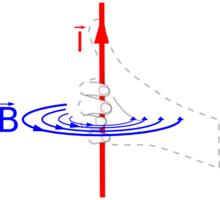
 
Further to ben m's post, the vertical B-field you show in this picture does indeed lead to the depicted electron moving in a spiral, but this B-field is not what you get from a vertical stack of electrons moving upwards, which would instead give B-field lines going in circles around the current, and the force on the electron would point away from the line.
Yes, as per the right-hand-rule diagram I showed earlier:

220px-Right_hand_rule.png


The typical result is braided galactic jets, where two streams of charged particles moving at different velocities spiral around one another.


RealityCheck: this isn't my theory, what I'm trying to get across here is the dualism of the electromagnetic field, as per Minkowski's wrench and Maxwell's screw. It isn't two distinct vector fields, it's one field. The motion of the electron that is described by vectors is the result of the field disposition and the dynamical nature of the electron itself. See the wiki page re dualism:
http://en.wikipedia.org/wiki/Electromagnetic_field#Dynamics_of_the_electromagnetic_field

"In the past, electrically charged objects were thought to produce two types of field associated with their charge property. An electric field is produced when the charge is stationary with respect to an observer measuring the properties of the charge, and a magnetic field (as well as an electric field) is produced when the charge moves (creating an electric current) with respect to this observer. Over time, it was realized that the electric and magnetic fields are better thought of as two parts of a greater whole — the electromagnetic field."

The scientific evidence is in electron properties and how the electron moves in an electromagnetic field.


RussDill: referring to Einstein, Minkowski and Maxwell is not "useless fluff". I've mentioned theories such as relativity and quantum electrodynamics and Jefimenko's equations. I'll show an experiment that has a behaviour that is not properly predicted by current models - pair production, and I'll show you some proper math for the electron. No, I can't predict the mass of the electron, but I can tell you why the fine structure constant takes the value it does, and why it's a running constant. But you'll doubtless dismiss it all.
 
I'll show an experiment that has a behaviour that is not properly predicted by current models - pair production,
Huh?!?

and I'll show you some proper math for the electron. No, I can't predict the mass of the electron, but I can tell you why the fine structure constant takes the value it does, and why it's a running constant. But you'll doubtless dismiss it all.
I wasn't aware we needed another explanation why it is a running constant.
 
RealityCheck: this isn't my theory, what I'm trying to get across here is the dualism of the electromagnetic field, as per Minkowski's wrench and Maxwell's screw. It isn't two distinct vector fields, it's one field. The motion of the electron that is described by vectors is the result of the field disposition and the dynamical nature of the electron itself. See the wiki page re dualism:
http://en.wikipedia.org/wiki/Electromagnetic_field#Dynamics_of_the_electromagnetic_field
That is standard physics . The electromagnetic field is a single field made up of 2 components (the electric field and the magnetic field).

This does not excuse the fact that your image is not of the electron’s electromagnetic field. But then you admitted that the image is notthing to do with electrons:
Originally Posted by Farsight
The spiral pattern is what you'd get if you tried to use a floor-polisher on a rubber sheet.


The scientific evidence is in electron properties and how the electron moves in an electromagnetic field.
And again - standard physics. Well known and treateed by the existing scientific theories.

Why are you telling everyone what any one with a basic science education already knows?

I suggest that if you want to have a thread about standard electromagnetic theory then you start a new one.
 
I'll show an experiment that has a behaviour that is not properly predicted by current models - pair production, and I'll show you some proper math for the electron.
Farsight:
Do you mean that current models do not predict pair production at all?
Or is there some aspect of pair production that is not seen in current models?

In either case a full description of this assertion with the supporting evidence (e.g. citations to the experiments that show the discrepancies with theory) would be appreciated.
 
OK, so I take it that you're retracting this statement:
If you start with a vertical stack of electrons moving upwards, your test electron doesn't move away, and instead spirals around the "magnetic field lines".

[qimg]http://www.mdahlem.net/img/astro/elgyro.jpg[/qimg]
 
No, I can't predict the mass of the electron, but I can tell you why the fine structure constant takes the value it does, and why it's a running constant. But you'll doubtless dismiss it all.
You can show why the fine structure constant is approximately 1/137? I'd be very interested in seeing that.
 
RealityCheck: this isn't my theory, what I'm trying to get across here is the dualism of the electromagnetic field, as per Minkowski's wrench and Maxwell's screw.
Did I call this or not?

Like always, Farsight will dodge answering a serious question that might actually provide some physical insight. No chance of getting any mathematics or experimental evidence in this thread.
 
Yes, as per the right-hand-rule diagram I showed earlier:

The diagram shows what the magnetic field lines look like near a column of moving charge. However, your discussion of the charged "wand" claimed that the force on the wand points in a circle, i.e. in the direction of the field lines. This second claim is incorrect. Do you understand the difference?
 
I'll show an experiment that has a behaviour that is not properly predicted by current models - pair production,

Let me guess---either:

a) This discrepancy arises when you yourself attempt to make the "prediction", and is never described as a discrepancy in the mainstream literature? If this is the case, Farsight, then I suspect the "discrepancy" is between your misevaluation of the model and what the model actually says.

b) You found some 1960s paper reporting a 1% discrepancy on something. You did not bother looking for a multi-experiment average (which is how you tell the difference between "current theory is fundamentally unable to explain electron-boron scattering" and "the cyclotron is malfunctioning at the University of Ottery St. Catchpole"
 
Last edited:
Let me guess---either:

a) This discrepancy arises when you yourself attempt to make the "prediction", and is never described as a discrepancy in the mainstream literature? If this is the case, Farsight, then I suspect the "discrepancy" is between your misevaluation of the model and what the model actually says.

b) You found some 1960s paper reporting a 1% discrepancy on something. You did not bother looking for a multi-experiment average (which is how you tell the difference between "current theory is fundamentally unable to explain electron-boron scattering" and "the cyclotron is malfunctioning at the University of Ottery St. Catchpole"

You'd be wrong, because it'd be c) The claim of the standard model that the electron is a fundamental particle, when in fact, it is a photon. Isn't it clear that pair production totally and completely disproves that?
 
RussDill: referring to Einstein, Minkowski and Maxwell is not "useless fluff". I've mentioned theories such as relativity and quantum electrodynamics and Jefimenko's equations.

Again, you are confusing the theory with the scientist. Theories stand and must stand alone. If a theory somehow does not stand alone, but depends on the greatness of the creator of the theory, its a crappy theory. Every theorist has come up with plenty of false starts, dead ends, etc, some that take decades to run down.

It's pretty dumb to claim that because SR and GR are well tested, and Einstein came up with them, that everything Einstein writes or speaks about the topic is correct. There is no logic than that, but it seems to be what you are claiming.

I'll show an experiment that has a behaviour that is not properly predicted by current models - pair production, and I'll show you some proper math for the electron.

That'll be a pretty amazing thing. Just remember, your own interpretations have no meaning or importance. The only thing that matters is what we can measure. I'll get the nobel committee on the line.

No, I can't predict the mass of the electron, but I can tell you why the fine structure constant takes the value it does, and why it's a running constant. But you'll doubtless dismiss it all.

That'll be another amazing trick. For 94 years, no one has found anything that produces it, much less explains how they produced it. You'll need to match 1/137.035999679(94).

If you can produce neither in the next few days, is it safe to say that we can laugh you off the forum.
 
That is standard physics . The electromagnetic field is a single field made up of 2 components (the electric field and the magnetic field).
Yes, it's standard, but many people who think they understand physics don't understand that it's one field, and don't know about quaternions and how Heaviside replaced them with vectors. I don't mean to sound too picky, but there are two aspects rather than components. If you're motionless with respect to the source of the field, you see it as an electric field. If you're not, you see it as a magnetic field.

This does not excuse the fact that your image is not of the electron’s electromagnetic field. But then you admitted that the image is nothing to do with electrons:
That's the best image I could find to get it across for a flat slice. Think about the right hand rule. The current in the wire is the same situation as you moving downwards past a vertical stack of electrons. Maxwell's screw analogy wasn't for nothing.

Do you mean that current models do not predict pair production at all? Or is there some aspect of pair production that is not seen in current models?
The latter. They don't explain how it works.

In either case a full description of this assertion with the supporting evidence (e.g. citations to the experiments that show the discrepancies with theory) would be appreciated.
I don't know of any discrepancies, and I'll describe it in full later. First I need to get the electromagnetic field across, and give you that grasp of the wrench/screw/reamer twist & turn concept with respect to the right-hand rule. People seem to have trouble with three-dimensional geometry like this, and for some reason it needs hands-on personal experience. Find a reamer or something like a drill bit and push it up into your right fist. Also try out the Falaco soliton via plate-dipping.
 
OK, so I take it that you're retracting this statement: If you start with a vertical stack of electrons moving upwards, your test electron doesn't move away, and instead spirals around the "magnetic field lines".
No. I might have expressed it better, but think about a solenoid. The electrons in the wire are spiralling around the magnetic field lines. Now chuck an electron into the solenoid, and its path is helical.

You can show why the fine structure constant is approximately 1/137? I'd be very interested in seeing that.
It's to do with kissing numbers. If electromagnetic fields were one-dimensional, an electron's field would extend in only two directions, so one electron would exert half its field on half the field of another, like this: ←○→ ←○→ . Hence if you pushed them together they'd "couple" with a quarter of their total field strength, and the fine structure constant would take a value of 1/4. If however electromagnetic fields were two-dimensional, you could push electrons together like pennies to form a hexagon.

190px-Kissing-2d.svg.png


Each electron would repel another with a sixth of its field in any given direction, and the fine structure constant would take a value of 1/36. Scale it up another dimension and you can push twelve spheres around a central sphere. Each electron repels another with about a twelfth of its field in any given direction. However the fine structure constant isn't 1/144 because the spheres don't quite fit. They don't fit snugly like the pennies. There gaps between them.

3d.jpg


To appreciate this, it's best to think of an icosahedron, with a sphere centered on each of the twelve vertices. If each edge is 1 unit long, the radius of one large sphere just enclosing the icosahedron would be √(10+2√5)/4 or 0.9510565163. This means for our twelve spheres to touch, the central sphere has to be smaller. But it isn't, and that's why they don't fit snugly. There's a gap between the surrounding spheres of circa 5%. If you were the last sphere to join the icosahedron you'd be able to see more than a twelfth of the central sphere on account of this gap. In similar vein an electron "sees" more than a twelfth of another electron when it repels it with its field. Each electron repels another with circa 1/11.7th of its field, which is more than 1/12th. One 11.7th of one field is working against one 11.7th of another, so the combined coupling factor is circa 1/137th. The "running" aspect is crucial when it comes to gravity, but's that's one for another day.
 
The diagram shows what the magnetic field lines look like near a column of moving charge. However, your discussion of the charged "wand" claimed that the force on the wand points in a circle, i.e. in the direction of the field lines. This second claim is incorrect. Do you understand the difference?
I didn't claim that, that's your misinterpretation. Read what I said.

Let me guess---either:

a) This discrepancy arises...

b) You found some 1960s paper reporting a 1% discrepancy...
No, don't guess. I didn't say anything about a discrepancy. Mainstream models do not adequately describe the electron, or the photon, or how pair production actually works.
 
Last edited:
People seem to have trouble with three-dimensional geometry like this, and for some reason it needs hands-on personal experience. Find a reamer or something like a drill bit and push it up into your right fist.
The problem is not with other people, the problem is that your example doesn't fit the facts, as many people have pointed out. If you want to support your case, show the numbers. Show the equations.
No, don't guess. I didn't say anything about a discrepancy. Mainstream models do not adequately describe the electron, or the photon, or how pair production actually works.
But you are the one claimng to have some secret underlying pair production. Can you show us how your secret produces the same mathematical results as maintstream theory?
 
You'd be wrong, because it'd be c) The claim of the standard model that the electron is a fundamental particle, when in fact, it is a photon.
Close, but the photon isn't fundamental either. Stress-energy is fundamental, and it doesn't always take the form of a photon.

Isn't it clear that pair production totally and completely disproves that.
If you can create and destroy electrons and positrons, they aren't fundamental. Ditto for quarks. Perform low-energy proton/antiproton annihilation and you don't see quarks. What you usually see is neutral pions, for a nanosecond. Then gamma photons. So try explaining to the board where those quarks went.

..It's pretty dumb to claim that because SR and GR are well tested, and Einstein came up with them, that everything Einstein writes or speaks about the topic is correct. There is no logic than that, but it seems to be what you are claiming.
I'm not claiming that. You're creating a straw man to dismiss what those guys said out of hand. There's no logic in that.

That'll be a pretty amazing thing. Just remember, your own interpretations have no meaning or importance. The only thing that matters is what we can measure. I'll get the nobel committee on the line.
It is pretty amazing actually. And here's somehting else you'll dismiss: Witten's working on it.

That'll be another amazing trick. For 94 years, no one has found anything that produces it, much less explains how they produced it. You'll need to match 1/137.035999679(94).
It's no trick. But there is no exact value to match because it's a running constant.

If you can produce neither in the next few days, is it safe to say that we can laugh you off the forum.
I'm getting the impression you'll do it anyway. People are very good at clinging to what they've been taught. They aren't nearly so good at thinking for themselves, and are often irrationally hostile to anything new. Even when it isn't new, and when Einstein said it. Or Feynman or Dirac or Minkowski or Maxwell or Newton.
 
The problem is not with other people the problem is that your example doesn't fit the facts, as many people have pointed out. If you want to support your case, show the numbers. Show the equations.
My examples fit the facts. How can you delude yourself to pretend they don't? Or that I dodge questions? And we've already got the numbers and the equations. What I'm describing explains those equations. This is the thing that people like you just don't get. You cannot explain what the mathematics means with mathematics. Now stop being such a spoiler troll. Contribute some sincerity to the discussion or butt out.

Tubbythin said:
I wasn't aware we needed another explanation why it is a running constant.
We need it because virtual photons are virtual, and because Feynman said nobody understands what it all means. Look at α = e²/2ε0hc and remind yourself of this: the electron has unit charge. The effect of that charge varies, but not the charge itself. Imagine you're in a black box in space, and I cannot enter to alter the contents. But I can move the box around without your knowledge. Maybe I do it while you sleep, whatever. You've got an electron in there with you. Between you and the electron is space. If the effect of that electron's charge varies, the properties of something else must have changed. What do you think it might be?
 
No. I might have expressed it better, but think about a solenoid. The electrons in the wire are spiralling around the magnetic field lines. Now chuck an electron into the solenoid, and its path is helical.
Yes, I get that inside a solenoid you have a nearly-uniform field, and a test charge would move as you describe. But a solenoid isn't a "vertical stack of moving electrons", which is what you were originally referring to - it's a helical current. Hence my confusion.
It's to do with kissing numbers. If electromagnetic fields were one-dimensional, an electron's field would extend in only two directions, so one electron would exert half its field on half the field of another, like this: ←○→ ←○→ . Hence if you pushed them together they'd "couple" with a quarter of their total field strength, and the fine structure constant would take a value of 1/4. If however electromagnetic fields were two-dimensional, you could push electrons together like pennies to form a hexagon.

[qimg]http://upload.wikimedia.org/wikipedia/commons/thumb/d/d2/Kissing-2d.svg/190px-Kissing-2d.svg.png[/qimg]

Each electron would repel another with a sixth of its field in any given direction, and the fine structure constant would take a value of 1/36. Scale it up another dimension and you can push twelve spheres around a central sphere. Each electron repels another with about a twelfth of its field in any given direction. However the fine structure constant isn't 1/144 because the spheres don't quite fit. They don't fit snugly like the pennies. There gaps between them.

[qimg]http://local.wasp.uwa.edu.au/~pbourke/geometry/kissing/3d.jpg[/qimg]

To appreciate this, it's best to think of an icosahedron, with a sphere centered on each of the twelve vertices. If each edge is 1 unit long, the radius of one large sphere just enclosing the icosahedron would be √(10+2√5)/4 or 0.9510565163. This means for our twelve spheres to touch, the central sphere has to be smaller. But it isn't, and that's why they don't fit snugly. There's a gap between the surrounding spheres of circa 5%. If you were the last sphere to join the icosahedron you'd be able to see more than a twelfth of the central sphere on account of this gap. In similar vein an electron "sees" more than a twelfth of another electron when it repels it with its field. Each electron repels another with circa 1/11.7th of its field, which is more than 1/12th. One 11.7th of one field is working against one 11.7th of another, so the combined coupling factor is circa 1/137th. The "running" aspect is crucial when it comes to gravity, but's that's one for another day.
I'll have to get back to you on this.
 
No. I might have expressed it better, but think about a solenoid. The electrons in the wire are spiralling around the magnetic field lines. Now chuck an electron into the solenoid, and its path is helical.

It's to do with kissing numbers. If electromagnetic fields were one-dimensional, an electron's field would extend in only two directions, so one electron would exert half its field on half the field of another, like this: ←○→ ←○→ . Hence if you pushed them together they'd "couple" with a quarter of their total field strength, and the fine structure constant would take a value of 1/4. If however electromagnetic fields were two-dimensional, you could push electrons together like pennies to form a hexagon.

[qimg]http://upload.wikimedia.org/wikipedia/commons/thumb/d/d2/Kissing-2d.svg/190px-Kissing-2d.svg.png[/qimg]

Each electron would repel another with a sixth of its field in any given direction, and the fine structure constant would take a value of 1/36. Scale it up another dimension and you can push twelve spheres around a central sphere. Each electron repels another with about a twelfth of its field in any given direction. However the fine structure constant isn't 1/144 because the spheres don't quite fit. They don't fit snugly like the pennies. There gaps between them.

[qimg]http://local.wasp.uwa.edu.au/~pbourke/geometry/kissing/3d.jpg[/qimg]

To appreciate this, it's best to think of an icosahedron, with a sphere centered on each of the twelve vertices. If each edge is 1 unit long, the radius of one large sphere just enclosing the icosahedron would be √(10+2√5)/4 or 0.9510565163. This means for our twelve spheres to touch, the central sphere has to be smaller. But it isn't, and that's why they don't fit snugly. There's a gap between the surrounding spheres of circa 5%. If you were the last sphere to join the icosahedron you'd be able to see more than a twelfth of the central sphere on account of this gap. In similar vein an electron "sees" more than a twelfth of another electron when it repels it with its field. Each electron repels another with circa 1/11.7th of its field, which is more than 1/12th. One 11.7th of one field is working against one 11.7th of another, so the combined coupling factor is circa 1/137th. The "running" aspect is crucial when it comes to gravity, but's that's one for another day.

What? The fine structure constant is in fact very easy to understand without all your contrived nonsense.

It is in fact just the ratio between two constants.

The Force between two charges is inversely proportional to the square of the distance separating those charges. For two electrons it is Fe=e2/4pe0Re2 making the constant e2/4pe0=FeRe2. So the force between two electrons times the separation radius between those charges squared (FeRe2) is a constant equal to e2/4pe0.


The energy of a photon at some wavenumber also a constant. It is Ep=hckp/2p Thus Ep/kp = hc/2p the energy of a photon divided its wavenumber (Ep/kp) is a constant equal to hc/2p.

You will note that both of these constants have the same units of Newton Meter2.

The ratio of these constants FeRe2kp/ Ep is 2pe2/4pe0hc or just e2/2e0hc the fine structure constant.

The relation becomes easier to understand when we set all the distances equal to Re, the separation distance between the charges. It then just becomes a ratio of forces. The force between the charges Fe over the Force a photon of a wavenumber equal to the separation distance bdetween those charges can apply through that separation distance Fpe.


ETA: Sorry wavelength l should have been wave number k I have corrected that.

ETA again, sorry I put the wavenumber in the wrong place (forgot to invert)
 
Last edited:

Back
Top Bottom