• Security incident: ISF was recently accessed by intruders. Please change your password, and change it anywhere else you used it. Read more

How do you deal with the 'science is a religion' crap?

I have often heard this "argument" that science is something that we just chose to believe; and it's just as much of a faith as religion.

To be more precise, the underlying assumptions of science are just that -- assumptions. Whatever your basic premises are, believing in them is an act of faith.
I think it's inaccurate to characterize science as a religion, because it doesn't fit the criteria (although I think it would be accurate to characterize academia as an authoritarian institution that is church-like).
But to the extent that most any pursuit requires the acceptance of basic assumptions, those assumptions must themselves be faith-based or they are not basic.
 
For example, hope drives people to turn to science in order to make things better for people, such as say finding the cure for cancer, or the hopes of finding the secrets to how life started. These are also things not seen until science develops or discovers it.

This is, in fact, people having faith in the results of the scientific process.
Which is a good thing; I certainly have it myself in significant measure (as a transhumanist).
 
Punch them in the face. Hard. Explain that you reject the scientific evidence for the assumption that this would hurt or injure them rather than see your point of view.

Or you could just explain to them that it was just their bad karma that resulted in them being hit... :D
 
I have often heard this "argument" that science is something that we just chose to believe; and it's just as much of a faith as religion. I'm sure you've heard it too. How do you deal with it? ..

....well, you just gotta have faith....:D


seriously, try this- find out what they mean by "science is just another belief system".

They may consider science as a religion if "science" is presented as the pre-emptive answer to all questions knowable and unknowable.

Religion is at it's core something to believe in.
Science is the collection of reproducable truths of the physical world, regardless of what you believe. If a person maintains that ultimately only science is the "hope" of humanity, it's a religion of sorts, although very dispersed.
But if they maintain that E=mc2 of itself is a "choice"......
it would be interesting to ask them what their personal "choice" on the equation is...and why?
 
Depends. If they don't mention Paul Feyerabend's work you can start talking about the scientific method. If they do mention it it's probably less effort to attack their defintion of religion.
 
Science is successful, proving it is not a superstition based belief system which is unsuccessful beyond coincidence.
 
Religion is a system based upon unevidenced faith and subjective experience.

Science is a system based upon evidence and objective experience.

Therefore, science is not (a) religion.

People can be religious about science but that doesn't transform science into religion.

Likewise, regardless of how much logic and evidence you try to pile into supporting religion, it never obliviates the need for faith to connect that last step between natural and supernatural.
 
Because somebody has to:

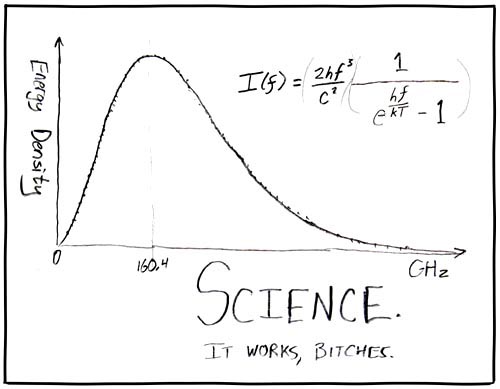
science.jpg


That's all there is to it: It works. Science allows us to make testable predictions about the future, and these predictions tend to pass the test.

The scientific method boils down to "we do what works". That is not a substitute-religion, it is nothing more but sanity. To not use the scientific method, to not simply do what works is insane.

Science: If my view of the world regarding X is correct, then doing A will lead to B.

I do A and see if B follows. Thereafter, whenever I want B, all I have to do is A. It works, it makes sense.

It is the same principle that believers claim to adhere to! Ask them why they pray - I doubt they do so because they genuinely believes that the results of prayer are absolutely random and unpredictable. No, people pray because they think it works. They wouldn't pray if they didn't think it would work - else, they would be insane.

The main problem with religion, however, is that it doesn't work, regardless of what one may believe. Prayer fails the test against reality - and if the believer would see and acknowledge that, they would stop praying.

The one difference here is that science, ideally, accepts when a prediction fails to come true and then rejects (or refines) the theory.
 
You mean besides inflation, dark energy and mythical forms of matter? :)

Hold on there! After several months of following many discussions about the above subjects, you do stand out as one who come across as a religious zealot. The positions you so fanatically espouse seem to be more religion than science. Look in the mirror.
 
To be more precise, the underlying assumptions of science are just that -- assumptions. Whatever your basic premises are, believing in them is an act of faith.
Not necessarily. We can see an assumption as a useful approximation of truth without having faith in it.
 
Nor is there one that it does. We choose to believe that it works, that nature is consistent, because we don't really have much choice. But I'm not aware of any reason for it to necessarily be true. It's the old problem of induction.

I would never normally describe it in this way, but perhaps belief in the scientific method is indeed a form of faith, albeit the most minimal and successful one.

I disagree if the scientific method did not work then you could not replicate experiements. It is not a matter of faith, you can preform the experiments your self.

There is good reason to beleieve the laws of physics are universal, there is no faith in that. It is demonstrable. You can demonstrate that a model accurately reflects the behavior of reality.

Planets do follow Kepler's laws of motion. Then you can add relativity.
 
I disagree if the scientific method did not work then you could not replicate experiements. It is not a matter of faith, you can preform the experiments your self.

The problem with that argument (you've basicaly described old style experimentalism) is that it doesn't give us any coherent way to form wider theories.
 
Science does make fundamental assumptions that you must accept to be a scientist. For instance, as a scientist, I think that observations made of the material world reflect something that exists outside of my own mind and apart from any delusional state I may be in. We assume things like uniformitarianism, which states that the same processes going on here and now operated in close to the same way at other places and times, unless there is evidence otherwise, and that these processes will continue to take place in the future.
Nope the fine structure constant can be measured at a great distance as can the effects of gravity, there is no evidence that the laws of physics are not universal.

That is not an assumption now a day, it is demonstrable. And it doesn't matter if it is butterfly dreams, godthought, dancing energy or delusion, if it is inconsistent then it is inconsistent.

Demonstrate the inconsistency.
 
The problem with that argument (you've basicaly described old style experimentalism) is that it doesn't give us any coherent way to form wider theories.

Not true, what are you trying to say. String theory is very wide. :)

You may not be able to create a cyclotron in your basement, but the point is still valid.

Show where the laws of physics are inconsistent.
 
Turn it back on them: their belief in a monotheistic deity is simply a form of atheism.
 
Not true, what are you trying to say. String theory is very wide. :)

You may not be able to create a cyclotron in your basement, but the point is still valid.

Show where the laws of physics are inconsistent.

Well there is some evidence for some minor chanages at exteme distances but thats not my point.

Pure experimentalism is flawed because:

It doesn't provide you with any guide about what experiments to do (until you have a theory that the laws of physics are universal there is no point in looking at distant gas clouds to see if they have exactly the same set of constants as we do).

It doesn't describe the way scientists actualy work (scientists tend to form theories then test them).

It doesn't allow you challange experimental results. For example there was a test for benzene that was fully reproduceable. Problem was that it was actualy testing for a contaminat and every known sample of benzene was contaminated.
 
Not necessarily. We can see an assumption as a useful approximation of truth without having faith in it.

Questionable. Without haveing faith in a objective shared reality science is pretty pointless. I would argue that there is good reason to think that such a thing exists but fundimentaly it's an act of faith that it does.
 
I think that really depends on what definition of the word "faith" you're using. If you mean "Confident belief in the truth, value, or trustworthiness of a person, idea, or thing," then yeah, I have faith in science. If you mean "Belief that does not rest on logical proof or material evidence," then no. The only way that definition applies to science is if you want to get into the pointlessness of "what if we're all brains in jars/the dreams of God/not sharing the same reality."
 

ISF - Join now!

Every member here is approved by hand. No bots, no spam, just people who care about evidence and honest debate.

Membership is free!

Create your free account

Back
Top Bottom