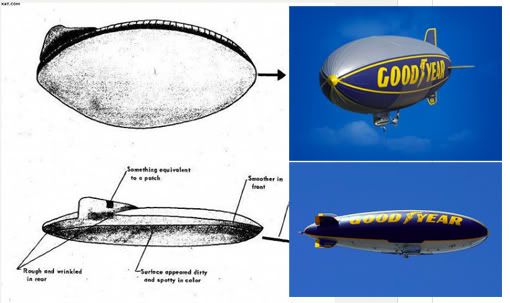
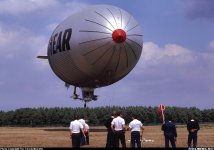
OK, you have now made the claim. Exactly what conditions allow for error-free observations or errors that can be quantified and corrected for?
The conditions on the day are clearly described (Mr C)
“It was a clear day and no clouds in the sky, and the sun was at our backs”, and (Mrs D)
“The day had been clear, visibility was good, and the sun was just setting.” And this was confirmed by Agent Brooks
“During his investigation, Agent Brooks compiled supplementary information from various sources: (a) the (low altitude) weather charts for the area indicated the coast was clear on the date of the sighting.”
Moreover, I do not claim “error free” and I never have. Your wilful ignorance of my statements on this matter would be perplexing - if I did not know that this to be a deliberate tactic on your behalf.
It seems you keep suggesting it was impossible for these witnesses to make a mistake. This is why I keep stating this.
This is madness. You completely ignore my statements on the issue. For example here:
Sure, eyewitnesses CAN be mistaken. BUT you have NOT commented on the countering statements by me (again from the very post you quote from):
”But you are yet to address my point that we CAN account for the conditions that make eyewitness testimony unreliable and factor them into our assessments of the sightings. The skeptics contend, in Rogue River for example, that there are factors that make perception unreliable. I pointed out that the “glare” hypothesis can be proved a nonsense simply by noting that the object was observed over more than a minute and a half (with binoculars) while it turned through various angles, both on its axis and in its plan view in relation to the observers…while the light source and observers remained stationary. THAT puts the lie to THAT particular misperception hypothesis. YET NO-ONE has bothered to note the death of it. IF you have any other conditions that might make the witnesses prone to misperceptions on a clear blue sky day with the sun low at their backs…then I’d like to hear about it. Otherwise, given the evidence against “hoax” we simply MUST accept that the witnesses had a clear view of the object and their descriptions were accurate. It is as simple as that.
So IN FACT it is YOU who are dismissing my arguments “with the wave of a hand”. You don’t even bother to pay them “lip service”. I present evidence, you merely present unfounded assertions. I represent a scientific point of view, You merely resent a scientific point of view.”
And here:
”Just because witnesses CAN be mistaken does not mean the ARE mistaken. Witnesses CAN be VERY accurate. That is a point YOU seem to miss. You also miss the fact that we KNOW the conditions under which witnesses can be mistaken and we CAN account for those conditions when making an assessment of the cases.
Give us the study that demonstrates this is true. I have cited a source (eyewitness testimony p. 30-31 - Loftus) where studies have shown witnesses tend to overestimate time. Your claim is this is not true based on.......Oh yeah.....Your say so. Another great scientific leap has occurred because Rramjet says so.
Then here for example:
”In 1990, William Friedman published a review of 70 time experiments, including a list of phenomena that occur during duration time estimates. The first of the Friedman phenomena is that people underestimate time while completing attention-demanding tasks. Most experimental research shows that this phenomenon occurs because people’s attention is diverted from time-keeping when they are engaged in challenging activities.
(…)
In a recent study, University of Alberta scientists Anthony Chaston and Alan Kingstone showed that time flies for people whose attention is actively engaged, supporting the first Friedman phenomena.
(…)
The two researchers found that even in prospective time measurements, people increasingly underestimate time as the difficulty of the activity increases. In other words, time flies when you’re busy.” (
http://www.jyi.org/features/ft.php?id=447)
So the research shows PRECISELY the opposite to your original contention. I DO notice you have NOT quoted Loftus on the topic…In other words you again have presented NO evidence to support your assertion. I suggest you do so now – oh of course you cannot because there will BE no assertion from Loftus that supports your contention!
But let me guess. You will ignore this won’t you?
So, once again, we are relying on witness testimony based on viewing an object with a pair of binoculars in a rocking boat on a river for a period that was about a minute or so.
What “rocking boat”? You are merely making things up now. You do NOT know if there even WAS a boat involved!
The witnesses stated: (Mr D)
” was visible to the naked eye for approximately two minutes.” and (Mr C – after some time spent viewing with the naked eye was passed the binoculars and)
“ As I watched it through the glasses, it picked up speed and when it vanished from sight approximately 90 seconds later” and (Mr B)
” The object was in sight for approximately one (1) minute.” – and in respect to the RESEARCH showing that time estimation is very subjective (as above) we can safely assume that the time the object was viewed was longer than any of the witnesses assumed.
You stated the reflection was implausible based on this. I suggested to falsify this you can demonstrate a reflection was impossible. Obviously this is beyond your means. BTW, the sun was behind the observers and about 30 degrees in altitude. I think that would mean the object would reflect the sun's light and cause glare. You can tilt it, shape shift it, distort it or whatever you like, but the potential for reflecting the sun is there.
I pointed out that the “glare” hypothesis can be proved a nonsense simply by noting that the object was observed over more than a minute and a half (with binoculars) while it turned through various angles, both on its axis and in its plan view in relation to the observers…while the light source and observers remained stationary.
Moreover, since it was the skeptics who raised the “glare” then it is up to them to show how it would have been possible for such a glare to obscure ONLY the lower fins, gondola, engines, etc, while leaving the rest of the object entirely within view. Also, the witnesses NEVER stated that “glare” was a problem in making out the lower details of the object.
Your statement that
“the sun was behind the observers and about 30 degrees in altitude” is nowhere supported in the eyewitness statements.
Therefore ignoring any possibility for human error. You have yet to demonstrate how you determine this. How do you quantify the reliability of the witness (a question you keep refusing to answer)? How do you determine they are accurate? As for the conditions at the time, you don't know the exact viewing conditions.
I have answered this question MANY times. The witnesses were reliable – but for you it seems I must repeat the arguments, Thus:
When the two men decided to report the UFO, they did not turn to the newspapers or TV or radio to get the maximum publicity for their story. Instead, the two men, who worked in responsible positions within the Ames Research Laboratory, reported it to the security office at their own laboratory. If it was a hoax, by reporting it directly to their workplace security, they were (at the very least) endangering their jobs if exposed.
One might suggest that the time between the sighting and the report lends an air of “hoax” to the situation. It took the witnesses about three weeks to report the sighting. To me however, this suggests an element of caution on their part, in keeping with their reported character assessments. Did they really dare to report such a thing? Certainly they would not have wanted to look foolish. And what about their positions within the Ames laboratory? Yet they probably would also have felt - as confirmed by several of the early witnesses who reported “flying saucers” - that it was their duty as American citizens to report these things so that the government would know about them.
Of course the "dyed in the wool skeptic" (a phrase used by Phil Klass to describe himself during my first phone conversation with him in 1974) or “debunker” might argue that they played for high stakes. If they could get their story past the OSI investigators they could either laugh at the government (they did it for the fun of it) or use the OSI investigation as evidence it was a genuine sighting and make lots of money selling their story to the press, or both.
However, this scenario is unlikely. There is no indication I am aware of that they ever told anyone other than the OSI the details of their sighting. Hence they certainly didn't "do it for the money". Of course, I cannot prove they didn't do it for fun, but it would seem to be a highly risky undertaking for men in responsible positions to put their jobs on the line merely to be able to laugh at the OSI investigators.
Let's try humidity, air transparency, wind speed, direction, cloud cover, wind patterns, etc. How about some real data to present.
I have presented the real data above. Clear blue sky, sun at their backs. If you have ANY information that would make such conditions amenable to misperception I suggest you present it.
Then we have the witness use of optics (which Hendry points out can sometimes be a detriment to observation). What was the condition of the optics? Were they collimated properly? Were the lenses cracked or dirty? Were the prism's dislodged? What about the use of those optics? Was the boat rocking? Were the binoculars held steady? Was the sun reflecting off the surface of the object? You have no idea what conditions were. All you have is what you want the conditions to be.
You seem to be making an awful lot of unfounded assumptions here in an effort to put the worst possible “spin” on the sighting. If we were to go down such a path I can assume that you are barking mad… but that does NOT make it true. We simply have the evidence as presented to us by the eyewitnesses and determined by subsequent investigations. To hypothesise about such things as you do –then you MUST present EVIDENCE for such assertions – otherwise we are entitled to dismiss them as speculations that are not supported by the evidence.
Regarding the “Catalina” UFO:
The film was seen by the witness who recorded it. He was a professional photographer and he saw it as a disc. Therefore, it is a good example of how an aircraft could be perceived as a disc. Once again, your resort to dismissing a case with a simple wave of the hand in order to prop up your beliefs.
Actually I think you will find that I dismissed its
relevancy to the Rogue River case. That is all. If you have ANY evidence that it is directly relevant, then please present it.