• Quick note - the problem with Youtube videos not embedding on the forum appears to have been fixed, thanks to ZiprHead. If you do still see problems let me know.

Has libertarianism ever been tried in the real world?

I have yet to se an honest depiction of liberatian ideas on this website.

Murder is steeling, theft, fraud and the like are illegal under libertarian philosphosphy and yet every depiction I read telling us how bad libertarian philosphy is all feature this. Why is that? Life, liberty, individual freedom, property rights are what we support. Murder, slavery, stealing, theft, fraud whether done by major corporations or the government are bad. The government's jon is protect life, liberty, property, contracts etc etc.
 
Last edited:
Why the question marks?
You asked for a libertarian argument in an area where libertarianism is silent.

The question was an attempt to highlight that a full-blooded libertarian system would have no protection against slum landlords, and indeed the philosophy of libertarianism won't even recognise that these would be A Bad Thing
I believe I have concurred with that.

Suppose you buy all the routes into a town, you can charge what you like to let the inhabitants get out, and to let goods in...
I am not aware of anything in libertarianism that would oppose that.

Just like a game of monopoly.
The game of monopoly is not a representative model of a national economy and establishing an extremely dominant market position is not the predestined end-point of open, price-driven systems. Whereas in the game, it is always the final result (it just takes varying lengths of time to reach it).
True, but there would be monopolies under libertarian systems and these would be abused.

I suppose it depends on whether you consider injustice to be undesirable.
I am merely answering questions and making statements about libertarianism
I meant "one" not you personally.

I would say that libertarianism is incompatible with a belief that injustice is bad.
You may be aware that there are many differing philosophies of what justice is, so you can't really proclaim that there is an objective unwavering ethical norm. In libertarianism, justice is overwhelmingly about freedom to choose from available alternatives (and the stuff about outlawing harm and protecting contract sanctity and property). In utilitarianism justice is about achieving the greatest level of aggregated system utility (happiness). In Kantian philosophy it is about observing motives rooted in respect. In Rawlsian justice it is about other stuff, and so on.
I am aware of this, however I am probably a pragmatist (it fits with me being an engineer). Morals and ethics are ultimately derived from value-judgements, which have ultimately the same *logical* justification as aesthetic decisions. My sense of justice and "fairness" is ultimately based on emotion, and isn't dissimilar to that in monkeys, so is probably pretty human-typical.
 
Slum landlords are not nice people. They also exist. Under a libertarian system they would find it easier to operate legally.

Yes, but they'd also have less power and more competition.

Are you arguing the slum-landlord question as *yourself* or as devils advocate for the libertarian view?

A bit of both. Other than the assault and murder bit, which would remain illegal under libertarian systems, I'm not sure what sort of laws you think constrained him from doing bad things. I don't state that to imply that I think there were none, but rather that I honestly don't know, and without knowing, I can't evaluate whether or not there might be any more specific response than what I've given already.
 
I have yet to se an honest depiction of liberatian ideas on this website.

utopia.jpg
 
No, Chaos. Those conditions will not be replicated unless civilization collapses and has to be rebuilt, because technology has made worker productivity far higher than it ever was during the 18th, 19th, and early 20th century....Those productivity increases are the primary difference between then and now, they are not the result of laws, and the repeal of laws will not eliminate them.

Many Europeans have better workplace conditions than American workers (shorter work days, shorter work weeks, more vacation time, paternity leave, etc.). So by your logic can we conclude that Europe is more technologically advanced than the United States?
 
I have yet to se an honest depiction of liberatian ideas on this website.

Why do you think the libertarians here so consistently have trouble describing an "honest" depiction?

Do you agree that child labor would be permissible under a libertarian system?
 
What, like the United States of America, for the most part, from 1781 to the early 20th century?

The problem is that a lot of you are lumping all libertarians together and then taking pot shots at the fringe elements disingenuously as if they're representative of the whole.

Most libertarians are fine with our current system, they'd just prefer the balance of power to be shifted back to the states and a slightly less overpowered Federal government.

The idea that all libertarians are against all regulation is as asinine as calling Democrats, Socialists and Communists.
 
I just discovered the Heritage Foundations Index of Economic Freedom. I have never heard of this before but it's quite interesting and seems like it should be a part of this discussion.
http://en.wikipedia.org/wiki/Index_of_Economic_Freedom_historical_rankings

What immediately strikes me is that, with the exception of Ireland, all of the countries that are ranked as being more "economically free" than the U.S. have a lower per capita GDP.
 
Thanks for proving my point.

Your point was that you have no sense of humor?

Listen, I already linked to a pretty damned good definition of libertarian philosophy. However, if you're referring to the Libertarian Party type of philosophy, that's a whole nother ball of wax, complete with shifting goalposts and utopian scenarios.

If you were so outraged at the lack of "an honest depiction of liberatian ideas" you could have presented one yourself. Instead you wanted to play the poor, misunderstood genius. Put up or... well, actually, or keep right on complaining about how nobody "gets it."


note to mods: XKCD explicitly gives permission to hotlink its comics, and provides the hotlink address at the bottom of each comic page. No breach of rules going on here.
 
Many Europeans have better workplace conditions than American workers (shorter work days, shorter work weeks, more vacation time, paternity leave, etc.). So by your logic can we conclude that Europe is more technologically advanced than the United States?

Of course one cannot conclude that, since their standards of living are frequently lower as well. But European and American standards of both living and working are far more similar to each other than either is to the standards of living of the industrial revolution. This was a weak argument, and I'm sure you knew it was when you made it. I'm just not sure why you bothered to put it forward.
 
Of course one cannot conclude that, since their standards of living are frequently lower as well.

Oh really? Which country and by what measure? I see evidence to the contrary. Human development index
Human poverty index

This was a weak argument, and I'm sure you knew it was when you made it. I'm just not sure why you bothered to put it forward.

I made no argument, I merely showed the weakness in yours. But please do explain this correlation between technology, productivity, and conditions in the workplace. My claim is that conditions in the workplace are primarily the result of regulations that oversee conditions in the workplace. I know it's a radical concept.
 
Um, except that's precisely what the Mises Institute, bailiwick of the Libertarian Austrian School arguments, has done with Somalia themselves.
That doesn't mean they're right. The late Michael van Notten--whose book that article is borrowing from--did not say that Somalia was a libertarian country. He thought it was a "near Kritarchy" (rule by judges interpreting so-called natural rights).

There are several aspects in which free markets in Somalia deliver higher levels of social welfare than in neighbouring countries ruled by predatory central governments. That doesn't make it a libertarian country either, even if libertarians use such examples to point out the dangers of government over-reach.

In other words: baloney. Libertarians themselves have invoked Somalia. Don't whine when their own words are used against them.
Viewing the discussion as a pissing contest rather misses the use of it IMO.
 
It's not beside the point for those of us who are not actually libertarians. I understand your statements in this regard, but libertarian policies can still be evaluated by criteria other than libertarian ones. If libertarians want people to adopt libertarian policies, pointing out consequences that others find beneficial is still useful to that cause, even if those consequences are of no direct relevance to libertarians.
Yes I agree.
 
True, but there would be monopolies under libertarian systems and these would be abused.
Most libertarians believe there would be fewer effective monopolies, and that is advanced and supported to justify the merit of their philosophy. However their philosophy, again, has nothing to say about monopolies being bad, or what constitutes abuse. Market dominance (bargaining power) gleaned without violating others' liberty is not something that libertarianism would seek to dismantle if it existed.

Governments create monopolistic trade deliberately in several cases as well. Some of them probably serve society, some don't. I tend to think one gets more monopolies the bigger the government is--which would mean more beneficient ones and more malign ones.

Morals and ethics are ultimately derived from value-judgements, which have ultimately the same *logical* justification as aesthetic decisions.
Well Kant didn't think they did; he thought they were derived from reason and "categorical imperatives"; hence he apparently would refuse to lie to a murderer. But science can't derive them, I would agree.
 
But please do explain this correlation between technology, productivity, and conditions in the workplace.
That's standard economics. Income (or output) is a function of [labour] [capital] and [multifactor productivity] (see Cobb-Douglas production function). The last term is a catch-all for any improvements in the ability to generate more income/output from the same [labour] and [capital] inputs, so it includes techonological innovation, education (human-capital formation), infrastructure, banking, laws, and other things. Societies grow richer by using some of their income to increase the capital stock, and to provide resourcing to increase the input value of the multifactor productivity term.

As they grow richer, societies can afford more "luxury goods" (I use the economic definition of this which is something that you spend a greater share of income on as your income increases). If you are starting from a position of relative poverty, then welfare states, workplace conditions, and--in fact--the myriad factors grouped under multifactor productivity itself, are mostly luxury goods. That means, if you are a dirt-poor society to start with, you don't have them--because it is of greater marginal value for you and all your fellow citizens to clothe, feed and shelter yourselves.

Thus, income growth is ultimately the overwhelming major driver of better workplace conditions, as well as better <whole bunch of things>. I have never read anything by any mainstream development economist (Jeff Sachs, William Easterly, Paul Collier, Dani Rodrick, it doesn't matter what political leaning they have) which does not agree with this. Naturally you can call that last addendum an appeal to authority. I prefer it over appeals to ignorance.

My claim is that conditions in the workplace are primarily the result of regulations that oversee conditions in the workplace. I know it's a radical concept.
And it's wrong too. Those regulations--assuming they are welfare-promoting--have next to no likelihood of ever being "afforded" until the society that desires them gets above some threshold income level. You need the growth first. This is why--for example--efforts to implement such regulation through "factories acts" in countries like Bangladesh tend to be accompanied by large-scale displacement of huge fractions of their (child) labour force into the informal sector.

That doesn't mean I am necessarily opposed to Bangladesh's labour laws. It means you can't simply regulate welfare out of thin air if you can't pay for it.

 
You could have asked the first time around.

Land use restrictions mean that new housing cannot be created in response to market demands. This artificially inflates the power of current owners, and restricts the supply of housing to the detriment of those who demand it. As for distortions of the market, consider rent control. Ostensibly the effect is to keep prices low, but the effect is often quite different. Rent control leads to things like Congressman Rangel renting four rent-controlled apartments (he's far from the only one playing that game), which further constricts available supply. And because those who might create new housing are constrained in how much profit they could get from creating it, they again restrict supply.

http://freedomkeys.com/pricecontrols7.htm

You're claiming that no one is allowed to build new housing, thus causing existing housing to become slums? Seriously?
 
You're claiming that no one is allowed to build new housing, thus causing existing housing to become slums? Seriously?

No. I'm saying that restrictions on building houses artificially inflate housing prices and, consequently, the power of landlords.

But thanks for that bit of straw. Care to address the actual claim with an actual response?
 
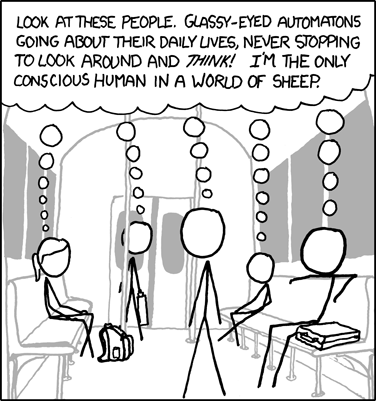
[qimg]http://imgs.xkcd.com/comics/sheeple.png[/qimg]

note to mods: XKCD explicitly gives permission to hotlink its comics, and provides the hotlink address at the bottom of each comic page. No breach of rules going on here.

And if you hover the mouse over that image on the XKCD webpage this is what you see:

"Hey, what are the odds -- five Ayn Rand fans on the same train! Must be going to a convention." alt="Sheeple"
 

Back
Top Bottom