I suppose the thing is,that there are two possible entry points. But how does the security differ? i suspect that malta wasn't that much source of problems,so they might not be under such pressure to guard against entry of explosives in bags and if they were not at that time known for problems,then other airports would skip luggages from it. So far however too much "might",unless somebody from airports,preffererebly of that time does input.
Actually, there are any number of possible entry points. However, there were only three examined at the trial and it seems as if the investigators only looked seriously at three - Luqa, Frankfurt and Heathrow.
The simple fact that has to be got round as far as the Luqa theory is concerned, is that the prosecution absolutely bust a gut trying to find evidence of something untoward at Luqa, and failed utterly.
There were 55 bags on KA180, all matched to passengers who actually flew. They were counted three times, in addition to the sniffer dogs. Nobody from that flight reported a missing bag (which rather rules out that a legit bag was taken off to get something sinister on). All 39 passengers were subjected to in-depth police investigation and they all checked out as legit.
The records from Luqa were all available, and checked out. To the point where Air Malta won damages from a TV company which broadcast a documentary with a "reconstruction" showing an unaccompanied bag going on flight KA180. (The TV company settled out of court when it saw the evidence Air Malta had that demonstrated that
didn't happen.)
It's all very well assuming security at Luqa
might have been more lax, or reading a post from some guy on the internet who was there once and thought he was waved through a bit quick, but the actual
evidence shows Luqa security to have been on the ball, and frankly as tight as a duck's arse. The best that could be managed in court was that a manager, asked whether it was conceivably even remotely possible that something could have been slipped past, said something like, well, anything's
possible. If you were asked about something that happened ten years ago, under oath, could you say anything more certain? He was adamant that to the best of his knowledge, nothing
had got past and it was extremely unlikely anything could have got past.
Not only that, but it was never really disputed that getting past that security, even if it were possible, would have required Megrahi to have had an accomplice with an air-side pass. That's where Fhimah was supposed to have come in - although he'd changed jobs and no longer worked for Air Malta, he still had his pass. However, the prosecution failed to lead any evidence to show that he was even at the airport that day, and the prosecution against him was dismissed as "no case to answer". Which kind of leaves the question open, if Megrahi
did get that case on the plane, who helped him? No other accomplice was suggested.
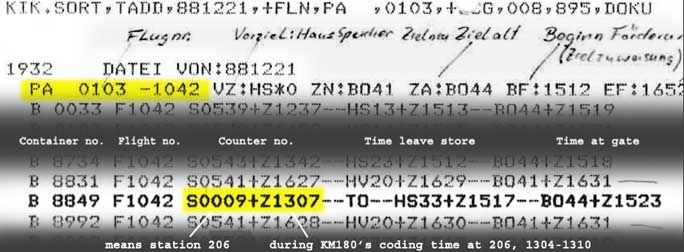
The faulty reasoning of the judges seems to have been that Megrahi bought the clothes, so he must have been the bomber. Megrahi was at Luqa airport on the morning of 21st December. There is evidence that an item of luggage was routed through Frankfurt to PA103A from KA180 out of Luqa, even though no passenger from LA180 was booked on PA103A. Therefore, Megrahi somehow
must have circumvented Luqa security undetected, even if we have literally no clue how.
The difficulty there is that there are also huge problems with the "Megrahi bought the clothes" part, which could be yet another thread (and probably will be, in the fullness of time). He was never identified as the purchaser; the best that could be done was that he
resembled the purchaser (except for being several inches too short, at least 10 years too young, and not heavily-enough built). And, as we're investigating, the evidence that an unaccompanied bag from KA180 was routed through Frankfurt on to PA103A is also pretty rocky.
Which is why I've concluded (and like all conclusions, this is subject to revision if more and better evidence emerges) that neither Megrahi nor anybody else put the bag on KA180. KA180 seems to be a complete red herring.
Which just leaves us with every other airport in the world.
I'll quickly return to theory of two groups/two bags. One signed in malta would have electronic timer(and/or any other trigger) and small,low powered radio transmitter. Second bag somehow entering second airport(Frankfurt) has reciever and bomb itself.
If Longtabber is right (his experties is at this time however suspect)then this could explain survival of fragment and possible casing and since reciever would be in direct contact with semtex,it would be destroyed or too small pieces would remain. IIRC it could acount for some more discrepancies.
But what I don't recall and cannot check right now,how strong were transmitters at that time for given power and how well would get signal to reciever.(It must not trigger on false signals and pick up correct signal with unkown strength,unless perp would place bag close enough to transmitter and could guarantee that it is in planned distance)
Longtabber aside, this doesn't fit with the evidence. The MST-13 timer (if we take the Official Version at face value) was very close indeed to the actual bomb, whichever way you slice it. Not only in the same luggage container, but certainly within feet of the bomb, and probably in the actual bomb suitcase. It was found lodged in the collar of a shirt which Tony Gauci was finally persuaded to state he sold to the mystery purchaser. Along with bits of shattered Toshiba radio-cassette player.
Also, could you explain the point of the two-bag trick? Even assuming your timer got through Luqa because it didn't smell of Semtex to your friendly springer spaniel, what good does it do you? You've still got to get "bomb plus electronics" on
somewhere, and putting the timer in a different bag doesn't make that any easier. It just adds another big risk that might go wrong. Why would anyone
possibly want to put the timer in a completely different bag from the bomb?
Rolfe.