Electric universe theories here.

Status
Not open for further replies.
MM,

Thanks for your answers:

How does a stable "iron crust" exist in association with the photosphere at the temperatures it is observed to be at?
 
The Iron Sun model states that coronal loops are electrical arcs that start on your hypothetical, thermodynamically impossible iron surface/crust, travel through 4800 kilometers of convection zone and photosphere (highly conductive plasma!), goes in a curve through the corona and then plunges back into the photosphere and convection zone to merge with the iron surface/crust again.

How did Birkeland do that discharge loop trick in his terella experiments?

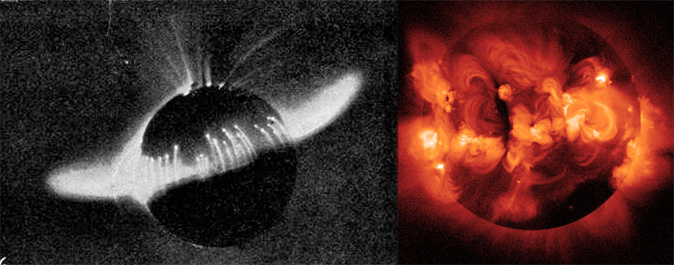
birkelandyohkohmini.jpg


First asked 13 July 2009
How does the electrical arc keep its shape and direction while traveling through the highly conductive plasma above your iron surface/crust?

The same way it kept its shape and direction in Birkeland's terella experiments, IOW "sustained current flow".

I am sure that you can cite a textbook with a chapter on the formation of electrical arcs in highly conductive media like plasma rather than the normally non-conductive media such as air as used in Birkland's terrella experiments.

I'll go you one better. Go to Walmart today and pick up an inexpensive plasma ball, plug it in and turn it on. You'll see all sorts of sustained filaments form inside of a "highly conductive plasma". Once Birkeland turned on his experiments, nothing was simply "air".

This sounds like something plasma scientists must have been researching and publishing papers on for decades. So a couple of citations to papers on the subject should be easy to find.

http://www.thesurfaceofthesun.com/A...r Atmosphere And A Theory Of Solar Flares.pdf

I might as well have you all read the very same paper.
 
How did Birkeland do that discharge loop trick in his terella experiments?

http://www.thesurfaceofthesun.com/images/birkelandyohkohmini.jpg

The same way it kept its shape and direction in Birkeland's terella experiments, IOW "sustained current flow".

I'll go you one better. Go to Walmart today and pick up an inexpensive plasma ball, plug it in and turn it on. You'll see all sorts of sustained filaments form inside of a "highly conductive plasma". Once Birkeland turned on his experiments, nothing was simply "air".

http://www.thesurfaceofthesun.com/Alfven/Currents%20In%20The%20Solar%20Atmosphere%20And%20A%20Theory%20Of%20Solar%20Flares.pdf

I might as well have you all read the very same paper.


How dumb MM.
  1. The first image is Birkeland's attempt for an analogy of Saturn (fig. 247a). It is in visible light.
  2. The second image is a soft X-ray (not visible light) image of the Sun.
  3. Air is not a highly conductive plasma.
  4. Birkeland did his experimensts with solid metallic globes. Your Iron Sun idea has a hollow metallic globe.
Also tusenfem points aout a flaw in your obsession with Walmart plasma balls:
Which is a breakdown of the dielectric, like in a plasma ball. And to advance a bit on that, inside a plasma ball there is no plasma (unlike you would think from the name). The only plasma in that ball is in the discharges from the central ball to the glass sphere.


Your only sensisble bit is a link to Alfven & Carlqvists's 1966 paper on solar flares in the solar atmosphere.

I wonder if you have ever read it and noticed the absence of a hypothetical, thermodynamicall impossible iron sufrace/crust.
I woonder if you have read it and noticed that the currents they use are closed loops (you like pretty pictures so look at figure 4).
 
Last edited:
Has the hollow Iron Sun been tested

Micheal Mozina: Yet another gap in your Iron Sun idea:
First asked 14 July 2009
Birkeland's experiments were done with solid iron and brass globes. Your Iron Sun idea has a hollow iron globe.

When did you or others do the controlled experiement that shows that hollow iron globes show the same behaviour as solid iron globes in this experiment?
 
Micheal Mozina: Yet another gap in your Iron Sun idea:
First asked 14 July 2009
Birkeland's experiments were done with solid iron and brass globes. Your Iron Sun idea has a hollow iron globe.

When did you or others do the controlled experiement that shows that hollow iron globes show the same behaviour as solid iron globes in this experiment?

Wherever did you get the idea I was suggesting that the sun was a "solid iron globe"? I personally *assume* (I can't see it of course) that the core is completely composed high temperature radioactive plasma, and I doubt that the solid part of the shell is particularly thick. I hold no strong beliefs about the core or the globe per se other than I'm certain it's not composed of solid iron.
 
Last edited:
Wherever did you get the idea I was suggesting that the sun was a "solid iron globe"? I personally *assume* (I can't see it of course) that the core is completely composed high temperature radioactive plasma, and I doubt that the solid part of the shell is particularly thick. I hold no strong beliefs about the core or the globe per se other than I'm certain it's not composed of solid iron.

Michael, he knows you're not suggesting the sun is a solid iron globe. He's asking why a solid iron globe (Birkeland's device) is analogous to a non-solid sun with an iron crust. Apples and oranges, yes?
 
How dumb MM.
  1. The first image is Birkeland's attempt for an analogy of Saturn (fig. 247a). It is in visible light.


  1. So what? We see x-rays and even high energy *GAMMA* rays from discharges here on Earth. You'll clearly have to "scale" Birkeland's work in terms of voltages, amps and overall energy releases.

    [*]The second image is a soft X-ray (not visible light) image of the Sun.

    And? You didn't see that DVD image yet I presume? You can also see those coronal loops in the visible spectrum in a single frame of that video at about the 30:04 second range. You'll also see the visible effect on the surface of the photosphere from both sides of the loops. Powerful discharges are not going to radiate a *SINGLE* wavelength, but *MANY* of them, including visible light and x-rays. Note that "electrical discharges" have already been shown to emit gamma and x-rays inside of a relatively cool environment. I don't need no stinking magnetic reconnection to make 171A emitting loops in the atmosphere of cathode spheres.

    [*]Air is not a highly conductive plasma.

    Are you suggesting that Birkeland limited his experiments with gasses in the chamber to "air"?

    [*]Birkeland did his experimensts with solid metallic globes. Your Iron Sun idea has a hollow metallic globe.

    Oh darn, I got it backwards then in your last post, because you evidently miffed Birkeland's experiments altogether. His model was "hollow' too. It has an "electromagnet" inside the sphere. It was not a "solid sphere".

    Also tusenfem points aout a flaw in your obsession with Walmart plasma balls:

    They are inexpensive and you folks seem to be ignorant of basic physics as it relates to plasma. Filaments form inside of current carrying plasma. The whole atmosphere of the sun is a "current carrying plasma" composed of million mile per hour charged particles. It should therefore be NO MYSTERY WHATSOEVER why we observe "lit filaments" in the solar atmosphere. Hopefully you folks might figure out from the ball that it is possible to sustain those threads indefinitely as long as the current keeps flowing.

    Your only sensisble bit is a link to Alfven & Carlqvists's 1966 paper on solar flares in the solar atmosphere.

    You folks will utterly ignore Alfven's work here today and tomorrow and next week just as you've been doing now for over 50 years. There's nothing new under the sun. :)

    I wonder if you have ever read it and noticed the absence of a hypothetical, thermodynamicall impossible iron sufrace/crust.

    Sure. I wonder if you noted that bit about "short circuits" and "electricity"?

    I woonder if you have read it and noticed that the currents they use are closed loops (you like pretty pictures so look at figure 4).

    I'm sure my "loops" close somewhere below the crust too.

    I notice none of you touched that comment from Kosovichev about the mass flows creating those "structures" under the photosphere and the "mass flows" we observe in 171A images near the surface. Kosovichev's quote *DESTROYS* your case in the final analysis because it is scientifically accurate in every detail. Those "mass flows" are clearly arranged in visible "structures" and they exist *under* not over the photosphere. The rigid features of the RD image are also located *UNDER* not over the photosphere as that DVD will demonstrate assuming you ever get around to watching it.
 
Last edited:
Michael, he knows you're not suggesting the sun is a solid iron globe. He's asking why a solid iron globe (Birkeland's device) is analogous to a non-solid sun with an iron crust. Apples and oranges, yes?

Yes, I realized that from the next post. Evidently he hasn't read Birkeland's work very well. Birkeland did not use a "solid" sphere. It was a hollow sphere with a strong electromagnet located inside the sphere.
 
MM,

Thanks for your answers:

How does a stable "iron crust" exist in association with the photosphere at the temperatures it is observed to be at?

It doesn't exist "with" or in the photosphere, but far below the photosphere, inside "cooler", more dense layers of plasma. The heat is being carried up and away from the surface with the particle flow from the surface. Just as the chromosphere is lighter and hotter than the cooler, more dense photosphere below, so too, the layers under the photosphere tend to be more dense and cooler than the layers that are higher in the atmosphere. There are *at least* two more double layers of plasma between the photosphere and the crust.
 
Wherever did you get the idea I was suggesting that the sun was a "solid iron globe"? I personally *assume* (I can't see it of course) that the core is completely composed high temperature radioactive plasma, and I doubt that the solid part of the shell is particularly thick. I hold no strong beliefs about the core or the globe per se other than I'm certain it's not composed of solid iron.
Your reading skiills have abandoned you once again MM.

Is this typical crackpot musings or do you have evidence for "completely composed high temperature radioactive plasma"
How thick is "particularly thick" - a centimenter seems particularly thick enough to me.
 
It doesn't exist "with" or in the photosphere, but far below the photosphere, inside "cooler", more dense layers of plasma. The heat is being carried up and away from the surface with the particle flow from the surface. Just as the chromosphere is lighter and hotter than the cooler, more dense photosphere below, so too, the layers under the photosphere tend to be more dense and cooler than the layers that are higher in the atmosphere. There are *at least* two more double layers of plasma between the photosphere and the crust.
That is not what the limb darkening measurements show. They show that the photosphere increases in temperature with depth.
 
Is Saturn the Sun

...usual rant...


Are you that dumb MM?
  1. The first image is Birkeland's attempt for an analogy of Saturn (fig. 247a). It is in visible light.
  2. The second image is a soft X-ray (not visible light) image of the Sun.
  3. The gasses used in the experiments were not a highly conductive plasma.
Thank you for the correction on Birkelands experiments. I should have realized that your obsession with him would make you duplicate his experiment exactly as the Iron Sun idea (I am surprised that you did not add a solid iron core to act as an electromagnet :D !)

Birkeland did his experiments with metallic globes that contained electromagnets (mostly solid). Your Iron Sun idea has a metallic globe that may be mostly hollow (you have no idea how thick it is).

First asked 14 July 2009
When did you or others do the controlled experiment that shows that the thickness of hollow iron globes does not effect the analogy with Saturn?

At what point did Saturn become the center of the Solar System?
 
Last edited:
Not open enough to believe a iron shell inside the Sun

Too bad that you don't realize the relevance of your own quotes. :) At least the irony was not lost on me.

What are the "s supposed to mean here. Is this another redefinition of yours, that we are unaware of?

No, most "plasma" is not fully ionized and includes plenty of "dust" (solids, liquids, gasses), hence the term "dusty plasma". That's the state of most plasma.

I read them, how often do I have to say that? (see page 12!!!!!!!!!!!!!)

If you did, you sure are silent on specific questions, like how Birkeland explained flying positive ions.

And you don't want a discharge between the sun and the heliosphere, you want a discharge from surface to surface.

Birkeland's terrela's were in a constant state of discharge toward the sides of the chamber but discharges also occurred all along the surface of the sphere. Why do you suppose that was?


So Birkeland was trying to model Saturn in this picture.

I thought you said you read his work which includes the following quotes just before publishing the image in question:

The Sun. The series of experiments that I have made with a magnetic globe as cathode in a large vacuum-box, for the purpose of studying analogies to the zodiacal light and Saturn's ring, have led to discoveries that appear to be of great importance for the solar theory.

He evidently thought they were related to solar activity, not Saturn's rings. Notice he "discovered" something about the sun during his experiments? That's called the "empirical scientific method" and a true "prediction" born of experimentation.


Holy cow your post is long. I'll have to "nibble" at it today between tech calls.
 
Last edited:
...snip...The rigid features of the RD image are also located *UNDER* not over the photosphere as that DVD will demonstrate assuming you ever get around to watching it.
Lets address this delusion of yours one more time.
Running difference animations are computer processed records of changes in the original images. Only changes in the original images show up in running difference animations.
Running = Do the computer processing between the original image and its previous image.
Differences = Take the difference between the original images to create frames of te differences between the original images.

Only a complete idiot would think that a persistent feature in an RD animation is a persistent feature in the original images.

Your optical illusion of "rigid features" are actually areas of constant change happening in one location. As Dr Kosovichev has told you
The consistent structures in the movie are caused by stationary flows in magnetic structures, sunspots and active regions.
We know this from the simultaneous measurements of solar magnetic field, made by SOHO. These are not solid structures which would not have mass flows that we see.
These images are Doppler shift of the spectral line Ni 6768A.
The Doppler shift measures the velocity of mass motions along the line of sight. The darker areas show the motions towards us, and light areas show flows from us. These are not cliffs or anything like this. The movie frames are the running differences of the Doppler shift. For the illustration purpose, the sunquake signal is enhanced by increasing its amplitude by a factor 4.
 
Are you that dumb MM?
  1. The first image is Birkeland's attempt for an analogy of Saturn (fig. 247a). It is in visible light.


  1. So what? If you'd watched the DVD I suggested and the parts I bothered to highlight for you, you'd have discovered you can see coronal loops in white light in some instances. You should also know that discharge in the Earth's atmosphere release x-rays and even gamma rays, so what's the big deal?

    The gasses used in the experiments were not a highly conductive plasma.

    Actually that's incorrect because the entire interior of the chamber is a "current carrying plasma" once he turned on the power.

    Thank you for the correction on Birkelands experiments. I should have realized that your obsession with him would make you duplicate his experiment exactly as the Iron Sun idea (I am surprised that you did not add a solid iron core to act as an electromagnet :D !)

    I figure a fission based plasma core would do fine for that function.

    Birkeland did his experiments with metallic globes that contained electromagnets (mostly solid). Your Iron Sun idea has a metallic globe that may be mostly hollow (you have no idea how thick it is).

    I assume it has a "heavy" (not to be confused with dense) plasma core composed of fissionable materials.

    At what point did Saturn become the center of the Solar System?

    At that point in the book he was discussing the sun and the coronal loops. You really need to sit down and read through the experiments side of his (their) work very carefully. He specifically explained that this was something he "discovered' via actual experimentation in the "old fashion" method of science. He associated these discharge events specifically to solar events. He realized that his own experiments could "teach him" things about the solar the solar system that were not obvious to him before hand. Those loops and jets and high speed solar with particles are all "true predictions" that were born of active experimentation. Those "prediction" correspond to a lot of "sweat equity" science on the part of Birkeland and his team of friends. At no time did he equate these events with Saturn, but rather he specifically relates them to flare events on the sun.
 
Last edited:
I can answer this:
I thought you said you read his work which refers to that actual image (fig. 247a) as Saturn.

Did you miss this part entirely?

The Sun. The series of experiments that I have made with a magnetic globe as cathode in a large vacuum-box, for the purpose of studying analogies to the zodiacal light and Saturn's ring, have led to discoveries that appear to be of great importance for the solar theory.

This is what empirical physics is all about. You *LEARN FROM* your active experiments and then APPLY IT to what is actually applies to, in this case the sun. He specifically equated that image with solar activity.

In the above-mentioned experiments, it (can be) seen how the rays from the polar regions bend down in a simple curve about the equatorial plane of the globe, to continue their course outwards from the globe in the vicinity of this plane. An aureole is thereby produced about the magnetic globe, with ray-structure at the poles, the whole thing strongly resembling pictures of the sun's corona.
 
Last edited:
That is not what the limb darkening measurements show. They show that the photosphere increases in temperature with depth.

That's because the heat source is from the loops that are mostly located below the photosphere and that are generating light at the limb from below the photosphere.

How come during sunspot activity do we find variations in the THOUSANDS of degrees and low temperature plasma upwelling from below?
 
Last edited:
So what? If you'd watched the DVD I suggested and the parts I bothered to highlight for you, you'd have discovered you can see coronal loops in white light in some instances. You should also know that discharge in the Earth's atmosphere release x-rays and even gamma rays, so what's the big deal?
{/quote]
The big deal is the stupidity of comparing an image that is supposed to be Saturn with an image that is the Sun.

The big deal is the stupidity of thinking that comparing images is valid science. Things that look alike need not be alike.

The big deal is the stupidity of thinking that visible light images look exactly like X-ray images. Any intellegent person would compare Birkeland's image with an image in visible light. The fact that you did not shows that you are cherry picking the images. Which leads to...

The big deal is that there are many images of the Sun that do not look like Birkeland's image of Saturn.

Actually that's incorrect because the entire interior of the chamber is a "current carrying plasma" once he turned on the power.
Citation please. Where does Birkeland satet in his book that all of the gas in his vacuum chnamer is a current carrying plasma?

I figure a fission based plasma core would do fine for that function.

I assume it has a "heavy" (not to be confused with dense) plasma core composed of fissionable materials.
Is this the definitive Iron Sun answer - that the core of the Sun is filled with something undergoing fission (uranium, plutonium, something else)?

At that point in the book he was discussing the sun and the coronal loops. ...snip...
That is right. The entire section is about the Sun. So what - are you stating that Birjeland can never refer to anything else in a section about the Sun?
Read what he said. This is a paragraph about Saturn's rings.
Originally Posted by Birkeland
It is by powerful magnetisation of the magnetisable globe that the phenomenon answering to Saturn's rings is produced. During this process, polar radiation and disruptive discharges at the equator such as that shown in fig. 247a (which happens to be a unipolar discharge) may also occur, if the current intensity of discharge is great. If the magnetisation of the globe be reduced (or the tension of the discharge increased) gradually, the luminous ring round the globe will be reduced to a minimum size, after which another equatorial ring is developed and expands rapidly (Fig 247 b).
 
The big deal is the stupidity of comparing an image that is supposed to be Saturn with an image that is the Sun.

According to Birkeland himself it *WAS SUPPOSED TO REPRESENT THE SUN AND THE CORONA!*. You can of course accuse Birkeland of being stupid, but he personally equated these events to solar coronal activity. I really get the impression that you're young and "winging it" as it relates to Birkeland's actual writings. How could anyone miss the fact he equated all of these events to solar activity?

The big deal is the stupidity of thinking that comparing images is valid science.

Oh the ignorance of that statement. How else did you expect us to falsify or verify any theory?

Things that look alike need not be alike.

And sometimes they are *EXACTLY* alike. How do we know which of these statements is true?

The big deal is the stupidity

A fifteen year old might continue to resort to childish insults, but you really aren't doing yourself any favors as you will learn when you finally grow up. That's twice now you've called someone (evidently Birkeland/yourself the first time) in this post and we're only like three paragraphs in. I smell fear now.

of thinking that visible light images look exactly like X-ray images.

That is a "strawman". I never said they were "exactly" alike, but they can and do follow the same patterns in nature, and electrical discharges have been shown to emit photons up to the energy state of gamma rays.

Any intellegent person would compare Birkeland's image with an image in visible light.

No. Any intelligent individual would scale the thing to size.

The fact that you did not shows that you are cherry picking the images. Which leads to...

No, you're cherry picking the images by refusing to look at, comment on or even acknowledge the images I have cited.

The big deal is that there are many images of the Sun that do not look like Birkeland's image of Saturn.

Birkeland knew enough to scale his model, and he himself said it looked like the sun's corona, not Saturn.. Either you didn't read the material at all (which seems likely after your "solid globe" blunder), or you simply misread his statements. I didn't compare that image to the sun, he did. He did not compare it to Saturn, he specifically compared it to *SOLAR* events.

You really need to do your homework, watch the images I have suggested, read the materials I have suggested, watch a few RD images so you can learn to pick out *REAL OBJECTS* in them, and then we'll have something useful to discuss. At the moment it sounds like you are clueless about what Birkeland did and said.

Citation please. Where does Birkeland satet in his book that all of the gas in his vacuum chnamer is a current carrying plasma?

OMG. What exactly do you figure is going to happen to the material(s) in the chamber when he flips the switch and the cathode starts emitting streams of electrons from the surface of the sphere?

Hoy. At this point I think I'll just stop. You're evidently completely ignorant of what Birkeland said, or you refuse to accept him at his own word. He specifically compared that very same image to solar activity, and the solar corona, not to Saturn. He was explaining what he learned about the sun by experimenting with a model of Saturns rings. At no time did he equate this activity with Saturn however, he realized immediately that it had implications as it relates to solar physics. You could not have read even the paragraphs I posted for you and have missed his comparison of this very image to solar activity and specifically events in the solar atmosphere.

 
Status
Not open for further replies.

Back
Top Bottom