What point did he make that you feel is "substantive"? Can you see stars in Lasco images? Can you see "flying stuff" in Lasco images? Is there a light source in these images other than our CRT?
When you look at a bar chart, a graph, a pie chart, a thermometer, a gas gauge, or any other such graphical presentation of a set of data, the light source, whether it is the dashboard lights in your car, the sun shining on the thermometer on your porch, or the florescent light behind the LEDs on your computer monitor, the light source is not part of the data. Until you understand this simple fact, and understand that a running difference image is a compilation of data prepared in graphical form, you will
never, and I mean
never know what you're talking about when it comes to running difference images. I'm confident that everyone in this discussion agrees with my explanation of the light source.
And who gives a damn about flying stuff? Your claim is there's a solid iron surface on the Sun. Aside from the sheer ridiculousness of that claim, from a legitimately scientific, physical sciences point of view, flying stuff, whether present or not, has nothing to do with a solid surface. You're not seeing flying stuff in a running difference image, that's true. But even if you were, it doesn't support your claim one little bit, so put a lid on it, will ya?
My substantive concern, which you consistently ignore, whether by intent or because you're so wrapped up in your delusion you can't see out (thereby meriting you the descriptor "ignorant"), is that you simply cannot see thousands of kilometers
under the Sun's photosphere using optical imagery,
however it might be filtered or processed, that is acquired from thousands of kilometers
above the photosphere. It's simply impossible.
It would be more realistic to claim to see the R.M.S. Titanic by looking at weather satellite images of clouds on Earth. You're just not going to do it. Yet with every posting I have been imploring you to present the science behind your claim to such an amazing feat of optical analysis. Set aside for a moment the Nobel Prize waiting for you for your discovery of the solid surface on the Sun, that kind of optical imagery and analysis process would get you a Nobel on its own! But with every response you fill your posts with moaning and whining, and still something obvious is missing. Any sort of explanation of any kind as to your method for performing your magical viewing feat.
What do we get instead? Constant hollering and tantrums and objections to the replies which clearly show you're wholly incapable of doing what you claim, and more whining and bitching about how you by God can see what you claim to see, but not a single effort put forth to demonstrate that you actually can do it. And this, after more than three years, hasn't changed a bit. You've gotten absolutely nowhere in all that time.
FYI, if I'm "getting my buttons pushed" it is due to RC and GM's constant reliance upon personal insult in each and every post. Instead of focusing on ideas, they focus on individuals and smear the individual, even when it turns out that neither of them has any experience at all with RD images. RC couldn't even locate the archives hours after I had posted you a link to them. Is he even actually reading my statements are making any attempt to understand them as you have done? I'm tired of the childishness and the constant barrage of insults from those two. Neither of them can see a star yet in a simple LASCO image, and there is no way either of them can understand anything about getting a directional component in the RD image based upon the positioning of the shadow. I think even you already understand these things and can see "flying stuff" in both the original Lasco images as well as the RD variety. Feel free to correct me if I am mistaken on any of these points.
There are no shadows or flying stuff in running difference images. They're graphs and charts, not pictures. And as I mentioned above, flying stuff in any form wouldn't support your crackpot fantasy about a solid surface on the Sun anyway. Notice how your entire comment above is just more whining, and totally irrelevant to your claim? No, I don't suppose you do. I get the idea you'd rather cry than engage in a discussion of actual science. Saves you a lot of embarrassment if you can fill your posts with complaints instead of making the stupid mistakes you tend to make in the rare instance when you actually do try to talk science.
First of all, even admitting that you aren't well versed in these images yet says volumes about your integrity. You aren't attacking me personally, you aren't calling me a crackpot in every post, you're simply noting that my beliefs are "incredible", and you're at least making an honest effort to understand my position before going ballistic. It turns out the RC isn't really any more versed in RD imaging than you are, he just *THINKS* he's an expert without evidently ever watching many of them. He's *SUCH* the expert he can feel comfortable calling me a crackpot and intentionally distorting my statements. Is that even rational or reasonable behavior?
But, Michael, you're a crackpot, by definition. You can't do math. You don't understand physics. You don't understand the process of science. You don't have a supportable claim. You're relying on very badly misinterpreted information you cherry pick from 100 year old material. You refuse to catch up. You refuse to learn math, or physics, or the scientific method. You haven't yet once offered any quantitative support for any of your crazy claims. You're a crackpot. Seems your choice is to get used to being called a crackpot, or learn some real math and physics, catch up to 21st century science, begin to scientifically address legitimate criticisms of your nutty fantasy instead of ignoring them. You know, just generally stop being a crackpot.
FYI you already know *INFINITELY* more about RD imaging than GM.
What's there to know. You take the value of pixel A,1 in Image 1, subtract it from the value of pixel A,1 in Image 2, and put a pixel representing that difference in position A,1 in the running difference output. Then repeat for every pixel in the source images. Duh.
Ok. I'll accept for the time being that you remain "unconvinced". That doesn't make me a crackpot, or even wrong. I simply have failed to convince you thus far into the conversation. Note that I haven't even posted a link yet to a real "explanation" of this image. All you really know is what I've been able to explain to you while under a constant barrage of personal insults on a public website. It's not the most conducive place for a scientific discussion, you'll at least acknowledge that much won't you?
You have failed to convince
anyone. There is not a single professional or educator in any field related to solar physics who agrees with your fruitcake fantasy that the Sun has a solid iron surface. That says something about your claim, something that you're missing, something very important. It says your claim either isn't correct, or you're wholly incapable of convincing anyone that it is correct.
Ok, but why would a light plasma corona show persistent patterns at these wavelengths? There has to be a "cause/effect" relationship here that relates to the geometric shapes we observe in the image.
You'd need to do a time span analysis of the imagery in order to determine any persistency. You'd also have to know about what falls into the range of normal. It's a quantitative thing, Michael. I'm sure you wouldn't' understand. Clue: It was all done for you on SFN a few years ago, because you didn't have the ability to do the math and science necessary. The conclusion was that it's all quite mundane. You ignored it.
The original images also show a lot of angular detail, all of which retains the same geometric relationships to one another. Plasma is fluid. It's mobile and hot and actively spewing from the sun at over a million miles per hour. If you look at images of the structures (light/dark areas) of the photosphere in white light, they move around. They flow like a boiling liquid and come and go in roughly eight minute intervals. We see *lots* of movement in plasma that is consistent with liquids and gasses, like that wave in Kosovichev's dopper image. Like that structure under the wave in Kosovichev's video demonstrates, there are "persistent" features under the photosphere that are much more "rigid" (that's the term we used in the paper rather than solid) than the plasma of the photosphere. You might argue the idea that this rigid feature is a more dense plasma, but its lack of movement throughout the video demonstrates is not moving at the same speed, rate or exhibiting any of the same behaviors as the light plasma photosphere.
More unsupported speculation about persistency and rigidity and more misunderstanding of what helioseismology research is actually showing us.
As it relates to issue of location, keep in mind that all of these images are monocular images, and the white light images do not go through the same exact camera equipment as the 171A images. They have to be put together in the same way as any composite image is put together.
The loops are three dimensional and therefore you can't *assume* their location is limited to one single layer of the solar atmosphere. It's possible I suppose that they could be, but we can't begin with that assumption. Even LMSAL seems to admit that the bases of the loops are more brightly lit than the rest of the loop, and they assume most of the heating of the plasma takes place in the base of the loops. The question then becomes, where are the base of the loops located (tops could be anywhere), and how is that heating process occurring and why in that specific location?
Demonstrate that the people at the research organizations who produce these images don't know what they're doing and you do. Demonstrate that there's any kind of particular error in processing or assembling any of the images that should call into question the accuracy of the presentation of data. Your simple incredulity doesn't support your claim.
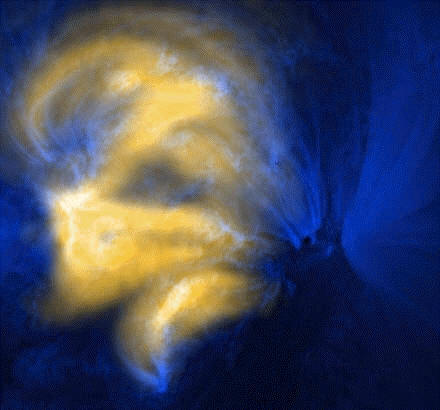
*IF* the base of the loops originate in the corona, then why can't we see the base of the loops in x-rays from the Yohkoh satellite (in yellow), whereas we can observe the bases of the loops in 171A (in blue)?
It's a two dimensional image. You can't know the depth of anything from looking at it. Although there are ways to know the depths, and those methods have been discussed at some length in conversations you were involved in, you never seems to get it. You, Michael, don't know how deep or shallow or high or low pretty much anything in that image really is. This was proven, in fact, several years ago on SFN, when you were offered an opportunity to show that you actually could point out various depths with any accuracy. You couldn't do it.
Now how about that detailed, quantitative analysis of that running difference image? You know, detailed, specific, and objective, describing your method in a way that other people can apply it and come to the same conclusion you've reached, you know, as complete and convincing as the ones given by me and the other people in this thread?
And where's that lab experiment done right here on Earth, with no fudge factors, repeatable, using no metaphysical hocus pocus, that shows how you can image something thousands of kilometers above the photosphere and process those images in such a way that the results show something thousands of kilometers below the photosphere? I'm sure you'll agree that if you can't meet your own standards of evidence, your claim is worthless. Allow me to repeat that: Your claim is worthless.