Vortigern99 said:
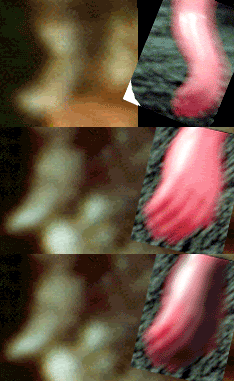
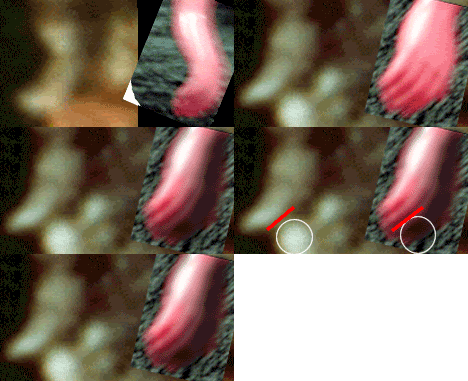
1. Bob's arm is foreshortened toward the camera, as evinced by the overlap of drapery, the oval of the wrist-cylinder, and the visible shortness of the arm compared to other known photos of Bob.
2. Bob's hand is tilted at an extreme oblique angle, which artificially brings up the baseline of his apparent arm-length
3. Bob's arm is angled farther back and therefore higher up at a point along the arc-circle (which controls arm length) than the P-G subject's arm, which is more vertical and therefore lower on the arc circle
4. The P-G subject is crouching slightly more so than Bob, which artificially brings down the baseline of "its" apparent arm-length
5. The baseline under the feet of the P-G subject is conjectural and may not be accurate, throwing off any attempted comparisons
6. The lens sizes of the cameras and enlargers which captured and developed these photos, and the digital compression of both pics when scanned into a computer, are unknown and can further throw off any comparisons between the two pics
I missed the photogrammetery study to show Bob's arm is foreshortened toward the camera, as well as the detailed comparison between this picture and other photos of Bob. I find it ludicrous that Bob is walking with his arms angle out to a degree it would have much of an effect, given the video of him doing the "BF walk" doesn't indicate his arms flailing out like that.
Brawniac, the reason you "missed the photogrammetery [sic] study" is that none has been performed, as far as I know. I'm a hands-on illustrator and figure artist, not a computer graphics or photographic expert. My base of knowledge tells me that certain physical rules of visual data, such as perspective and foreshortening, are in operation in the pic of Bob we're discussing. If you'd like to conduct a photogrammetric study in order to show that Bob's arm is not foreshortened, by all means, be our guest. The burden is on the claimant, in case you missed that as well. (The claim that I'm refuting is that Bob's arms are shorter than Patty's.)
Yes, the line should be at the wrist. Not sure how that would help Bob out though.
I'm addressing Mr. Yeti's placement of the baseline below the fingers, which is obviously distorted by the tilt of Bob'a hand. If you elect to place the baseline at the wrist, see my numerous other points (above) addressing why Patty's arm appears longer.
The arc is still pretty much a horizontal line through the angle range you're describing...it might buy Bob a pixel at best. But if your assertion that his arm is angled towards the camera is correct, then it won't buy Bob much of anything. You can't have both, in other words.
I appreciate your generosity, but your assertion that a "horizontal line" is part of an arc circle is incorrect. You may wish to examine a circle at this time to determine whether or not a "horizontal line" is in fact an element of that geometric shape. I'll wait.
...
No? No horizontal line? Huh. I thought not.

Meaning if Patty "straightens up", the shoulders moves up. Then the hands might then align, but the shoulders wouldn't. That doesn't help Bob.
Perhaps you'd like to show us exactly where the topline of Bob's shoulder is underneath his bi-colored shirtsleeve. Then we can discuss whether his and Patty's shoulders align.
If you can infer Bob's arms are longer based on comparing it to other photos, then one can infer Patty's right foot location by comparing it to the left leg. Even more so, since they're in the same shot.
Please explain how comparing the length of a single subject's arms in two different pics, in which the arms are clearly visible, translates into placing an imaginary foot into a pic of another subject with no comparison pic as a guide.
You're saying you can't actually assert Bob's arm is foreshortened toward the camera by comparing to other known photos of Bob?
No, I certainly am not saying that. The problem with the unknown lens sizes and degree of digital compression is a problem for matching up two pics of two different subjects. One may look taller than the other, or broader, simply because of these photographic distortions -- thereby making it difficult or impossible to compare the two pics on a 1:1 basis. There is also the problem that in one pic, the subject is very likely inside of a suit, distorting his/her precise anatomical measurements. In two pics of the same unsuited (or suited) human, we can account for such lens/compression distortions, and match them one to the other to compare, for example, the question of limb length.



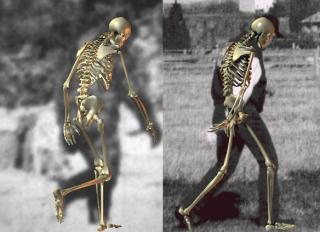
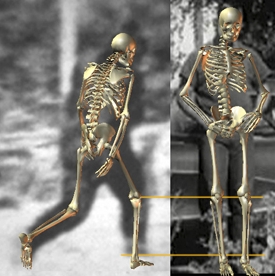


 ...
...