• Quick note - the problem with Youtube videos not embedding on the forum appears to have been fixed, thanks to ZiprHead. If you do still see problems let me know.

The PG Film - Bob Heironimus and Patty

Status
Not open for further replies.
First image...


[qimg]http://i172.photobucket.com/albums/w28/SweatyYeti/NelsSkels/NelsSkel2BB.jpg[/qimg]


Second image...


[qimg]http://i172.photobucket.com/albums/w28/SweatyYeti/NelsSkels/NelsSkel1B.jpg[/qimg]


Third image...


[qimg]http://i172.photobucket.com/albums/w28/SweatyYeti/NelsSkels/NelsSkel3B.jpg[/qimg]


Anybody notice anything odd about Nel's skeleton's upper arm in those 3 frames??

Not especially. Why not come out and just say what you mean? Then we can discuss it.
 
Not especially.
Why not come out and just say what you mean? Then we can discuss it.


It's fun to put the "critical thinker's" critical thinking skills to the test...that's why.


I like your "middle-of-the-road-say-something-yet-nothing" answer, Vort. ;)
 
Last edited:
It's fun to put the "critical thinker's" critical thinking skills to the test...that's why.


I like your "middle-of-the-road-say-something-yet-nothing" answer, Vort. ;)

Just because the majority of this board disagrees with you Sweaty doesnt mean they are not Critical Thinkers.
 
First image...

[qimg]http://i172.photobucket.com/albums/w28/SweatyYeti/NelsSkels/NelsSkel2BB.jpg[/qimg]


Second image...

[qimg]http://i172.photobucket.com/albums/w28/SweatyYeti/NelsSkels/NelsSkel1B.jpg[/qimg]


Third image...

[qimg]http://i172.photobucket.com/albums/w28/SweatyYeti/NelsSkels/NelsSkel3B.jpg[/qimg]


Anybody notice anything odd about Nel's skeleton's upper arm in those 3 frames??


Yeah, it doesn't have crayon scribbled all over it. It makes it more difficult than normal to recognise who posted the pics when I'm scrolling through all this dross.
 
Last edited:
Well, actually, there are more boards with more threads about the PGF and more people actively discussing it.

Of course

The important difference is that this site represents the largest online skeptic community in the world, so you are going to get more attention because of that.

Attention is not that important to some of us.

Also, we tend to know more about the PGF than Bigfoot searchers do and discuss it in a more focused manner.

You know more about it? Hmmm. It is either a film of a Bigfoot or it is not. Either way, it is just a film and not proof to the scientific community.

Correct "Bigfoot searchers" do not focus on the PG film.


But yeah, we've had a ton of discussion on the PGF. What's your point? Many of the most important modern revelations about the film have come from us. Your welcome.

I have seen tons of interesting theories, but very few "revelations". Don't remember thanking you, but OK.
 
Sweaty, I just don't know what you're talking about. Do you want to discuss this, or not?


Sure.

What I was refering to is how the length of the skeleton's upper arm changes, as the skeleton moves from Patty to Bob.

It looks 'odd' to me, because it's length shrinks, continually, as the arm swings backwards.

I measured the number of pixels in the vertical plane (not along the diagonal), for the upper arm...in each of those images.

The 1st image...it's 160 pixels.
The 2nd image...it's 155 pixels.
The 3rd image....it's 138 pixels.


In the middle image, in which the arm is hanging straight down, the upper arm should be at it longest length, vertically (in the circular arc of it's swing), but it has actually become shorter than it was in the previous frame.
The exact opposite of what it should have done.


So, what is causing the skeleton's upper arm to appear shorter and shorter as it swings backwards?
 
Sure.

What I was refering to is how the length of the skeleton's upper arm changes, as the skeleton moves from Patty to Bob.

It looks 'odd' to me, because it's length shrinks, continually, as the arm swings backwards.

I measured the number of pixels in the vertical plane (not along the diagonal), for the upper arm...in each of those images.

The 1st image...it's 160 pixels.
The 2nd image...it's 155 pixels.
The 3rd image....it's 138 pixels.


In the middle image, in which the arm is hanging straight down, the upper arm should be at it longest length, vertically (in the circular arc of it's swing), but it has actually become shorter than it was in the previous frame.
The exact opposite of what it should have done.


So, what is causing the skeleton's upper arm to appear shorter and shorter as it swings backwards?

Do you have a theory? I think it would be interesting if you could tell us what you think you are seeing here.

The "alt view" images I uploaded to Photobucket should be in sync with the primary view. That means that the same frame number in each should represent the same point in the sequence.
 
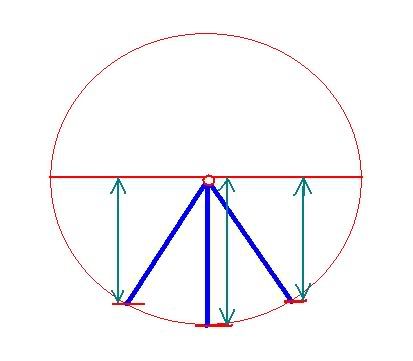
Here's a diagram that illustrates what I'm talking about...

SwingingArm2.jpg


The 3 blue lines represent the upper arm, in it's 3 different points in the arm's swing.
The green lines represent the 'vertical length' that I was refering to....the longest line being at the point where the arm is hanging straight down.
 
Last edited:
neltana wrote:
Do you have a theory? I think it would be interesting if you could tell us what you think you are seeing here.


No, not at the moment.

I explained, and illustrated what I'm seeing in that animation....at least as far as the 'upper arm length' changing (as the skeleton moves) is concerned.


Can you explain, at least partially, how you created that particular section of the animation, neltana?


The "alt view" images I uploaded to Photobucket should be in sync with the primary view. That means that the same frame number in each should represent the same point in the sequence.


I haven't looked at that yet. I'll take a look at them.
 
Just to elaborate on what I mean, by this...


So, what is causing the skeleton's upper arm to appear shorter and shorter as it swings backwards?


I realize that in a computer-generated animation....anything is possible, as far as lengths, and shapes, changing...

http://www.youtube.com/watch?v=nice6NYb_WA


....but what I'm asking is....what physical change, in the real world, would cause this apparent change of length of the subject's arm, as it is seen swinging?
 
Maybe neltana hoaxed us, too.

Or, maybe Sweaty is a desperate believer who will grab anything to keep hope alive in his mind.

I'll take door #2.
 
Come on, Astro. You should know better. Sweaty doesn't do numbers.
You don't do anything. :)

That is a simple fact? Then we have more evidence Sweaty doesn't comprehend what simple facts are. Drapier does plenty. He's one of my favourite posters and he doesn't even have 250 posts. That is impressive to me. He makes highly pertinent observations, makes me laugh (with him, not at him), and makes me think. He knows you better than many and I can think of very few times I've disagreed with his statements.
 
Sweaty, the principle you're observing is a normal and predictable feature of human anatomy. From Dynamic Figure Drawing by Burne Hogarth, p. 136 [bracketed information is my clarification; italics and standard parentheses () are original to Hogarth]:

The Joint as Pivot; the Member as a Radius

Let us point up the significance of the concept which emerges from the foregoing demonstrations [the depiction of circles and ellipses in perspective]. In the perspective circle, we see that the variable lengths of line are identical and equal in different directions in depth. This means that while these lengths appear to change -- because they are put within the control of an ellipse -- they are actually unchanged in length.

Should this proposition be applied to a pivoting member of the body -- to an arm or a leg -- then the over-all control of such members would be maximum, no matter what their direction in foreshortened space, Indeed, we should then have precise control of the irrational lengths of forms in space. Perhaps the following will serve to illustrate this concept to the reader.

[Insert: An ink drawing of a nude man in profile, with three right arms arranged in different poses and three left arms arranged in different poses, with a semi-circle drawn in dashed lines through each of the elbow and wrist joints, indicating the proper and correct placement of each along a circular arc. This dashed-line circle continues through the torso to bisect the navel. This bisection point is marked "A".]

Suppose we look at a simple side view of the upper body and study the movement of the arm. First, the length of the upper arm (extended left arm) will be given the correct proportions by establishing the elbow, taken at the inner bony projection (the condyle), on a line held equal to the position of the navel. This position occurs midway between the rib base and the pelvic crest, carried across the mid-axial waistline of the body (A). Opposite, we see the right arm also taking this equivalent position at the elbow (A). Now, using the shoulder as a pivot, the extended arm swings up. The swing describes two arcs -- a short radius, and a longer radius -- held by the limits of the upper arm-to-elbow and the lower arm-to-wrist (see dotted curves). To the right, the elbow rises backward, describing an arc, using the shoulder as a pivot.

It is obvious that, in this multiple sequence of positions, if the arm length (on each side) is given to the arc of the circle, any position on the arc must be held correct as a radius. Hence, if the rotating elbow is drawn on such an arc, it, too, must be held correct at any position and can be developed fully as an arm, without distortion.


The author goes on, over the next seven pages, to describe how this arc circle also controls the pivot points of the leg, and can be tilted into foreshortened perspective using an ellipse.

I hope this clarifies the matter for you, Sweaty, and puts to rest your stated opinion that limb lengths extend horizontally ad infinitum rather than pivoting along an arc circle.

 
SwingingArm2.jpg


The 3 blue lines represent the upper arm, in it's 3 different points in the arm's swing.
The green lines represent the 'vertical length' that I was refering to....the longest line being at the point where the arm is hanging straight down.

In fact, this diagram is a close representation of the diagram in Hogarth's book. The central point (the red dot) is the shoulder pivot, the blue lines are the upper arms down to the elbow joint. Imagine the blue lines continuing outward to another, wider circle that describes the wrist joint placement, and you've got yourself an anatomical measurement diagram.

EDIT: BTW, Burne Hogarth was resident figure drawing instructor at the New York School of Visual Arts in the 60s and 70s. His "Dynamic" drawing series (Dynamic Anatomy, Figure Drawing, Light & Shade, Wrinkles & Drapery, etc.) are renowned and indispensable works of reference for illustrators, comics artists and draftsmen. He was also an extraordinarily nice man, who at San Diego Comics Con in 1995 took me around to personally introduce me to all my comics artist heroes. /blush/
 
Last edited:
I was just trying to interject a little humor, there, Vort.

Seriously....can you provide some kind of illustration, that demonstrates specifically how it applies to the images I posted?


Vort wrote:
In fact, this diagram is a close representation of the diagram in Hogarth's book.
The central point (the red dot) is the shoulder pivot, the blue lines are the upper arms down to the elbow joint. Imagine the blue lines continuing outward to another, wider circle that describes the wrist joint placement, and you've got yourself an anatomical measurement diagram.


Gee, I guess my crayon-drawings aren't all "worthless scribbles". :cool:
 
Last edited:
Just read the text, Sweat. The central red dot is the shoulder pivot-point. The blue lines are the spans of the arm. The red circle is the arc that controls the apparent length of the arm.

Leonardo's famous "Man" is a less complex representation of this principle. Although Leonardo did not apply it to the arms as clearly, it is observable in the lengths of the legs as indicated by the placement of the feet along the arc circle.

2228644171_b1d20784f3.jpg
 
Anybody notice anything odd about Nel's skeleton's upper arm in those 3 frames??

No, I do not. Not at all. I am confident that there is nothing defying spatial physics at all here.

It's fun to put the "critical thinker's" critical thinking skills to the test...that's why.

I think it's delicious that you're implying that people here have not quite the prowess you do at critical thinking and that you are adept at pointing it out with simple little observations.

I am quite confident you are about to look even denser than is usual for you...

In the middle image, in which the arm is hanging straight down, the upper arm should be at it longest length, vertically (in the circular arc of it's swing), but it has actually become shorter than it was in the previous frame.
The exact opposite of what it should have done.

Here's a diagram that illustrates what I'm talking about...

[qimg]http://i172.photobucket.com/albums/w28/SweatyYeti/NelsSkels/SwingingArm2.jpg[/qimg]


The 3 blue lines represent the upper arm, in it's 3 different points in the arm's swing.
The green lines represent the 'vertical length' that I was refering to....the longest line being at the point where the arm is hanging straight down.

Lines, lines, lines. Sweaty loves his lines. He is so avant garde with his lines. So bold, like a bucket of boldness. Hey, big thinker, I get it. I really do. Let's try a little experiment regarding your newest contribution to the Sweaty collection...

Take a nice, long pencil or any suitably long, thin, and rigid object. Close one eye and hold it in front of the computer screen before your open eye so that the bottom apeears to be lined up with the bottom of your screen. Keeping your arm as stationary as possible, move the pencil left to right like an upside-down windshield wiper.

Now let's repeat the process but instead of using a long and thin object like a pencil, let's use an object like a rectangular piece of paper. Do the same thing again lining up the paper so that the bottom of the long side is lined up with the computer screen. Again make the same motion and pay attention to the way the bottom edge of the paper (or whatever) appears in relation to the screen bottom. Notice anything?

I have a great, big picture of Jean-Luc waiting for you to try it again with, ol' Sweat.;)
 
Last edited:
Status
Not open for further replies.

Back
Top Bottom