Seymour Butz
Muse
- Joined
- Jun 20, 2008
- Messages
- 884
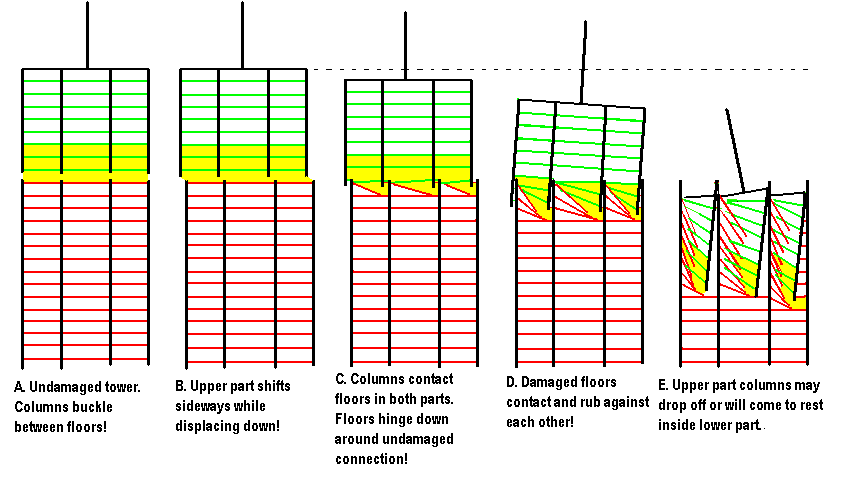
We are Off Topic a long way, but one reason why a one-way Crush down is not possible is the high g-forces applied at contact.
Imagine a part C dropping on part A and that C bounces, as they usually do, when stiff objects collide. Soft objects, like ships, damage each other a little. One-way crush down never occurs.
Stiff C has dropped on A from 3.7 m and has thus velocity v (down) = 8.52m/s at impact with A. After say 0.05 seconds contact with stiff A, stiff C is bouncing up with say velocity v(up) = -0.7 v(down) = -5.97 m/s. The total change in velocity is thus 14.49 m/s during 0.05 s corresponding to a deceleration/acceleration of 290 m/s² or 29.5 g that stiff C was subject to.
Say that C does not bounce up after impact but comes to rest on part A. Only elastic compression/damping takes place. Thus C v(up)=0 after impact. The change in velocity is just 8.52 m/s. Say that it took 0.028 s. The deceleration is thus 304 m/s² or 31g.
Luckily, this high g-force deceleration only lasted 0.028 s, so no damages to A and C took place. On molecular contact level in C and A there was hard work going on that nobody noticed. Actually all energy applied by C at impact was absorbed and converted into heat!
It is why this thread is so hot!
You have just made an argument AGAINST entanglement/friction causing arrest. You're saying that it never should have happened.
You are contradicting previous statements about how you feel the collapse should have arrested.
Are you now going to change your website to reflect that change?
You can't have it both ways either.