• Quick note - the problem with Youtube videos not embedding on the forum appears to have been fixed, thanks to ZiprHead. If you do still see problems let me know.

NIST Releases FINAL WTC 7 Report - Nov. 20

Redibis. You want to rethink that "never before" in history?

http://www.fpemag.com/archives/article.asp?issue_id=27&i=153

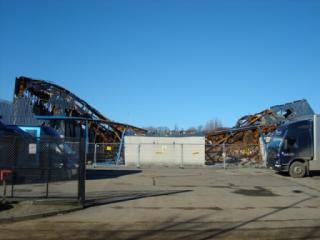
Two large department store fires in Athens, Greece, in 1980 are documented in the paper by Kyriakos Papaioannoa, 1986.4 These fires began at 3 a.m. on Dec. 19, 1980, with arson being suspected as the cause. The Katrantzos Sport Department Store was an 8-story reinforced concrete building. Its fire started at the 7th floor and rapidly spread throughout the building, due to lack of vertical or horizontal compartmentation and the absence of sprinklers. Collected evidence indicated that the fire temperatures reached 1000°C over the 2- to 3-hour fire duration, and the firefighters concentrated on containing the fire spread to the adjacent buildings. Upon termination of these fires, it was discovered that a major part of the 5th to 8th floors had collapsed. Various other floor and column failures throughout the Katrantzos Building were also observed (see Figure 1). The cause of these failures was considered to be restraint of the differential thermal expansion of the structure that overloaded its specific elements or connections. On May 21, 1987, Sao Paulo had one of the biggest fires in Brazil, which precipitated a substantial partial collapse of the central core of the tall CESP Building 2.5 This was a 21-story office building, headquarters of the Sao Paulo Power Company (CESP), after whom the building was named. Buildings 1 and 2 of this office complex were both of reinforced concrete framing, with ribbed slab floors. These two buildings had several unique internal features and contents. Both buildings still retained their original wood forms used for pouring the concrete floor slabs, which were never removed. Low-height plywood partition walls were also used in the interiors. Approximately two hours after the beginning of the fire in CESP 2, its structural core area throughout the full building height collapsed. This collapse was attributed to the thermal expansion of the horizontal concrete T-beam frames under the elevated fire temperatures, which led to the fracture of the vertical framing elements and their connections in the middle of the building, and the consequent progressive loss of gravity load-carrying capacity (see Figure 2).
 
Well seeing as concrete expands LESS than steel. it actually hurts your case. (although they are very close)

:dl:

So instead of admitting your false analogy and failing to provide a comparable example, you choose to post arguably, the most played out, silly gif overused on this forum.

The alternative was for you to admit the two building collapses have almost nothing in common. You went for the cornier option.
 
So instead of admitting your false analogy and failing to provide a comparable example, you choose to post arguably, the most played out, silly gif overused on this forum.

The alternative was for you to admit the two building collapses have almost nothing in common. You went for the cornier option.

As far as thermal expansion is concerned the example is a demonstration of exactly why it's considered in every form of construction. A point which you appear to selectively not understand. You are again playing an extension of that first time in history canard despite having your earlier hypocrisy pointed out:
* WTC7 collapses due to loss of structural integrity caused by thermal expansion.
* Columbia burns up in the atmosphere due to loss of structural integrity caused by foam impact.

* [you deny] that thermal expansion could cause global collapse, because it's never happened before, and because we lack a "critical" and primary piece of physical evidence (column 79), despite acknowledging (or, at least, not denying) that thermal expansion is a known phenomenon.
* [you accept] that a Shuttle can burn up in the atmosphere upon reentry, despite it having never happened before, and despite our lack of a "critical" and primary piece of physical evidence (the damaged wing). He accepts this simply because impact of foam is a known phenomenon.

I really am having a difficult time understanding your position with your apparent differential standards of evidence...
 
Last edited:
So instead of admitting your false analogy and failing to provide a comparable example, you choose to post arguably, the most played out, silly gif overused on this forum.

The alternative was for you to admit the two building collapses have almost nothing in common. You went for the cornier option.


Oh im sorry. you mean when troofers like you point out the windsor tower? and claim its concrete core didnt "globally collapse" along with the steel that did?
 
Well seeing as concrete expands LESS than steel. it actually hurts your case. (although they are very close)

:dl:

Here's a good source to corroborate this too :)


"Structural steel members embedded in exterior masonry walls expand and contract due to temperature variations. However, steel and masonry expand at different rates. Steel experiences a volumetric change 40% to 50% greater than masonry. The volumetric change between the two systems is further enhanced when both sides of a steel beam are exposed to the exterior environment, such as a steel beam supporting masonry over an entrance portico"
 
Here's a good source to corroborate this too :)


"Structural steel members embedded in exterior masonry walls expand and contract due to temperature variations. However, steel and masonry expand at different rates. Steel experiences a volumetric change 40% to 50% greater than masonry. The volumetric change between the two systems is further enhanced when both sides of a steel beam are exposed to the exterior environment, such as a steel beam supporting masonry over an entrance portico"
I once saw a documentary on a bridge being constructed. The concrete slabs were actually on rollers on top of the steel support structure, so as the steel and concrete expanded and contracted at different rates they could simply roll past each other.
 
We are talking 3D steel column/beam structures with correct joints. No classic total collapse, ever. Just local failures - some beams overloaded. No big deal!

You lied that NIST made up progressive collapse and that it had not happened before. The fact you had no more credibility to lose is pretty sad actually.

 
RedIbis, why do you think structural engineers aren't rushing to the truther cause?

Note to all: RedIbis won't answer this question.
 
RedIbis, why do you think structural engineers aren't rushing to the truther cause?

Note to all: RedIbis won't answer this question.

But they are! Haven't you ever heard of AE911Truth? They have such structural engineers as that guy who believes the towers were blown up using nuclear weapons.
 
RedIbis, why do you think structural engineers aren't rushing to the truther cause?

Note to all: RedIbis won't answer this question.

Well he cannot admit that the Columbia illustration is analogous or that steel actually can expand and affect its ability to carry a load so why would he admit that only a few loons in the engineering community bother to side with the TM?
 
Well he cannot admit that the Columbia illustration is analogous or that steel actually can expand and affect its ability to carry a load so why would he admit that only a few loons in the engineering community bother to side with the TM?

Does he truly believe that steel can't expand at all? If not, then I will direct his attention to many of our bridges, which are steel and concrete.

When you're driving on the road right before you get to one and after you leave it, notice how there's two steel interlocking "teeth" across the entire road with a gap in it.

Now if steel can't expand (even just through the normal temperature fluctuations during the course of a day), then why design these expansion slots to begin with?

I await Red's answer to this.

EDIT:

Picture of the expansion joints I'm talking about:
ExpansionJoint_withcar_510.jpg
ExpansionJoint.gif


http://www.henneganandassociates.com/expansion_joints.htm

News article about a bridge being shut down because of a failed expansin joint. If steel doesn't expand and these expansion joints aren't needed according to Red, then why would officials block off a bridge when one failed?
http://blog.pennlive.com/lvbreakingnews/2008/03/tatamy_bridge_closed_due_to_ex.html
 
Last edited:
And Concrete does as well. Which is whyl, if you notice on overpass freeways, you see little 'rubber' sections in between the different sections. this allows for the concrete to expand and contract during the times of day.
 
And Concrete does as well. Which is whyl, if you notice on overpass freeways, you see little 'rubber' sections in between the different sections. this allows for the concrete to expand and contract during the times of day.

That is true too. Otherwise if it didn't, the steel imbedded inside it for strength would just start breaking it apart after a much lower amount of thermal expansion cycles.
 
Note to all: RedIbis won't answer this question.

He reminds me of those kids in America's Funniest Videos, the ones getting caught painting the whole room with crayons, their faces all dirty with it, the mom asking "Did you do this?" and the kid says "No", expecting she doesn't notice.

All these crucial questions he didn't answer, does he really think nobody noticed?
 
Last edited:
Doesn't look like a classic total collapse to me! Left side remains standing, etc.


this doesn't look like a global collapse to me either Anders. Sections of the north and south tower still standing circles in yellow. and a few even survived the collapse in a core stairwell. Guess you cannot use that old "global" canard anymore? can ya?

wtc_overview_west_1-1.jpg
 

Back
Top Bottom