A W Smith
Philosopher

Math for the pole entering the car? How old are you? Check out the
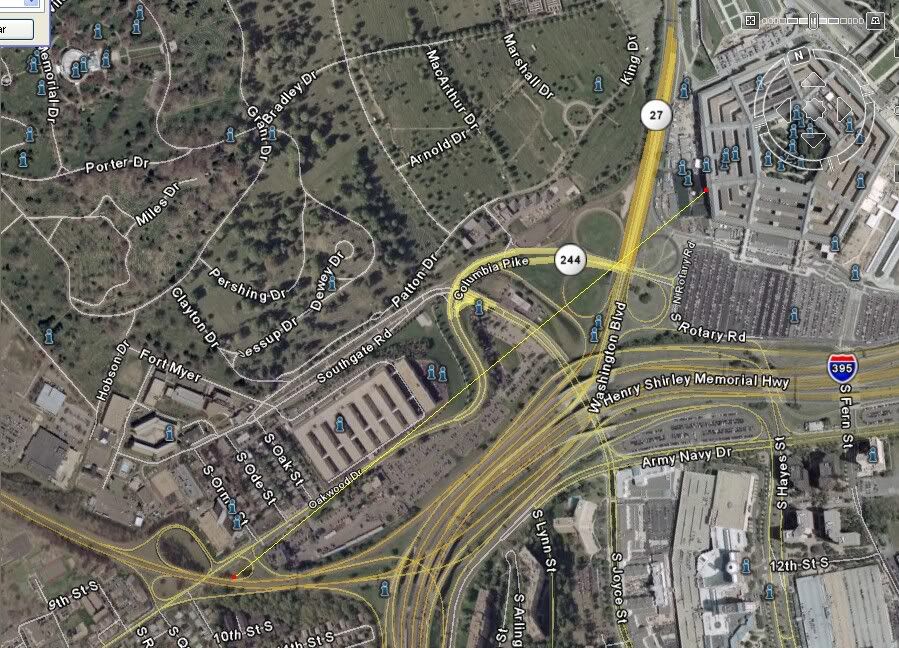
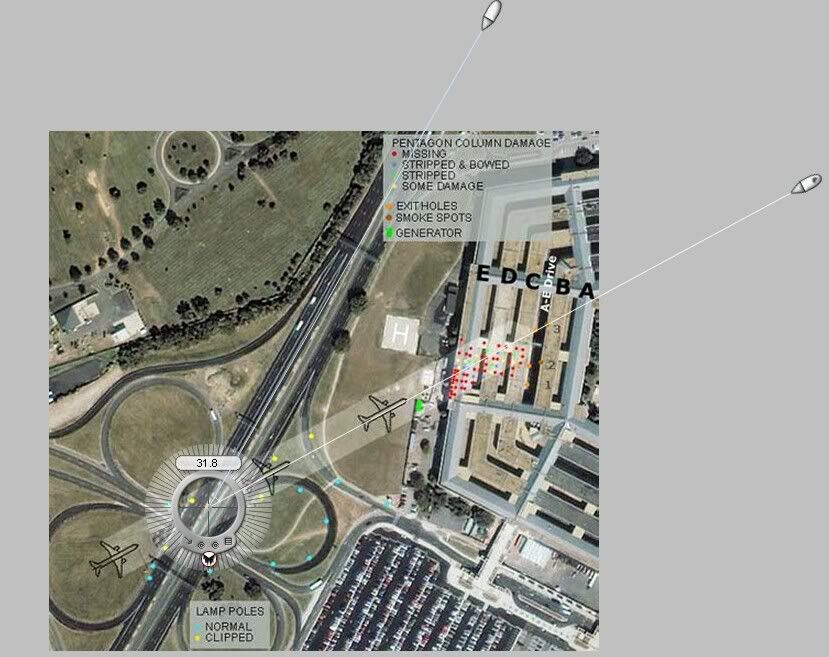
orientation of the road and alleged damage path. How does the pole
falling in a diagonal direction enter the cab which is on a huge angle?
Please explain mr math?!
define "huge angle" mr argument from ignorance,
And Furthermore;;
From Caustic Logic
http://i133.photobucket.com/albums/q62/chainsawmoth/FrustratingFraud/Crime_Scene_fakery_1.jpg
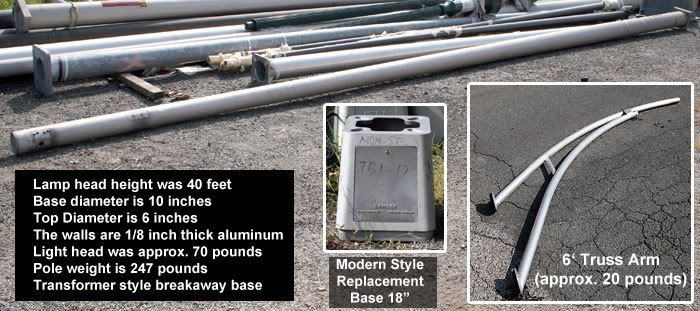
Russel Pickering's analysis at PentagonResearch.com found that they were 27.66 feet high, made of .188 inch-thick aluminum, 8 inches in diameter at the base and 4.5 inches at the top and topped with 70 pound lampheads. The reason the wings wouldn't be damaged is because the use of a "breakaway style" pole design. As Pickering explains: "this limited damage factor is why the FAA requires these type of poles in the "safety zones" around airports and helipads. They recognize that this type of pole minimizes damage to aircraft." He cited the FAA's rules: "any structure located within 250 feet of runway centerline has to be frangible, which means the structure needs to break away when hit by an aircraft to minimize damages to the aircraft and its pilot."
more at pentagon research
http://www.pentagonresearch.com/lamps.html
LAMP POLES
5 aluminum lamp poles were knocked down preceding the Pentagon wall. Through contact with the VDOT, the distributors and manufacturers of the poles used in the area I have been able to determine the following basic information.*
1) The poles were breakaway style on a 18 inch transformer style base. This means that at 23 inches off the ground the pole would be broken by a Volkswagen Rabbit traveling 20 mph.
2) The poles themselves were 27.66 feet high with a weight of approximately 175 pounds.
3) The truss style mast arms were 8 foot long with a rise that brought the pole height up to 30 feet. The mast arm weighs between 15-20 pounds.
4) The lamp head weighs approximately 70 pounds.
5) The aluminum on the poles was .188 of an inch thick. The pole was 8 inches in diameter at the base and 4.5 inches in diameter at the top.
Since the light poles are the first physical damage we encounter at the Pentagon I will break the rest of this page into a consideration of them in light of a plane and a no-plane point-of-view. This is very important in order to continue on into the rest of our investigation. The damage preceding the Pentagon wall has to be logically accounted for in either scenario.
[SIZE=+1]PLANE[/SIZE]
At the speed of 345 mph which was recorded by the recovered AA77 flight data recorder, the leading edge of the wing could slice through the approximately 5 inch diameter pole (at that height) with .188 of an inch thick aluminum walls like butter. This would cause the top half of the pole to pop up over the wing and essentially fall straight back down, which is effectively what we see with all the poles in the photos. The bottom half of the pole would have been driven forward with little resistance. If a VW Rabbit can break one at 20 mph 23 inches off the ground then it takes significantly less force with the leverage effect of being hit higher up. This may be why we have minimal wing debris on the ground.
This limited damage factor is why the FAA requires these type of poles in the "safety zones" around airports and helipads. They recognize that this type of pole minimizes damage to aircraft, "FAA regulation requires any structure located within 250 feet of runway centerline has to be frangible, which means the structure needs to break away when hit by an aircraft to minimize damages to the aircraft and its pilot." (Source)
One of the most commonly reported features in the eyewitness reports was the aircraft impacting light poles. In conjunction with the reported striking of the poles many eyewitnesses mentioned a change in the sound of the engines. Some described it as the engines being "revved up" or the aircraft going to "full-throttle".
The minimum wingspan required to create the pole damage was approximately 100 feet. The maximum wingspan before you would have had additional poles impacted is approximately 140 feet. The wingspan of a 757-200 is 124 feet 10 inches. This accounts for the minimum of 100 feet and allows for a 16 foot tolerance which is exactly what we see in the diagrams.
The first pole impact occurred at approximately 1000 feet prior to the Pentagon wall. 345 mph is 506 per second. That means it would have been roughly 2 seconds with the aircraft being driven by momentum between the first pole and the wall. There would not have been the force or the time for the pole damage to cause a deviation in the flight-path.
Last edited: