
Based on CIT's nonexistent learning curve, you can repost this in 13 years when CIT celebrates 20 years of hearsay, and made up flight paths.About a year ago I speculated that the shadow of the plane might have passed north of the Citgo, which given the speed of the plane and the various view obstructions such as the Citgo canopy, might have caused some of the witness' confusion about the plane's exact path.
At the time, working from the "official" flight path, I ended up concluding that the shadow would still have been too far south to be north of the Citgo, and discarded the hypothesis.
However, since that time I've learned more about the range of uncertainty of the actual path and the altitudes and rates of descent in that region. For instance, the approximately 10 degree bank at impact suggests that the plane was indeed turning slightly to the right, indicating that it came from a slightly more northerly direction in the final few hundred feet. So, the hypothesis that the plane's shadow passed over or slightly north of the Citgo station building turns out to be plausible (though far from proven) after all.
Respectfully,
Myriad

-
Security incident: ISF was recently accessed by intruders. Please change your password, and change it anywhere else you used it. Read more
You are using an out of date browser. It may not display this or other websites correctly.
You should upgrade or use an alternative browser.
You should upgrade or use an alternative browser.
Challenge to CIT
- Thread starter Reheat
- Start date
-
- Tags
- cit edward paik pentagon
That is a great thread!
At least at ATS he doesnt have mods banning people who disagree with the CIT.
It is refreshing to see Craig squirm.

Based on CIT's nonexistent learning curve, you can repost this in 13 years when CIT celebrates 20 years of hearsay, and made up flight paths.
Well, that's as may be, but in this particular issue I wasn't trying to teach the CIT folks anything, but rather, trying to find the best fit scenario to fit the available information including all of the witness statements. Knowing that when witness statements contradict one another, some must be mistaken, it's reasonable (though often difficult) to take into account plausible reasons why a given witness might be mistaken in a given recollection.
At first glance, the hypothesis that some witnesses reacted initially to the plane's shadow seemed promising. On further examination, based on the information I had available at the time, I had to reject it. With additional information since then, it appears my rejection of it was premature and it might be worth another look.
That's all. Because my initial calculations did not support the hypothesis that the shadow could have passed over or north of the Citgo, I never even discussed it with CIT, so there's no particular reason for them to be cognizant of it.
Respectfully,
Myriad

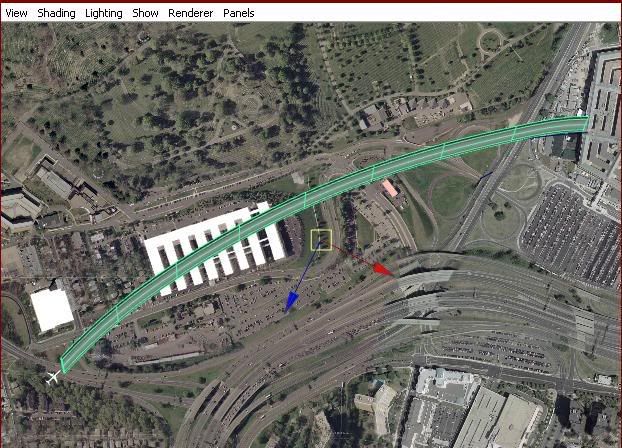
A prize of 1 twoofer $ goes to the first person who correctly calculates the bank angle/G forces required for making the turn depicted in this diagram at 350 KIAS (the Minimum speed Morin estimated).
http://i14.photobucket.com/albums/a327/lytetrip/Pentagon/flight%20path/NorthPath_CIT.jpg
Reheat, you are doing a tremendous job here. Wow!--just, wow!
Last edited:
2.66 Gs. 68 degree of bank
just the whole path as if the plane was already in the bank
not seen on 9/11, boy those wing would be bening up a lot
$ please
This means Paik would be looking up at a wingtip and along that wing to see the plane, wow, this would be the first time he had seen a 68 degree bank turn of an airliner (most likely, and the last time)
just the whole path as if the plane was already in the bank
not seen on 9/11, boy those wing would be bening up a lot
$ please
This means Paik would be looking up at a wingtip and along that wing to see the plane, wow, this would be the first time he had seen a 68 degree bank turn of an airliner (most likely, and the last time)
Last edited:
2.66 Gs. 68 degree of bank
just the whole path as if the plane was already in the bank
not seen on 9/11, boy those wing would be bening up a lot
$ please
By golly you're close. It's amazing what a little bit of aerodynamic knowledge is worth. There are still some assumptions as the bank would already have to be established and what about the roll out/pullup by Washington Blvd which would make the bank/G even more.
I got 2.7 G's, but what's one tenth among friends.
You are awarded the 1 $ twoofer $, pay up CIT. YOU LOST.
A W Smith
Philosopher

What was the radius of that turn? That looks sharper than the turn i got 3.18G on
Confuseling
Irreligious fanatic
- Joined
- Feb 26, 2008
- Messages
- 1,243
So that's double corroborated then.

I was using 4300 feet or so. I do not claim exact, but close.What was the radius of that turn? That looks sharper than the turn i got 3.18G on
There is roll in time, and you have to give me 2 seconds or so before the turn starts, so the actually path has a lot more to it. And a lot more turn will not fit the CIT story book.
They are also trying to say any bank at all kills the official story. But the official story contains bank angles of up to 10 degrees in the last 20 seconds and those angles give you a heading difference of 1 or 2 degrees in 3 to 5 seconds, not much of turn.
A 757 could roll to 60 degree and pull 2 gs. On 9/11 77 in the last 20 second did not go over 10 degree of bank (or was it 11), and the witnesses confirm the FDR.Ok I am blond.
Can you elaborate on what would have happened to flgiht 77 during a 2g turn or bank?
Can a plane that large even make such a turn or bank?
I have seen banks of over 60 degrees while refueling but we were pulling ~1 g and doing very precise turns while in contact, refueling as confidence maneuvers for instructor upgrade. We were big planes a KC-135 and a B-52.
757 can pull 2 gs, and is most likely limited to 2.5 g, but the wings may be able to handle up to 6 before they fail. (based on 777 test; think it failed at 7 g). The CIT using witnesses who said no bank or little bank proves all their non-paths impossible for NoC. They also refuse to use the positions their witnesses us to place the path. Paik as 77 near the tower, but CIT uses over his work! They also have a basic hatred of math, physics and geometry refusing to recognize parallel. I have never seen anyone as dumb on these topic who claim to be researchers.
Ok I am blond.
Can you elaborate on what would have happened to flgiht 77 during a 2g turn or bank?
Can a plane that large even make such a turn or bank?
Follow on to Beachnut's answer:
It's not just the 2+ G's that are the problem. In order for the aircraft to pull 2 G's for more than a second or two it must be at 60 degrees of bank or it will climb. Everyone who saw that kind of bank that close to the ground would have been astounded and undoubtedly would have mentioned it. As it flew over/beside (depending on viewing angle) they would have been looking at either the top or bottom of the aircraft. That kind of maneuver in that size aircraft WOW's! spectators at airshows.
A 757 has a ~124' wingspan. Terry Morin said it was 50-100' as it flew over him, so the inboard wingtip would be awfully close to the ground at 60 degrees of bank. Notice in the diagram posted above CIT has the aircraft in that kind of bank from PRIOR TO Paik's position all the way to the Pentagon.
What about the sign on Washington Blvd. that Robert Turcois said the aircraft pulled up to avoid? How did it pull up to avoid the sign in a 60 degree bank? It would have either needed to roll out of the bank to pull vertical G's (and pass north of the impact point) or it would have needed to pull additional G's while in the turn, over stressing the aircraft.
One more point, while we're on the subject. CIT is going to say the aircraft was traveling ~300 KIAS in order for this to work. That speed violates what every single one of their witnesses said. All of the witnesses said it was traveling at high speed. CIT has argued for over a year that it was at high speed in order for the deception to fool viewers. Now, they change their mind when they discover it won't work.
How their supporters can continue to believe their tripe as they violate everything their witnesses say EXCEPT one item, is further evidence of the BM's CULT STATUS.


jaydeehess
Penultimate Amazing

A 757 has a ~124' wingspan. Terry Morin said it was 50-100' as it flew over him, so the inboard wingtip would be awfully close to the ground at 60 degrees of bank. Notice in the diagram posted above CIT has the aircraft in that kind of bank from PRIOR TO Paik's position all the way to the Pentagon.
If my quick trig is correct
(0.5)124sin(60)= 53 feet closer to the ground than the center of the fuselage
So the plane would have to be greater than 50 feet agl and 50 above all other ground obstacles such as cars and buildings. Even at 100 feet any building hiher than 4 stories is going to be in strike range of a 124 foot wingspan plane in a 60 degree bank
If my quick trig is correct
(0.5)124sin(60)= 53 feet closer to the ground than the center of the fuselage
So the plane would have to be greater than 50 feet agl and 50 above all other ground obstacles such as cars and buildings. Even at 100 feet any building hiher than 4 stories is going to be in strike range of a 124 foot wingspan plane in a 60 degree bank
My rough estimate says you're pretty darn close. Only problem is you're forgetting about the new compact fold-up wings Robbie has up his sleeve at pfffft!

"companct fold-up wings"?
Yea, they fold up kinda like a portable lawn chair designed specifically for 9/11 so the decoy aircraft could go North of the Citgo, not scrape a wingtip, and conceal the "airshow" banks it needed at low level. They must have worked because NOBODY saw that!
