• Security incident: ISF was recently accessed by intruders. Please change your password, and change it anywhere else you used it. Read more

Question for Apollo20

A paper?

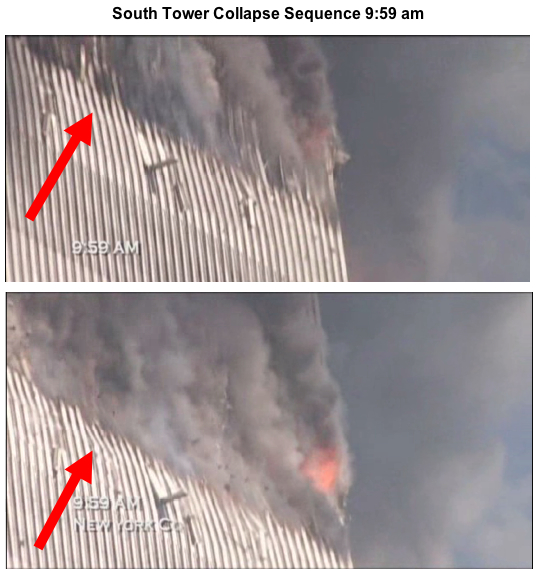
We are talking about a paper (Bazant's) which relies on perimeter buckling, even though a photographic mapping of the crime scene capturing hundreds of these perimeter column-spandrel plate pre-fabricated sections shows no such buckling.


And you want me to "write a paper" about it?

No, I guess what I want you to do is rather than bitch and whine about the alleged short comings of his paper, take your superior knowledge and write up a paper showing what "really" happened with the towers, and submit it to the same journal and others.

TAM:)
 
Ah, now I understand the sense of deja vu.

Month and a half goes by, Major Tom reappears, and says absolutely the same nonsense he did before. Gets the same answers as before, still learns nothing.

Consistency is not a virtue if one is wrong, Major Tom. Please take this as my very, very last invitation to you to educate yourself.
 
No buckling here. Nosiree.

879045fd54c927534.jpg
 
Gravy, The Bazant model is meant to explain PROGRESSIVE collapse. It predicts buckling along the perimeter during the crushing effect of the upper block.

After that first set of buckles you show you have quite a few more to go to explain the 80 floor "collapse" to follow.

The Bazant model predicts buckling to occur to the columns of the "lower block" being crushed.

The photo album mentioned before shows that the buckling of perimeter columns on the "lower block" never occurred.


Are you following the argument?
 
Last edited:
Gravy, The Bazant model is meant to explain PROGRESSIVE collapse. It predicts buckling along the perimeter during the crushing effect of the upper block.

After that frist set of buckles you show you have quite a few more to go to explain the 80 floor "collapse" to follow.

The Bazant model predicts buckling to occur to the columns of the "lower block" being crushed.

The photo album mentioned before shows that the buckling of perimeter columns on the "lower block" never occurred.


Are you following the argument?

I admit I've come in late to this thread, but why would they be saying that the collumns were buckling all the way down?

Wasn't the falling mass of the top of the building enough to sever the joints connecting the trusses of the lower floors to the exterior collumns and cause the collumns to fall away?

As I understand it, once the floors are detached and the collumns are no longer connected to the roof hat-truss, there is nothing holding them up and they are pushed outwards by the violence inherent in the system(sorry, couldn't help myself).

As usual, please note I am a total non expert in these things, but that is my layman's understanding of it.
 
Ground Control to Major Tom:

Take some protein pills and put your thinking cap on!

Bazant's 1st paper considers buckling as a POSSIBLE collapse mechanism. And please note that column buckling is probably the most energy INEFFICIENT mode of collapse. Nevertheless, it turns out (as Bazant proves!) there was still enough KE in the upper descending mass to overwhelm the resistance to buckling.

Now it may well be true that the towers failed more by weld and bolt failures at the column splices than by column buckling. That was not predicted by Bazant, but that does NOT invalidate Bazant's paper! It simply shows that the splices were the weakest link in the chain holding up the buildings. And perhaps this observation raises questions such as: Were the core columns only tack welded? Should the welds have been stronger? Etc.............
 
Ground Control to Major Tom:

Take some protein pills and put your thinking cap on!

Bazant's 1st paper considers buckling as a POSSIBLE collapse mechanism. And please note that column buckling is probably the most energy INEFFICIENT mode of collapse. Nevertheless, it turns out (as Bazant proves!) there was still enough KE in the upper descending mass to overwhelm the resistance to buckling.

Now it may well be true that the towers failed more by weld and bolt failures at the column splices than by column buckling. That was not predicted by Bazant, but that does NOT invalidate Bazant's paper! It simply shows that the splices were the weakest link in the chain holding up the buildings. And perhaps this observation raises questions such as: Were the core columns only tack welded? Should the welds have been stronger? Etc.............

Apollo20, the welds fail because they are a dis-conformity in the structure, the Columns were heat treated steel, there is no physical way to make a perfect weld there will always be some dis-conformity between the weld and the material to which the weld is attached.

In other words the welds are always be weakest link in the columns. Swift compression waves can open manufactures in the welds pretty easily, however that compression has to come down the beams from the top.

Under stress micro fractures will grow fairly rapidly, also these columns are over 40 years old what is the likelihood that they might have had micro fractures from just normal motion in the structure?

Compression waves travel at 5100 meters per second in steel, the steels Electron structure rebounds back at exactly the same speed.
IT is the rebounding action against the weld at the dis-conformity of the weld that shatters the welds connection and creates the micro Fracture that damages the Columns.
Think of the columns as a set of rubber splices set on top of one another, held together by Elmer's glue,-the welds, and you will see how the compression and shock waves rebounding will effect the welds.
The Columns actually jump upward as the momentum energy is absorbed and released.
When running heavy equipment you learn about the rebounding of steel fast, it is how you can break something easily, steel under pressure can fail if the pressure on the steel is released to quickly learning to be patient is the hardest part to being a good equipment operator.
Think of each Column section as a separate spring with limited motion, touching at the welds and you will see the Idea. The speed of the rebounding energy simply does not travel though the weld as fast as it does though the Column sections creating a pushing effect of Column on column joint.
 
Did core columns have superficial welds?

Now it may well be true that the towers failed more by weld and bolt failures at the column splices than by column buckling. That was not predicted by Bazant, but that does NOT invalidate Bazant's paper! It simply shows that the splices were the weakest link in the chain holding up the buildings. And perhaps this observation raises questions such as: Were the core columns only tack welded?
[bold mine]


The FEMA ground zero photos (photo set #1391) show many welds clearly, and my non-expert eye was really struck by how superficial the welds were.

For example, massive box columns only had very shallow fillet (?) welds on the two long sides.

They make me think of two little beads of Elmer's glue.


Perhaps some kids were playing whiffleball and...
 
Last edited:
[bold mine]


The FEMA ground zero photos (photo set #1391) show many welds clearly, and my non-expert eye was really struck by how superficial the welds were.

For example, massive box columns only had very shallow fillet (?) welds on the two long sides.

They make me think of two little beads of Elmer's glue.


Perhaps some kids were playing whiffleball and...

No max the perimeter columns were tack welded the core Columns were contiguously welded, however there is no way to prevent some layering in the welded structure.

The fillet look was simply an outer defect in the weld that was not compressed because it was on the outside of the weld.
 
Some 8th grade High School Science should help this discussion.

http://mrsec.wisc.edu/Edetc/IPSE/educators/amMetal.html

Crystalline materials are the opposite of amorphous. They have a regular atomic structure where the atoms are neatly arranged with a simple organization that can be described by a unit cell. The face-centered cubic (fcc) model built with the Solid State Model Kit is an example of one such unit cell. Although we often do not think of them that way, most metals are crystalline. They are often polycrystalline, meaning that they contain many individual crystals packed together in what is call a grain structure. This crystallinity is what gives metals much of the familiar behaviors we associate with them, such as malleability and ductility.

Most crystalline solid structures contain missing atoms, called defects, impurity atoms of other elements, and misaligned planes of atoms called dislocations. Impurity atoms, defects, and dislocations all have an important impact on the physical and chemical properties of the solid. For example, copper wire is easy to bend because the structure contains planes of atoms that can slip easily past one another. The planes that dislocations move along are called slip planes. A slip plane can be observed in the face-centered cubic (fcc) model by picking up one of the bottom corners of the model so that half of the model slides up. Amorphous materials do not contain such planes.

Many students have heard of atoms, but few have an understanding of how the arrangement of atoms can affect the properties of materials. In addition, most students do not know what the word amorphous means. Our goal is to introduce the concepts of crystalline and amorphous structures and the link between structure and properties. Students should be encouraged to come up with different experiments after observing and discussing the differences between the two materials.

One difference that can be observed by the students is the pits that have been made in the steel base where the ball has bounced on it. These pits are a direct result of the impact producing many dislocations and causing permanent deformation. If the ball starts out with an initial amount of kinetic energy then some of the energy lost with each bounce goes into the movement of the dislocations, the misaligned planes of atoms. Such pits are not seen in the amorphous metal because the random arrangement of atoms in this material precludes dislocations. Thus energy is not lost in the movement of dislocations in the amorphous material.

There are several ways in which the ball loses kinetic energy: sound, random collisions with the sides of the tubes, and friction with the air. Assuming these factors are the same, on average, for both bases, the difference in the bouncing of the ball must be due mainly to the difference in energy transfer between the ball and each surface. The fact that the ball bounces longer on the amorphous metal surface indicates a much different energy transfer interaction than that of the stainless steel base. The difference in "reboundability" (coefficient of restitution) of the ball bearing with each metal surface is due to differences in how the atoms pack.

The coefficient of restitution represents the degree to which an impact is elastic. Upon collision, one or both of the objects mar deform, and this deformation may be elastic or plastic (permanent). A perfectly elastic impact, in which the kinetic energy loss is zero, would have a coefficient of restitution of one. A perfectly inelastic impact, where all of the energy goes into plastic deformation, will have is no rebound and a coefficient of restitution of zero. The coefficient of restitution can be determined for the two cases in this demonstration by measuring the height from which the ball is dropped (h1) and the height of the first bounce (h2).

Coefficient of Restitution = e = (h1/h2)1/2

Stainless steel is a crystalline metal made primarily from iron with a few percent of additional elements such as carbon, chromium, and sometimes nickel. Steel has an ordered, repeating pattern of atoms, while the Vitreloy amorphous metal is comprised of five elements (41.2% zirconium, 22.5% beryllium, 13.8% titanium, 12.5% copper, and 10.0% nickel). The different atomic radii of atoms in Vitreloy promote its highly disordered arrangement. The different sized marbles in a jar can be used to represent this amorphous arrangement of atoms. With all of the different atomic sizes it is difficult for the atoms to pack neatly.


It is important to note, however, there are many amorphous materials that are not made up of a collection of differently sized atoms. When a material is molten the atoms are farther apart because they have more thermal energy, their arrangement is irregular and random. If a material can be frozen (i.e. quenched) into the solid state fast enough, crystallization can be prevented and the random arrangement can be trapped in a tightly-packed solid form. This occurs because the atoms do not have enough time to arrange themselves in an ordered structure.

Because there are no planes of atoms in an amorphous material, the atoms are gridlocked into the glassy structure, making the movement of groups of atoms very difficult. One consequence of this atomic gridlock, is that some amorphous metals are very hard. Vitreloy is more than two times harder than stainless steel. However, besides being a very hard material, this amorphous alloy has a low elastic (or Young's) modulus.

Demonstrate the relationship between wavelength and frequency by watching the ball bounce on the amorphous metal surface. Explain that the distance the ball travels in one bounce represents the wavelength of a photon of electromagnetic radiation. The time it takes for the ball to bounce once represents the frequency of the photon. As the "wavelength" decreases the frequency of the bouncing ball increases demonstrating the inverse relationship of the formula c = ln.

By the end of the 8th grade, students should know that:
Energy cannot be created or destroyed, but only changed from one form into another.
Energy appears in different forms. Heat energy is in the disorderly motion of molecules; chemical energy is in the arrangement of atoms; mechanical energy is in moving bodies or in elastically distorted shapes; gravitational energy is in the separation of mutually attracting masses.

 
Ultra sonic welding techniques were not around in the 1970s, so dislocations would have been present in the welds.
Such dislocations can form into micro fractures during rebounding from compression, though crystalline grain separation.
 
Apollo20 writes:

Bazant's 1st paper considers buckling as a POSSIBLE collapse mechanism.


Buckling, or failure of an over-stressed column, considered a POSSIBLE collapse mechanism?

What other collapse mechanisms did he have in mind?

It's a real simple rectangular building consisting of core columns, perimeter pre-fabricated column sections and floors.

So what other possibilities does Bazant have in mind?

Real simple:

1) perimeter buckles

2) core columns buckle

3) floors fall


Apollo20, there's really not much more to it than that. So if Bazant considers buckling to be a POSSIBLE mechanism, he doesn't have a whole lot of other choices after he eliminates #1 and #2 from the list above.


Apollo20 then writes:

And please note that column buckling is probably the most energy INEFFICIENT mode of collapse.


Please let me know what the basic "modes of collapse" are. Again, we have a rectangular building consisting of 3 basic elements.


We are not delving into the structure of a nucleus here or trying to visualize electron spin.

It should be very easy to explain, in simple terms and a few pencil-sketched drawings what these limited and basic "modes of collapse" are.


Apollo20 concludes:

Now it may well be true that the towers failed more by weld and bolt failures at the column splices than by column buckling. That was not predicted by Bazant, but that does NOT invalidate Bazant's paper!

But it does. If we compare "modes of collapse" with with the actual forensic evidence seen in the detailed mapping of the entire "scene of the crime", we will see whether these "modes of collapse" exist only in our imagination or whether these is actual froensic proof backing the theorized "mode".
 
Last edited:
Apollo20 writes:


Buckling, or failure of an over-stressed column, considered a POSSIBLE collapse mechanism?

What other collapse mechanisms did he have in mind?

It's a real simple rectangular building consisting of core columns, perimeter pre-fabricated column sections and floors.

So what other possibilities does Bazant have in mind?

Real simple:

1) perimeter buckles

2) core columns buckle

3) floors fall


Apollo20, there's really not much more to it than that. So if Bazant considers buckling to be a POSSIBLE mechanism, he doesn't have a whole lot of other choices after he eliminates #1 and #2 from the list above.


Apollo20 then writes:


Please let me know what the basic "modes of collapse" are. Again, we have a rectangular building consisting of 3 basic elements.


We are not delving into the structure of a nucleus here or trying to visualize electron spin.

It should be very easy to explain, in simple terms and a few pencil-sketched drawings what these limited and basic "modes of collapse" are.


Apollo20 concludes:


But it does. If we compare "modes of collapse" with with the actual forensic evidence seen in the detailed mapping of the entire "scene of the crime", we will see whether these "modes of collapse" exist only in our imagination or whether these is actual froensic proof backing the theorized "mode".


It's very simple, after the collapse initiates, the columns are subjected to small lateral out of plane forces which break the columns at their splices. It takes a whole lot less energy than to buckle the column (and conviently, would happen at the earliest stages of column failure).
 
Thanks, NB

Now how about the perimeter webbing and the open office flooring?

I'm referring to the perimeter and core columns. Even if not subjected to lateral forces large enough to shear the column splices, the mechanism of buckling would introduce large bending moments at the column splices which would cause them to break long before the column underwent any serious deformation.

The floors would becomes disconnected from the columns and get broken up into large and smaller pieces and fall through the slabs of the floors below. The idea that the floor slabs remain relatively intact and impact each consecutive floor one after another isn't really based in reality, it's just something we do to make understanding the building and modelling in mathmatically somewhat easier. But only in the realm of Wiley Coyote does the slab stay intact through the descent.
 
Newtons Bit:

Thanks!

And if Major Tom wants another collapse mechanism he should try reading Cherepanov's papers dealing with fracture waves.....
 

ISF - Join now!

Every member here is approved by hand. No bots, no spam, just people who care about evidence and honest debate.

Membership is free!

Create your free account

Back
Top Bottom