• Quick note - the problem with Youtube videos not embedding on the forum appears to have been fixed, thanks to ZiprHead. If you do still see problems let me know.

I need all debunkers I can get!

1. Normally steel structures do not collapse due to heat. Everything else burns leaving a steel skeleton!

I see. In that case I look forward to a detailed rebuttal of the various points put to you in my post regarding fire testing of steel and building regulations. Because if you cannot do that, then a major part of your argument fails


2. Local collapse of any steel part of WTC1 is not expected in WTC1 given the circumstances. If for any reason, e.g. bad steel/workmanship/quality, a single part (a column?) would locally collapse releasing energy, the redundancy ensures that no progressive collapse would occur, i.e. the energy released is absorbed by the intact adjacent structure. The local collapse is then arrested.

You've not responded to my point regarding the capacity of the structure to transmit such loads, pending which you are indulging in nothing more than unsubstantiated speculation.
 
Yes, you do know a little, and you're making a fool of yourself before people who know a lot.

I think you're smart enough to understand the principles involved, Heiwa, but you have a strange compulsion to try to make reality fit your beliefs. That will never happen as long as you believe in nonsense.

Muezzin muddle - haven't I heard it before.
 
That much is very apparent. The problem is that you believe "knowing a little" is enough. And not just enough, you seem to believe that "knowing a little" somehow puts you far ahead of those who know a lot, from specific education and experience.

Where do you get off with such arrogance?

More muezzin muddle. Empty echo!
 
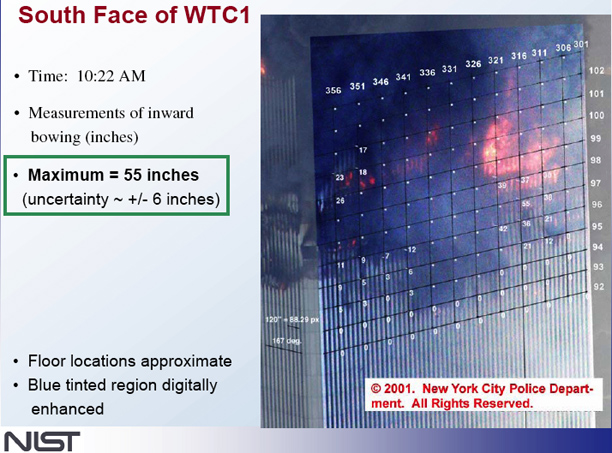
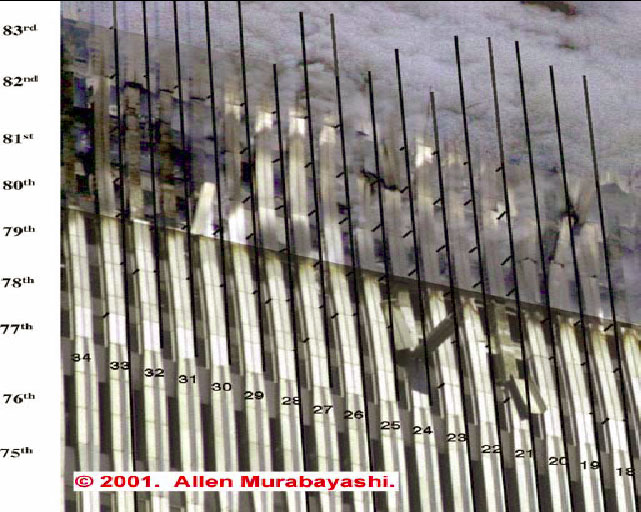
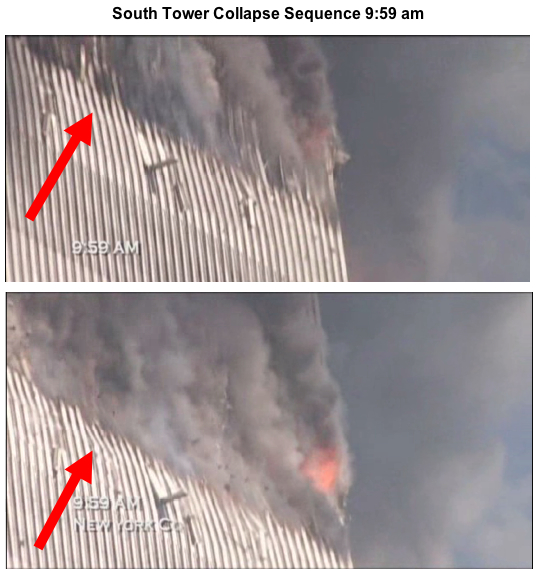
Wall perimeter columns bending inward? Based on the available loads/stresses/cross areas/slenderess ratios and boundary conditions it is unlikely that it would occur. It is recommended to check the videos and photos again.

It is recommended that you post your calculations in respect of loads/stresses/cross areas/slenderess ratios and boundary conditions in order that we can look at them in detail. And in anticipation of glaring errors.
 
It is recommended that you post your calculations in respect of loads/stresses/cross areas/slenderess ratios and boundary conditions in order that we can look at them in detail. And in anticipation of glaring errors.

Please, it is recommended to read my article - all the info is there. http://heiwaco.tripod.com/nist.htm .

You are supposed to debunk the content of the article. How can you do it if you do not read the article?
 
I see. In that case I look forward to a detailed rebuttal of the various points put to you in my post regarding fire testing of steel and building regulations. Because if you cannot do that, then a major part of your argument fails


You've not responded to my point regarding the capacity of the structure to transmit such loads, pending which you are indulging in nothing more than unsubstantiated speculation.

I think my article is quite clear in these respects (fire testing/load transmission) and that your points are not helpful. But thank you anyway.
 
Please, it is recommended to read my article - all the info is there. http://heiwaco.tripod.com/nist.htm .

You are supposed to debunk the content of the article. How can you do it if you do not read the article?

With the deepest of respect there have been a series of substantive technical points put to you by myself and Newton. You have failed to respond in any meaningful or professional manner to any of them.

The item at hand is a case in point; you have not, in fact, provided any calculations to support your assertions regarding the ability (or otherwise) of the external envelope to deflect in the absence of restraint yet you nevertheless refer readers back to same when the issue is raised.

Likewise the ability of structures to resist normal fire loadings is based on nothing more than your own personal incredulity. It is unsupported by the technical data and links which I posted, all of which are beyond reproach.

Under these circumstances one can only speculate as regards your apparent reluctance to engage fully with the technical issues at hand, however it certainly would lead the reader to query your grasp of the complex issues at hand and perhaps your desire for the failure to suit some preconception you might have hard regarding a conspiracy.

And before you get uppity about credentials, be aware that the Mods have had sight of sufficient information to confirm my own qualifications in the field.
 
Last edited:
More muezzin muddle. Empty echo!


No, it's not. I want to know why you feel that "knowing a little" makes you better able to analyze the structural response of the towers than the folks at the NIST, or even the members here who deal with these things as part of their daily job.

Surely you must realize that you're dismissing, out-of-hand, information from individuals much more knowledgeable than you about this specific subject, correct? I want to know why you think that's OK.
 
Last edited:
Hell what would all us qualified people know. It's not like we actually work on this kind of thing.

(cough)
 

Attachments

  • gravity2.jpg
    gravity2.jpg
    95.4 KB · Views: 9
debunked

Please, it is recommended to read my article - all the info is there. http://heiwaco.tripod.com/nist.htm .

You are supposed to debunk the content of the article. How can you do it if you do not read the article?


The wall bar is obviously fitted in the wall and cooled by external air and can never be heated very much. That is why the wall perimeter columns were not fire proofed!

if you have read the nist report then you are a liar.

Read page 17 of this pdf regarding exterior fireproofing and the reasons for it
http://wtc.nist.gov/NISTNCSTAR1-6A.pdf
 
You'll notice I build these things in England, not Scotland.

:)


Was this your idea?
ztfloorplan.jpg


:mad:

:mad:

:mad:
 
Here's an example of an error in your paper:

Evidently more than half of the columns were never heated at all. Nevertheless, assuming that more than half of the columns are affected by heat, do these columns actually split or buckle? Why do they not only compress more, while transferring their load carrying capacity to adjacent columns?
(emphasis added)

Are you suggesting that a compressed or buckled column could transfer its load-carrying capacity to adjacent columns? Is this just careless wording, and you meant to say that it would transfer its load to adjacent columns, or did you really mean to say that it would transfer it's load-carrying capacity to adjacent columns?

This is an important question affecting the validity of the remainder of your paper, because your failure to mention increased loads on adjacent columns from the columns buckled and severed by the plane crash suggests that you really did mean to claim that damage to columnns would transfer those columns' load-bearing capacity, as opposed to their load, to adjacent columns. Which would be a patently absurd contention.

You are ignoring a key physical characteristic of the condition of the buildings leading to collapse, and the only rationale you've given for doing so is the silly idea that load-carrying capacity can be transfered from one column to another.

So please, clarify what you really meant in the above quote.


The spandrels connecting the columns transfer compressive load in a broken column to an adjacent column as shear in the spandrel. Example - the original hole in the wall - reason why the wall above does not fall down is simple that the spandrels above keep it in place. It is a simple 2-D strength problem of a vertical grid.

The intact floors above the hole in the wall might also carry some load to the core = pull the wall so it does not fall down. Then we talk 3-D. The vertical grid (the wall above the hole) is connected to horizontal supports, etc.

Easy to analyse with a 3-D beam structural analysis software - takes longer to do long-hand but it is also possible.


Hi Heiwa,

You have described a mechanism by which loads are transferred from a compressed, buckled, or severed column to adjacent intact columns. However, you have not answered my question regarding the suggestion in your paper (quoted above) that load carrying capacity transfers from a compromised column to adjacent columns. Do you agree that the quoted passage is in error? Do you acknowledge that the notion that load carrying capacity "transfers" from one column to another is absurd?

Do you plan to change this passage, to avoid misleading and confusing the kiddies whom you expect to read your paper?

Further, assuming that you can agree that load is transferred to intact columns while load carrying capacity is not, what happens to the load on the intact columns, when load from adjacent compromised columns is transferred to them? Let's start with a simple question that shouldn't require any calculations or analysis software to answer: does it (a) stay the same, (b) decrease, or (c) increase?

Respectfully,
Myriad
 
well now your just being a trouble maker and he will ignore you

Hi Heiwa,

You have described a mechanism by which loads are transferred from a compressed, buckled, or severed column to adjacent intact columns. However, you have not answered my question regarding the suggestion in your paper (quoted above) that load carrying capacity transfers from a compromised column to adjacent columns. Do you agree that the quoted passage is in error? Do you acknowledge that the notion that load carrying capacity "transfers" from one column to another is absurd?

Do you plan to change this passage, to avoid misleading and confusing the kiddies whom you expect to read your paper?

Further, assuming that you can agree that load is transferred to intact columns while load carrying capacity is not, what happens to the load on the intact columns, when load from adjacent compromised columns is transferred to them? Let's start with a simple question that shouldn't require any calculations or analysis software to answer: does it (a) stay the same, (b) decrease, or (c) increase?

Respectfully,
Myriad

why of course every Swiss ship builder knows that once a column fails the adjacent one becomes twice as strong.
 
Last edited:
Last edited:
So instead of taking the obvious bowing inward as a clue that his theory may need some 'adjusting', Heiwa simply proclaims that it's 'unlikely to occur' and any videos or images that show a bowing inward must be fakes. Or maybe we just need to take another look.

Rational people don't do that.
 
Was this your idea?

:mad:

:mad:

:mad:

Erm, Actually I had projecting balconies. The boss decided on the inline ones.

The engineers love the curves. Honest. No, Really. Would I lie to you?


If its any consolation, my previous one was a plain old boring rectangle.

:p
 
Last edited:

Back
Top Bottom