• Security incident: ISF was recently accessed by intruders. Please change your password, and change it anywhere else you used it. Read more

Time for skeptics to grow up?!

I'd consider a rational aim the narrowing of the poverty incidence (if you can define poverty in functional terms) to the 2.5 - 4 sigma region under a standard bell curve, rather than this woo induced sound byte of "eliminate poverty." The definition of "what poverty is" changes with political motivations for redefinition.

Perfectly stated. I've pointed out to dann that his equating poverty and ignorance is unfalsifiable. He won't define "poverty" in any meaningful economic terms. Poverty will always be with us as there's always a left side to a distribution. Poverty does not have to mean hunger or lack of shelter and medical care. Nor does it mean that the poor have carte blanche to practice ignorance and child abuse. That's the state we should be striving for.
 
Puppycow said:
Let me paraphrase the critique in the OP:
Poverty is a more important problem than superstition. Skeptics only get upset by the superstition but not the poverty. If skeptics really cared, they would be for "banning poverty."
In fact, if we are to take this admonition seriously, everyone should only be worrying about the most important issue, whatever that may be.

~~ Paul
 
Why is it so hard for many skeptics to notice that poverty and misery breed superstition, an insight which makes it very obvious how to go about fighting superstition if you actually want to do away with it in an efficient manner? Or do they really believe that these children would be so much happier if they were starving without the added insult of being called witches?


I think skeptics have it really clear that poverty is one of the things that breed superstition (Notice I clarified, it's one of the things. It's not THE ONE thing)

Skeptics are indeed doing the one thing that fights against this disease: Skeptics struggle to promote critical thinking and they stress education above indoctrination. Education is the one tool. Misery and poverty are results of ignorance (Indoctrination is the mother of ignorance).

Now, if your claim is that skeptics are not doing their work because they're not donating money to the poor, then I have to disagree. Like the old saying goes: Give a man a fish and you feed him for a day. Teach him how to fish and you feed him forever.
 
Let me paraphrase the critique in the OP
Great! Thanks for bumping my thread, guys, but won't you please stop paraphrasing my critique!? It is not so difficult to understand that it needs paraphrasing!
That also goes for:
Now, if your claim is that skeptics are not doing their work because they're not donating money to the poor, then I have to disagree. Like the old saying goes: Give a man a fish and you feed him for a day. Teach him how to fish and you feed him forever.
No, Ron, that's not my claim. What makes you think that it is? I can see that you are yet another fan of the strawman approach, but would you mind telling me what makes you come up with this particular one?
The obvious retort to the OP is that there is plenty of superstition in rich countries too.
And how exactly would that be a retort to my opening post - and an obvious one at that??!
 
Last edited:
I would like to add that you can no longer access Steve Kowit's brilliant article The Mass Suicide of the Xhosa: A study in collective self-deception in its entirety for free, but you can access the beginning of the article in order to decide whether or not you'd like to buy the rest:
http://goliath.ecnext.com/coms2/gi_0199-36844/The-mass-suicide-of-the.html
http://goliath.ecnext.com/coms2/summary_0199-36844_ITM

That is, unless you are one the lucky guys who read and understand Danish, of course!
http://www.skeptica.dk/2005/kowit.htm

The article about poverty in the Third World, however, is still for free:
http://www.gegenstandpunkt.com/english/poverty.html
 
Eliminate or reduce?

I'd consider a rational aim the narrowing of the poverty incidence (if you can define poverty in functional terms) to the 2.5 - 4 sigma region under a standard bell curve, rather than this woo induced sound byte of "eliminate poverty." The definition of "what poverty is" changes with political motivations for redefinition.

Poverty thus ends up as a relative condition, although when you exist at that end of the economic bell curve, it isn't hard to tell when you are there.

The elimination of poverty, as a soundbyte, is not evidence of critical thinking. The problem of eliminating it is the inverse of the insanely rich person's problem of grasping "how much is enough?" What are the minimum functional standards of life quality that define crossing the line from "poverty" to "getting by, but just." A slight raise in that bar changes the numbers, and any concrete achievement of the aim.

DR
Reduce. Does the word 'elimination' imply total elimination? Is partial elimination (=reduction) not a valid concept?
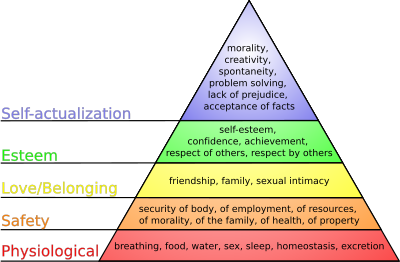
Granted total elimination is unlikely, but relative poverty is not what I was thinking of. By poverty, I mean a condition in which the most basic needs in Maslow's hierarchy are not satisfied. That is, the lower two rungs, physiological needs and safety needs.
400px-Maslow%27s_hierarchy_of_needs.svg.png
 
That also goes for:
No, Ron, that's not my claim. What makes you think that it is? I can see that you are yet another fan of the strawman approach, but would you mind telling me what makes you come up with this particular one?
And how exactly would that be a retort to my opening post - and an obvious one at that??!


That's why I said "Now, if your claim is..." as opposed to "Your claim is". I didn't imply that that's your claim. I was wondering if it was. Obviously it isn't. Very well then, what is your claim then?
 
Great! Thanks for bumping my thread, guys, but won't you please stop paraphrasing my critique!? It is not so difficult to understand that it needs paraphrasing!
gtc said:
The obvious retort to the OP is that there is plenty of superstition in rich countries too.
And how exactly would that be a retort to my opening post - and an obvious one at that??!

OK, but the function of paraphrasing is to show that I have read and understood your post, as gtc seems to have failed to.
 
I would like to add that you can no longer access Steve Kowit's brilliant article The Mass Suicide of the Xhosa: A study in collective self-deception in its entirety for free, but you can access the beginning of the article in order to decide whether or not you'd like to buy the rest:
http://goliath.ecnext.com/coms2/gi_0199-36844/The-mass-suicide-of-the.html
http://goliath.ecnext.com/coms2/summary_0199-36844_ITM

The article about poverty in the Third World, however, is still for free:
http://www.gegenstandpunkt.com/english/poverty.html

As to the former article, I didn't find anything in the exerpt to disagree with. I am aware of confirmation bias, and I have read some of Robert Wright's work and generally agree with it.

But that second article.
People in developing countries are poor because they are excluded from wealth in general, and in particular in their own countries. ... What causes this exclusion from wealth? Private property.

Here we have a failure to understand economics. This is Marxist ideology, not critical thinking. This sort of thinking when put into practice has resulted in massive famines in the Soviet Union, China and North Korea. An ideology that fails to understand human nature cannot produce a society that is livable by humans.
 
I think skeptics have it really clear that poverty is one of the things that breed superstition (Notice I clarified, it's one of the things. It's not THE ONE thing)
Only indirectly. I think the more direct link is the other way around: That is, superstition breeds poverty.

Skeptics are indeed doing the one thing that fights against this disease: Skeptics struggle to promote critical thinking and they stress education above indoctrination. Education is the one tool. Misery and poverty are results of ignorance (Indoctrination is the mother of ignorance).
Yes. That's I mean. Superstition is a symptom of ignorance. Ignorance is indirectly a result of poverty but poverty and ignorance are the default human condition. IOW, people are animals born in the jungle and they have to rely on their instincts and wits to survive. The way out of this state of nature is through rational thinking. Each person has to learn to think for themselves. They can be taught, if they are willing to learn.
There are three ways to acquire wealth: you can be given it, you can take it, or you can produce it. The first two depend on others to produce the wealth. Only the third way creates new wealth, and this way requires rational thinking. The first two do not require rational thinking (the second one requires a certain sort of self-interested antisocial rational thinking, but leave that aside) but won't reduce poverty overall.
 
Only indirectly. I think the more direct link is the other way around: That is, superstition breeds poverty.

Hmmmm, I don't know. I don't really see it. When you say superstition breeds poverty, do you mean poverty literally, understood as a financial status, or do you mean poverty of mind? If you meant the first, could you illustrate please?

I'm not saying I don't agree, I just don't see it.


Yes. That's I mean. Superstition is a symptom of ignorance. Ignorance is indirectly a result of poverty but poverty and ignorance are the default human condition. IOW, people are animals born in the jungle and they have to rely on their instincts and wits to survive. The way out of this state of nature is through rational thinking. Each person has to learn to think for themselves. They can be taught, if they are willing to learn.
There are three ways to acquire wealth: you can be given it, you can take it, or you can produce it. The first two depend on others to produce the wealth. Only the third way creates new wealth, and this way requires rational thinking. The first two do not require rational thinking (the second one requires a certain sort of self-interested antisocial rational thinking, but leave that aside) but won't reduce poverty overall.


I completely agree with that.
 
Yes. That's I mean. Superstition is a symptom of ignorance. Ignorance is indirectly a result of poverty but poverty and ignorance are the default human condition. IOW, people are animals born in the jungle and they have to rely on their instincts and wits to survive. The way out of this state of nature is through rational thinking. Each person has to learn to think for themselves. They can be taught, if they are willing to learn.
Just to make sure, I've asked around, and so far not a single one of the people I've asked was,
a) born in the jungle,
b) then had to rely on their instincts to survive,
c) or even on rational thinking.
A very large majority of them were actually born at a maternity ward in a hospital, they were cared for by doctors and nurses - and their mothers, of course - and for an extensive number of years they had no idea what rational thinking was.
There are three ways to acquire wealth: you can be given it, you can take it, or you can produce it. The first two depend on others to produce the wealth. Only the third way creates new wealth, and this way requires rational thinking. The first two do not require rational thinking (the second one requires a certain sort of self-interested antisocial rational thinking, but leave that aside) but won't reduce poverty overall.
Well, one and two are capitalism in action, which seems to work very well. It certainly does not reduce poverty, but that was never its intention.
 
That's why I said "Now, if your claim is..." as opposed to "Your claim is". I didn't imply that that's your claim. I was wondering if it was. Obviously it isn't. Very well then, what is your claim then?
Please answer my question, Ron Tomkins! "What makes you think that it is?"
 
dann, you should let people paraphrase your OP. It makes more sense that way.
In a way you're right, Slimething. Your failure to understand my opening post might imply that you'd be happier reading something completely different. It may not be what I wrote, but at least you're able to grasp it.
That other people's strawmen aren't better than yours is a problem that shouldn't concern you.
 
Here we have a failure to understand economics. This is Marxist ideology, not critical thinking. This sort of thinking when put into practice has resulted in massive famines in the Soviet Union, China and North Korea. An ideology that fails to understand human nature cannot produce a society that is livable by humans.

:clap::clap::clap:
 
Ignorance is indirectly a result of poverty but poverty and ignorance are the default human condition. IOW, people are animals born in the jungle and they have to rely on their instincts and wits to survive. The way out of this state of nature is through rational thinking.

News flash: We don't live in caves anymore.

Each person has to learn to think for themselves. They can be taught, if they are willing to learn.

So....people who believe in Sylvia Browne only have themselves to blame?
 
Just to make sure, I've asked around, and so far not a single one of the people I've asked was,
a) born in the jungle,
b) then had to rely on their instincts to survive,
c) or even on rational thinking.
A very large majority of them were actually born at a maternity ward in a hospital, they were cared for by doctors and nurses - and their mothers, of course - and for an extensive number of years they had no idea what rational thinking was.

Well, one and two are capitalism in action, which seems to work very well. It certainly does not reduce poverty, but that was never its intention.

There is a book called The Jungle by Upton Sinclair. It turns out that it's not about tropical rainforests. It's supposed to be a metaphor for something else. The Jungle is a metaphor for the world. Does the world owe anyone a living? We might like to think so, but for billions of years it has been "survival of the fittest." That is the default. I think that modern welfare states are better than the jungle but it takes a lot of rational thinking and cooperating by a lot of people to get from the jungle to a modern state.

Actually, capitalism is about number 3, creating wealth, not 1 and 2. Capitalism is how new wealth is created. Now, I'm not Ann Rand. I'm not saying that we shouldn't have any welfare at all. I'm only saying that a market economy is more efficient than a command economy, although it needs certain interventions like anti-trust laws, some public goods likes roads, police, an army and schools, and occasionally corrections for externalities to optimize the benefit for everyone.
Capitalism generally refers to an economic system in which the means of production are all or mostly privately[1][2] owned and operated for profit, and in which investments, distribution, income, production and pricing of goods and services are determined through the operation of a market economy.
China is an example of a country that has given up a command economy in favor of a market economy. The results have been dramatic. During the Great Leap Forward, tens of millions starved to death. Today:
There has been a significant rise in the Chinese standard of living in recent years. Today, a rapidly declining 10 percent of the Chinese population is below the poverty line. 90.9% of the population is literate,[61] compared to 20% in 1950.[62] The life expectancy in China is the third highest in East Asia, after Japan and South Korea.
Prc1952-2005gdp.gif


So there it is: Capitalism reduces poverty. It may result in inequality, but more people can afford to meet their basic physiological and safety needs.
 
China is an example of a country that has given up a command economy in favor of a market economy.

You may want to read up on China's economy. It's not a "market economy", but a mix of very centralized controlled economy and market economy.

The results have been dramatic. During the Great Leap Forward, tens of millions starved to death.

You commit the same fallacy as Creationists, when they blame all things bad on Evilution:

There were huge famines in China way before the Communists.

Between 108 BC and 1911 AD there were no fewer than 1828 major famines in China, or one nearly every year in one or another province, which however varied greatly in severity.
 

ISF - Join now!

Every member here is approved by hand. No bots, no spam, just people who care about evidence and honest debate.

Membership is free!

Create your free account

Back
Top Bottom