http://img165.imageshack.us/img165/337/copyof3kt0.jpg
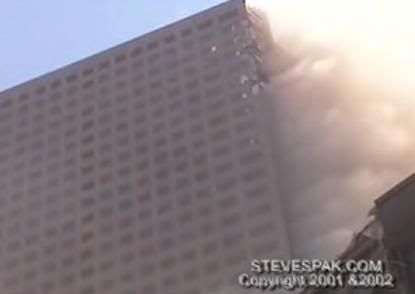
Chris, these fires are on the east half of the north side and all fires in WTC 7 started on the south side. You have shown then that fire ravaged floors 7 through 12 on the east side of the building.
Welcome back jaydeehess
There were fires on floors 8, 11, 12 and 13, burning at different times, in the east end of WTC 7
Floor 12 was gutted and the fire burned out before 4:45.
Floor 11 burned from the south east corner toward the north between 2 and 3 p.m. but did not appear on the north side
[in the middle] until around 4:45.
Floor 7 started on the west side* and burned to the center of the north face where it appears to have burned out around 4 p.m.
[when the photo you posted was taken]
*At 12:10 to 12:15 p.m.:
Cubicle fire was seen along west wall on Floor 7 just before leaving
Around 3 p.m., fires were observed on Floors 7 and 12 along the north face.
[near the middle]
Some time later, fires on floors 8 and 13, with the fire on Floor 8 moving
from west to east and the fire on Floor 13 moving from east to west.
The fire on floor 8 eventually burned to NE corner and moved to east face
.... the fire on Floor 7 appeared to have stopped progressing near the middle of the north face.
Around 4:45 p.m., a photograph showed fires floors 7, 8, 9 and 11 near the middle of the north face.
The main core supports are more to the south of the building's center but still certainly it is quite possible that fire damage occured to them due to these fires.
The implosion began near the east end of the building, columns 79, 80 and 81.
These columns weighed over 4 tons per floor.
NIST Apx. L pg 38 [42 on pg counter]
I4.2 Unbraced Columns:
At a floor where fires were noted, interior columns were comprised of W14x730 cores and reinforcing plates, and could support several stories
unbraced without failure.
The column is not very sensitive to the number of stories of unbraced
column length, K. This column, which had a service load stress of approximately 21 ksi, would be
approaching its load carrying capacity for an unsupported length of four stories if it was also subject to a uniform temperature of 500 °C.
pg 39 [43 on pg counter]
I4.4 Lateral Displacements: Fire effects may have caused column instability
failure by lateral displacements from asymmetric thermal expansion of the floor system.
Such thermally-induced displacements
must overcome the restraining effect of the remaining floor system
against further lateral deflection of the column.
When expanding steel cannot overcome the restraining effect of the remaining floor system, it will sag or buckle.
Meridian Plaza
http://img520.imageshack.us/img520/2...ridian5lo2.png
http://www.interfire.org/res_file/pdf/Tr-049.pdf
pg 19 [24 on pg counter]
After the fire, there was evident significant structural
damage to horizontal steel members and floor sections on most of the fire
damaged floors. Beams and girders sagged and twisted -- some as much as
three feet -- under severe fire exposures, and fissures developed in the
reinforced concrete floor assemblies in many places.
Despite this extraordinary exposure, the columns continued to support their loads without obvious damage.
http://www.iklimnet.com/hotelfires/m...a_lessons.html
[FONT="]
12. Columns and certain other structural elements are normally exposed to fire from all sides. In this fire, the steel columns retained their structural integrity and held their loads. Experience in this and similar high-rise fires suggest that columns are the least vulnerable structural members, due to their mass and relatively short height between restraints (floor to floor).
Major damage has occurred to horizontal members, without compromising the vertical supports.[/FONT]