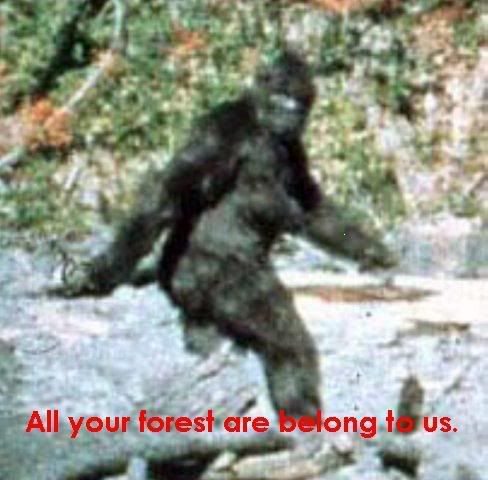
Let us assume, just for the sake of argument, that bigfoot exists. Bear with me, please.
Assuming this bigfoot critter actually exists (and that, I know, is a big assumption), what sort of measures should we take to conserve it? Putting it on a protected species list sounds like a plan (assuming, remember), but what does that mean in terms of actual measures? Do we just make sure there's enough muddy ground for it to gleefully make footprints? Do we place a death penalty on picking blueberries? What are we doing?
Without some information on the critter, it's needs, habits and preferred environs, we have no measures we can really take to protect it. We can't find it, so we don't know its natural habitat. We have no feces, so we don't know its diet. We don't know its mating patterns, so we can't influence increasing the growth of the population. What, exactly, are we supposed to do?
Let's get down to it.
The problem with placing it on an endangered species list is that this entails recognizing the existence of the critter and legitimizes those who want to advance the cause of privately-held "knowledge." Suddenly these "experts" on "knowledge" only they can access begin to influence policies and laws. This is not a good path to tread on; we've been down it before...
Nearly all of the progress we have made, and specifically the rise of science, has been because we moved away from privately-held, inaccessable-to-others "knowledge" in favour of independant verification in the public realm. This is why we must not permit a particular species not proven to exist to be the foundation for our laws and policies. Anyone could make up anything and influence whole aspects of society on the basis of whatever-it-is-today.
Now, this is not the same thing as the protecting of bio-diversity suggestion (as alluded to, I think, by others) and to confuse the two is to misunderstand the critical difference between private and public "knowledge," the difference between verificationism and intuitionism. Bio-diversity is a well-established idea and we can point to examples of it and the consequences (neutral use of the term) of protecting it or failing to protect it. And that's the critical point - we can point at it. So far we've had distressingly little ability (i.e. none) to point to bigfoot, except in the fluffy, little private realms of certain individuals who steadfastly refuse (or fail) to provide verification of their ideas. As a result, all we have to point to, is their heads. Their motives are irrelevant to the argument really. What's important is the absolute lack of verifiable, reproducable evidence to back their claims. Period.

 )
) ).
). What a maroon!!


 Methinks that be an Ad Hominem!