• Quick note - the problem with Youtube videos not embedding on the forum appears to have been fixed, thanks to ZiprHead. If you do still see problems let me know.

Debate! What debate?

What I am adding is Anhydrite
http://en.wikipedia.org/wiki/Anhydrite

Gypsum is Anhydrite plus water.
Ok, then after you add water, allow the concrete to stiffen, then remix it. You should get a higher slump for the material after you remix.
I am getting a condition similar to false set, but I was trying to follow as best as I could the conditions of the concrete in the World Trade Center.
I would suggest finding a hydrated source of gypsum, if you're going to simulate those conditions. I think Plaster of Paris is actually hydrated gypsum. False set is something well known by the industry, and they certainly wouldn't have allowed it to happen during the construction of the WTC towers.
Here is a quote from Dr. Greening.
Dr. Greening is correct that gypsum is added to clinker to form cement. The amount of gypsum added depends on the amount of C3A in the clinker. If you add too little gypsum, you get flash set when the C3A hydrates to form monosulfoaluminate and hydrogarnet. If you add too much, you get a host of other problems like delayed ettringite formation, and weakened cement paste.
Since the aggregate is small crushed limestone, and that is what is most interesting in the debate, some of it probably formed Gypsum which is why I am having the problems that I have with false set.
Limestone is primarily composed of calcite and dolemite (CaCO3 and Mg*CaCO3), so I don't know how gypsum would form. You can calcine the limestone by heating calcite. That reaction is:

CaCO3 + Heat ---> Ca(OH)2 + CO2

From that, you can sulfonate the mixture by applying acid washes, but the end result is that you can't necessarily spontaneously create gypsum in concrete. Calcination occurs at about 800 degrees centigrade, and ettringite breaks down to monosulfoaluminate far before that happens.
Thank Almond you have been very helpfully, if gypsum was formed in the concrete it can store sulfuric acid the same as the drywall did, and as the limited samples that I prepared of the concrete did.

Thank you, your incite has been most helpful.
When heated to 350c Gypsum breaks down into anhydrite and water releasing the trapped water and sulfuric acid.
That can happen in wall board or in concrete with high Gypsum.
I am just trying now to figure out the maximum acid that a content that a four in slab of concrete can store, and stay together.

Any incite anyone has will be helpful.

As for your hypothesis, my fire protection class mentioned nothing of such a reaction. I also haven't seen anything like this in the literature. Of course, that does not rule out the possibility that sulfuric acid is released when concrete is heated, but I just don't know what the effects would be.

Remember that concrete has a pH of about 10.5, and that, while ettringite will break down at anything below 10, CSH gel is quite hardy, and will remain stable below a pH of 7. If you think sulfuric acid is the culprit, you're going to have to account for huge volumes of material.

I'll be interested to see what you come up with.
 
An interesting fire-resisting treatment that's used in some concrete buildings is the addition of polyester fibers to the mix. When the concrete is heated by fire, the fibers melt and create channels to allow steam to escape, helping to prevent spalling.

There aren't many accounts of sounds like explosions at the WTC where the source is unknown. If concrete was fracturing due to heat during the collapses, that sound would have been mixed in with the much larger sounds of everything else failing.
Just as hydrogen explosions could be mistaken for steam pipes exploding, and the chemicals mistaken for those that were naturally occuring in the concrete. Such as gypsum, calcium chloride, HCL, and others.
Also since air blasts are not usually recorded on seismographs, they might have been over looked as long as they were small.
They could have however blasted water under the oxide coating of Aluminum causing a lot of heat, and forming more hydrogen for the reactions, it is hard to tell the steam from hydrogen from the steam from a steam pipe both are steam only one will be hotter and traveling in a blast wave.
All it takes is suficent S02, and H20, along with maybe some carbon black as fuel.
I should not say any more, on this right now.
 
If by "irrefutable" you mean "easily refutable," I agree.

I have much, much more information than in the post linked above. I'll have it on the internet soon.

Ah, it appears that it is a simple matter of his not understanding the definition of irrefutable. That word means it can't be refuted.

So, if something can be refuted, or is simply conjecture with nothing to back it up, then it can't be irrefutable.

Whew! Glad I could clear that up.
 
Which elevator caused the damage in the basement?
Try reading the quotes I linked to, which I did for your edification, not for mine. That's not too much to ask, is it? By the way, the jet fuel explosion happened in the elevator shafts of both towers, not only in the north.
 
Try reading the quotes I linked to, which I did for your edification, not for mine. That's not too much to ask, is it? By the way, the jet fuel explosion happened in the elevator shafts of both towers, not only in the north.

I read them.

Which elevator caused the basement damage in the North Tower? It is a simple question.
 
oridginally posted byThe Almond
Ok, then after you add water, allow the concrete to stiffen, then remix it. You should get a higher slump for the material after you remix.

I would suggest finding a hydrated source of gypsum, if you're going to simulate those conditions. I think Plaster of Paris is actually hydrated gypsum
.
Hydrated Anhydrite is gypsum.
Plaster of Paris is cooked Gypsum after it is heated to 350c. Plaster of Paris is Anhydrite, acids increase the Hydrating ability and the ability to retain more acid, especially sulfuric acid.

False set is something well known by the industry, and they certainly wouldn't have allowed it to happen during the construction of the WTC towers.
Yes but they were experimenting with using Gypsum in concrete for fire resistance. Were not even talking about the set here we are talking about fire resistance. The Gypsum used in fire resistance concrete is Hydrated gypsum it is not used for the same purpose as setting.


Dr. Greening is correct that gypsum is added to clinker to form cement. The amount of gypsum added depends on the amount of C3A in the clinker. If you add too little gypsum, you get flash set when the C3A hydrates to form monosulfoaluminate and hydrogarnet. If you add too much, you get a host of other problems like delayed ettringite formation, and weakened cement paste.
Your confusing Anhydrate, plaster of paris, Calcium + Sulfate, with gypsum, Calcium+Sulfate+H20.

Limestone is primarily composed of calcite and dolemite (CaCO3 and Mg*CaCO3), so I don't know how gypsum would form. You can calcine the limestone by heating calcite. That reaction is:

CaCO3 + Heat ---> Ca(OH)2 + CO2
Yes the quick lime process, at 600c thought of that.
But sulfuric acid breaks the Co3 bond releasing carbon dioxide and carbon monoxide.
That leaves Calcium Sulfate it absorbs H20 and Sulfuric acid from the air as it forms Gypsum.
From that, you can sulfonate the mixture by applying acid washes, but the end result is that you can't necessarily spontaneously create gypsum in concrete. Calcination occurs at about 800 degrees centigrade, and ettringite breaks down to monosulfoaluminate far before that happens.
I can desolve lime stone in battery acid, sulfuric acid I do it all the time always froms gypsum hydrated calcium sulfate.
HCl in toilet bowl cleaner will do it forming calcium chloride.
These are very simple known chemical reactions HCL is formed by sulfate attack on limestone in concrete releasing Sodium Chloride + Sulfuric Acid creates sodium sulfate, and HCl that reacts with Calcium carbonate to form Calcium Chloride. Calcium Chloride leaching from the concrete was believed to cause the rusting problem at the world trade center.


As for your hypothesis, my fire protection class mentioned nothing of such a reaction. I also haven't seen anything like this in the literature. Of course, that does not rule out the possibility that sulfuric acid is released when concrete is heated, but I just don't know what the effects would be.
If it had been known I could have looked it up on the internet, insteed of looking for it for the past 6 or so years.

Remember that concrete has a pH of about 10.5, and that, while ettringite will break down at anything below 10, CSH gel is quite hardy, and will remain stable below a pH of 7. If you think sulfuric acid is the culprit, you're going to have to account for huge volumes of material.
Thousands of gallons of diesel fuel continually refreashed, sulfuric acid batteries, and others sources do that. The Gypsum formed by the reaction of sulfuric acid with Calcium Carbonate is stable and locks further acid in harmless suspention between the gypsum Crystals with H20, until released by heating to 350c.

I'll be interested to see what you come up with.[/QUOTE]

I wish I had some one to help me film it, it is just an unknown reaction, of common materials.
Gun cotton drywall the material also has to be in a place where the hydrogen will collect like in a building designed to stop chimney effects from traveling up elevator shafts.
I have been using an old home made barbecue grill to test samples I sealed the grill with clay and then use charcoal to heat the samples, when the hydrogen ignites the top of the grill is thrown open. I can used the weight of the grills top to determine how big the reaction was.
I can also add extra weights on top to see how much more hydrogen can be produced. Since the hydrogen rises
it is trapped in the top sealed by the clay.
I did a big sample earlier now I am doing smaller samples to give me some ball park figures as to strength of the reaction.

If this fails I am finally going out and buy one of those boxes that you guys have to think in. :D
 
I read them.

Which elevator caused the basement damage in the North Tower? It is a simple question.
Who says the elevator itself caused the damage? It's my understanding that fuel spilled down the shaft and ignited. The elevator itself could have been anywhere.
 
Who says the elevator itself caused the damage? It's my understanding that fuel spilled down the shaft and ignited. The elevator itself could have been anywhere.

And this FAE reduced a machine shop to rubble and made a 400-600 pound press disappear?

I have seen people claim that the elevator falling caused it.
 
I read them.

Which elevator caused the basement damage in the North Tower? It is a simple question.

So you read them, and could not find the answer to your question above within, or you found the answer, but just want to see gravy post the answer for kicks?

TAM:)
 
And this FAE reduced a machine shop to rubble and made a 400-600 pound press disappear?

I have seen people claim that the elevator falling caused it.

What type of press was it a powered press, With a reserve oil tank and high pressure pump?

What was the operating pressure of the press was the person near the press since a high pressure Hydraulic explosion can literally blast the skin off the human body with out even producing a flame.

Also Ten weight hydraulic oil can explode into flame if an ignition source is available for it to do so such as an electrical arch.

Give me some specifics and I will try to answer your question.
 
An interesting fire-resisting treatment that's used in some concrete buildings is the addition of polyester fibers to the mix. When the concrete is heated by fire, the fibers melt and create channels to allow steam to escape, helping to prevent spalling.

There aren't many accounts of sounds like explosions at the WTC where the source is unknown. If concrete was fracturing due to heat during the collapses, that sound would have been mixed in with the much larger sounds of everything else failing.

A fellow I worked with did his PhD thesis on concrete spalling, and he made up samples with polyester fibre in them to test their effect.

As an aside, I think it is generally held that old concrete doesn't spall. Not true. We were using an aviation fuel fire in a metal tray as the heat source for a fire test in the Cardington hangar. The floor in there was about 70 years old, and it spalled from the heat of the fire. It sounded pretty loud as well, but that may have been because we were close to it.

Dave
 
Last edited:
Tripod... :) If you have a camera you can pick up a little tripod capable of holding a handycam for pretty cheap. Frame it up, allowing some space, press record, and get stuck in. :)

Just be sure to keep it a decent distance away (maybe zoom in) so you don't melt your camera like they did in Mythbusters!

-Gumboot

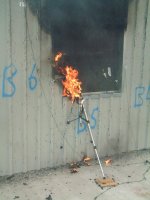
This is what can happen if an experiment gets out of hand.
 

Attachments

  • DSCF2031.jpg
    DSCF2031.jpg
    56.8 KB · Views: 4
This is what can happen if an experiment gets out of hand.

AT least you did not loose the tripod as I did, a burning fireball of molten aluminum is hot enough to melt concrete you know.
Only I lost two cameras and tripods I really do not want to risk another, PS. and 3 months of recorded experiments on the same tape big mistake that was.
I think though it was an inside job, invisible elves planting thermite in the camera.
Or a space beam weapon shot it from space.
Well I have to go I made the mistake of mixing Calcium Chloride, Sulfuric acid and steel. Now I have a big mess spread out everywhere to clean up. Can anyone say Hydrogen Lots of Hydrogen.
I will be using lime water to take care of the acid the Calcium chloride I will just have to wash off.
Have a nice day,:)
Mine already is depressing :( because of all the cleaning up I have to do.
Some one should have told me not to do this.;)
 

Back
Top Bottom