• Quick note - the problem with Youtube videos not embedding on the forum appears to have been fixed, thanks to ZiprHead. If you do still see problems let me know.

Simple Challenge For Bigfoot Supporters

Status
Not open for further replies.
Such claims can be tested. I made a quick check and found there's no actual match.

And just how did you do that? Got a Sasquatch jaw to compare to Gigantopithecus? A precise IM index to compare to the Australopithecines? A Bigfoot to compare to Little Foot (Stw 573)?
 
The bottomline is:
The fossil register provides no backing for the claim bigfeet are real.

The fossil register does however provide backing for the possibility that bigfoot 'like' creatures did actually exist in various locations at one time or another.

It's possible, perhaps likely, that even giganto was bipedal. There is not a shred of evidence to show it wasn't.
 
The fossil register does however provide backing for the possibility that bigfoot 'like' creatures did actually exist in various locations at one time or another.
Disregarding the flaws in this statement... Such as?
It's possible, perhaps likely, that even giganto was bipedal. There is not a shred of evidence to show it wasn't.
This statement is also incorrect.

Evidence supporting a bipedal Giganto:

- 'U' shaped mandibles as H. sapiens vs 'V' shaped mandibles of great apes.

Evidence supporting Giganto was not bipedal:

- Great size makes bipedalism unlikely.
- Closest known relatives were not bipedal.
- Evidence of dentition indicates a diet comprised largely of bamboo, a food source not consistent with bipedal adaptations.
 
Last edited:
I'd be interested in knowing how anyone was able to obtain a precise IM index from a squatch. I've been arguing against any such precision for a couple of years now.

Not only that, you've been arguing against any IM index gathered from a figure in a motion picture, regardless of it's species.

By accepting the IM index from the clearly seen figure, you'd be in danger of having to admit that it's outside the range of humanity.

And we all know how offensive that would be for you.................
 
I'd be interested in knowing how anyone was able to obtain a precise IM index from a squatch. I've been arguing against any such precision for a couple of years now.

RayG

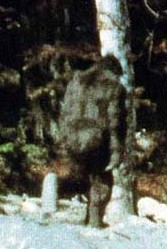
No one has. But an approximation can be obtained from measuring Frame 52:

rearview.jpg


"Identifying the positions of the joints on the film subject can only be approximate and the limbs are frequently oriented obliquely to the plane of the film, rendering them foreshortened to varying degrees. However, in some frames the limbs are nearly vertical, hence parallel to the filmplane, and indicate an IM index somewhere between 80 and 90, intermediate between humans and African apes.

In spite of the imprecision of this preliminary estimate, it is well beyond the mean for humans and effectively rules out a man-in-a-suit explanation for the Patterson-Gimlin film without invoking an elaborate, if not inconceivable, prosthetic contrivance to account for the appropriate positions and actions of wrist and elbow and finger flexion visible on the film. This point deserves further examination and may well rule out the probability of hoaxing." -Jeff Meldrum

http://www.internationalskeptics.com/forums/newreply.php?do=newreply&p=2221211

Steindorf's digitaliization showed 88 - quite close to Meldrum's 80-90. But you're reading the book so you knew that, didn't you?
 
Last edited:
Disregarding the flaws in this statement... Such as? This statement is also incorrect.

Evidence supporting a bipedal Giganto:

- 'U' shaped mandibles as H. sapiens vs 'V' shaped mandibles of great apes.

I think you have that backwards. Human and Australopithecines are "V" shaped; Gorillas "U" shaped.

Evidence supporting Giganto was not bipedal:

- Great size makes bipedalism unlikely.
- Closest known relatives were not bipedal.
- Evidence of dentition indicates a diet comprised largely of bamboo, a food source not consistent with bipedal adaptations.

The width of the jaw makes passage of a vertical spinal column likely. The dention is like other hominids; the canines are reduced. Why would size matter? We're pretty huge for a primate. The last common ancestor was likely a biped, or at least upright.

Even the sceptical Dr. Daegling notes studies show a wear pattern indicating an omnivore. The pattern most resembles Chimps; they're omnivorous.

However, given a few hundred thousand years for adaptation, there's no reason a specialized bamboo eater couldn't have produced descendants capable of crossing the Bering Land bridge. Adding meat to the diet goes a long way toward providing the estimated 5000 calories a day they would need.

Closest known relative would be Gigantopithecus giganteus, and there's nothing known about its way of going. Are there any others? (Sivapithecus may be out of the running as an Orang ancestor and there's a huge gap between it and giganteus.)

Below are Giganto jaws from Krantz' Bigfoot Sasquatch Evidence:
 

Attachments

  • Giganto jaws.jpg
    Giganto jaws.jpg
    113.6 KB · Views: 2
Last edited:
I think you have that backwards. Human and Australopithecines are "V" shaped; Gorillas "U" shaped.
Is that so? This footnote from wikipedia's entry on bigfoot most be an error then.
The method of locomotion for Gigantopithecus is not entirely certain, as no pelvis or leg bone has ever been found; the only remains of Gigantopithecus being discovered is the teeth and mandible. A minority opinion, championed by Grover Krantz, holds that the mandible shape and structure suggests bipedal locomotion. The only fossil evidence of Gigantopithecus — the mandible and teeth— are U-shaped, like the bipedal humans, rather than V-shaped, like the great apes. A complete fossil specimen, with the pelvis and leg bones, would be necessary to conclusively resolve the debate one way or the other, but are absent to date.
 
- Closest known relatives were not bipedal.

Closest known relative would be Gigantopithecus giganteus, and there's nothing known about its way of going. Are there any others? (Sivapithecus may be out of the running as an Orang ancestor and there's a huge gap between it and giganteus.)
I think my error was in not writing 'Gigantopithecine' and 'closest living relative' as I did not specifically mention blacki, bilaspurensis, or giganteus to all of which is not orang-utan the closest living relative (and are not bipedal)?
 
I think you have that backwards. Human and Australopithecines are "V" shaped; Gorillas "U" shaped.


The width of the jaw makes passage of a vertical spinal column likely. The dention is like other hominids; the canines are reduced. Why would size matter? We're pretty huge for a primate. The last common ancestor was likely a biped, or at least upright.

Even the sceptical Dr. Daegling notes studies show a wear pattern indicating an omnivore. The pattern most resembles Chimps; they're omnivorous.

However, given a few hundred thousand years for adaptation, there's no reason a specialized bamboo eater couldn't have produced descendants capable of crossing the Bering Land bridge. Adding meat to the diet goes a long way toward providing the estimated 5000 calories a day they would need.

Closest known relative would be Gigantopithecus giganteus, and there's nothing known about its way of going. Are there any others? (Sivapithecus may be out of the running as an Orang ancestor and there's a huge gap between it and giganteus.)

Below are Giganto jaws from Krantz' Bigfoot Sasquatch Evidence:

Thanks LAL. Always on the ball, as usual. I see that there in that one post you have answered kitakaze's points.

No further input from me neccesary.:)
 
Nails it. This is basically as good a sumation of what really sucks about bigfoot as I can think of. And wriggle and try as you might you just can't get away from the fact that all creatures are bound to their habits and patterns of behaviour. Simply an 8 ft, 1000 lb bipedal primate living in North America is going to have very specific habits and behaviours in the aquisition of food and contact with eachother that no matter how wily and rare you posit them their eluding identification as actual fauna within an ecosystem is not an encouraging concept.

Compare to Wolverines.

I don't think they'e especially wily and elusive. They're rare, with huge territories lightly utilized by humans (who do manage to see them). They're well camoflaged in dark forest and need only step behind a tree to become "invisible". The high pitched calls may be an adaptation for communicating over great distances. The social structure seems to be like that of Orngutans. They're omnivorous. There's an association with rainfall over 20" per year.

The denial seems to me to be based more on emotion than evidence.

We've had religion telling us we're a special creation, a kind of cosmic afterthought after a creator had things going pretty well. Scince has gone from assuming 20 million years for our brain to evolve and trying to cram every ancient hominid into our ancestry (Weidenreich thought Giganto was a human ancestor) to having to admit our cousins (and our uncles and our aunts ;)) were bipedal too. Bipedalism arose in a forested envirionment, more than once in the case of Oreopithecus, and was not the result of the retreating African forests dumping our ancestors on their own two feet. It may have been down from the trees, but it wasn't up from the apes.

So, bipedalism isn't an exclusive with Homo after all, but Mayr forbid we shouldn't be the only surviving bipedal hominid. Giving up our place in the center of the Universe was hard enough.

Science has its paradigms, and the idea we're sharing the planet with other surviving bipedal hominds doesn't seem to be one of them.

Possibly the most common sceptical argument is "If Bigfoot exists Science would have found it by now". Science might have if Science had bothered to look.
 
My goodness. Haven't you been reading the various discussion about all this previously in different threads here?
What is being discussed here is whether or not we have a creature that matches bigfoot and not what the fossil register may possibly provide. If a Gigantopithecine can be shown to be that match I would obviously and happily recognize that. I think that remains to be seen.
 
I think my error was in not writing 'Gigantopithecine' and 'closest living relative' as I did not specifically mention blacki, bilaspurensis, or giganteus to all of which is not orang-utan the closest living relative (and are not bipedal)?


"Gigantopithecus bilaspurensis is a very large fossil ape identified from a few jaw bones and teeth from India. G. bilaspurensis lived about 6 to 9 million years ago in the Miocene. It is related to the Gigantopithecus blacki."

http://en.wikipedia.org/wiki/Gigantopithecus_bilaspurensis

So, nothing above or below the jaw to show the way of going.

Orangutans can walk quite well bipedally. Gibbons are even better at it. A Chimpanzee with arms paralysed by polio became an habitual biped.

Orangutans are thought to have split off about 12 mya. They've been evolving too. Their way of going is not like other Great Apes and it's thought knuckle-walking evolved three times in the different Great Ape lines. As Tim White put it, the idea that the common ancestor looked like a Chimpanzee is simply wrong.

Our closest relative is the Chimpanzee, which is a knuckle-walker, therefore humans are knuckle-walkers. Am I getting that right?
 
....Science has its paradigms, and the idea we're sharing the planet with other surviving bipedal hominds doesn't seem to be one of them.

Possibly the most common sceptical argument is "If Bigfoot exists Science would have found it by now". Science might have if Science had bothered to look.

Thank you!
 
The denial seems to me to be based more on emotion than evidence.
I can see where you're coming from and certainly living sasquatches may freak some people out but I still disagree.

The doubt is based on a lack of quality evidence.
 
Oh, f'r Pete' sake. Yes, we've been over it and you didn't learn a thing.
...snip...

Have you learned the differences between soil and sediments?
And that fossils are preserved in sediments instead of soils?

Now, once again:
Bigfeet -if they are real and if the geographical distribution of sighting records is worth of anything- are not restricted to PNW. You are aware of this, aren't you? So, there are lots of potential sites all over North America...

Read my post and you'll see some possibilities of how land animals can be fossilized.
OH, BTW, from your own link
(http://www.cartage.org.lb/en/themes/...ossilation.htm)
:
The best chances of preservation occur when an animal falls into a fissure or cave, is drowned and sinks to the bed of a lake, sinks into a swamp, is swept by a flood into a swamp or lake, is buried in a cool volcanic ash shower, or is overtaken by some other rapid process which preserves the body intact and buries it quickly. The great majority of hominid and early human remains have been found in cave deposits, river terrace deposits, lake beds and in down-faulted troughs (such as East
African Rift Valleys) which have been infilled by sediment and volcanic ash.
Compare with what I wrote.

Have you forgotten the links I once posted on fossil remains at lava tubes?
http://hvo.wr.usgs.gov/volcanowatch/2000/00_01_20.html
http://www.carolina.com/owls/galapagos.asp
http://www.nps.gov/crmo/naturescience/fossils.htm

And I am the one who didn't learn a thing...
 
What is being discussed here is whether or not we have a creature that matches bigfoot and not what the fossil register may possibly provide. If a Gigantopithecine can be shown to be that match I would obviously and happily recognize that. I think that remains to be seen.

A foramen magnum or any part of a pelvis or a knee joint or a foot of a Gigantopithecine remains to be found. Tell Ciochon, et al, to get on it.

What is a match is the size (of Gigantopithecus blacki), the diet as shown by the dentition, reduced canines, and the proximity to NA, compared to other candidates, such as Paranthropus, or an overgrown Ardipithecine.
 
A foramen magnum or any part of a pelvis or a knee joint or a foot of a Gigantopithecine remains to be found. Tell Ciochon, et al, to get on it.

What is a match is the size (of Gigantopithecus blacki), the diet as shown by the dentition, reduced canines, and the proximity to NA, compared to other candidates, such as Paranthropus, or an overgrown Ardipithecine.
I'm searching for it now but LAL, can you or anyone point me in the direction of new literature indicating Gigantopithecus blacki as being a generalist? I'm very interested to see this in detail.
 
So far I got this from a John Hawk's weblog.
In any event, Ciochon and colleagues (1990) conclude it likely that Gigantopithecus had a very broad diet, that nonetheless included bamboo as a staple. In support of this, they cite an examination of tooth wear by Daegling and Grine (1989 in abstract; later published in 1994 in SAJS) that found Gigantopithecus microwear to be similar to chimpanzees. Chimpanzees themselves eat a majority of fruit, with smaller proportions of leaves, insects, and meat.
 
Status
Not open for further replies.

Back
Top Bottom