WTC 1 & 2:
Planes crashed, causing massive structural damage, knocking fire-protection off steel structural members, and igniting multi-floor fires.
Fires grew and heated exposed steel, weakening it until the mass above the damage overcame the strength of the structure.
The PE of the upper mass converted to KE, and the initial impact of the upper mass into the lower mass was powerful enough to cause total structural failure of the floor below, slowing acceleration somewhat but not reversing it.
This led to global collapse because:
For each floor the falling mass impacted, the downward velocity was greater and the additional debris increased the total falling mass.
This is an evocative narrative. Unfortunately, it is divorced from reality. Given that CS provided no evidence of any kind to support his narrative, we have a short series of naked assertions. Most of these assertions will turn out to be irrelevant to the larger picture anyway, as we shall see. Nevertheless, I will analyze the assertions.
Planes crashed, causing massive structural damage
What is meant by massive? We are left to wonder. All things have mass. The twin towers were designed to withstand multiple jet impacts, and they did withstand these impacts, as the buildings stood motionless afterwards. Until immediately prior to "collapse", no undamaged floors were seen to be unlevel, no vertical lines were out of plumb.
knocking fire-protection off steel structural members
Where is the evidence of this? CS has provided exactly no evidence. We're aware that NIST claims significant fireproofing was dislodged, but they base this on a test involing firing a shotgun. Kevin Ryan explains:
[NIST's] test for fireproofing loss, never inserted in the draft reports, involved shooting a total of fifteen rounds from a shotgun at non-representative samples in a plywood box. Flat steel plates were used instead of column samples, and no floor deck samples were tested at
all. In the end, they slid the results into a 12 page appendix to the final report.
Unfortunately, it’s not hard to see that these tests actually disproved their findings. One reason is that there is no evidence that a Boeing 767 could transform into any number of shotgun blasts. Nearly 100,000 blasts would be needed based on NIST’s own damage estimates, and these would have to be directed in a very symmetrical fashion to strip the columns and floors from all sides. However, it is much more likely that the aircraft debris was a distribution of sizes from very large chunks to a few smaller ones, and that it was directed asymmetrically. Also, there is
no indication that fireproofing was stripped from beneath the aluminum cladding on the exterior columns, but in subsequent steps of their story, NIST depends on this."
We continue with CS -
Fires grew and heated exposed steel, weakening it until the mass above the damage overcame the strength of the structure.
Evocative CS, but where is your evidence? In WTC1, about 13 stories were above the point of collapse. This leaves about 96 stories below. In terms of height, the 13 stories represent about 10% of the building. But considering that such buildings are built the heaviest and strongest at the bottom, and continue to become lighter and weaker as they go up, the 13 stories might represent, what, about 5% of the mass? 3%?
How does this "overcome the strength of the
structure?" (bolding added)
CS later says that it merely overcame the strength of the floor below , and I'll deal with that in a moment, but this begs the question. We have an undamaged 95 (or so) stories of steel superstructure founded on bedrock. A significant amount of the energy of any falling mass would be transmitted throughout the entire structure below, and ultimately to the ground. Where is the evidence or reasoning that this tiny portion of the building can overwhelm the majority? CS offers nothing.
The PE of the upper mass converted to KE, and the initial impact of the upper mass into the lower mass was powerful enough to cause total structural failure of the floor below, slowing acceleration somewhat but not reversing it.
This led to global collapse because:
For each floor the falling mass impacted, the downward velocity was greater and the additional debris increased the total falling mass.
This is preposterous, and CS offers nothing at all to support his position.
Dr. Wood has given a simple momentum lesson for us to see why CS's momentum assertion is unfounded.
Conservation of Momentum and Conservation of Energy
[SIZE=+1]Conservation of Momentum: [/SIZE]
The amount of momentum ([SIZE=+1]p[/SIZE]) that an object has depends on two physical quantities: the mass and the velocity of the moving object.
[SIZE=+1]p = mv[/SIZE]
where [SIZE=+1]p[/SIZE] is the momentum, [SIZE=+1]m[/SIZE] is the mass, and [SIZE=+1]v[/SIZE] the velocity.
If momentum is conserved it can be used to calculate unknown velocities following a collision.
[SIZE=+1](m1 * v1)i + (m2 * v2)i= (m1 * v1)f + (m2 * v2)f[/SIZE]
where the subscript i signifies initial, before the collision, and f signifies final, after the collision.
If [SIZE=+1](m1)i[/SIZE] = 0, and [SIZE=+1](v2)i[/SIZE] = 0, then [SIZE=+1] (v2)f[/SIZE] must =0.
So, for conservation of momentum, there cannot be pulverization.
____________________________________
If we assume the second mass is initially at rest [[SIZE=+1](v2)i[/SIZE] = 0], the equation reduces to
[SIZE=+1](m1 * v1)i= (m1 * v1)f + (m2 * v2)f[/SIZE]
As you can see, if mass [SIZE=+1]m1[/SIZE] = [SIZE=+1]m2[/SIZE] and they "stick" together after impact, the equation reduces to ,
[SIZE=+1](m1 * v1)i= (2m1 * vnew)f[/SIZE]
or [SIZE=+1]vnew[/SIZE] = (1/2) * [SIZE=+1]v1[/SIZE]
If two identical masses colliding and sticking together, they will travel at half the speed as the original single mass.
[SIZE=+1]Conservation of Energy: [/SIZE]
In elastic collisions, the sum of kinetic energy before a collision must equal the sum of kinetic energy after the collision. Conservation of kinetic energy is given by the following formula:
[SIZE=+1](1/2)(m1 * v21)i + (1/2)(m2 * v22)i= (1/2)(m1 * v21)f + (1/2)(m2 * v22)f[/SIZE]+ (Pulverize) + (Fail Floor Supports)
where (Pulverize) is the energy required to pulverize a floor and (Fail Floor Supports) is the energy required to fail the next floor.
If [SIZE=+1](1/2)(m1 * v21)i + (1/2)(m2 * v22)i= [/SIZE](Pulverize) + (Fail Floor Supports), there well be no momentum transfer.
In reality, [SIZE=+1](1/2)(m1 * v21)i + (1/2)(m2 * v22)i< [/SIZE](Pulverize) + (Fail Floor Supports),
So, for conservation of energy, we must assume there is some additional energy such that,
[SIZE=+1](1/2)(m1 * v21)i + (1/2)(m2 * v22)i+[/SIZE] (Additional Energy)[SIZE=+1] = [/SIZE](Pulverize) + (Fail Floor Supports),
where (Additional Energy) is the additional amount of energy needed to have the outcome we observed on 9/11/01.
[SIZE=+1]Appendix B: [/SIZE][SIZE=+1]Assuming elastic collisions:[/SIZE]
Assume that the top floor stays intact as a solid block weight, Block-A. Start the collapse timer when the 109th floor fails. At that instant, assume floor 108 miraculously turns to dust and disappears. So, Block-A can drop at free-fall speed until it reaches the 108th floor. After Block-A travels one floor, it now has momentum. If all of the momentum is transferred from Block-A to Block-B, the next floor, Block-A will stop moving momentarily, even if there is no resistance for the next block to start moving.
[SIZE=+1](m1 * v1)i=(m2 * v2)f[/SIZE]
If Block-A stops moving, after triggering the next sequence, the mass of Block-A will not arrive in time to transfer momentum to the next "pancaking" between Block-B and Block-C. In other words, the momentum will not be increased as the "collapse" progresses.
However, as we can observe, the building disintegrated from the top down and there was no block of material.
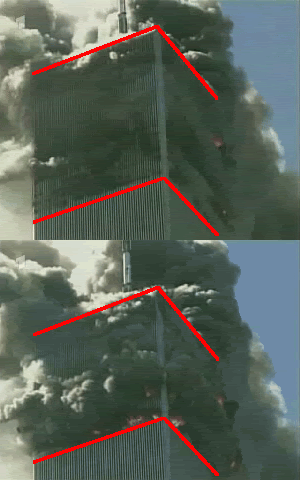
CS evocative imagination is easily refuted by observing the following graphic. Notice how the top block does NOT overwhelm the structure below, but rather the top block begins to disintegrate while the lower structure remains intact.
This image alone refutes CS, as it clearly shows a behavior quite different from what CS describes.
CS has indicated that he believes and relies upon the NIST report as the scientific explanation for the behavior of the towers. This must be rejected out of hand because NIST admits in plain English that they did not study the collapse behavior of the towers at all, and thus are, by their own admission, not a source on this topic.
The focus of the Investigation was on the sequence of events from the instant of aircraft impact to the initiation of collapse for each tower. For brevity in this report, this sequence is referred to as the "probable collapse sequence," although it does not actually include the structural behavior of the tower after the conditions for collapse initiation were
reached...(NIST, 2005, p. 80, fn. 12; emphasis added.)
In summary, CS has provided nothing of substance. More glaring than the empty nature of his assertions, are the many observational data that are ignored by CS, a gross violation of the scientific method. In the next post, as time allows, I will detail the litany of observational data ignored by CS, which are not explained by his assertions, even if we grant these assertions for sake of argument.