• Security incident: ISF was recently accessed by intruders. Please change your password, and change it anywhere else you used it. Read more

Split Thread The difference between 0.556mm and 0.223" ammunition

oops yes.

or .223 Remington* as it was known before NATO adopted it and made it metric.

*actually there are some subtle differences that can cause problems if .223 is used in a 5.56 chambered gun but not vice versa.
Actually *yes im.being that guy*, feeding 5.56 Nato rounds into a rifle chambered for 223 Remington is a good way to destroy your gun and possibly injure your face.
 
What about vice-versa?
.223 works fine in a 5.56 chamber

Per the internet and personal experience:

The primary difference between .223 Remington and 5.56 NATO is that 5.56 is loaded to higher chamber pressures (~58,000–62,000 psi) and features a longer throat (freebore) than the .223 Remington (~55,000 psi). Because of these dimensional and pressure differences, you can safely fire .223 ammo in a rifle chambered for 5.56, but firing 5.56 in a strict .223 chamber is unsafe due to potential pressure spikes
 
Actually *yes im.being that guy*, feeding 5.56 Nato rounds into a rifle chambered for 223 Remington is a good way to destroy your gun and possibly injure your face.

.223 and 5.56 are dimensionally exactly the same specification.

A .223 chambered gun is quite happy with 5.56. NATO loadings. Some very old guns proofed for the 1950s SAMI standard might have problems with 5.56 pressures which wasn't standardised until the 1960s but nothing is going to blow up.

There could at one time be problems the other way though 'Hot' (over NATO spec) loaded .223 rounds could cause extraction problems in a 5.56 as the military chamber usually has slightly 'tweaked' dimensions by a few thou to ensure easy extraction when it's fouled or dirty and to allow for slight variations in ammo tolerance (they have to be able to swallow ammo made anywhere in NATO and possibly in stores for up to 20 years)
A hot loaded .223 case could over expand and require excessive extraction force, this could result in a failure to extract but more usually prolonged use caused excessive wear on the chamber and extractor.

A .223 gun usually has a chamber that conforms to the SAMI standard dimensions and will be a bolt action rifle so it's not a problem. Modern .223 hunting rounds tend to have hotter loading than NATO standard ammunition.

Actual problems were rare and any gun made in the last 30 years is completely safe for either.223 or 5.56.
There is massive exaggerated among the online 'gun community ' who like to pass on and amplify half remembered mythology.

I think a lot of the 'lore' stems from 7.62 NATO and .308 being virtually identical but with some actual subtle dimensional differences that make a big difference.
308 has a marginally shorter headspace and thinner case walls than 7.62 NATO.
This allows 7.62 NATO ammunition to feed reliably and be used in rifles chambered for .308, but can cause .308 Winchester ammunition cases to rupture if used in a rifle chambered for 7.62 NATO.

That's my understanding anyway.
5.56 was just coming in to general issue when I left the Navy. I went on a level one armourer course for the SA80 but never had to work on any.
Most of my experience is with 7.62 .303 and 9mm Para.

 
Last edited:
Not at all. .223 and 5.56 are dimensionally exactly the same specification.

A .223 chambered gun is quite happy with 5.56. NATO loadings. Some very old guns proofed for the 1950s SAMI standard might have problems with 5.56 pressures which wasn't standardised until the 1960s but nothing is going to blow up.

There could at one time be problems the other way though 'Hot' (over NATO spec) loaded .223 rounds could cause extraction problems in a 5.56 as the military chamber usually has slightly 'tweaked' dimensions by a few thou to ensure easy extraction when it's fouled or dirty and to allow for slight variations in ammo tolerance (they have to be able to swallow ammo made anywhere in NATO and possibly in stores for up to 20 years)
A hot loaded .223 case could over expand and require excessive extraction force, this could result in a failure to extract but more usually prolonged use caused excessive wear on the chamber and extractor.

A .223 gun usually has a chamber that conforms to the SAMI standard dimensions and will be a bolt action rifle so it's not a problem. Modern .223 hunting rounds tend to have hotter loading than NATO standard ammunition.

Actual problems were rare and any gun made in the last 30 years is completely safe for either.223 or 5.56.
There is massive exaggerated among the online 'gun community ' who like to pass on and amplify half remembered mythology.
If your gun barrel is stamped 223 Remington on it, its only for sure built to SAMI standards for 223 Remington, not 5.56x45mm. It could be fine, or it could cause a catastrophic failure, or it could just wear your gun out quicker than otherwise.
If you bought an AR-15 made in the 21st century, it very likely is designed to work with either cartridge. This is a bit like saying go ahead and load up your 38 Special cartridges to 357 Magnum pressures... fine for a newer gun, probably.

Also the internet is telling me that American miliary 5.56 NATO cartridges are loaded hotter than European ones... but that could be a bunch of BS for all I know.
 
Last edited:
If your gun barrel is stamped 223 Remington on it, its only for sure built to SAMI standards for 223 Remington, not 5.56x45mm. It could be fine, or it could cause a catastrophic failure, or it could just wear your gun out quicker than otherwise.
If you bought an AR-15 made in the 21st century, it very likely is designed to work with either cartridge. This is a bit like saying go ahead and load up your 38 Special cartridges to 357 Magnum pressures... fine for a newer gun, probably.

Also the internet is telling me that American miliary 5.56 NATO cartridges are loaded hotter than European ones... but that could be a bunch of BS for all I know.

Rubbish The spec documents say it's wrong
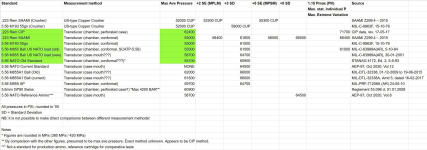
People who don’t understand that NATO and SAAMI use different methods to test pressure are very confident that 5.56x45mm is a higher pressure cartridge than .223 Remington

1789506342074.png


Public link to Bloke On The Range's collection of ammunition spec documents.

 
Last edited:
Rubbish The spec documents say it's wrong
People who don’t understand that NATO and SAAMI use different methods to test pressure are very confident that 5.56x45mm is a higher pressure cartridge than .223 Remington

View attachment 75805


Public link to Bloke On The Range's collection of ammunition spec documents.

Well, you'll have to explain it to me please. I'm not contesting it, but just pleading ignorance. In that table it seems to show higher pressure numbers for 5.56 rounds than .223 rounds. If they're in different units, you'll have to tell me what the units actually are for the two, before I can make an informed comparison.
 
Well, you'll have to explain it to me please. I'm not contesting it, but just pleading ignorance. In that table it seems to show higher pressure numbers for 5.56 rounds than .223 rounds. If they're in different units, you'll have to tell me what the units actually are for the two, before I can make an informed comparison.
The first two entries using the same test show the same pressure for .223 and 5.56

Also the pressure for standard M195 5.56 and .223 measured by SAMI is the same.

SAMI (Sporting Arms Manufacturers Institute) measurement for .223 is lower than the CIP (Permanent International Commission for the Proof of Small Arms) measurement by 7400psi

5.56 NATO measurements are all CIP and they never rise above the .223 measurement.
 
Last edited:

ISF - Join now!

Every member here is approved by hand. No bots, no spam, just people who care about evidence and honest debate.

Membership is free!

Create your free account

Back
Top Bottom