• Security incident: ISF was recently accessed by intruders. Please change your password, and change it anywhere else you used it. Read more

Apollo 11 Moon Landing Revisited: Hoax ~vs~ Debunk

... and then transmitted by pointing a TV camera at the receiving monitor.
I wonder if you are talking here about converting slow-scan tv pictures to domestic broadcast tv.

The slow scan pictures were coming back at ten frames per second. US domestic TV ran at 29.97 frames per second.

It's 1969 so obviously you don't have a computer. Tell me how you would convert one video frame rate to another, live on TV, other than by simply pointing an NTSC camera at a 10 fps monitor and relying on the persistence of the screen's phosphor glow to smear over the flicker?
 
Correct: that happens in the outer electron belt. Some high-energy electrons are absorbed in the outer stainless steel and create x-rays, which are then attenuated by the inner aluminum shell. The goal is for most of the high-energy electrons to pass through the steel and be trapped instead by the LMW materials, which do not produce secondary radiation when they absorb electrons.
It’s almost like NASA actually had experts that understood the radiation concerns of space travel.
 
I think it would be marvellously entertaining if you were to show us the sources you looked up to come up with this. Will you show us the resources you based this on?
She seems to be implying that the Hasselblad photographs were directly transmitted to earth? But it's just as likely that she is simply misusing terminology again and trying to say that the TV signals from the moon needed a geostationary communications satellite, because, I'm sure, she's also something of an expert regarding broadcast communications.

Vixen, geostationary communications satellites are used to transmit signals around the world. You send a signal to the satellite, and it broadcasts it back to earth, or even to another satellite, so that you can send signals to receivers far beyond the horizon.

With Apollo this wasn't necessary, because the sending and receiving antennae were in line of sight of each other, so they didn't need a relay. The high gain antenna on the lunar surface didn't even need to be particularly powerful or sensitive, either, because the enormous radio telescopes of the Deep Space Tracking Network used at the earth end were both extremely powerful and extremely sensitive.
 
I wonder if you are talking here about converting slow-scan tv pictures to domestic broadcast tv.

The slow scan pictures were coming back at ten frames per second. US domestic TV ran at 29.97 frames per second.

It's 1969 so obviously you don't have a computer. Tell me how you would convert one video frame rate to another, live on TV, other than by simply pointing an NTSC camera at a 10 fps monitor and relying on the persistence of the screen's phosphor glow to smear over the flicker?
And it's not like that conversion technology had already been in use by TV stations for years before the Apollo 11 EVA.
 
She seems to be implying that the Hasselblad photographs were directly transmitted to earth? But it's just as likely that she is simply misusing terminology again and trying to say that the TV signals from the moon needed a geostationary communications satellite, because, I'm sure, she's also something of an expert regarding broadcast communications.
I'm sure she's confused. Unfortunately it really does matter what exact medium you're talking about when you discuss Apollo imaging. Saying "photo" when you really mean "television" is a cognizable mistake. Too many conspiracy theorists confuse live TV with 16 mm film, and stills from these with 70 mm and 35 mm still photography.

With Apollo this wasn't necessary, because the sending and receiving antennae were in line of sight of each other, so they didn't need a relay. The high gain antenna on the lunar surface didn't even need to be particularly powerful or sensitive, either, because the enormous radio telescopes of the Deep Space Tracking Network used at the earth end were both extremely powerful and extremely sensitive.
After the signal is received at those stations, that's the only time satellites come into play. For listening stations on ships at sea, the signal goes from there right to any of a series of special-purpose satellites, some of which were in LEO and MEO. With these, from some point on Earth, you have only 20-30 minutes' line of sight per satellite. But they can use protocols already familiar to the military.

In contrast, the ground stations on land used ordinary leased telephone lines for voice and telemetry. They "striped" the content across three lines. These connections used whatever the telephone company was using at any given moment. This is a series of underwater cables, microwave stations, and Intelsat satellites. Specialized channels on the satellites were temporarily switched into dedicated patches for the television broadcasts, which required higher bandwidth than other trans-Pacific links. This became more common in the later missions.

Intelsat F-4, for example, was the primary television link from the Australian ground stations (Parkes and Honeysuckle Creek) to the receiver in California. From there the television signal went over terrestrial and microwave links to Houston. Yes, Intelsat F-4 was in geostationary orbit, and was part of the existing global telecommunications network. Claiming that no geostationary satellites were used and then protesting that we should just all "look it up" is amazingly lazy.

In any case, what's the nexus between the composition of the global telecommunications network in 1969 and a purported hoax? Some of these conspiracy theorists just blurt out random assertions and think that hoax somehow automatically follows.

 
Last edited:
Has Vixen ever posted a number to nail down exactly how much exposure is expected to be received by anyone traveling through the radiation belts? If one does not know, then why would anyone think the belts are an insurmountable obstacle?
 
Too many conspiracy theorists confuse live TV with 16 mm film, and stills from these with 70 mm and 35 mm still photography.
And this is because the Apollo Hoax nonsense didn't take hold until the early 21st Century. You, and I, and others in our age bracket remember the Apollo missions, and how the technology progressed for each landing as the mission designers updated the parameters as new information came in telling them what was possible. Apollo 11 was a bare-bones lunar mission. They didn't bring everything they could have because of the unknown risks. But by Apollo 14 they knew what they could safely bring along to the moon.

AND THEY EXPLAINED THIS AT THE TIME.

Apollo 11 gave us grainy black and white TV images from the few cameras they had, but it was enough. And once back on earth NASA processed the film and still images. They were on the covers on Time, LIFE, and Newsweek in all their glory within days, but it wasn't live. The films showed up on TV specials, and most American public school students got to see them in classrooms off and on through the early 1980s. Apollo 14 had better TV cameras (in color!) that gave the world amazing footage. There is the iconic shot of the LM lifting off that lives rent free in my head to this day.

Hell, at the first Star Trek convention I ever attended in 1978, after George Takei spoke, and they ran the blooper reel twice, they ran an hour of Apollo footage that had no sound. Just raw film, and all us nerds stayed to the end.
 
They will never confirm it but they'll 'suggest' the spacecraft went via the 'safe route' via one of the poles.
Oh, and NASA never even suggested that they went "via one of the poles". That's just you getting your terminology all wrong again and fundamentally misunderstanding concepts.

The S-IVB, the third and final stage of the Saturn V, entered low earth orbit on a plane inclined to the plane of the VARB. When the S-IVB was restarted for the TLI (Trans Lunar Injection) burn, it flew a trajectory that carried it through the outer regions of the belts, where the flux is considerably lower. Contrary to your claim, NASA has never been vague about this at all.

f0803 (1).png
 
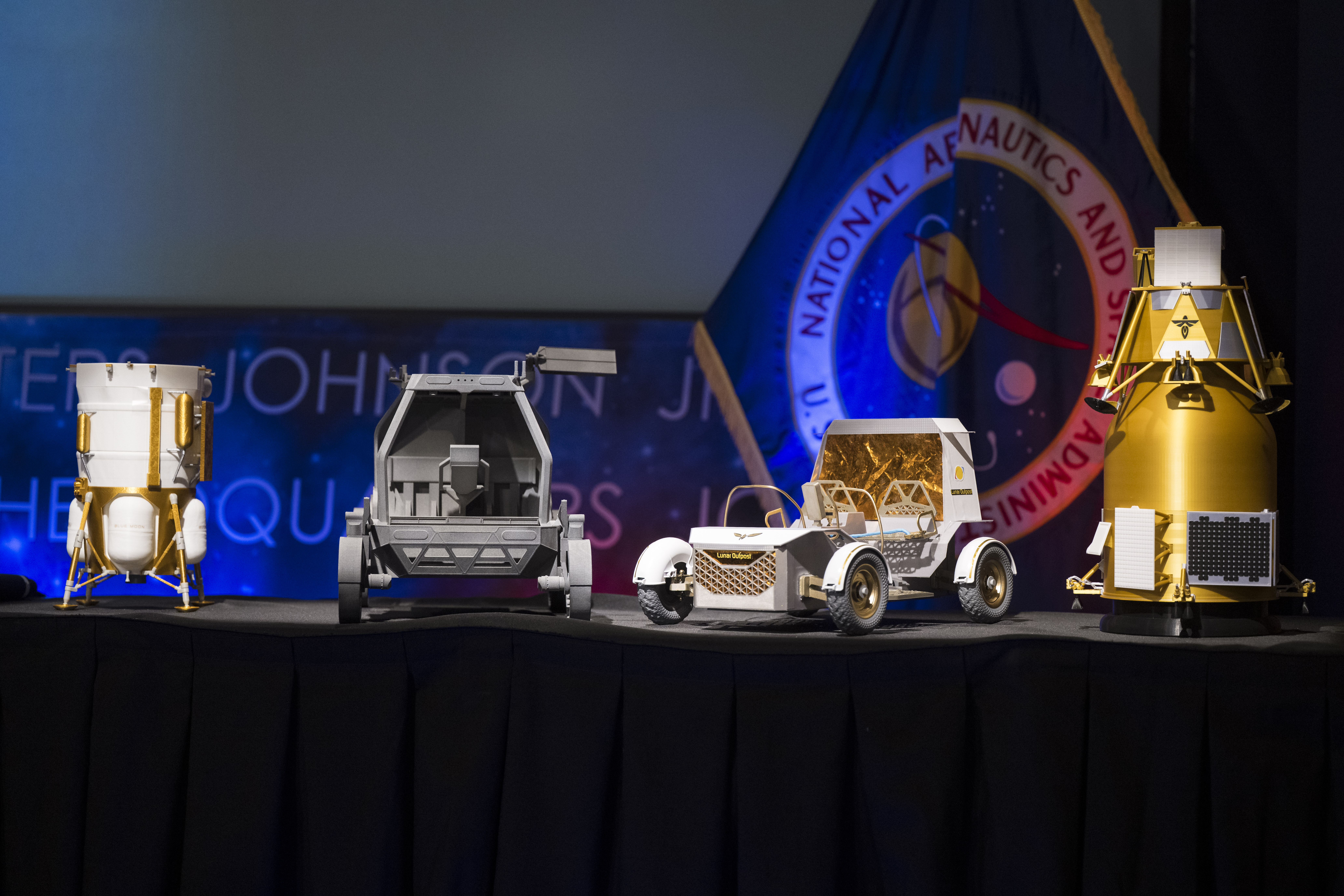
Meanwhile, in normal people land, NASA updates anyone who's interested on the ongoing lunar missions to come:


Even better, our lunar rovers are getting fancy:


The best part is this NASA has always been up front about everything it's doing. They want people to know because they're usually doing something exciting.
 
Oh, and NASA never even suggested that they went "via one of the poles". That's just you getting your terminology all wrong again and fundamentally misunderstanding concepts.
In 2000, NASA published a work called Apollo by the Numbers. It's a statistical abstract of the entire Apollo program containing such things as the orbital elements of all the spacecraft maneuvers. Which means that aside from some prose sections describing the mission objectives and overview, it's 300 pages of tabular data. If you want to know the spacecraft geodetic latitude and longitude and mission elapsed time of when Frank Borman first took a crap, it's in there. And because the world is full of nerds, these figures have been used to recreate the Apollo missions in various ways. The notion that NASA keeps all the historical cards close to its chest is just a straight-up lie.

Contrary to your claim, NASA has never been vague about this at all.
A substantial amount of Apollo conspiracism is simply doing almost nothing to understand how Apollo worked, doing absolutely nothing to investigate the scientific and engineering environment, and then arrogantly parlaying that egregious and willful ignorance into some sort of narrative about how NASA is hiding things. In no serious area of scholarship would it be acceptable simply to speak from a position of colossal ignorance and try to pin the consequences of that onto the target of your investigation.
 

ISF - Join now!

Every member here is approved by hand. No bots, no spam, just people who care about evidence and honest debate.

Membership is free!

Create your free account

Back
Top Bottom