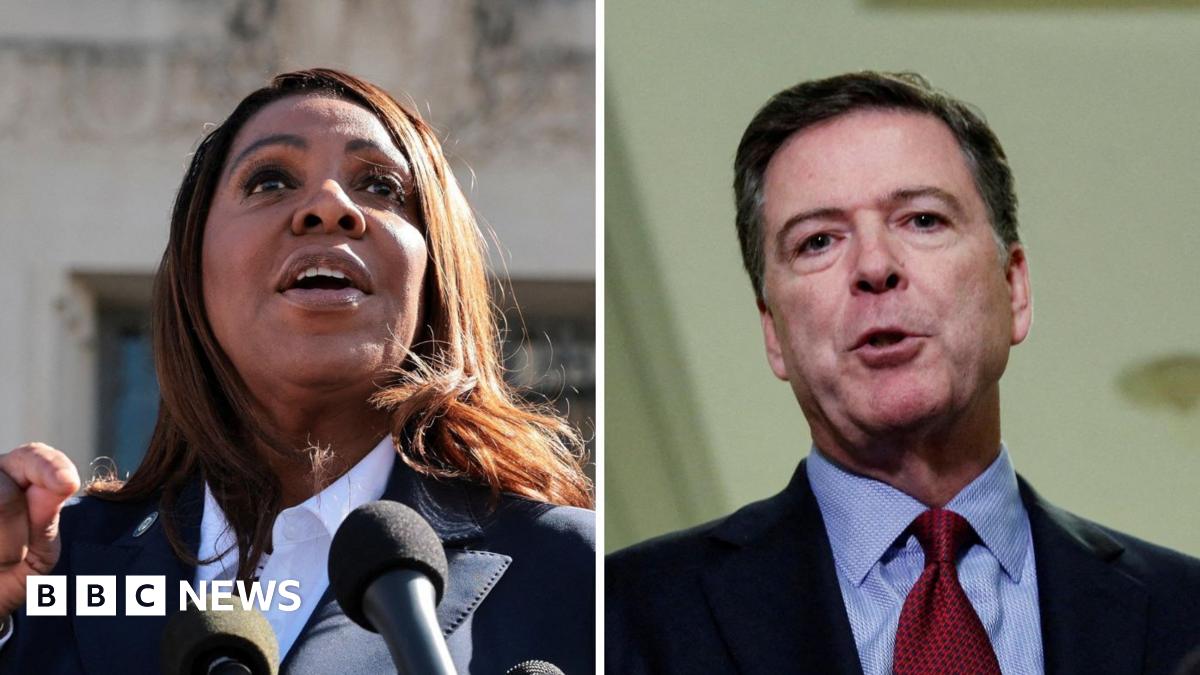
Yesterday (Friday, 21 November 2025), James Comey and his defense team filed a new
29-page motion to dismiss the indictment. Those who are following the case may remember that, on 20 October, Comey filed a
51-page motion to dismiss, along with several exhibits including
Exhibit D's list of public statements made by President Donald J Trump and James B Comey. Those who like to follow along in their hymn books can peruse the
entire docket, which now consists of 212 entries.
Yesterday's motion to dismiss reiterated Comey's argument (of 20 October) that his prosecution is both selective and vindictive.
Yesterday's motion says "the case should be dismissed because the grand jury never approved the operative indictment....the grand jury rejected the only indictment that the government presented to it." Furthermore, "dismissal is independently warranted because of the government’s misconduct before the grand jury." That misconduct included the government's reliance upon information obtained in violation of the Fourth Amendment and attorney-client privilege, and also include Lindsey Halligan's "serious misstatements of law to the grand jury."
Yesterday's motion to dismiss also refers to events of the two previous days, Wednesday (19 Nov) and Thursday (20 Nov). For context, it quotes from the transcript of 26 September's return of indictment proceedings before Judge Lindsey R Vaala. (That transcript is not yet available online, but should be available by the end of the month.) In the following quotation, "THE COURT" means Judge Vaala.
THE COURT: So this has never happened before. I’ve been handed two
documents that are in the Mr. Comey case that are inconsistent with one another.
There seems to be a discrepancy. They’re both signed by the foreperson. The
one that says it’s a failure to concur in an indictment, it doesn’t say with respect
to one count. It looks like they failed to concur across all three counts, so I’m a
little confused as to why I was handed two things with the same case number that
are inconsistent.
MS. HALLIGAN: So I only reviewed the one with the two counts that our office
redrafted when we found out about the two -- two counts that were true billed, and
I signed that one. I did not see the other one. I don’t know where that came from.
THE COURT: You didn’t see it?
MS. HALLIGAN: I did not see that one.
THE COURT: So your office didn’t prepare the indictment that they --
MS. HALLIGAN: No, no, no -- I -- no, I prepared three counts. I only signed the
one -- the two-count. I don’t know which one with three counts you have in your
hands.
THE COURT: Okay. It has your signature on it.
MS. HALLIGAN: Okay. Well...
Halligan first said she never saw the three-count indictment. Then she said she prepared it, but didn't sign it. Then she said okay, she did sign it. Glad we could get that straight.
Addressing Thursday's "Notice Correcting the Record", submittted by Halligan
et al., Comey's motion noticed the fact that Thursday's notice "contradicts numerous other representations that the government has made to this Court." Even if it were true that the two-count indictment was presented to the full grand jury (which would imply that several of the government's statements to the court on Wednesday were untrue), "that would only raise a host of additional problems for the government—not least of which is the apparent absence of any recording of that presentment."
The motion also reiterated Comey's argument that the indictment should be dismissed because it was signed only by "an improperly appointed interim U.S. Attorney." That matter is now before a different court, which (on 28 October) ordered the government to submit "all documents relating to the indictment signer’s participation in the grand jury proceedings, along with complete grand jury transcripts." (Note that Judge Currie (the presiding judge in that court) has been careful to refer to Lindsey Halligan as "the indictment signer", not as the interim US attorney.) On 3 November, the government pretended to comply with that order. On the very next day, Judge Currie noted that the transcript was incomplete and "contains no records or transcripts regarding the presentation of the three-count indictment".
On 31 October, the US Attorney General (Pam Bondi) stepped in to "ratify" Halligan's conduct despite its irregularities. On 13 November, Judge Currie "observed that [Bondi's] purported ratification could not pertain to the entirety of Ms. Halligan’s conduct before the grand jury because the complete transcript had not been prepared until after the purported ratification." Judge Currie also noted that the transcript was incomplete because it ended at 4:28pm. Halligan responded by saying she "had no interaction whatsoever with any members of the grand jury" between 4:28pm and the return proceeding in front of Judge Vaala at 6:40pm. Which means Halligan could not possibly have shown the two-count version of the indictment to the entire grand jury during that time, nor could she have shown it to the grand jury's foreperson during that time.