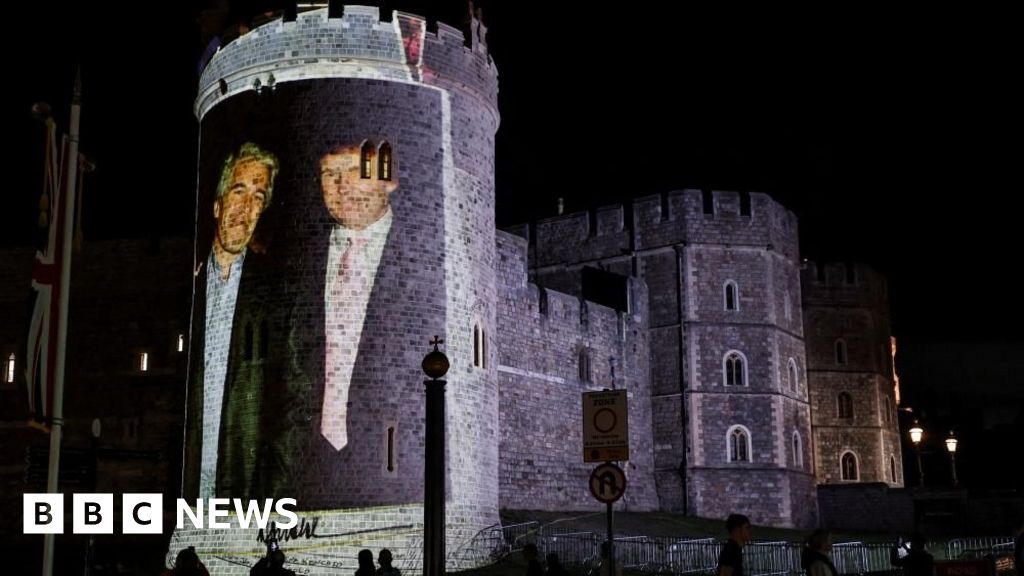
Wow, UK has lost freedom of speech


No charges will be brought against four men arrested after images of Donald Trump and convicted sex offender Jeffrey Epstein were projected on to Windsor Castle, Thames Valley Police has said.

The men - a 60-year-old from East Sussex, a 36-year-old and a 50-year-old both from London, and a 37-year-old from Kent - were arrested in September over the incident during the US president's state visit.

They were arrested on suspicion of offences including malicious communications and public nuisance.

In an update on Wednesday, the force said no further action would be taken against them after an investigation concluded.
 
Yes, in the UK it is a crime to express an unpopular opinion and you heartily support it.
You are completely mischaracterizing what its about.

The proscription of terrorist organizations is about taking away support for organizations whose main purpose is to kill people they disagree with.

It sounds like it would also be a crime to criticize the government for banning an organization under the Terrorism Act.
Nope, it is not. You're just playing the part of dumb contrarian now
 
You are completely mischaracterizing what its about.

The proscription of terrorist organizations is about taking away support for organizations whose main purpose is to kill people they disagree with.
Nope. There is no indication that she belong to, supported (materially) or invited support for a terrorist organization. Her only crime is speaking out in favour of it.
 
Nope. There is no indication that she belong to, supported (materially) or invited support for a terrorist organization. Her only crime is speaking out in favour of it.
You are simply wrong...

12 Support.
(1) A person commits an offence if-​
(a) he invites support for a proscribed organisation, and​
(b) the support is not, or is not restricted to, the provision of money or other property (within the meaning of section 15).​
(1A) A person commits an offence if the person—
(a) expresses an opinion or belief that is supportive of a proscribed organisation, and
(b) in doing so is reckless as to whether a person to whom the expression is directed will be encouraged to support a proscribed organisation.

(2) A person commits an offence if he arranges, manages or assists in arranging or managing a meeting which he knows is—​
(a) to support a proscribed organisation,​
(b) to further the activities of a proscribed organisation, or​
(c) to be addressed by a person who belongs or professes to belong to a proscribed organisation.​

When you are "speaking out in favour of" a proscribed organisation, you are definitely expressing "an opinion or belief that is supportive of" that organzation. When you are a doctor in the NHS, you have a significant public profile, and when you and publish that sort of material widely on social media, you are definitely being "reckless as to whether a person to whom the expression is directed will be encouraged to support a proscribed organisation."
 
You are simply wrong right
ftfy.

When you are "speaking out in favour of" a proscribed organisation, you are definitely expressing "an opinion or belief that is supportive of" that organzation. When you are a doctor in the NHS, you have a significant public profile, and when you and publish that sort of material widely on social media, you are definitely being "reckless as to whether a person to whom the expression is directed will be encouraged to support a proscribed organisation."
Just what I have been saying all along. It is a crime to speak out in favour of a "proscribed" organization. I have already pointed out that she should have to justify keeping her medical licence.
 
Last edited:
...snip....
(1A) A person commits an offence if the person—
(a) expresses an opinion or belief that is supportive of a proscribed organisation, and
(b) in doing so is reckless as to whether a person to whom the expression is directed will be encouraged to support a proscribed organisation.

(2) A person commits an offence if he arranges, manages or assists in arranging or managing a meeting which he knows is—​
(a) to support a proscribed organisation,​
(b) to further the activities of a proscribed organisation, or​
(c) to be addressed by a person who belongs or professes to belong to a proscribed organisation.​

When you are "speaking out in favour of" a proscribed organisation, you are definitely expressing "an opinion or belief that is supportive of" that organzation. When you are a doctor in the NHS, you have a significant public profile, and when you and publish that sort of material widely on social media, you are definitely being "reckless as to whether a person to whom the expression is directed will be encouraged to support a proscribed organisation."
You missed out that it is an "AND" - a and b are both required to be true before it becomes an offence, and the term "reckless" has a well-defined specific meaning in legislation. (In the 1980s a new meaning was created by a new precedent - that was thankfully eventually overturned, and the old precedent reestablished.)

If you think about it if the "and" and "reckless" wasn't there then no one would be able to say - for example - that an organisation has changed and should no longer be a proscribed organisation.

I think it will be interesting to see what will happen to the recent 1000 plus people who have been arrested for a Section 13 offence for supporting Palestine Action. I suspect that the CPS will decide to prosecute very few because of that "and" and the "reckless". I really can't believe that the courts will decide that saying a proscribed organisation should not be proscribed organisation can fall under the act (which is what many of them were doing). But the courts have surprised me in the past however I really do hope that it will not end up being another backdoor way to erode our right to freedom of expression.
 
I have been posting stuff on the internet for 20 years, some of it has been rather controversial. Much is anonymous, using this Nessie account, but there is something else I do, often using a nickname which links to who I am, which his highly critical of many in authority, MPs, the police, journalists and members of the public. I have managed all that without generating any complaints, or visits from the police. I have been banned from some forums, where they censor me, because they do not like my views, but that is private individuals, not the government.
 
You missed out that it is an "AND" - a and b are both required to be true before it becomes an offence, and the term "reckless" has a well-defined specific meaning in legislation. (In the 1980s a new meaning was created by a new precedent - that was thankfully eventually overturned, and the old precedent reestablished.)
Moot.

Speaking out in the manner she did IS reckless in and of itself
 
I have been posting stuff on the internet for 20 years, some of it has been rather controversial. Much is anonymous, using this Nessie account, but there is something else I do, often using a nickname which links to who I am, which his highly critical of many in authority, MPs, the police, journalists and members of the public. I have managed all that without generating any complaints, or visits from the police. I have been banned from some forums, where they censor me, because they do not like my views, but that is private individuals, not the government.
You're a singular example - and so am I. But I'll bet neither of us have participated in protests wearing the logo/insignia of proscribed terrorist organizations, or expressed views in support of such organizations.

I have some pretty unpopular opinions. Some on this forum... some with the left, some with the right. for example

- Climate change is real and caused by humans (unpopular with the right)
- Unconditionally, and without exception, pro-women's rights (very unpopular here and with the left)
- Pro environmentalism and a supporter of both Greenpeace and Sea Shepherd (unpopular with the right)
- Pro choice w.r.t. abortion rights (very unpopular with the right)
- Anti systemic racism (unpopular with the right)
- Pro free speech and free expression (unpopular with both the far left and the far right)
- Pro legal migration (unpopular with the right)
- Anti illegal immigration (unpopular with the left)

I too have been banned from a couple of forums for expressing some of those opinions, but I stand by all of them. Some of those opinions are very unpopular here, but are popular among the general public (probably because this forum tends to be something of a left-wing echo chamber).
 
Last edited:
In the legal sense?
Yes. Here is the legal definition of recklessness in the UK


Recklessness is unjustified risk taking.
A person acts recklessly with respect to:
(i) a circumstance when he is aware of a risk that it exists or will exist;
(ii) a result when he is aware of a risk that it will occur; and
it is in the circumstances known to him unreasonable to take the risk. Failure to consider a risk – however obvious it might be – does not give rise to recklessness; but closing one's mind to a risk requires first realising that there is one and is thus equivalent to awareness
This clearly applies to Aldawan's actions. You won't convince me that this ◊◊◊◊-stain wasn't 100% aware of the risk she was taking with respect to her audience. If there was sufficient risk for Lucy Connolly to be jailed for her tweet, there is definitely sufficient risk that Aldawan's words and actions would inspire someone to undertake a terrorist act as a result.

Worth noting:
After Lucy Connolly suggested to burn down migrant hotels, no-one actually did so.
After Rahmeh Aldawan called for the death of Jews and displayed a throat-slitting action, someone did commit a terrorist attack on a synagogue.

Because that is what it would have to be - you can find the (current) decision that sets out what reckless means in law here: https://publications.parliament.uk/pa/ld200203/ldjudgmt/jd031016/g-2.htm
R v Cunningham [1957]
R v Briggs (Note) [1977]
R v Parker (Daryl) [1977]
R v Stephenson [1979]
Herrington v British Railways Board [1972]
R v Caldwell [1982]
R v Lawrence (Stephen) [1982]
R v Miller [1983]
Elliott v C [1983]
R v Stephen Malcolm R (1984)
R v Reid [1992]
R v Coles [1995]

All precede the Terrorism Act 2000, so none of those examples are on point. Also worth noting that in some cases, the application of "reckless" was challenged and the appeals failed.

ETA, its also worth noting that the Terrorism Act 2000, Section 13 is based on strict liability. For Section 13 offenses, a person is guilty if they are aware they are wearing, carrying, or displaying the article, but the prosecution does not need to prove they knew the item would arouse suspicion or intended to cause it.

In other words, you wear a Hamas or Palestinian Action logo, or carry eithr of their flags, you are presumed to have known that it was illegal to do so, and the prosecution do not have to prove you knew.


Section13 Uniform and publication of images.
(1) A person in a public place commits an offence if he—
(a) wears an item of clothing, or
(b) wears, carries or displays an article
in such a way or in such circumstances as to arouse reasonable suspicion that he is a member or supporter of a proscribed organisation.
(1A) A person commits an offence if the person publishes an image of—
(a) an item of clothing, or
(b) any other article,
in such a way or in such circumstances as to arouse reasonable suspicion that the person is a member or supporter of a proscribed organisation.
(1B) In subsection (1A) the reference to an image is a reference to a still or moving image (produced by any means).

 
Last edited:
Yes. Here is the legal definition of recklessness in the UK


Recklessness is unjustified risk taking.
A person acts recklessly with respect to:
(i) a circumstance when he is aware of a risk that it exists or will exist;
(ii) a result when he is aware of a risk that it will occur; and
it is in the circumstances known to him unreasonable to take the risk. Failure to consider a risk – however obvious it might be – does not give rise to recklessness; but closing one's mind to a risk requires first realising that there is one and is thus equivalent to awareness
This clearly applies to Aldawan's actions. You won't convince me that this ◊◊◊◊-stain wasn't 100% aware of the risk she was taking with respect to her audience. If there was sufficient risk for Lucy Connolly to be jailed for her tweet, there is definitely sufficient risk that Aldawan's words and actions would inspire someone to undertake a terrorist act as a result.

Lucy Connolly wasn't prosecuted under the terrorism act but the public order act. They are two very different things.

Worth noting:
After Lucy Connolly suggested to burn down migrant hotels, no-one actually did so.
After Rahmeh Aldawan called for the death of Jews and displayed a throat-slitting action, someone did commit a terrorist attack on a synagogue.


R v Cunningham [1957]
R v Briggs (Note) [1977]
R v Parker (Daryl) [1977]
R v Stephenson [1979]
Herrington v British Railways Board [1972]
R v Caldwell [1982]
R v Lawrence (Stephen) [1982]
R v Miller [1983]
Elliott v C [1983]
R v Stephen Malcolm R (1984)
R v Reid [1992]
R v Coles [1995]

All precede the Terrorism Act 2000, so none of those examples are on point. Also worth noting that in some cases, the application of "reckless" was challenged and the appeals failed.
And because they precede the act that would be the definition the act would be judged to mean as it is a term of law.
 
Lucy Connolly wasn't prosecuted under the terrorism act but the public order act. They are two very different thing
Doesn't matter. Your issue was recklessness, and what both Aldawan and Connelly said/did was reckless
And because they precede the act that would be the definition the act would be judged to mean as it is a term of law.
Still not seeing how any of those apply

NOTED; you side stepped the recklessness definition and the strict liability in Section 13... but of course you did.
 
Doesn't matter. Your issue was recklessness, and what both Aldawan and Connelly said/did was reckless
Of course it matters what laws they are meant to have broken! Is the term "reckless" in the legislation and the section that was used to prosecute Connelly?
Still not seeing how any of those apply

NOTED; you side stepped the recklessness definition and the strict liability in Section 13... but of course you did.
Not got a clue what you mean.
 

Back
Top Bottom