• Security incident: ISF was recently accessed by intruders. Please change your password, and change it anywhere else you used it. Read more

Cont: The Trials of Amanda Knox and Raffaele Sollecito: Part 32

In Italian trials, the verdict (the short form operative verdict) is issued by the judges soon after the conclusion of the adversarial debate and final summation parts of the trial. Then, after some months, a motivation report is issued with the reasoning justifying the verdict. Therefore, one shouldn't be surprised if the some "judicial facts" in a motivation report are constructed after the verdict is reached to support that verdict.

Similarly, when the Italian prosecutor - and in particular, Mignini in this case - formulates reasoning for arresting persons - the suspicion of the persons may come first, and the reasons for the suspicions come after, to justify those suspicions. Furthermore, the initial suspicions could actually have been the recognition of the persons most convenient and vulnerable to prosecution. See, for example, Giobbi's testimony in the Massei trial - his reasons for suspicions related firstly to his negative perceptions of the innocent noncriminal behavior of Knox and Sollecito.


As we know, Italy - like most of Europe - has a tribunal style of court. Whereas in the UK, specifically in England & Wales, although Scotland and Northern Ireland are probably the same in this respect, the CPS via the appointed prosecutor has to lay out its case at the start of the trial and then has the onus of proving its case to the jury, randomly selected from the electoral register. It can't change these initial detals once established at the start of a trail, without calling for a mistrial or a retrial (one such case recently happened). In Italy, the prosecutor still has the burden of proof, but can modify the details of the charges when new details or perspectives come to light as the case progresses. In the UK the verdict of the jury is final and sovereign. It is illegal for any member of a jury to reveal how they reached the verdict or how they deliberated (unlike in the US). The verdict is given and the judge may give a verbal summing up whilst explaining his or her sentencing but there are no written reasons explaining the courts findings or facts found. These are to be inferred from the CPS' original case against the defendant - to be found in opening submissions. In tribunal style systems, 'Written Reasons' or as it is called in Italy, a 'Motivational Report', wherein the judges are expected to provide facts found and motives behind the crime from these facts. So, if a crime involves a characteristic teenage thrill-killing type element, as was claimed re the Memphis Three or some of the recent 'teenage thrill-killer crimes in the UK (for example, of Brianna Ghey, who was transgender), one can readily ascertain that proving a motive is a near impossibility, because how do you prove that anyone has a 'fantasy' that they have put into action, except by showing what they have produced in social media, My Space, FB and school essays, reading matter, 'the manifesto', etc? So although a murder might have all the hallmarks of a ritualistic 'satanic' halloween vampire, day of the dead, killing written all over it, it is little wonder why prosecutors simply abandon this angle and present the much simpler, 'The pair got into a row over rent money or cleanliness', as they did here, which makes the murder, whilst labelled as 'futile' by the prosecutor, makes it difficult for the average member of the public to comprehend or accept. Hence, particularly heinous - and seemingly unlikely - crimes attract a high level of scepticism and support for the convicted as being somehow a miscarriage of justice. We see this time and again. For example, the Memphis Three or the Lucy Letby case, where a normal-looking ordinary well-qualified nurse systematically killed babies for a few years without detection.


.
 
Last edited:
Witness testimony is direct evidence. Circumstantial evidence is evidence from which we can infer a thing. For example, forensic evidence is circumstantial evidence*. So, as the witness was describing the act of he himself finding the porno-horror fantasy comics n RS' bedroom when the police search was carried out, it does count as both direct evidence and also circumstantial insofar we can deduce RS had a liking for this type of stuff.


*The circumstantial evidence of DNA is a powerful one, yet because it is invisible to the naked eye, some people can't quite believe it is possible it really was Mez' DNA on the knife blade or RS' full profile on the bra clasp. They seriously try to claim it was 'contaminated', as if a grotty dusty student digs should be akin to a sterile hospital ward in the first place. By that criterion, all crime scene DNA should be impermissible. They can understand the footprint on the bathmat because 'seeing is believing' - the mantra of the 'stands-to-reason' brigade- but despite extremely fine analysis by highly skilled engineers with PhD's, using the technical drawing skill to record the parameters of the minutest measurements, angles and dimensions, of every toe, 'hammer' defect, ball of foot ratio to other parts, width, depth and thickness, still insist that somehow, the imprint on the bathmat, in the victim's blood, can be shoehorned (pun intended) to also fit Guede's foot!!! :wackylaugh: And LondonJohn epitomises this 'true believer's unbelievers' mindset. "No science, today, thanks! It's Fantasy Island Day today." :wackylaugh:


.
Nope. Try reading more than the "AI overview" on your google search results, and have another go.
 
There is more than one frame to a comic strip!

Room not too small. When the jury visited, seven people (including 'larger' middle-aged types) fit in easily, milling around as Comodi explained where was what.
The room was very small. Specifically, it was 281 cm (9.2') x 336 cm (11'). That is a small room. My closet is bigger than that.

But what you're forgetting is when the jury visited the room, the furniture was not there. When you add in the bed, the nightstand, the wardrobe and the desk, the room suddenly goes from small to extremely small. The open area within the confines of that furniture left an area approximately 130 cm (4.2') x 160 cm (5.2'). That is EXTREMELY small.

I'm curious, how do you know the seven people included 'larger' types, that they "fit easily, milling around"? I don't believe there was any video or photos of them visiting the site. If I'm correct about that, then how could you know this? ...or are you just inserting some characterizations in an attempt to portray a clearly small space as larger than it is?
 
Last edited:
Witness testimony is direct evidence. Circumstantial evidence is evidence from which we can infer a thing. For example, forensic evidence is circumstantial evidence*. So, as the witness was describing the act of he himself finding the porno-horror fantasy comics n RS' bedroom when the police search was carried out, it does count as both direct evidence and also circumstantial insofar we can deduce RS had a liking for this type of stuff.


*The circumstantial evidence of DNA is a powerful one, yet because it is invisible to the naked eye, some people can't quite believe it is possible it really was Mez' DNA on the knife blade or RS' full profile on the bra clasp. They seriously try to claim it was 'contaminated', as if a grotty dusty student digs should be akin to a sterile hospital ward in the first place. By that criterion, all crime scene DNA should be impermissible. They can understand the footprint on the bathmat because 'seeing is believing' - the mantra of the 'stands-to-reason' brigade- but despite extremely fine analysis by highly skilled engineers with PhD's, using the technical drawing skill to record the parameters of the minutest measurements, angles and dimensions, of every toe, 'hammer' defect, ball of foot ratio to other parts, width, depth and thickness, still insist that somehow, the imprint on the bathmat, in the victim's blood, can be shoehorned (pun intended) to also fit Guede's foot!!! :wackylaugh: And LondonJohn epitomises this 'true believer's unbelievers' mindset. "No science, today, thanks! It's Fantasy Island Day today." :wackylaugh:
Among its defects in logic and the implicit definitions of some legal terms, the above post is deficient in its understanding of DNA contamination.
 
Oh dear, Myriad. Car screeches past, two guys jump out, throw dynamite at the bank doors, the pair make off with a heist of gold bars and money bags. Myriad: (for it is he). I can't see anything suspicious about that. <shrugs>

By the way, you left out the part where the prosecutors go easy on those guys because they're convinced the dynamited door was only staged by the true robber, the bank teller, and after seizing and destroying the evidence she wasn't there at the time, they try to convict her because her DNA is on the sink in the employee rest room and she owns an unopened BluRay of Dog Day Afternoon.

Hey, that would make a good movie all by itself. They could title it The Italian Job II.
 
Some quick definitions of evidence types for a criminal case:

Circumstantial aka Indirect Evidence: Evidence that requires an inference to establish a fact directly relevant to a crime. Testimony or forensic evidence may be circumstantial evidence. For example: Witness A testifies that he saw Defendant C enter a bank 10 minutes before that bank was robbed.

Direct evidence: Evidence that establishes a fact directly relevant to the crime. For example, Witness B testifies that she was inside the bank during a robbery and saw Defendant D inside the bank pointing a pistol at a teller and then saw the teller handing what appeared to be a stack of currency to D.

Credible evidence: Evidence that is worthy of belief; it is trustworthy and reliable. Evidence becomes non-credible if it, its origin, or chain of custody has been comprised in some way. Forensic evidence must be collected using scientifically valid protocols and with controls as required to assure validity, for example, to show that DNA profile results have not been made non-credible by DNA contamination. In some forensic tests, such as DNA testing, repeated tests on the same sample are used to establish whether or not the test results are reliable. Evidence or a hypothesis which requires a physically, biologically, or chemically impossible action is not credible evidence nor a credible hypothesis. For example, a claim that DNA evidence of one person was allowed to remain at a crime scene while the DNA evidence of other persons alleged to be at the crime scene was selectively removed is not credible.
 
Last edited:
There appear to be quite a few cases of calunnia in Italian judicial history. There are different scenarios to be considered. For example, what if there is an accusation against someone, but the accuser presents an absurd accusation or one that lacks credibility, or the accuser has doubts about whether or not the accused person is guilty or innocent? Then:

Therefore, the criminal relevance of the conduct is excluded if the reported or simulated facts lack credibility, as they are grotesque or absurd, such as to exclude the initiation of criminal proceedings ictu oculi, or in cases where the crime is prosecutable only in the presence of a condition of admissibility, which is in fact absent (for example, when there is a report but not a complaint by the alleged injured party - Pescara Court, 03/04/2023, (hearing 03/04/2023, dep. 03/04/2023), no. 736).

What happens in the event that there is uncertainty about the innocence of the accused person?

A) According to a jurisprudential orientation, in a situation of doubt or reasonable uncertainty about the innocence of the accused, the psychological element of the crime provided for by art. 368 of the Criminal Code does not occur. (cfr. Cass. pen. sent. n. 27846 of 2009).

The crime of slander requires the accuser to know the innocence of the accused ("that he knows he is innocent") and the average man cannot be required to be able to formulate "sure judgments of guilt".

If there are doubts about the innocence of the accused, in other words, it is not possible to make a reproach against the accuser, also because reasoning differently would end up restricting citizens' recourse to justice.

A different orientation, however, has observed that doubt, in itself, is not incompatible with intent, for the integration of which it is sufficient that the agent represents the innocence of the accused, even without the contours of certainty. In other words, according to this orientation only error can exclude intent.

It has been stated, for example, that in case of doubt, the complainant has the duty to clearly and precisely explain the reasons for his doubts (a duty that can be traced back to the sense of responsibility of each citizen) when he presents complaints to the authorities.
Source: https://www.avvocatodelgiudice.com/...reato-previsto-dall-art-368-del-codice-penale

Google Translation.
 
An instance of calunnia can be retracted, but current Italian law requires the retraction to occur quickly, apparently before any legal consequence to the person accused by a calunnious statement:

Retraction is the statement by which a person who had previously committed the crime of calunnia admits the falsity of his accusation and reports the truth of the facts.

Retraction is governed by art. 376 of the Criminal Code and constitutes a cause for non-punishability.

In this regard, it is important to clarify that retraction alone is not enough to render the crime of calunnia previously committed non-punishable, and in fact some conditions must be met:

the retraction must occur at the same time or immediately after the false accusation, and in particular before the registration of the criminal proceedings;

the retraction must be precise and clear on all points of the calunnious complaint filed (it is not enough to simply insinuate doubts about its truthfulness);

the retraction must be voluntary and conscious and therefore free from any form of coercion.
At least one of the above points suggests it is not generally possible to retract an alleged act of calunnia: the retraction must occur before the "registration of the criminal proceedings" against the person falsely accused, and that registration may occur perhaps within minutes or an hour after the calunnious statement is made. And simply expressing doubts after making the statement is not enough, under current Italian law.

It's ironic that the retraction must be voluntary and free from coercion; there is no statement about what happens legally if the allegedly calunnious statement was not voluntary and was made under coercion. IIUC, Knox's lawyers had explained at the arrest hearing that her statement was made against her will, in violation of CPP Article 188, but this defense was not accepted then nor at any of the relevant trials. If an Italian court had accepted this defense, it would imply that the police and prosecutor had committed criminal acts, including calunnia against Knox.

Source: https://www.avvocatodelgiudice.com/...reato-previsto-dall-art-368-del-codice-penale
Google Translation. I have used the Italian legal term "calunnia" rather than in this context its misleading translation "slander".
 
Last edited:
There is more than one frame to a comic strip!
Panel. The correct term is panel. Pedantic as ◊◊◊◊, admittedly, but wanton misuse of jargon annoys me.

Frames are the individual images that make up a motion picture, be that live action or animated. The individual images that make up a comic strip or book are called panels (BTW, the publication under discussion here is a comic book, not a comic strip. Arguably it isn't either, it's a manga, but it is way closer to a comic book than it is to a comic strip).

Rant over, I return to lurking.
 
Once again, you are failing to keep track. The thrust of the discussion was a poster announcing he was reading WTBH to get familiar with the case.
Another mischaracterization as Spitfire never "announced" any such thing. THIS is what he said:
i had thought of this, but someone had mentioned that Filomena stated that Meredith never locked her door. However, I just got Waiting to Be Heard from the library, and Amanda states, on p. 71 (hardback), that she told the Postal Police that Meredith only locked her door when she was changing clothes or out of town for the weekend, and then Filomena interrupted, clearly agitated, to say that Meredith never locked her door, and to demand that the police break it down.

I pointed it that it was hardly an accurate account and cited the key alibi of staying home all evening and watching Amélie. Given the film Le Monde d'Amélie was the pair's key alibi,
How is watching Amelie from 6:27 p.m. to 9:10 p.m. their "key alibi" when the earliest Meredith could have been attacked was at 9:00? Additionally, the Naruto cartoon was downloaded and played between 9:26 and 9:46. Is it any wonder the prosecution needed the murder to happen closer to 11:00?

Any reasonable, objective person can see the problem with your claim.

it is rather striking Knox blatantly lies about this in her book. She knowingly and disrespectfully deceives her reader and this is clearly deliberate as she had, at that stage,
Once again, you declare you know what is in Knox's mind. 🔮
over five years to establish all of the facts, major and minor, of the alibi she would be relying on in court.
As I said, WHEN the damn movie was DOWNLOADED has no evidentiary value because it makes NO difference to the case. When it was WATCHED does. Knox would have no need to research when it was downloaded so she's going by what she remembers. This is just another classic example of the PGP need to give every little, irrelevant, nitpicked detail a nefarious "guilt" spin because the relevant evidence for guilt is just not there.

So your claim about people's causal memory of past events being naturally faulty is a laughable attempt to defend the indefensible.
Are you now claiming that people's "casual memory of past events" is NOT faulty? That we remember correctly all details of any past event or conversation?

Or more likely, you know perfectly well Knox is deliberately misleading her readers but you somehow think this type of criminal is to be admired, rather like a lot of Brits idolise the escaped Great Train Robber, Ronnie Biggs (yes, there was a railway worker left dead directly as a result of the audacious heist but, like Mez, everybody's forgotten about him, and Biggs is their hero because he screwed the police).
Oh, just stop it. This is beyond pathetic.
 
Accusations of calunnia may be common in Italy. The source I am using, the website of a lawyer's office, has 37 citations to CSC judgments on calunnia cases. From each of these citations the website includes an excerpt from the judgment - the "maxim" (la massima) that summarizes the "jurisprudence" (the CSC's semi-binding legal guidance; supposedly Italian courts do not have binding precedents, only semi-binding CSC jurisprudence). Another website, from the Brocardi law office, lists 138 CSC maxims (each from a single case); the first one listed is from 1984.

Here's one of the maxims that may have some relevance to the Knox case:

Indirect calunnia: the production of writings, information or testimonies is sufficient

The maxim

For the material element of the crime of calunnia to exist, in the form of the so-called real or indirect accusation, it is sufficient that circumstances suitable to indicate someone as responsible for an act constituting a crime that he did not commit are brought to the attention of the judicial authority - either in writings or with information or even testimonies given in the course of a trial. (Case in which the Supreme Court held that the material element of the crime existed in the production, in a trial for the crimes of threat and insult, of a false report of a contravention for violation of the Highway Code, aimed at demonstrating that the defendant was elsewhere at the time of the facts attributed to him and, therefore, to unequivocally accuse the plaintiff of having falsely accused him - Criminal Cassation, Section VI, 29/01/2016, no. 10160).

Source: https://www.avvocatodelgiudice.com/...reato-previsto-dall-art-368-del-codice-penale
Google Translation. I've used the Italian legal term "calunnia" rather than a misleading English translation of "slander" or "calumny".
 
Last edited:
Rubbish, that was just Bongiorno for Sollecito trying to catch Chiacchiera out in the witness box. He was the joint prosecutor with Mignini originally, so quite high up and experienced in giving testimony. When Bongiorno asked if the mags were still shrink-wrapped, he realised it was a trap so gave a noncommital answer rather than say, 'No they were not shrink wrapped' aware that some might have been and hence the 'AHA!' moment so instead said some might have been. It doesn't follow that they were ALL shrink wrapped and unread. Whilst witness testimony counts as direct evidence and circumstantial evidence, the judges and jury is still entitled to take it or leave it as they see fit.
Step right up, ladies and gentlemen! Madame Vixen sees all and tells all! Once again she has demonstrated her incredible ability to read the minds of others!
Please read more carefully in future. Chiacchiera did NOT confirm the magazines were 'all shrink-wrapped and unread',
he was being non-committal - i.e., it was possible that some might have been - rather than fall in to Bongiorno's 'GOTCHA!'. (i.e., that none were.)
Please quote more carefully in future and stop mischaracterizing what is said. I never said Chiacchierra "confirm[ed] the magazines were 'all shrink-wrapped and unread'". I said, "Chiacchiera testified [the comics] could have been sealed and which he opened:

LAWYER - They were wrapped in cellophane and you opened them?
WITNESS - Maybe, it's absolutely possible. Maybe I opened them even though they were wrapped in cellophane.
She asked if they were in cellophane and if he opened them. How could Chiachierra fall into Bongiorno's "trap" simply by telling the truth of a yes or no?

Since you like to assume what he (among others) was thinking and why, let's consider whether he didn't want to confirm he did, in fact, unwrap them thereby revealing that RS could not have read them. Maybe...just maybe...he knew he could that prosecution set-back and declare that it's only "absolutely possible". But, no... cops would never do that because they're all honest and aboveboard. Just like Stefanoni was aboveboard when she failed to mention the crucial negative TMB results and kept referring to the prints as "luminol revealed". Just like the cops who kept leaking false or prejudicial "info" to the tabloids like her diary.
 
You 'saw the photos of the crime scene'. Let's go over the the actual fact of the matter:

From Death in Perugia, John Follain, p 298:

And yet Marasca- Bruno declared the room was too small for Knox and Sollecito to have participated in the murder and leave no evidence of themselves.
Please stop trying to rewrite history to fit in with the 'story you tell yourself'. Yes, it causes cognitive dissonance to realise the 'story we tell ourselves' is wrong and a form of rationalisation of unsavoury or unwanted information. For example, "Smoking is not dangerous, my old aunt lived to 99 and she smoked forty cigarettes a day from age of eleven; and drank two bottles of vodka every day". Get rid of the rationalisation and face up to the fact you have been deceived into believing AK's fairy tale of the wicked prosecutor.

:i:🤯🤯
 
Here's a CSC guidance for a calunnia case that seems about as complicated, although no coercion is mentioned, as the Knox case:

The maxim

The crime of calunnia is constituted by the conduct of someone who, while knowing him to be innocent, accuses another person of having made a false complaint (so-called calunnia complaint), even if the allegedly false accusations formulated by the latter are revealed, through subsequent investigations, to be true, with the exclusive relevance being given to having attributed to the falsely accused person a fact that does not correspond to the truth. (Case in which the Court, underlining the nature of calunnia as a crime of danger, annulled with referral the acquittal of the defendant who, knowing them to be innocent, had accused the defense attorney and the technical consultant of having induced him to accuse his own daughter, who was then actually convicted of this crime, of the murder of his niece, noting the irrelevance of this last circumstance and it having to be ascertained instead whether the aforementioned, in formulating the accusations against these professionals, had reported a false circumstance or not - Criminal Cassation, Section VI, 22/10/2020, no. 30639).

Source: https://www.avvocatodelgiudice.com/...reato-previsto-dall-art-368-del-codice-penale
 
As readers here may recall, the crimes attributed to Mignini and the police by the Florence prosecutor in the document charging Knox with calunnia against the police, interpreter, and Mignini included but were not limited to calunnia (falsely accusing her knowing she was innocent) and "ideological forgery" (or "falsity") [entering false information into an official document]. Here's the maxim from a CSC case where those two charges were leveled against an Italian official; the issue was whether the two charges were related or separate crimes:

There is no apparent concurrence of norms [elements of the crime] between the crime of calunnia and the crime of ideological forgery committed by a public official in a public document and, therefore, the principle of speciality referred to in art. 15 of the Criminal Code is not applicable, given the diversity of the typical fact - having regard to the structural comparison between the abstract types of the two crimes outlined respectively by art. 368 of the Criminal Code and 479 of the Criminal Code - constituted as regards calunnia by the accusation of a crime and as regards forgery by the attestation in a public document, with the consequence that the two incriminating types are placed in a relationship of mere interference, forgery being only one of the possible instruments of slander.

I understand the above maxim to state that a malicious false accusation (calunnia) included in an official document by a public official constitutes two separate crimes under Italian law.

Source: https://www.avvocatodelgiudice.com/...reato-previsto-dall-art-368-del-codice-penale
 
Here's a CSC ruling on calunnia that is something of a shocker. It states that a person who has committed a crime who accuses other(s) of that crime as a defense is exercising a legitimate means of defense and is not committing calunnia. This is a little stunning to me, because I had thought that Guede was somewhat hesitant to clearly blame Knox and Sollecito for the murder of Kercher - he seemed to dance around that a little, although he more than hinted. I had thought he was trying to evade a potential charge of calunnia if they were acquitted. Now I see that his evasions would not have shielded him from a charge of calunnia - except the CSC would state that blaming others he knew to be innocent was not calunnia but an allowable act of defense. But in a sense, he was covering up his full responsibility in the murder/rape of Kercher through those accusations, and Knox had been charged with aggravated calunnia on the grounds that her allegedly calunnious statements (in reality obtained through coercion) was covering up for Guede, and provisionally convicted of that by Massei and Nencini courts. You've got to love the circular reasoning of Italian law and judicial decisions.
s 61 an
The maxim

In terms of slander, the conduct of an agent who falsely states facts that implicate other people, who he knows to be innocent, in liability for the crime attributed to him constitutes a legitimate exercise of the right of defense and is exonerated by art. 51 of the Criminal Code*, provided that the false accusations do not exceed the limits of usefulness and essentiality, in the sense of the absence of reasonable alternatives for an effective refutation of the facts in dispute, regardless of the degree of articulation of the mendacious accusatory indication.
* CP Article 51:

Art. 51.
Exercise of a right or fulfillment of a duty.

The exercise of a right or fulfillment of a duty imposed by a legal provision or by a legitimate order of the public authority excludes punishability.
If an act constituting a crime is committed by order of the authority, the public official who gave the order is always liable for the crime.
The person who carried out the order is also liable for the crime, unless, by mistake of fact, he believed he was obeying a legitimate order.
The person who carries out an illegitimate order is not punishable, when the law does not allow him any review of the legitimacy of the order.
I didn't get this the first time. Exercise of the right of defense - in general - excludes accountability, according to CP Article 51.

Was there a public official who gave the order to coercively interrogate Knox and Sollecito?
 
Last edited:
If and when the ECHR examines a second Knox v. Italy case to examine the fairness of her retrial and re-conviction for calunnia against Lumumba, the ECHR will rely on its case law. One relevant case is Ayetullah Ay v. Turkey 20884/07 and 1191/08 published 27/10/2020. Here are some relevant excerpts from that final judgment, with inline citations omitted. Emphasis by bolding and italicizing is mine.

123. In deciding whether applicants have received a fair hearing the Court does not take the place of the domestic courts, who are in the best position to assess the evidence before them, establish facts and interpret domestic law....

124. Similarly, the Court reiterates that as a principle the weight attached by the national courts to particular items of evidence or to findings or assessments submitted to them for consideration are matters that fall within the remit of the national courts, unless and in so far as they may have infringed rights and freedoms protected by the Convention or their findings can be regarded as arbitrary or manifestly unreasonable, and provided that the proceedings as a whole were fair, as required by Article 6 § 1 of the Convention.... Therefore, its task under Article 6 of the Convention is to ascertain whether the proceedings as a whole, including the way in which evidence was taken, were fair.

125. While Article 6 guarantees the right to a fair hearing, it does not lay down any rules on the admissibility of evidence as such, which is primarily a matter for regulation under national law.... The Court notes, however, that there is a distinction between the admissibility of evidence (that is to say the question of which elements of proof may be submitted to the relevant court for its consideration) and the rights of the defence in respect of evidence which in fact has been submitted to the court.... There is also a distinction between the latter (that is to say whether the rights of defence have been properly ensured in respect of the evidence taken) and the subsequent assessment of that evidence by the court once the proceedings have been concluded. From the perspective of the rights of the defence, issues under Article 6 may therefore arise in terms of whether the evidence produced for or against the defendant was presented in such a way as to ensure a fair trial....

126. In determining whether the proceedings as a whole were fair, regard must be had to whether the rights of the defence were respected. It must be examined in particular whether the applicant was given the opportunity to challenge the authenticity of the evidence and to oppose its use. In addition, the quality of the evidence must be taken into consideration, including whether the circumstances in which it was obtained cast doubt on its reliability or accuracy.... The burden of proof is on the prosecution, and any doubt should benefit the accused....

127. The Court furthermore reiterates that, in view of the principle that the Convention is intended to guarantee not rights that are theoretical or illusory but rights that are practical and effective, the right to a fair trial cannot be seen as effective unless the requests and observations of the parties are truly “heard” – that is to say, properly examined by the tribunal.... In examining the fairness of criminal proceedings, the Court has also held in particular that by ignoring a specific, pertinent and important point made by the accused, domestic courts fall short of their obligations under Article 6 § 1 of the Convention....

128. Moreover, according to the Court’s established case-law reflecting a principle linked to the proper administration of justice, judgments of courts and tribunals should adequately state the reasons on which they are based.... The extent to which this duty to give reasons applies may vary according to the nature of the decision and must be determined in the light of the circumstances of the case.... Without requiring a detailed answer to every argument advanced by the complainant, this obligation presupposes that parties to judicial proceedings can expect to receive a specific and explicit reply to arguments that are decisive for the outcome of those proceedings....

130. Furthermore, the Court reiterates that in matters of criminal justice it attaches significant importance to appearances, as what is at stake is the confidence which the courts in a democratic society must inspire in the public....

131. The Court reiterates that the right of everyone charged with a criminal offence to be effectively defended by a lawyer, assigned officially if need be, as guaranteed by Article 6 § 3 (c), is one of the fundamental features of a fair trial.... Prompt access to a lawyer constitutes an important counterweight to the vulnerability of suspects in police custody, the effect of which is amplified by the fact that legislation on criminal procedure tends to become increasingly complex, notably with respect to the rules governing the gathering and use of evidence.... The right to a lawyer also contributes to the prevention of miscarriages of justice....

Source: https://hudoc.echr.coe.int/eng?i=001-205373
 
Panel. The correct term is panel. Pedantic as ◊◊◊◊, admittedly, but wanton misuse of jargon annoys me.

Frames are the individual images that make up a motion picture, be that live action or animated. The individual images that make up a comic strip or book are called panels (BTW, the publication under discussion here is a comic book, not a comic strip. Arguably it isn't either, it's a manga, but it is way closer to a comic book than it is to a comic strip).

Rant over, I return to lurking.


I knew 'frame' wasn't quite the correct word but couldn't think of an alternative ATT. Good we have someone with a famous close relative who wrote comic strips, or comic books, who can point us in the right direction.


.
 
The room was very small. Specifically, it was 281 cm (9.2') x 336 cm (11'). That is a small room. My closet is bigger than that.

But what you're forgetting is when the jury visited the room, the furniture was not there. When you add in the bed, the nightstand, the wardrobe and the desk, the room suddenly goes from small to extremely small. The open area within the confines of that furniture left an area approximately 130 cm (4.2') x 160 cm (5.2'). That is EXTREMELY small.

I'm curious, how do you know the seven people included 'larger' types, that they "fit easily, milling around"? I don't believe there was any video or photos of them visiting the site. If I'm correct about that, then how could you know this? ...or are you just inserting some characterizations in an attempt to portray a clearly small space as larger than it is?

If a whole load of people can get in a lift a fraction of that size, of course four people can fit into Mez' room. 9' x 11' is spacious enough for a small bedroom. Remember, a glass of water was knocked over and things dropped off the desk.

RS, RG and MK were all svelte and AK is quite diminutive. It's common sense that the jurors and prosecutor visiting being older are larger than when they were young adults. So seven of them stood around without getting close up and personal with each other.


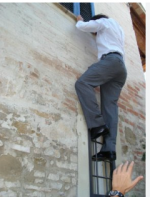
In fact, it was the defence that requested the visit to the cottage, bringing Delfo with them, but they shot themself in the foot as the jurors milling around the outside wall commented that anyone trying to climb that steep face was putting life and limb at risk. Poor old Delfo could only cling on at shoulder height and he was very tall and determined.


1747856208828.png

.
 
Last edited:
If a whole load of people can get in a lift a fraction of that size, of course four people can fit into Mez' room. 9' x 11' is spacious enough for a small bedroom. Remember, a glass of water was knocked over and things dropped off the desk.

RS, RG and MK were all svelte and AK is quite diminutive. It's common sense that the jurors and prosecutor visiting being older are larger than when they were young adults. So seven of them stood around without getting close up and personal with each other.


In fact, it was the defence that requested the visit to the cottgae, bringing Delfo with them, but they shot them self in the foot as the jurors milling around the outside wall commented that anyone trying to climb that steep face was putting life and limb at risk. Poor old Delfo could only cling on at shoulder height and he was very tall and determined.


View attachment 60958

.
And there is the hyperbole and mischaracterization. I'm 5'10", 57 years old and could make that climb.
 

ISF - Join now!

Every member here is approved by hand. No bots, no spam, just people who care about evidence and honest debate.

Membership is free!

Create your free account

Back
Top Bottom