• Quick note - the problem with Youtube videos not embedding on the forum appears to have been fixed, thanks to ZiprHead. If you do still see problems let me know.

Cont: The Trials of Amanda Knox and Raffaele Sollecito: Part 32

TomG, here are some comments on the second section of your post. The comments can't be all-inclusive because we don't know what the Italian government's future actions in the case will be. But we can be fairly confident that Italy will respond to the DEJ/CoM in some document - an action plan laying out some future actions or an action report claiming that the case has now been finally settled and the CoM should issue a resolution declaring the case closed.

There are two nonexclusive paths forward: 1. Review of the Italian government's action to resolve the original ECHR judgment Knox v. Italy and 2. Initiation of a new application by Knox and her lawyers in response to the CSC final judgment re-convicting her of calunnia but supposedly on evidence not used in the original conviction.

For the first path, I believe that any claim by Italy using the re-conviction as justification for closing the case will be rejected by the DEJ/CoM as not meeting the conclusion and spirit of the original final ECHR judgment Knox v. Italy. Italy maintaining that position could lead to it being brought before the ECHR in an infringement of Convention Article 46 case.

The DEJ/CoM, presented with an AP or AR, will tell the Italian government to think of some new way forward, and perhaps offer help. One possibility is that the Italian government could initiate a case with the Constitutional Court of Italy to declare CPP Article 628 bis unconstitutional, because it does not contain a requirement that the ordinary Italian courts treat the final judgments of the ECHR to be treated by those courts as binding in both conclusion and spirit as required by the Convention and ECHR case law. The Constitutional Court would then, pending an act of the Italian parliament, provide the required change on a "temporary" basis. Something of that nature happened in 2011 when the Constitutional Court ruled that CPP Article 630, the law specifying the grounds for revision, was declared unconstitutional because it lacked a provision for revision in the case of an ECHR judgment of an unfair trial (Constitutional Court judgment 113/2011). Revision then became the mechanism for Italy's correction of unfair trials (that were "final") until the parliament passed the law that became CPP Article 628 bis.

The other path, which can proceed in parallel with the first path, is for Knox and her lawyers to file a new application with the ECHR alleging a violation of Convention Article 6.1, unfair trial (along with other relevant Convention articles, such as perhaps 6.2, presumption of innocence). Since the re-conviction is a "new" trial using "new" evidence in a "new" reasoning by the Italian courts, it would be eligible for consideration by the ECHR. The ECHR can very certainly in the new ECHR case declare that the "new" reasoning by the Italian courts is a distortion of its findings in the first Knox v. Italy, and therefore a violation of Convention Article 46. That's a close approximation to stating that it's wrong.
Here's a quick summary of the Constitutional Court of Italy:

The Constitutional Court has a website that provides a lot of info on what it is and does. Remarkably, it even devotes part of its website to an English translation section covering that information and even legal summaries and full texts of important judgments.

See:

The legal summary for the decision # 113 of 2011:

In this case the Court considered a reference from the Bologna Court of Appeal concerning the constitutionality of the provision of the Code of Civil [sic; should read: Criminal] Procedure which did not provide for criminal proceedings to be reopened if the original judgment had been ruled unfair by a final judgment of the European Court of Human Rights. The Court ruled that the situation was unconstitutional, and that the relevant provision had to be read as granting the right to request that a criminal trial be reopened under those circumstances.

https://www.cortecostituzionale.it/actionJudgment.do

The purpose of CPP Article 628 bis was to replace the above Constitutional Court temporary fix with a permanent law in the Codice di Procedura Penale.

Also, it's important to know that the Italian Constitution, Article 10, states that "The Italian legal system conforms to the generally recognised principles of international law." This means, according to the Constitutional Court, that Italy must obey the treaties it has signed, including the CoE treaty, so that the "binding force" of ECHR judgments must be obeyed as Italian law. The question then is the legal mechanism to do that. The Constitutional Court in its decision #113 of 2011 identified the revision procedure (CPP Articles 629 - 647) as that mechanism to be used until the Italian parliament passed a specific law to accomplish this goal. The specific law passed in 2022 was incorporated as CPP Article 628 bis.*

Note that the Italian Constitutional Court differs from, for example, the US Supreme Court, in that individuals may not appeal or "reference" to it. Only a judge from one of the various Italian courts, the national Italian government, or a regional Italian government can seek a decision of the Constitutional Court on a constitutional question, and the Constitutional Court has no other function (except to try the President of the Republic if he or she is accused of a crime).

* https://www.altalex.com/documents/n...ecuzione-decisioni-corte-europea-diritti-uomo
 
Last edited:
The number of people who claim that from analysis of how and what people speak, how they behave they can determine guilt or innocence is large.

Thus we get highly dubious stuff like Statement Analysis and other supposedly "scientific" techniques for finding out if someone is lying. Youtube has all sorts of channels with such "Experts" analyzing people and determining if some is lying, hiding something.

It's all based a pseudo highly dubious crap. My favorite is example is from Statement analysis in which if you say three people attacked etc., you that is a sign of deception. Aside from what if three people were in fact involved what is this based on? Apparently little more than than a pull out of the ass assumption by a creator of Statement Analysis.

Amanda as, of course, been a victim of this so-called "scientific" analysis it bluntly sheer garbage.
It's amazing how many people fall for the "Body language" and "statement analysis" nonsense. I consider these "experts" nothing but grifters making a career out of selling their books and courses and getting sponsors for their podcasts. There is no such thing as a degree or official license in either, no governmental standards, no oversight. Anyone can claim to be an 'expert'. A 'certificate' from any of these offered paid courses isn't worth the paper it's printed on.

Many studies have shown that neither is reliable and that the ability to detect deception in no better than chance. It's also noteworthy that grifters like "The Behavior Panel" always manage to detect 'deception' no matter who it is.

The belief in this nonsense is widespread.
 
Let's examine some of the ECHR's case law relevant to the current situation for the ECHR case Knox v. Italy. Here's the relevance of the ECHR case law listed below:

1. A distortion of the meaning of the ECHR's judgment in the reasoning of a new respondent state trial in its alleged execution of the ECHR judgment is a new violation of Convention Article 6.1.

2. The ECHR is prevented by the Convention from examining how its judgments are executed by the Respondent States; that responsibility falls under the supervision of the Committee of Ministers. However, when the execution of a judgment results in a new matter - a claim of a new development, such as an alleged new violation of the Convention, under the Convention and ECHR case law the ECHR can take on the examination of that new development, even while the supervision of the original case by the CoM continues.

The meaning is that Knox and her lawyers can file a new application to the ECHR alleging a violation of Convention Article 6.1 (and any other relevant articles) as a result of her re-conviction for calunnia and the ECHR, according to its case law, must accept it.

1. SERRANO CONTRERAS v. SPAIN (No. 2) 2236/19 final 26/01/2022

Brief summary from the heading text of the case:

[Article 6.1 (criminal)] Unfairness of revision proceedings before Supreme Court due to distortion of [ECHR] judgment which had found a violation of the applicant’s right to a fair trial • Complaint connected with execution of [ECHR]’s earlier judgment but sufficiently distinct to permit its examination • Art 6 § 1 safeguards applicable to revision proceedings in present case, in light of the scope of Supreme Court’s scrutiny
General Principles: Paragraphs 32 - 34; Conclusion: Paragraphs 39 - 40

Legal Summary:

Given the scope of the Supreme Court’s scrutiny in the present case, the [ECHR] considered that it should be regarded as an extension of the criminal proceedings against the applicant. The Supreme Court had once again focused on the determination, within the meaning of Article 6 § 1, of the criminal charge against the applicant. Consequently, the safeguards of Article 6 § 1 had been applicable to the proceedings before the Supreme Court. .... [T]he Supreme Court, when making its own interpretation as to the scope and meaning of the [ECHR]’s findings in the judgment of March 2012, had gone beyond the national authorities’ margin of appreciation and distorted the conclusions of the [ECHR]’s judgment; the impugned proceedings had therefore fallen short of the requirements of a “fair trial” under Article 6 § 1

2. BOCHAN v. UKRAINE (No. 2) [GC] 22251/08 final 05/02/2015

In the excerpts below, I have omitted all but one of the inline citations. I have added bold and italic emphasis.

31. The Court must determine in the first place whether it is prevented by Article 46 of the Convention from dealing with the various complaints made by the applicant, in view of the distribution of powers effected by the Convention between the Committee of Ministers and the Court as regards the supervision of the execution of the Court’s judgments .... Secondly, in so far as it is not so prevented, it must examine whether the domestic proceedings on the applicant’s exceptional appeal attracted the guarantees of the Convention, in particular those under its Article 6 § 1 ... and, if so, whether the requirements of Article 6 § 1 were complied with.

33. The question of compliance by the High Contracting Parties with the Court’s judgments falls outside its jurisdiction if it is not raised in the context of the “infringement procedure” provided for in Article 46 §§ 4 and 5 of the Convention .... Under Article 46 § 2, the Committee of Ministers is vested with the powers to supervise the execution of the Court’s judgments and evaluate the measures taken by respondent States. However, the Committee of Ministers’ role in the sphere of execution of the Court’s judgments does not prevent the Court from examining a fresh application concerning measures taken by a respondent State in execution of a judgment if that application contains relevant new information relating to issues undecided by the initial judgment....

34. The relevant general principles were summarised in Egmez v. Cyprus ((dec.), no. 12214/07, §§ 48-56, 18 September 2012), as follows.

48. The Court reiterates that findings of a violation in its judgments are in principle declaratory ... and that, by Article 46 of the Convention, the High Contracting Parties undertook to abide by the final judgments of the Court in any case to which they were parties, execution being supervised by the Committee of Ministers.... It follows, inter alia, that a judgment in which the Court finds a breach of the Convention or its Protocols imposes on the respondent State a legal obligation not just to pay those concerned the sums awarded by way of just satisfaction, but also to choose, subject to supervision by the Committee of Ministers, the general and/or, if appropriate, individual measures to be adopted in their domestic legal order to put an end to the violation found by the Court and to redress so far as possible the effects.... Subject to monitoring by the Committee of Ministers, the respondent State remains free to choose the means by which it will discharge its legal obligation under Article 46 of the Convention, provided that such means are compatible with the conclusions set out in the Court’s judgment.... For its part, the Court cannot assume any role in this dialogue....

49. Although the Court can in certain situations indicate the specific remedy or other measure to be taken by the respondent State ..., it still falls to the Committee of Ministers to evaluate the implementation of such measures under Article 46 § 2 of the Convention....

50. Consequently, the Court has consistently emphasised that it does not have jurisdiction to verify whether a Contracting Party has complied with the obligations imposed on it by one of the Court’s judgments. It has therefore refused to examine complaints concerning the failure by States to execute its judgments, declaring such complaints inadmissible ratione materiae....

51. However, the Committee of Ministers’ role in this sphere does not mean that measures taken by a respondent State to remedy a violation found by the Court cannot raise a new issue undecided by the judgment....

52. On that basis, the Court has found that it had the competence to entertain complaints in a number of follow-up cases for example where the domestic authorities have carried out a fresh domestic examination of the case by way of implementation of one of the Court’s judgments whether by reopening of the proceedings ... or by the initiation of a[n] entire new set of domestic proceedings....

53. Moreover, in the specific context of a continuing violation of a Convention right following adoption of a judgment in which the Court has found a violation of that right during a certain period of time, it is not unusual for the Court to examine a second application concerning a violation of that right in the subsequent period.... In such cases the ‘new issue’ results from the continuation of the violation that formed the basis of the Court’s initial decision. The examination by the Court, however, is confined to the new periods concerned and any new complaints invoked in this respect....

54. It is clear from the Court’s case-law that the determination of the existence of a ‘new issue’ very much depends on the specific circumstances of a given case and that distinctions between cases are not always clear-cut. {A number of examples from the ECHR case law are summarized in the remainder of this paragraph.}

55. Reference should also be made in this context to the criteria established in the case-law concerning Article 35 § 2 (b), by which an application is to be declared inadmissible if it ‘is substantially the same as a matter that has already been examined by the Court ... and contains no relevant 'new information': (i) an application is considered as being ‘substantially the same’ where the parties, the complaints and the facts are identical...; (ii) the concept of complaint is characterised by the facts alleged in it and not merely by the legal grounds or arguments relied on...; and (iii) where the applicant submits new information, the application will not be essentially the same as a previous application....

56. Accordingly, the powers assigned to the Committee of Ministers by Article 46 to supervise the execution of the Court’s judgments and evaluate the implementation of the measures taken by the States under this Article will not be encroached on where the Court has to deal with relevant new information in the context of a fresh application.
 
Last edited:
Amanda said it was probably the translator but she wasn't sure.

In the interview with Mignini on Dec. 17, 2007, Knox said several times that she didn't remember how she learned how Kercher had died when pressed by Mignini. She was not remembering clearly. It was actually Mignini who first suggested it was a policeman:


You mean the claim that Altieri and Paola Grande later verified? Oh, but I forgot! They obviously perjured themselves and just made it up because the felt sorry for her! LOL!


Let's not forget that there was no such thing as "lady-sized digit marks". That description is pure speculation. Smaller bruises do not equate to a female making them. Unless you'd care to provide actual evidence of such?


Yes, Knox claimed under formal early police questioning - with her lawyers present - that her knowledge that Mez had her throat 'slit' probably came from a police officer named Fabio D''Astolto but he denied having any such knowledge.

Unfortunately, Altieri was not considered a reliable witness because of his claims about a couple of mobile phones. I am sure he meant well but it wasn't helpful. Altieri claims he came by the knowledge the throat was cut because he happened to glance at a medic at the scene who made a cut throat gesture (he claims). That cannot be true as the scene was preserved for the arrival of Lalli, who was the person who removed the duvet covering the body. Napoleoni and Mignini had had a glimpse earlier as the crime investigators, and yes, a medic was called in in case the victim could be resuscitated. But do you really believe a medic would make such a crass and disgusting gesture at a bunch of sundry people hanging around outside the cottage? And what does a cut throat gesture mean anyway, other than amongst freemasons, where it means, ''Help!' so a mason defendant might make that gesture to a judge, who is also a mason, and with a wink and a nudge will get him off the charge (is the idea behind such a gesture between masons). So I highly doubt the early medic made any such crass gesture at Altieri.

How does it explain Knox yelling at Mez' friends, words to the effect of, 'of course she suffered, she had her ◊◊◊◊◊◊◊ throat slashed', when Lalli did not examine the body at the scene until sometime around midnight, long after the party left for the Questura?


All you have are non-sequitur type logical fallacies.


.


.
 
The number of people who claim that from analysis of how and what people speak, how they behave they can determine guilt or innocence is large.

Thus we get highly dubious stuff like Statement Analysis and other supposedly "scientific" techniques for finding out if someone is lying. Youtube has all sorts of channels with such "Experts" analyzing people and determining if some is lying, hiding something.

It's all based a pseudo highly dubious crap. My favorite is example is from Statement analysis in which if you say three people attacked etc., you that is a sign of deception. Aside from what if three people were in fact involved what is this based on? Apparently little more than than a pull out of the ass assumption by a creator of Statement Analysis.

Amanda as, of course, been a victim of this so-called "scientific" analysis it bluntly sheer garbage.


Sure there is a lot of pop psychology garbage around, with ordinary journalists or members of the public claiming to have expertise in what people mean based on statement analysis. Whilst this is the stuff of the 'self help' section in your local book shop, in fact it is a serious science. When I did psychology it included having to do some 'content analysis' of various magazine articles - and of course, those studying English will do literary criticism, a line by line analysis of the author's every word to understand the nuances and meanings of their works, so clearly, there is something to be gleaned from this. One of the paperbacks I read early into my studies was Vance Packard's The Hidden Persuaders, 1957, about how advertisers and PR guys work their stuff, and do you know what, it really works ('Eight out of ten say...' 'When we introduced our spread to the UK it sold out immediately...' 'Persil washes whiter...') People are amazingly easily influenced by this stuff. Without wishing to invoke Godwin's Law, Goebbels and Himmler found disseminating stuff they wanted people to believe worked like magic.

So, it is no surprise it has its use in criminology in deconstructing what people have said in their statements. There is one reason police the world over like to interview people and ask the same questions over and over again...and one reason many suspects brought in for questioning know that discretion is the better form of valour and respond, 'no comment' rather than be caught out by what they say or don't say.

Knox' big mistake was to try to control the narrative by her telling police and whoever would listen how it's gonna be. After four different versions of course she made herself a suspect.

No, it doesn't determine innocence or guilt but to a cop, if someone lies about where they were or what they were doing as of the time of the crime, then they have reason to investigate further.


.
 
Last edited:
Teenagers should really be better trained in resisting interrogation before they take up student places in countries where the police play by their own rules. It's just basic common sense.
 
If it were at all scientifically valid that guilt or evil can be seen in someone's eyes, then there would be forensic optometrists and ophthalmologists testifying in criminal trials. What is scientifically valid is that when we look into someone's eye we see a (miniature) reflection of ourselves. That's why the black disk in the middle of our eyes is called the "pupil". And, I suggest, we may metaphorically see a reflection of our own personality.


Strangely enough, whilst it is a cliché to say you can look into a person's eyes and see evil or 'soulless eyes', some criminolgists have found some truth in this. I forget the reference but these guys pointed out an extraordinary number of childkiller/rapist serial murderers had a sleazy sleepy-eyed look.


.
 
Yes, Knox claimed under formal early police questioning - with her lawyers present - that her knowledge that Mez had her throat 'slit' probably came from a police officer named Fabio D''Astolto but he denied having any such knowledge.

Unfortunately, Altieri was not considered a reliable witness because of his claims about a couple of mobile phones. I am sure he meant well but it wasn't helpful. Altieri claims he came by the knowledge the throat was cut because he happened to glance at a medic at the scene who made a cut throat gesture (he claims). That cannot be true as the scene was preserved for the arrival of Lalli, who was the person who removed the duvet covering the body. Napoleoni and Mignini had had a glimpse earlier as the crime investigators, and yes, a medic was called in in case the victim could be resuscitated. But do you really believe a medic would make such a crass and disgusting gesture at a bunch of sundry people hanging around outside the cottage? And what does a cut throat gesture mean anyway, other than amongst freemasons, where it means, ''Help!' so a mason defendant might make that gesture to a judge, who is also a mason, and with a wink and a nudge will get him off the charge (is the idea behind such a gesture between masons). So I highly doubt the early medic made any such crass gesture at Altieri.

How does it explain Knox yelling at Mez' friends, words to the effect of, 'of course she suffered, she had her ◊◊◊◊◊◊◊ throat slashed', when Lalli did not examine the body at the scene until sometime around midnight, long after the party left for the Questura?


All you have are non-sequitur type logical fallacies.


.


Guilters constantly boast about the strong evidence against Amanda and Raffaele but if this is the case how do you how to explain the argument guilters have to resort to. This post makes the claim Altieri give false witness testimony. This was never part of the prosecution's case or mentioned
in any motivation report. Why is it necessary for guilters to make claims for things never used by the prosecution? If there was strong evidence surely guilters should be able to argue on evidence actually used by the prosecution. This posts highlights the repulsive hypocrisy of guilters. They attack Amanda and Raffaele for lying and falsely accusing Lumumba of a crime but spread malicious falsehoods Altieri gave false witness testimony.
 
Last edited:
Welshman said #3,210

Guilters constantly boast about the strong evidence against Amanda and Raffaele but if this is the case how do you how to explain the argument guilters have to resort to. This post makes the claim Altieri give false witness testimony. This was never part of the prosecution's case or mentioned
in any motivation report. Why is it necessary for guilters to make claims for things never used by the prosecution? If there was strong evidence surely guilters should be able to argue on evidence actually used by the prosecution. This posts highlights the repulsive hypocrisy of guilters. They attack Amanda and Raffaele for lying and falsely accusing Lumumba of a crime but spread malicious falsehoods Altieri gave false witness testimony.

It's possible he wasn't lying per se, more in his eagerness to be helpful he imagined things that he thought could be the answer.

In respect of the two mobbile phones stolen from Mez, on one day he testified under oath he saw the mobile phones on the kitchen table, this after having sworn to be telling the truth and nothing but. The next day, he completely recanted and said it wasn't the mobile phones he saw but a piece of paper with the two numbers on it. So you see, Altieri was NOT a reliable witness. He either imagined things, perhaps because he wanted to appear a font of knowledge, he was eager to ingratiate himself to whomever was asking or he wanted to help out a couple of contemporaries/ peers he perceived to be [unfairly] in trouble with the police.

In any case, it was a police officer Knox first claimed to have got the 'slit' throat info from, when nobody but a pathologist could know what caused death, after a post mortem, not Altieri. Altieri was a later claim, thanks to his volunteering to provide that info to her although why he should be the recipient of the information and nobody else is anybody's guess. He had to make up a cock and bull story about seeing a doctor make a cut throat gesture.

"LG:

And you got into the car of Filomena's two friends, Paola and...?

AK:

Yes, it was really really cold. First, Raffaele gave me his jacket, but then the others saw that I was cold, really in shock, so they said come, come, let's get in the car and get warm. And inside that car, we talked more about... we kept on saying "But what did you see? Who was there?" So in the car, heh, still using Raffaele a bit like an interpreter, they explained to me that they heard from someone, from someone else, from one of the officers who were talking, that she...

LG:

Meredith

AK:

...that Meredith had had her throat slit, and at that point I became a bit...uh [sigh]...I closed myself off a bit inside...I cried a bit because I kept thinking but...how is it possible? No...[slightly desperate laugh], it was too much, so [sigh, voice trembling], and then, we went to the Questura.

LG:


To the Questura. After the Questura...there followed all these phases, you were heard, then they took photographs, and you did cartwheels and splits? Are those things true? How did they happen? And where did they happen?"
.

So, yes, it was Knox who made the claim she heard it from a cop.


.
 
Last edited:
Vixen, I asked you a direct question, which is hilited below. Kindly respond.

@Stacyhs, who knows far more about the case than I do, has addressed the "substance" (and I use the word loosely) of your response quite well. However, I will point out that you utterly failed to answer any of the points that I made, choosing only to attack one tangential aside that you thought gave you a small rhetorical opening.
  • You failed to admit that you were wrong about Mignini's having been convicted of abuse of office, and you have twice failed to acknowledge that the Committee to Protect Journalists sent two letters to the President of Italy protesting his intimidation and harassment of reporters.
  • You failed to retract your accusation that I said that anyone who thinks Knox and Sollecito are guilty is a conspiracy theorist, even when I provided incontrovertible evidence that I had said no such thing.
  • You failed to admit that you were wrong about the ECHR's having "dismissed almost all" of Knox's claims.
Direct question, Vixen. How is it that you're so wrong about so many things so much of the time, stubbornly refuse to admit it, but then accuse us of being desperate?

For reference, the above is a response to your highly evasive response to this post.
 
Vixen, I asked you a direct question, which is hilited below. Kindly respond.


For reference, the above is a response to your highly evasive response to this post.


Any alleged 'conviction' for abuse of office has absolutely nothing to do with this case. As I said, there was a procedural technicality wherein his office staff omitted to give Sollecito's counsel the usual printed version of his rights on one interview occasion.

Knox made a very extensive application to the ECHR claiming for example she had been falsely told she had HIV. And that she had been tortured.

The only grounds on which she won out of many claims was under Article 6, right to a fair trial in that, as an official suspect/defendant she should have had a lawyer when she accused Lumumba and a procedural point under Article 3. The summary is here:


FOR THESE REASONS, THE COURT UNANIMOUSLY


1. Rejects the objection of non-exhaustion of domestic remedies raised by the Government with regard to the complaints under Article 6 §§ 1 and 3 (c) and (e) of the Convention;


2. Together with the Government's plea of non-exhaustion of domestic remedies under article 3 of the Convention and rejects it;


3. Declares the complaint admissible in respect of the complaints under Articles 3 and 6 §§ 1 and 3 (c) and (e) of the Convention and inadmissible for the remainder;


4. Holds that there has been no violation of Article 3 of the Convention in its material aspect;


5. Holds that there has been a violation of Article 3 of the Convention under its procedural limb;


6. Holds that there has been a violation of Article 6 §§ 1 and 3 (c) of the Convention;


7. Holds that there has been a violation of Article 6 §§ 1 and 3 (e) of the Convention;


(a) that the respondent State is to pay the applicant, within three months from the date on which the judgment becomes final according to Article 44 § 2 of the Convention, the following amounts, at the rate applicable on the date of the regulation:


i. EUR 10 400 (ten thousand four hundred Euro), plus any tax that may be chargeable, in respect of non-pecuniary damage,


ii. EUR 8 000 (eight thousand euros), plus any tax that may be chargeable to the applicant for costs and expenses;


(b) that from the expiry of that period until payment, those amounts shall be increased by simple interest at a rate equal to that of the marginal lending facility of the European Central Bank applicable during that period, increased by three percentage points;


9. Rejects the claim for just satisfaction for the remainder.


Done in French, and notified in writing on 24 January 2019, pursuant to Rule 77 §§ 2 and 3 of the Rules of Court.


Renata DegenerLinos-Alexandre Sicilianos

Clerk AssistantPresident


As we know, the statements she made as of that time were not allowable in court anyway. The statement she made in private written of her own volition with nobody present but herself and which she insisted on giving to the police was allowable evidence. It was proven she showed criminal intent - mens rea - in giving Lumumba's name to the police as the rapist/killer.

So no, I was not wrong when I said Knox had almost all of her ECHR complaints rejected. Note she was only awarded €10.4K , which gives you some insight into just how minor the impact of the breaches were weighted by the ECHR.

As for your claim of being a conspiracy theorist please substantiate your claim.


.


.
 
Last edited:
Vixen, I asked you a direct question, which is hilited below. Kindly respond.


For reference, the above is a response to your highly evasive response to this post.


BTW the committee to protect journalists you mention is actually the Seattle Free Herald Editor whose grandson is Knox' current husband. How surprising it issued a complaint, all the way from the USA, not under Italy's jurisdiction. And how completely impartial.

:wackylaugh: :wackylaugh: :wackylaugh:


.
 
BTW the committee to protect journalists you mention is actually the Seattle Free Herald Editor whose grandson is Knox' current husband. How surprising it issued a complaint, all the way from the USA, not under Italy's jurisdiction. And how completely impartial.

:wackylaugh: :wackylaugh: :wackylaugh:


.
Vixen's post is misleading and false. Here's the truth.

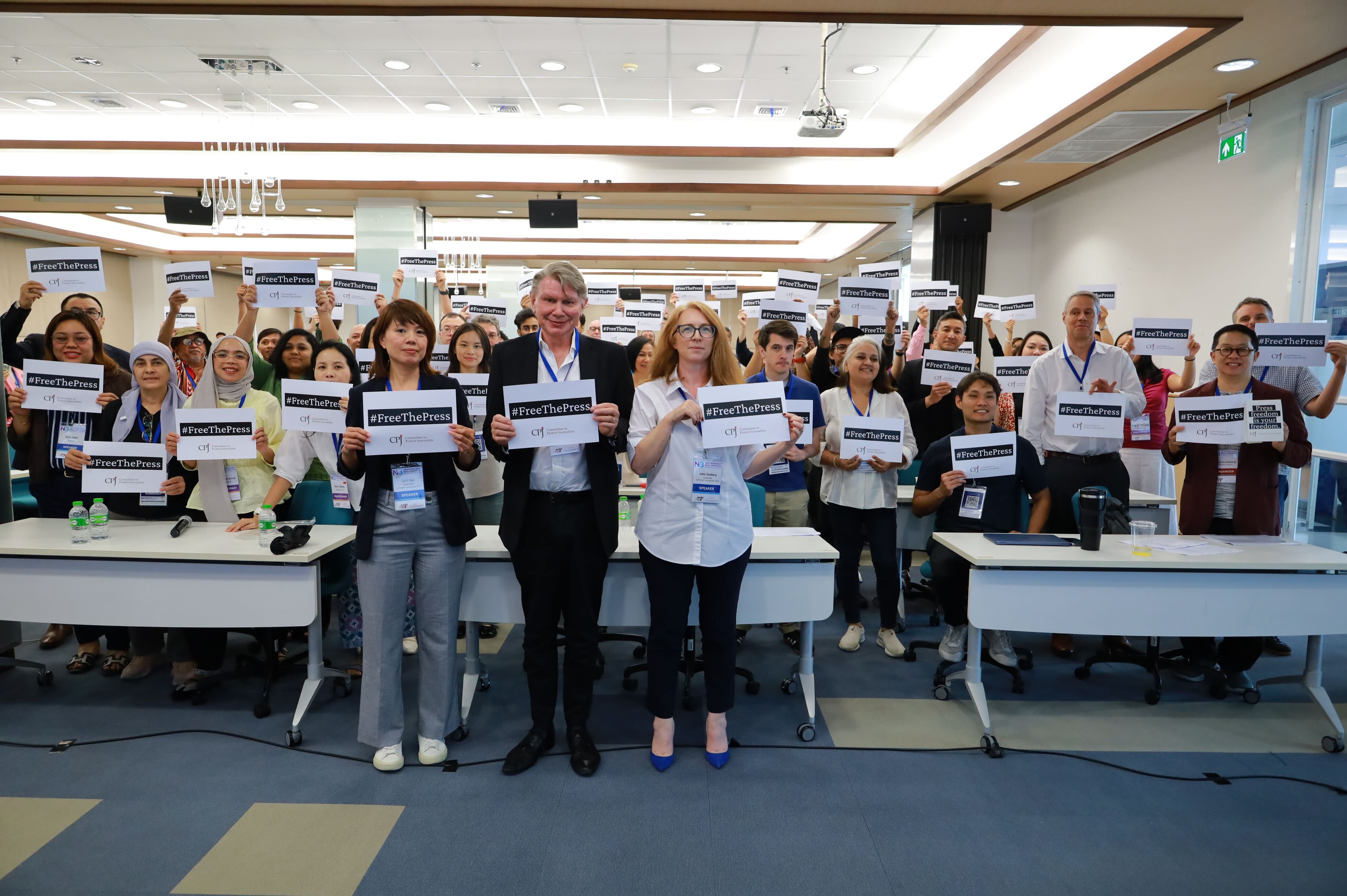
The Committee to Protect Journalists is an independent, nonprofit organization that promotes press freedom worldwide. We defend the right of journalists to report the news safely and without fear of reprisal.

The Committee to Protect Journalists promotes press freedom worldwide and defends the right of journalists to report the news safely and without fear of reprisal. CPJ protects the free flow of news and commentary by taking action wherever journalists are under threat.

The CPJ is headquartered in New York City.

The Committee to Protect Journalists was founded in 1981 by a group of U.S. correspondents who realized they could not ignore the plight of colleagues whose reporting put them in peril on a daily basis.

The idea that journalists around the world should come together to defend the rights of colleagues working in repressive and dangerous environments led to CPJ’s first advocacy campaign in 1982. At the time, three British journalists—Simon Winchester, Ian Mather, and Tony Prime—were arrested in Argentina while covering the Falklands War. A letter from CPJ Honorary Chairman Walter Cronkite helped spring them from prison.

Today, CPJ’s networks are made up of journalists, researchers, and advocates, working together to support journalists and press freedom around the world.

The CPJ, along with similar organizations to promote freedom of the press, has often called for journalists who have been wrongfully targeted by authorities because of their legitimate news-gathering actions to be freed from detention. See, for example:

CPJ, RSF, IJF call for release of Italian journalist Cecilia Sala*

(A journalist detained in Iran, but released in January, 2025)

Sources:
*https://cpj.org/2024/12/cpj-rsf-ijf-call-for-release-of-italian-journalist-cecilia-sala/
 
Vixen's post is misleading and false. Here's the truth.


The CPJ, along with similar organizations to promote freedom of the press, has often called for journalists who have been wrongfully targeted by authorities because of their legitimate news-gathering actions to be freed from detention. See, for example:

CPJ, RSF, IJF call for release of Italian journalist Cecilia Sala*

(A journalist detained in Iran, but released in January, 2025)

Sources:
*https://cpj.org/2024/12/cpj-rsf-ijf-call-for-release-of-italian-journalist-cecilia-sala/


As you know, in relation to THIS case, on being warned of interfering in Italy's legal process, the editor of Seattle Free Herald, which had Knox writing a column for it, and her husband's uncle as editor, with his grandfather as proprietor, had run a series of highly defammatory articles about Mignini. CPJ was headed, or had as a lead campaigner, Doug Preston, a journalist with a huge grudge against Mignini, for issues that have NOTHING to do with THIS case, in which Preston had been told to leave Italy or face jail.

Whatever it is Stacyhs is supposedly claiming about Mignini re CPJ, needs to be put into context the relationship Knox had with the newspaper in question. In other words, CPJ's complaint headed by Preston was not a third party arm's length, free of conflict of interest one.

It is a complete side issue anyway.

.
 
Yes, Knox claimed under formal early police questioning - with her lawyers present - that her knowledge that Mez had her throat 'slit' probably came from a police officer named Fabio D''Astolto but he denied having any such knowledge.
Was he also one of the police officers who denied abusive interrogation of Knox and/or Sollecito took place? Also, you do realize that, had he actually told her that and admitted to it, he could have been disciplined, right? Finally, how long after did he deny this? It's possible he genuinely misremembered. But, no, to you, this is incontrovertible evidence that Knox is guilty. :rolleyes:

Unfortunately, Altieri was not considered a reliable witness because of his claims about a couple of mobile phones. I am sure he meant well but it wasn't helpful.
Granting, arguendo, that this is true, that doesn't mean he was necessarily wrong about everything.

Altieri claims he came by the knowledge the throat was cut because he happened to glance at a medic at the scene who made a cut throat gesture (he claims). That cannot be true as the scene was preserved for the arrival of Lalli, who was the person who removed the duvet covering the body. Napoleoni and Mignini had had a glimpse earlier as the crime investigators, and yes, a medic was called in in case the victim could be resuscitated. But do you really believe a medic would make such a crass and disgusting gesture at a bunch of sundry people hanging around outside the cottage?
Argument from personal incredulity. Further, the medic could have been indicating to a police officer, or to another medic, the location of the wounds.

And what does a cut throat gesture mean anyway, other than amongst freemasons, where it means, ''Help!' so a mason defendant might make that gesture to a judge, who is also a mason, and with a wink and a nudge will get him off the charge (is the idea behind such a gesture between masons). So I highly doubt the early medic made any such crass gesture at Altieri.
My late father was a 33rd Degree Freemason (the highest degree). My grandfather and great uncle were Freemasons. One of my brothers is a Freemason. My grandmother and great aunt were in Eastern Star, a Masonic women's organization. My other brother and I were both in DeMolay, a Masonic fraternity for boys. I would say your ignorance about Freemasonry is astounding, except that you're also so profoundly ignorant about so many other subjects. It is, however, highly offensive.

Further, you're completely wrong (as usual) about the throat-cutting gesture. That's the sign of an Entered Apprentice (the lowest degree), and is based on the penalty, as stated in the Masonic ritual, for revealing the secrets of the order. And in case you or anyone else is wondering, no, they don't really do that to people; it's just part of the ritual. And in any case, the entire ritual has been available in library books (and now, of course, online), for well over a century, so there's nothing that hasn't already been revealed. The Grand Hailing Sign of Distress looks something like the signal for a touchdown in American football, except the elbows are bent at 90-degree angles. See here.

How does it explain Knox yelling at Mez' friends, words to the effect of, 'of course she suffered, she had her ◊◊◊◊◊◊◊ throat slashed', when Lalli did not examine the body at the scene until sometime around midnight, long after the party left for the Questura?
See above.

All you have are non-sequitur type logical fallacies.
:id:That's three you owe me now, Vixen.

EDIT: Typo corrected
 
Last edited:
As you know, in relation to THIS case, on being warned of interfering in Italy's legal process, the editor of Seattle Free Herald, which had Knox writing a column for it, and her husband's uncle as editor, with his grandfather as proprietor, had run a series of highly defammatory articles about Mignini. CPJ was headed, or had as a lead campaigner, Doug Preston, a journalist with a huge grudge against Mignini, for issues that have NOTHING to do with THIS case, in which Preston had been told to leave Italy or face jai

Whatever it is Stacyhs is supposedly claiming about Mignini re CPJ, needs to be put into context the relationship Knox had with the newspaper in question. In other words, CPJ's complaint headed by Preston was not a third party arm's length, free of conflict of interest one.

It is a complete side issue anyway.

.
Vixen's post is again false and misleading.

Mario Spezi was arrested on the orders of Mignini and his police associates on April 7, 2006, long before Amanda Knox was in Italy.

The CPJ wrote a letter to Silvio Berlusconi, in his role as President of the Council of Ministers (prime minister) on April 19, 2006, alerting him of the injustice and asking for his intervention to stop the harassment of Spezi. The letter was signed by Ann Cooper, the Executive Director of the CPJ. The letter mentions Mignini as well as Preston, who may have alerted CPJ to some of the facts.

See: https://cpj.org/2006/04/crime-journalists-imprisonment-raises-alarm
 
Was he also one of the police officers who denied abusive interrogation of Knox and/or Sollecito took place? Also, you do realize that, had he actually told her that and admitted to it, he could have been disciplined, right? Finally, how long after did he deny this? It's possible he genuinely misremembered. But, no, to you, this is incontrovertible evidence that Knox is guilty. :rolleyes:


Granting, arguendo, that this is true, that doesn't mean he was necessarily wrong about everything.


Argument from personal incredulity. Further, the medic could have been indicating to a police officer, or to another medic, the location of the wounds.


My late father was a 33rd Degree Freemason (the highest degree). My grandfather and great uncle were Freemasons. One of my brothers is a Freemason. My grandmother and great aunt were in Eastern Star, a Masonic women's organization. My other brother and I were both in DeMolay, a Masonic fraternity for boys. I would say your ignorance about Freemasonry is astounding, except that you're also so profoundly ignorant about so many other subjects. It is, however, highly offensive.

Further, you're completely wrong (as usual) about the throat-cutting gesture. That's the sign of an Entered Apprentice (the lowest degree), and is based on the penalty, as stated in the Masonic ritual, for revealing the secrets of the order. And in case you or anyone else is wondering, no, they don't really do that to people; it's just part of the ritual. And in any case, the entire ritual has been available in library books (and now, of course, online), for well over a century, so there's nothing that hasn't already been revealed. The Grand Hailing Sign of Distress looks something like the signal for a touchdown in American football, except the elbows are bent at 90-degree angle. See here.


See above.


:id:That's three you owe me now, Vixen.

Don't put words in my mouth. At no point have I said, "But, no, to you, this is incontrovertible evidence that Knox is guilty. :rolleyes:"

I followed the trial and the evidence and AFAIAC the verdict of the trial (merits) court and Nencini Appeal were sound. Of course, not every small detail is going to be correct but IMV it was a fair trial with a level playing field. The idea that the pair were only found guilty because of Mignini is preposterous. He wasn't even involved after Massei and was one of two prosecutors (as seems to be the custom in Italy) leading the case. Crini was equally a prosecutor, as was Commodi. I believe in the rule of law and I could see justice had been done. For Gill, Vecchiotti & Conti and Hellmann to intervene and subvert it - thanks to Sollecito's contacts via Bongiorno - is a disgraceful hijacking of justice for Meredith Kercher and sadly, her parents, who died without seeing it apart from for Guede. Italy is a highly advanced country, contrary to the belief of ignorant pigs like Trump. Yes, like many modern day countries it is not perfect, thanks to the unfair influence of the rich and the powerful having the advantage of the best legal professionals.

What you are trying to do by insisting the pair are innocent in the face of all evidence to the contrary is to deny the real victim and her family any justice. The pair having got off on a technicality of 'insufficient evidence' are now trying to cash in as much as possible by going for spurious claims of compensation because stupid people like Trump have convinced them Italy is a third world banana republic.


You are welcome to believe the sentimental nonsense which you wish to believe, - and of course you will! - but me, I'll look at the grim reality full in the face, thanks.

Altieri did not see a medic making a cut throat gesture thus concluding that was the cause of death, which he passed on to Knox. Knox knew the cause of death because, as has been revealed time and again, 'I cannot lie. I was there' and to which all evidence points, circumstantial, forensic, directly and indirectly.

She was hyped up at the Questura because she was still on an adrenaline rush. That is why her behaviour was conspicuous to all. But that is not why she was convicted. It was one red flag of very many of them, which when added up made a whole.


Even Marasca & Bruno conclude she was involved at some level.


How is that not sinking in?


.
 
Last edited:
Vixen's post is again false and misleading.

Mario Spezi was arrested on the orders of Mignini and his police associates on April 7, 2006, long before Amanda Knox was in Italy.

The CPJ wrote a letter to Silvio Berlusconi, in his role as President of the Council of Ministers (prime minister) on April 19, 2006, alerting him of the injustice and asking for his intervention to stop the harassment of Spezi. The letter was signed by Ann Cooper, the Executive Director of the CPJ. The letter mentions Mignini as well as Preston, who may have alerted CPJ to some of the facts.

See: https://cpj.org/2006/04/crime-journalists-imprisonment-raises-alarm


That was my link. And as you may recall, the CPJ as taking the lead by Doug Preston issued a complaint about Mignini issuing a warning about Seattle Free Herald trying to subvert justice.


.
 

Back
Top Bottom