Cont: Why James Webb Telescope rewrites/doesn't the laws of Physics/Redshifts (2)

Status
Not open for further replies.
Your point is that it's not good enough for what we're trying to do with it, but if you want to make that point it's a quantitative point.

That's not my point, though.

I described a metric, the response to which was "it's not homogeneous."

So what? Reality isn't homogeneous. Cosmologists are questioning the cosmological principle and if FLRW has run its course.

https://arxiv.org/abs/2207.05765

What's more important, a model of observable reality? Or a homogeneous universe beyond observable reality?

Obviously it should be the former. I think many people are quite heavily invested in the latter though.
 
I described a metric, the response to which was "it's not homogeneous."
Oh, I'd say the responses were a little more thorough than that.

And more devastating.

[size=+1]Summary of conclusions.[/size]

  • According to the Helland metric form, the Helland universe is static in these three senses:
    1. Its metric tensor field does not change over time.
    2. Its curvature tensor field does not change over time.
    3. Its distributions of mass-energy and pressure do not change over time.

  • Those consequences of the Helland metric form should not be trusted, because the Helland metric form implies other consequences that are not consistent with the general theory of relativity.

  • In particular, a universe with the extreme negative pressure implied by the Helland metric form would not be static.

  • The Helland universe is geocentric in the following sense: Its spatial slices are spherically symmetric around a central point whose physical properties distinguish it from all other points of space.

  • The Helland universe has a curvature singularity at that central point.

  • If the cosmological constant is zero, then the mass-energy density is zero throughout the Helland universe.

  • If the cosmological constant is positive, then the mass-energy density is negative throughout the Helland universe. That density is most negative at the center of the Helland universe, dropping to zero as Hr approaches c.

  • If the cosmological constant is negative, then the mass-energy density is positive throughout the Helland universe. That density is greatest at the center of the Helland universe, dropping to zero as Hr approaches c.

  • At the center of the Helland universe, the pressure is negative infinity, regardless of the cosmological constant. That means the center of the Helland universe, where Mike Helland imagines us to reside, is uninhabitable.

  • The infinitely negative pressure at the center of the Helland universe means the center of the Helland universe is undergoing unimaginably rapid inflation/expansion, contradicting the static universe asserted by the Helland metric form.

  • The static universe implied by the Helland metric is not consistent with Einstein's general theory of relativity, because a universe with the Helland universe's distribution of pressure would not be static.


That list comes from just one of the past month's many responses. See, for example, a followup from just yesterday.
 
The speed of light in the past was lower than it is today.

This is your hypothesis. It is not something we have actually observed.

Either that's because of changing distances, or changing clock rates. So whatever would cause space to distort, should also be capable of causing time to distort.

That doesn't actually answer my question. You're just hand waving.
 
This is your hypothesis. It is not something we have actually observed.

If the dx/dt of light was c, there would be no big bang, there would be no redshifts

That's a fact.

omega0.gif


That doesn't actually answer my question. You're just hand waving.

You have a 4d box under pressure. If time is invariant, then it's space that gives. If space is invariant, it's time that gives.
 
No, that's just another example of a clueless individual mistaking maps for territory.


We have already established that a z=9 galaxy spreads out its light over a surface area of 4pi(30 Gly)2 in just 12.9 billion years (in LCDM).

If that's true the light's change in position over a change in time had to have exceeded c.

If that's just a map, if that's not "real" then the expansion of space is an illusion and there was no big bang.


As to the map-territory platitude...

Which territory are speaking about now? The manifold? Or the ambient space?

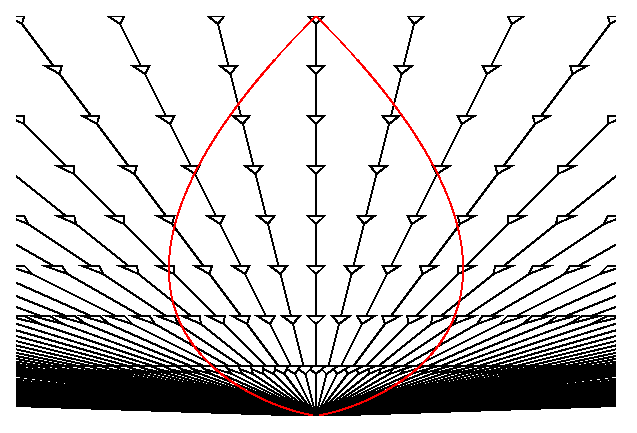
Our three dimensions of space and one dimension of time exist on the surface of a 5D shape in a 5D space called ambient space.

In the ambient space, dimensions are invariant and the speed of light is always c.

The null paths on the manifold are described by the interaction of the manifold with another shape, the light cone.


FLRW is basically a clever hack to change the speed of light.

After every second that light has traveled, spacetime says "ok, good, this next second, you're going to have to travel a little bit farther."

My metric is a less clever hack to mimic FLRW, but by changing clock rates instead distances.

Both are obtuse and lead to singularities, just in different places. Both begin, unjustifiably, with invariant space, time, and speed of light in ambient space. It's all neat-o math stuff, but the 5D is clearly removed from our reality.

Here's what the metric itself says.

http://latex.codecogs.com/gif.latex?ds^2 = -c^2 dt^2 + a(t)^2 dx^2

http://latex.codecogs.com/gif.latex?0 = -c^2 dt^2 + a(t)^2 dx^2

http://latex.codecogs.com/gif.latex?c^2 dt^2 = a(t)^2 dx^2

http://latex.codecogs.com/gif.latex?c^2 = a(t)^2 \frac{dx^2}{dt^2}

http://latex.codecogs.com/gif.latex?\frac{c^2}{a(t)^2} = \frac{dx^2}{dt^2}

http://latex.codecogs.com/gif.latex?\frac{dx}{dt} = \frac{c}{a(t)}​
 
We have already established that a z=9 galaxy spreads out its light over a surface area of 4pi(30 Gly)2 in just 12.9 billion years (in LCDM).

If that's true the light's change in position over a change in time had to have exceeded c.

If that's just a map, if that's not "real" then the expansion of space is an illusion and there was no big bang.


As to the map-territory platitude...

Which territory are speaking about now? The manifold? Or the ambient space?

Our three dimensions of space and one dimension of time exist on the surface of a 5D shape in a 5D space called ambient space.

In the ambient space, dimensions are invariant and the speed of light is always c.

The null paths on the manifold are described by the interaction of the manifold with another shape, the light cone.

[qimg]http://www.internationalskeptics.com/forums/imagehosting/thum_762186543cb01b1a33.png[/qimg]

FLRW is basically a clever hack to change the speed of light.

After every second that light has traveled, spacetime says "ok, good, this next second, you're going to have to travel a little bit farther."

My metric is a less clever hack to mimic FLRW, but by changing clock rates instead distances.

Both are obtuse and lead to singularities, just in different places. Both begin, unjustifiably, with invariant space, time, and speed of light in ambient space. It's all neat-o math stuff, but the 5D is clearly removed from our reality.

Here's what the metric itself says.

http://latex.codecogs.com/gif.latex?ds^2 = -c^2 dt^2 + a(t)^2 dx^2

http://latex.codecogs.com/gif.latex?0 = -c^2 dt^2 + a(t)^2 dx^2

http://latex.codecogs.com/gif.latex?c^2 dt^2 = a(t)^2 dx^2

http://latex.codecogs.com/gif.latex?c^2 = a(t)^2 \frac{dx^2}{dt^2}

http://latex.codecogs.com/gif.latex?\frac{c^2}{a(t)^2} = \frac{dx^2}{dt^2}

http://latex.codecogs.com/gif.latex?\frac{dx}{dt} = \frac{c}{a(t)}​

I should note that's in comoving coordinates. The speed of light being c(1+z) being the give away.

Comoving coordinates is a hypothetical version of spacetime where nothing has ever moved, where it is now is where it was.

In these coordinates, the farther you go back, the faster light has to be moving to intersect distant worldlines in an increasingly smaller amount of time. Things don't go back to a big bang in these coordinates.

Assuming two objects are at rest with respect to each other, if you were to freeze the universe at some moment in time, however many rigid meter sticks it would take to get between two objects would be their proper distance at time t. It's this distance that goes to zero back in time.
 
No, that's just another example of a clueless individual mistaking maps for territory.


Mike Helland responded by demonstrating his cluelessness.

As quoted above, I accused him of mistaking a coordinate speed of light (map) for the true speed of light (territory).

In his cluelessness, he tried to defend himself against that accusation by doing exactly what he had been accused of doing: calculating a coordinate speed of light, and mistaking it for the true speed of light.

As though that vomitus weren't enough to confirm his cluelessness, he ejected the following nonsense:
As to the map-territory platitude...

Which territory are speaking about now? The manifold? Or the ambient space?

Our three dimensions of space and one dimension of time exist on the surface of a 5D shape in a 5D space called ambient space.

In the ambient space, dimensions are invariant and the speed of light is always c.
All manifolds reside in their own ambient space. Like any other manifold, four-dimensional spacetime can be embedded within manifolds of higher dimension, and one can spin tales about its relationship to those higher-dimensional ambient spaces.

In his cluelessness, however, Mike Helland thinks there is only one such ambient space, and falsely assumes there is only one possible embedding of spacetime into that particular ambient space. He then adorns that confection by frosting it with the dreck I highlighted above.

FLRW is basically a clever hack to change the speed of light.
The FLRW metrics comprise the most general family of metrics that can possibly describe a four-dimensional Lorentzian spacetime that is homogeneous and isotropic.

The FLRW metrics include the Minkowski metric and the metric for Einstein's static universe, neither of which describes an expanding universe. The FLRW metrics also include the de Sitter metric (for a universe that is expanding at an exponential rate) and the more general FLRW metrics for a universe that can be expanding or contracting (of which the de Sitter metric is a special case).

In his cluelessness, Mike Helland is unaware of all that. He thinks the FLRW metrics are just a clever hack to change the speed of light.

Or maybe he's aware of some of it, but is dishonestly pretending to be clueless. By saying he is clueless, I am giving him the benefit of the doubt.

My metric is a less clever hack to mimic FLRW, but by changing clock rates instead distances.

Both are obtuse and lead to singularities, just in different places. Both begin, unjustifiably, with invariant space, time, and speed of light in ambient space. It's all neat-o math stuff, but the 5D is clearly removed from our reality.
I guess the highlighted explains why Mike Helland thought it was important to mention a 5D manifold and to invest it with magical properties.

In mainstream ΛCDM cosmology, there is no need or reason to embed spacetime within some manifold of higher dimension. (Such embeddings become essential for string theory, but we can thank our lucky stars that Mike Helland's cargo cultism has not—yet!—led him to think he has special insight into string theory. It is of course possible that his web searches have turned up a few references to string theory, which might account for some of the inanity in his recent posts.)

Here's what the metric itself says.
Following that sentence, Mike Helland posted a bog-standard derivation of a coordinate speed of light in co-moving coordinates, thereby confirming his confusion between map and territory.

But he posted the following blather less than an hour and a half later. Might he have realized he had made himself look silly? Was he trying to cover his mistakes by pretending to enlighten us about the co-moving coordinates he had used to confirm his cluelessness?

I should note that's in comoving coordinates. The speed of light being c(1+z) being the give away.

....snipped banal blather about comoving coordinates....
 
In mainstream ΛCDM cosmology, there is no need or reason to embed spacetime within some manifold of higher dimension.

Sure. But isn't that where the speed of light is always c?

But he posted the following blather less than an hour and a half later. Might he have realized he had made himself look silly? Was he trying to cover his mistakes by pretending to enlighten us about the co-moving coordinates he had used to confirm his cluelessness?

Hehe. More or less. I realized I should have kept going before I posted:

On the other hand, if you use my metric, you get:

http://latex.codecogs.com/gif.latex?\frac{dx}{dt} = c - Hx​

Which we know is the speed of light in proper coordinates.

These coordinates more directly reflect the territory than comoving coordinates.
 

Ok. Just so I'm clear.

A 2D manifold, let's say (t,x) is a surface of a 3D shape in 3D ambient space.

If that 3D shape were a sphere, every point on the manifold would have a constant positive curvature.

If you zoom in any point until it's spatially flat, the speed of light should be c there.

It's also true that the speed of light is always c in the 3D ambient space.

Right?

In the case of our 4D spacetime, (t, x, y, z), that's the surface of a 5D shape in a 5D space.

The speed of light is constant in the 5D space, and in any "zoomed in" enough point of the manifold itself.
 
Ok. Just so I'm clear.

A 2D manifold, let's say (t,x) is a surface of a 3D shape in 3D ambient space.
True but irrelevant and, as you go on to demonstrate, misleading.

If that 3D shape were a sphere, every point on the manifold would have a constant positive curvature.
In your posting history, it seems you regularly say "sphere" when you mean "ball". It is certainly true that a perfect sphere of any dimension has constant curvature at every point.

If you zoom in any point until it's spatially flat,
No. Zooming in on a point does not change the curvature at that point.

ETA: Zooming in on a point alters the map, not the territory.​

the speed of light should be c there.
No. The speed of light as observed at a point has nothing to do with the curvature at that point. You have made this mistake repeatedly.

It's also true that the speed of light is always c in the 3D ambient space.

Right?
At every point of a spacetime manifold, the speed of light (ETA: in a vacuum) is c.

The coordinate speed of light is often something other than c. A coordinate speed of light is often not meaningful, but it can correspond to what is observed from some other vantage point, which is why (for example) we say the speed of light approaching the event horizon of a black hole slows to zero as seen by an observer infinitely far away from that event horizon. To an observer falling into the black hole, the speed of light at the event horizon is c.

You have consistently shown confusion concerning the facts stated in the two paragraphs immediately above, and that particular confusion accounts for a discouragingly large fraction of Helland physics.

In the case of our 4D spacetime, (t, x, y, z), that's the surface of a 5D shape in a 5D space.
Irrelevant and, as you go on to demonstrate, misleading.

The speed of light is constant in the 5D space, and in any "zoomed in" enough point of the manifold itself.
No.

ETA: The speed of light in vacuo is constant, period, and is unaffected by whether you choose to use a map that has "zoomed in" on some point.
 
Last edited:
In your posting history, it seems you regularly say "sphere" when you mean "ball".

Right. A 2-sphere is the surface of a 3-ball.

I seem to recall you scoffing at the terminology at one point in the past, so I was reluctant to use it.


No. Zooming in on a point does not change the curvature at that point.

ETA: Zooming in on a point alters the map, not the territory.​

No. The speed of light as observed at a point has nothing to do with the curvature at that point. You have made this mistake repeatedly.

I thought being "locally flat" was pretty important.

In any case, if my metric describes a non-static universe, then if H is given by the Friedmann equation, my metric actually is an FLRW model?
 
I thought being "locally flat" was pretty important.
Yes, but it helps to understand what the phrase means. Note well that "homeomorphic" does not imply "diffeomorphic". Furthermore, "locally flat at x" does not imply "locally flat".

In any case, if my metric describes a non-static universe , then if H is given by the Friedmann equation , my metric actually is an FLRW model ?
Hoo boy.

Your metric describes a static universe that is incompatible with general relativity, so the green antecedent is false.

The H that appears within your metric form is an arbitrary constant that has absolutely nothing to do with the Hubble parameter that appears within the Friedmann equations, so the alleged consequent in blue is nonsense. If you had even the slightest understanding of the Hubble parameter H, that would have been obvious to you because H abbreviates the (da/dt)/a term that appears within the first Friedmann equation, and that scale factor a(t) does not appear at all within your metric form.

The red text is spectacularly clueless. Every FLRW model is spatially homogeneous and isotropic. Your metric describes a manifold that offers an isotropic view from its spatial center, but is not isotropic as viewed from any other point. In other words, the Helland universe is geocentric. Furthermore, the Helland universe is not homogeneous, as should be obvious from the curvature singularity at its central point.
 
Your metric describes a static universe

I thought you said it doesn't.

Your metric describes a manifold that offers an isotropic view from its spatial center, but is not isotropic as viewed from any other point. In other words, the Helland universe is geocentric. Furthermore, the Helland universe is not homogeneous, as should be obvious from the curvature singularity at its central point.

Well, I referenced this a few posts back.

https://arxiv.org/abs/1104.1300

Never mind whether or not the universe is homogeneous for a second... what is it we are actually looking at?

A common misconception is that “homogeneity is obvious from the CMB and the galaxy distribution”. In fact, we cannot directly observe or test homogeneity – since we observe down the past lightcone, and not on spatial surfaces that intersect that lightcone (see Fig. 1). We only see the CMB on a 2-sphere at one redshift, and galaxy surveys give us the galaxy distribution on 2-spheres of constant redshift.​

Somewhere we need to acknowledge the fact that our reality is cone shaped. Not universe shaped.

The curvature singularity. The horizons. The metric doesn't describe the proverbial fish tank. It basically just describes our tentacles. If that makes sense.
 
Your metric describes a static universe

I thought you said it doesn't.
It helps to read what I wrote. What I wrote is
Your metric describes a static universe that is incompatible with general relativity
In other words, your metric proclaims itself to be static, but that claim places your metric at odds with general relativity, which says a universe with the pressures implied by your metric would not be static.

The rest of your post was drivel, but I'll quote a bit of it just to highlight the idiocy of your argument.

Somewhere we need to acknowledge the fact that our reality is cone shaped. Not universe shaped.

The curvature singularity. The horizons. The metric doesn't describe the proverbial fish tank. It basically just describes our tentacles. If that makes sense.
It doesn't.
 
The universe is clearly approximately homogenous and isotropic. But how good of an approximation is that? Your point is that it's not good enough for what we're trying to do with it, but if you want to make that point it's a quantitative point.

Let me answer this another way.

My model is compatible with the perfect cosmological principle.

That is, if you were a trillion light years away, a trillion years in the past or future, you would see roughly the same universe we do, with the same horizons.

It is compatible with this. It doesn't require it. It isn't based on the universe being fundamentally that way. It isn't guided by it either. It just happens to turn out that way.

My model essentially ends at r=14 Gly. If, beyond our observable region, things happen to smooth out completely, neat-o. But that's clearly the territory of myth and legend.
 
It helps to read what I wrote. What I wrote is
Your metric describes a static universe that is incompatible with general relativity
In other words, your metric proclaims itself to be static, but that claim places your metric at odds with general relativity, which says a universe with the pressures implied by your metric would not be static.

The rest of your post was drivel, but I'll quote a bit of it just to highlight the idiocy of your argument.


It doesn't.

He read what you wrote. And the he removed the rather important stuff that he didn't understand before making a rather inane comment about the irrelevant bits that he quoted.
 
Status
Not open for further replies.

Back
Top Bottom