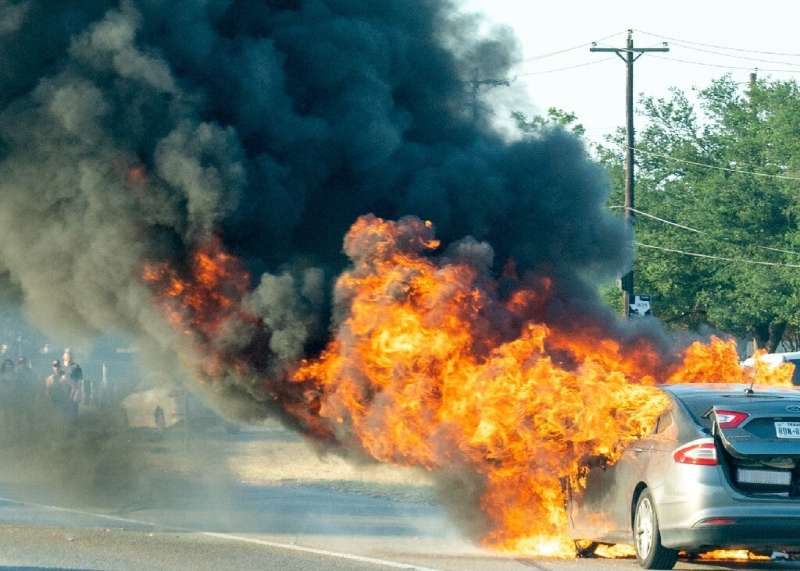
The fire in the photograph appears to be confined to the front left of the car and towards the lower part. There is no smoke coming from the engine at the front or the fuel tank at the rear. The flames are orange and red with the grey smoke that is a classic of a lithium-ion fire. The driver was unable to extinguish it with a couple of fire extinguishers which would normally do the job, or failing that by the fire brigade who arrived very promptly - 'within eight minutes'.
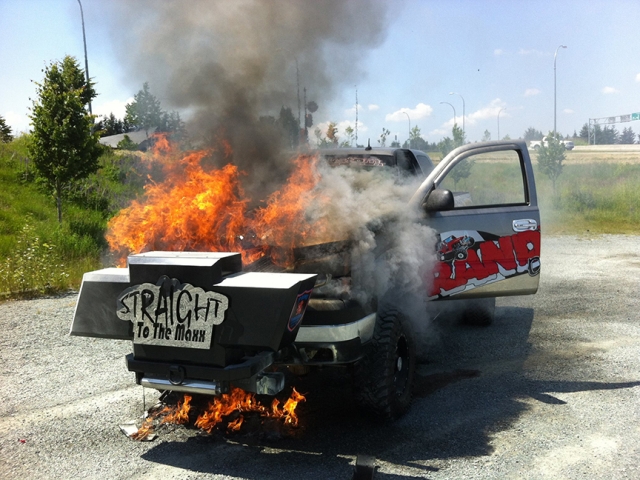
Oh? Like this
hybrid vehicle on fire?
Classic gray smoke, right?
Anyway, is it your suggestion that the battery didn't catch any diesel on fire by the time this photo was taken? You say there is no smoke coming from the front in the photo below, but how can you tell? The photo is from the rear and the presence or absence of smoke from the engine compartment is obscured.
(Oops. I don't know how to link to her image, but it is the upper image in
this post.)
If the vehicle is a diesel hybrid, then the diesel has to burn at some point. If the absence of black smoke is evidence it's not a diesel ICE, then it is also evidence that either it's not a diesel hybrid or the diesel hasn't caught yet. But the car is well aflame, so the latter seems unlikely to me.
So what happened here? I likely scenario IMV having looked at all of the possible facts available so far is that a thermal runaway started in a lithium-ion battery situated towards the front of the vehicle. This is uncontainable by ordinary means as it self-oxygenates, so the driver abandoned his attempts. A burning lithium-ion battery is not only intensely hot (up to 2,000°) - it is the size of a suitcase and is packed with cells - but it gives of projectiles of intense heat. A shrapnel from this lithium battery fire penetrated the diesel fuel tank, causing the hot vapours there, which are given off by the diesel at circa 100 °C, to ignite being within 10% of the flashpoint, causing a massive fireball and it is this fireball of intense heat together with the lithium-ion battery fire that caused rapid spread to other vehicles and causing the concrete and steel rebars to buckle, somehow causing the vehicles in the next roof top level to ignite, being completely open-air and fanned by windy weather. The evidence for this are witnesses describing flame being 'thrown'.
Ah. So when was the fuel tank ruptured? Was it before or after this image was taken? If before, you have a problem, of course, but if after, then you seem awfully confident of an event that was not witnessed as far as we know.
Lithium-ion fires throw flames and become so hot, it explains why the floor beneath Vehicle Zero collapsed from the heat intensity. In addition, lithium-ion battery fires give off extremely noxious fumes and this explains why five personnel were immediately stricken by inhalation difficulties and the entire fire brigade having to withdraw from the building all together. If you recall, at Liverpool they were able to fight the fire from the stairwells for nigh on two hours before giving up. At Luton a major incident was declared just half an hour after their arrival.
If all this were true and an amateur like you can deduce it from just a few still images, then clearly the fire brigade would have made the same inferences. Hence, when they say they believe it's a diesel (and hence, implicitly, not a hybrid), they are lying whether they add "pending verification" or not.
ETA: It's not that I doubt that diesel fires are often black. It just seems plausible to me that smoke color can vary due to a lot of factors, including the particular position of the photographer. Here's a big diesel engine burning and the smoke doesn't look particularly black.