Cont: Luton Airport Car Park Fire part II

Status
Not open for further replies.
So you didn't claim that welding does not involve melting steel or that welding machines can't melt steel?

Vixen said:
I don't accept that using a welding kit in your living room would be able to heat steel up to 700°.

Because you also said the following:So how does a welding kit work if it can't even raise the temperature of steel to within several hundred degrees of its melting point? :confused:

Vixen simply tried to lie her way out of a remarkable display of ignorance regarding subjects about which she pretends to be knowledgeable enough to do detective work.
 
Impression given being in the same sentence as their standing at the top of the plane steps.

Standing at the top of the steps when getting off the plane which they had been on for a couple of hours but which could not depart due to the fire.
 
Has anybody mentioned yet that it was a diesel car that started the fire and that it has been confirmed?

(answer on page 94)

Compus
 
What does that have to do with a consumer battery exploding when it's squashed by a hyrdaulic press? :confused:

When the battery pack weighs as much as a duck, she's a witch! Don't you understand basic logic? If things have one point in common they're the same.

okay I don't know, but my explaination will be as valid & less condescending than the actual one, if it's ever forthcoming.
 
Yes, and what normally triggers diesel to ignite? Pressure.

So Li-ion batteries are filled with diesel oil? Seriously, WTF are you even arguing about?

And no, it's not "pressure", it's still heat. The compression stroke of a diesel engine rapidly heats the air/fuel charge to the ignition point. But in cold weather, diesels can be difficult to start, so they have heating elements called glow plugs that help ignite the air/fuel charge until the engine reaches a set operating temperature, and can continue running without the added help. The compression ratio is exactly the same when the engine is too cold to start, so "pressure" isn't what's doing it.

And, as we've already seen, diesel can also be ignited with a wooden match.

ETA: I should go into a bit more detail about how diesels work. The fuel isn't mixed with air before entering the cylinder during the intake stroke. It's injected, at high pressure into the cylinder near the top of the compression stroke.
 
Last edited:
Design requirements for wheeled motor vehicle fuel tanks require a physical arrangement that directs any leakage to the ground, rather than allowing it to accumulate on any structure or surface of the vehicle. This is why you find them at the lowest point in many vehicle designs.

Sure, but not usually projecting below the floor level of the passenger cabin, otherwise the tank would be vulnerable to impact with any object the car drove over. Set up into some void toward the rear behind the cabin is typical I think.

The point I was trying to make is to express my doubt there would be a clear line of sight for a piece of 'shrapnel' spat out of a burning hybrid battery to pierce the fuel tank.
 
Has anybody mentioned yet that it was a diesel car that started the fire and that it has been confirmed?

(answer on page 94)

Compus

We're still waiting for the fire service to rule out flux capacitors and infinite improbability drives.
 
Cut straight to 6:57 to see how a couple of power tool lithium-ion batteries flame throw shrapnel at high velocity.

I saw mostly sheets of flame and a few pieces of debris flying off. I didn't see anything I would call shrapnel. If you spotted anything shoot out so fast you think could have pierced a fuel tank please indicate where you see it, because I did not.

Thanks.
 
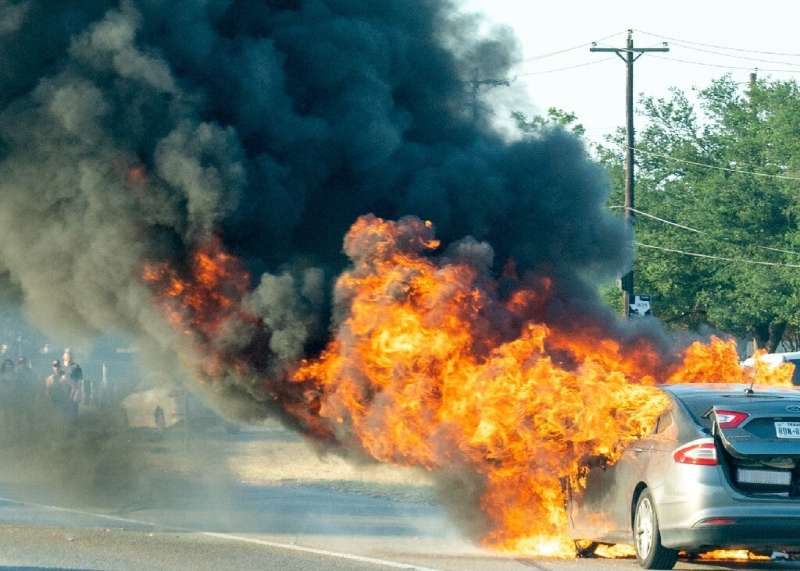
The fire in the photograph appears to be confined to the front left of the car and towards the lower part. There is no smoke coming from the engine at the front or the fuel tank at the rear. The flames are orange and red with the grey smoke that is a classic of a lithium-ion fire. The driver was unable to extinguish it with a couple of fire extinguishers which would normally do the job, or failing that by the fire brigade who arrived very promptly - 'within eight minutes'.

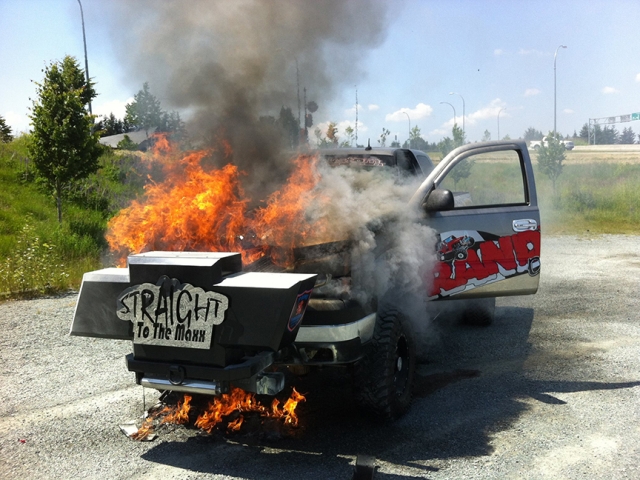
Oh? Like this hybrid vehicle on fire?

a-ford-fusion-hybrid-v.jpg


Classic gray smoke, right?

Anyway, is it your suggestion that the battery didn't catch any diesel on fire by the time this photo was taken? You say there is no smoke coming from the front in the photo below, but how can you tell? The photo is from the rear and the presence or absence of smoke from the engine compartment is obscured.

(Oops. I don't know how to link to her image, but it is the upper image in this post.)

If the vehicle is a diesel hybrid, then the diesel has to burn at some point. If the absence of black smoke is evidence it's not a diesel ICE, then it is also evidence that either it's not a diesel hybrid or the diesel hasn't caught yet. But the car is well aflame, so the latter seems unlikely to me.

So what happened here? I likely scenario IMV having looked at all of the possible facts available so far is that a thermal runaway started in a lithium-ion battery situated towards the front of the vehicle. This is uncontainable by ordinary means as it self-oxygenates, so the driver abandoned his attempts. A burning lithium-ion battery is not only intensely hot (up to 2,000°) - it is the size of a suitcase and is packed with cells - but it gives of projectiles of intense heat. A shrapnel from this lithium battery fire penetrated the diesel fuel tank, causing the hot vapours there, which are given off by the diesel at circa 100 °C, to ignite being within 10% of the flashpoint, causing a massive fireball and it is this fireball of intense heat together with the lithium-ion battery fire that caused rapid spread to other vehicles and causing the concrete and steel rebars to buckle, somehow causing the vehicles in the next roof top level to ignite, being completely open-air and fanned by windy weather. The evidence for this are witnesses describing flame being 'thrown'.

Ah. So when was the fuel tank ruptured? Was it before or after this image was taken? If before, you have a problem, of course, but if after, then you seem awfully confident of an event that was not witnessed as far as we know.

Lithium-ion fires throw flames and become so hot, it explains why the floor beneath Vehicle Zero collapsed from the heat intensity. In addition, lithium-ion battery fires give off extremely noxious fumes and this explains why five personnel were immediately stricken by inhalation difficulties and the entire fire brigade having to withdraw from the building all together. If you recall, at Liverpool they were able to fight the fire from the stairwells for nigh on two hours before giving up. At Luton a major incident was declared just half an hour after their arrival.

If all this were true and an amateur like you can deduce it from just a few still images, then clearly the fire brigade would have made the same inferences. Hence, when they say they believe it's a diesel (and hence, implicitly, not a hybrid), they are lying whether they add "pending verification" or not.

ETA: It's not that I doubt that diesel fires are often black. It just seems plausible to me that smoke color can vary due to a lot of factors, including the particular position of the photographer. Here's a big diesel engine burning and the smoke doesn't look particularly black.

10368943_708567769223116_4233148723253151924_o-1-640x480.jpg
 
Last edited:
We have been given little to no information at all. But think about it. The fire was on 10 October and the fellow was arrested 23 October. A nice fortnight's holiday in the sun, perhaps?

I thought he was arrested in order to deflect any blame Land Rover might face (on the same day the fire brigade attributed the fire to "vehicle fault", but whatever).

Anyway, it's possible he really did leave immediately after his car caught fire and it's possible that he was arrested on the day he returned. It's possible, but we haven't any reason to think it's so yet. And if it is so, then all your theories that he was arrested as a distraction fall apart, because leaving the scene of what turned out to be a terrible fire caused by the driver's vehicle seems like a good reason to arrest the driver. Especially if the driver didn't call the fire brigade before leaving.

Again, we don't know any of this is the case, but simply the possibility that it is so is enough to weaken the claim that the arrest must have been a mere distraction.
 
The car fire is just the excuse for a 'Look-At-Me' thread.

Well the sunken ferry and the drowned woman didn't pan out so.....

Although maybe, just maybe, Vixen's unique ability to ferret out coverups where absolutely no one else is able will be recognized by expert investigators in all fields and she will become to "go to" for all such puzzles.


Nah.
 
I took the lady's words at face value. It seems to be her perception that the car park floor collapsing was connected to her being about to fly off with Ryanair. I appreciate now that the reporter was likely condensing the Wexford lady's observations into one sentence to get her article to fit the '500 words' rule. This was misleading as it was in quotation marks as a verbatim comment.

Blame the reporter without evidence all you like. The excerpt did not say or imply "almost immediately".

But let us not miss the point that the car park floor collapsed very quickly, given how new the building was, and built to withstand the weight of modern cars. The heat must have been extraordinarily intense, of an all together higher magnitude than the Liverpool one.

Different buildings and different situations are, I think, different. The South Tower collapsed first on 9/11 despite being hit second. In total, the North Tower lasted more than 50% longer after its impact than the South Tower lasted after its own. So it goes.
 
Yes, and what normally triggers diesel to ignite? Pressure.

Vixen's absolutely right. There's pressure in the diesel engine cylinders which are mere feet from the hypothetical hybrid battery[1]. If even a smidgen of that pressure leaked, well, I wouldn't want to be there, I can tell you.

Alternatively, that electrical current is flowing hither and yon. If a bit splashes into the cylinder, same thing.

[1] And hypothetical lithium batteries are theoretically just as deadly as the real thing.
 
Last edited:
Vixen's absolutely right. There's pressure in the diesel engine cylinders which are mere feet from the hypothetical hybrid battery. If even a smidgen of that pressure leaked, well, I wouldn't want to be there, I can tell you.

Alternatively, that electrical current is flowing hither and yon. If a bit splashes into the cylinder, same thing.

Not when its turned off.
 
Status
Not open for further replies.

Back
Top Bottom