• Quick note - the problem with Youtube videos not embedding on the forum appears to have been fixed, thanks to ZiprHead. If you do still see problems let me know.

Cont: The sinking of MS Estonia: Case Reopened Part VI

Status
Not open for further replies.
Er, these were found washed up several days later. Capn. Makela says he was expecting to see all kinds of detritus when he went to the rescue, and the ship, whilst capsized, should still have been visible in the water. He was shocked to see nothing at all. Bumpf! Gone.

Entire ships have sunk and disappeared so quickly that not a single person got off them.
Ships have disappeared without leaving any flotsam.

What do you think he was expecting to see?
 
Wait. Are you saying Del Boy and Dessie's wide boy friend also used the phrase? Whilst it is obviously a reference to the Lone Ranger, I am sceptical it has anything to do with 'an Algonquin dialect' as far as Del Boy from Peckham is concerned.

The Lone Ranger was shown in Britain, the phrase was popularised in that as I said in the post you quoted. It was what Tonto called the Lone Ranger, hence it being used as "friend". Del Boy also misused French expressions despite not being from Paris.


The Definitive Word on "Kemo Sabe"

We all know, or at least those of us over 30, that Tonto called the Lone Ranger "Kemo Sabe." Did you know that during the early radio shows the Lone Ranger also called Tonto "Kemo Sabe?"

https://owd.tcnj.edu/~hofmann/kemosabe.htm#:~:text=A%20respected%20researcher%20at%20the,%22one%20who%20is%20white.%22


Ke-mo sah-bee (/ˌkiːmoʊˈsɑːbiː/; often spelled kemo sabe, kemosabe or kimosabe) is the term used by the fictional Native American sidekick Tonto as the "Native American" name for the Lone Ranger in the American television and radio programs The Lone Ranger. Derived from gimoozaabi, an Ojibwe and Potawatomi word that may mean 'he/she looks out in secret',[1] it has been occasionally translated as 'trusty scout' (the first Lone Ranger TV episode, 1949) or 'faithful friend'.[2]

https://en.m.wikipedia.org/wiki/Ke-mo_sah-bee


“Kemosabe,” also spelled “Kemo Sabe” or “Kemo Sabhay”…
What is the meaning of this expression that became such a memorable part of the Lone Ranger series?

Fran Striker, who wrote the original Lone Ranger scripts, was also the person who answered the fan letters to the Lone Ranger. He always started his replies with… “Ta-i ke-mo sah-bee” (Greetings trusty scout, according to him).

https://www.aaanativearts.com/what-is-the-meaning-of-the-word-kemosabe-or-kemo-sabe
 
When the devices detonated at Swedish midnight, perhaps the ship swerved into the escorting submarine and was thus pranged.


The JAIC never dealt with the eye witness reports of a collision of some sort.

Are we back to a bomb again?
 
I think you'll find that the whole "kemo sabe" thing was gone through in excruciating detail in one of the previous threads. Obviously it isn't rhyming slang, it's from an Algonquin dialect but for practical purposes it's from "The Lone Ranger" and on the rare occasion it's used in Britain it's used like "my friend" or "mate", it does have a reputation in popular culture for being used by people trying and failing to come across as clever, most famously by Del Boy in "Only Fools and Horses" but also by Dessie's spivish, wide-boy friend in the film adaption of "The Snapper" by Roddie Doyle (set in Ireland).

But this is irrelevant, because of course it's just a distraction.

Distraction, distraction, distraction....
 
Try: quién no sabe?


See the play on words? Cockneys are bloody witty bastards.

It's a line from a feeble Lone Ranger joke.

It's got nothing to do with cockneys.

I am certain this is a put on

You are just trolling for laughs.
 
It's a line from a feeble Lone Ranger joke.

It's got nothing to do with cockneys.

I am certain this is a put on

You are just trolling for laughs.

Actually a long running, and even longer repeated radio & TV drama, it was still showing on the BBC when I was a kid in the 70's.

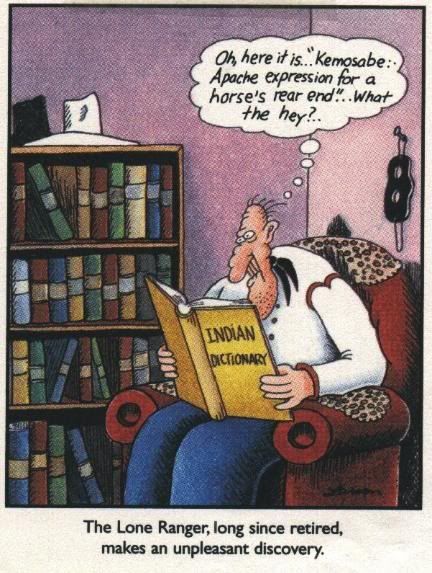
But the phrase & context remained well known enough for it to be the subject of a Far Side cartoon.
 
Actually a long running, and even longer repeated radio & TV drama, it was still showing on the BBC when I was a kid in the 70's.

But the phrase & context remained well known enough for it to be the subject of a Far Side cartoon.

Lone-Ranger-Learns-Meaning-of-Kemo-Sabe-1.jpg
 
Er, these were found washed up several days later. Capn. Makela says he was expecting to see all kinds of detritus when he went to the rescue, and the ship, whilst capsized, should still have been visible in the water. He was shocked to see nothing at all. Bumpf! Gone.

This is what he saw in the water when he arrived:

https://www.youtube.com/watch?v=qhowN4_Z_1c

Everything that floated off Estonia's deck was subject to wind and tidal forces. It would float around directly above the wreck. I doubt the life rafts in this footage are even near where she went down.
 
He was there. You were not.

The Ancient Romans had a very simple method for ascertaining truth. Their aphorism was: 'Seeing is believing'. This still applies to criminal law today.

Capn Makela and Capn Thoresson saw what they saw and they are quite capable of making up their own minds.

The whole point of the Skeptics Forum is that in fact - no - you cannot always believe what you see.
 
Actually a long running, and even longer repeated radio & TV drama, it was still showing on the BBC when I was a kid in the 70's.

But the phrase & context remained well known enough for it to be the subject of a Far Side cartoon.

Can I just lean in to clarify that cockney rhyming slang and also backslang, wasn't there so that they could look cute like Del Boy & Rodney, the whole point was an underworld language developed by 'villains' and prison inmates paranoid that people might understand what they were plotting. So actually, it was inventive and not just restricted to terms such as 'up the apples and pears' and 'down the rub-a-dub-dub'. There is a good scene in Vinnie Jones' 'Lock Stock and Two Smoking Barrels" entirely in this mode and only the villains in the pub understand what they are talking about.


This puts to bed Mark_Corrigan's claim that he is the arbiter of what Cockney slang is.
 
It's more a concern as to what happened to the nine Estonians, mostly very senior crew, who were initially listed as survivors together with Piht, who was definitely spoken of in the respectable press as being alive and available for interviewing.

Could the nine people Svensson is said to have brought to Stockholm at about two in the morning, and hailed a hero in the early Swedish papers be the real subjects of the heroic 'Operation'? So they were renditioned by he CIA as enemies of the state, lined up against a wall and executed.

No, you are claiming what is an obvious clerical error as fact.

It has become a cruel and pathetic lie, told by the small band of Estonia CT loons.

And please keep your conspiracies straight. Either the Russians sank it, the Swedes sank it, or the CIA sank it. You drift haphazardly from one to the other, mixing fantasies on a whim.

And tell me the name one person the CIA renditioned between 1990 and 2001. I'll wait.
 
Of course you can calculate apx distance travelled if you have the parameters of unit of speed x time taken.

For example, a car travelling at 60mph for 20 mins can be estimated to have traveled 20 miles (60 x 0.33333).

Oh, look, a non-sequitur using trivial physics in order to avoid admitting that you thought "knot" was a measure of distance. No one saw that coming.
 
“Many a true word hath been spoken in jest.”
― William Shakespeare, King Lear

Fact.

I don't care for all the time spent trying to convince you to admit trivial errors. I think it's pointless and mean spirited.

However, any sympathy I might have diminishes when you mislead like this. The above is a quote from King Lear, but it's not what you wrote. You wrote, "There hath been many a true word spoken in jest."

Just admit a minor misquote and move on to making more important errors regarding the sinking of the Estonia.
 
Of course you can calculate apx distance travelled if you have the parameters of unit of speed x time taken.

For example, a car travelling at 60mph for 20 mins can be estimated to have traveled 20 miles (60 x 0.33333).

A car drives in circles (say about the size of a racetrack) for 20 mins at 60 miles an hour- doesn't end up 20 miles away from the racetrack...

https://www.youtube.com/watch?v=2fCbNgfWgRY

In fact, by using 'vixens patented speed calculator' system (measure the straight line distance from start to finish and divide (or possibly multiply, depending on which way the wind is blowing, if the sun is up or down, or just at random) the time taken- those cars never moved at all!!! (one lap = distance around the course from start line to finish line- so measure the straightline distance from the two lines- um zero, so speed = zero...)

It makes about as much sense as her mess LOL
 
Status
Not open for further replies.

Back
Top Bottom