• Security incident: ISF was recently accessed by intruders. Please change your password, and change it anywhere else you used it. Read more

Merged Strict biological definitions of male/female

That and the stipulative definitions of biology are "true" by definition.
I don't think that phrase means what you think it does.

Definitions may be classified as lexical, ostensive, and stipulative. Lexical definition specifies the meaning of an expression by stating it in terms of other expressions whose meaning is assumed to be known (e.g., a ewe is a female sheep). Ostensive definition specifies the meaning of an expression by pointing to examples of things to which the expression applies (e.g., green is the color of grass, limes, lily pads, and emeralds). Stipulative definition assigns a new meaning to an expression (or a meaning to a new expression); the expression defined (definiendum) may either be a new expression that is being introduced into the language for the first time, or an expression that is already current.
https://www.britannica.com/topic/definition#ref1034298

It is possible that somewhere a biologist has stipulated a definition for the sake of introducing a new idea within a paper, but there are no definitions stipulated for the entire field of study; commonly used terms are lexical, even if its a specialized lexicon.
 
Absent the Steersman Conundrum, is there anything left to discuss, on this topic? Seems like we're all pretty much settled as far as strict biological definitions go. We all see the general utility and clarity of the structural definitions. We're all agreed that in some contexts certain functional definitions are better. We all understand that specific details of sex and sex definitions may vary wildly from species to species. None of us are confounded by basic properties of natural languages, such as apparent ambiguity and the importance of context clues.
 
Absent the Steersman Conundrum, is there anything left to discuss, on this topic? Seems like we're all pretty much settled as far as strict biological definitions go.
I'd say the interesting questions basically fall into the DSD thread, which ought to have been in this forum instead of the social issues forum.
 
Last edited:
That's a good point about the location of the DSD thread. But I think the wider question of whether a definition using the present habitual tense should be interpreted as meaning that to be a member of the group that individual must at that very moment fulfil the stipulated criteria is worth arguing.

I mean it's the seven-legged spider question, or the "can you be a mammal if you lack mammary glands and fur?" thing.
 
But I think the wider question of whether a definition using the present habitual tense should be interpreted as meaning that to be a member of the group that individual must at that very moment fulfil the stipulated criteria is worth arguing.
My mom is a black powder sharpshooter, a handbell ringer, an accomplished quilter, and an avid reader, but not literally all at once.
 
Last edited:
That's a good point about the location of the DSD thread. But I think the wider question of whether a definition using the present habitual tense should be interpreted as meaning that to be a member of the group that individual must at that very moment fulfil the stipulated criteria is worth arguing.

I mean it's the seven-legged spider question, or the "can you be a mammal if you lack mammary glands and fur?" thing.
If we are arguing about what a woman is, then we are so hopelessly lost that what the definition should be is the least of our worries. It's like arguing what the appropriate procedure is if you walk off a cliff, should you plummet to the ground, or something else. It's only a discussion that you would have if we've parted company from reality.
 
"We" seem to be arguing whether an organism that has the set of organs that produces either small or large gametes is technically male or female respectively on that account alone, or whether the organs have to be actively producing gametes (and capable or delivering them too, apparently) at the time in question.
 
"We" seem to be arguing whether an organism that has the set of organs that produces either small or large gametes is technically male or female respectively on that account alone, or whether the organs have to be actively producing gametes (and capable or delivering them too, apparently) at the time in question.
Among mammals, I think it's enough that the organism develops organs which could potentially produce mature gametes someday.

(No need to worry about sequential hermaphrodism, obvs.)
 
"We" seem to be arguing whether an organism that has the set of organs that produces either small or large gametes is technically male or female respectively on that account alone, or whether the organs have to be actively producing gametes (and capable or delivering them too, apparently) at the time in question.

Only one person is really arguing against that premise. If not for them this thread would never have been necessary.
 
Among mammals, I think it's enough that the organism develops organs which could potentially produce mature gametes someday.

(No need to worry about sequential hermaphrodism, obvs.)


I can see the issue with sequential hermaphrodites, but I think it's pinhead-dancing. The organs the clownfish has now are the organs that produce or are capable of producing (we could imagine an infertile clownfish) one or the other type of gamete. A male clownfish that's firing blanks is still a male clownfish, not a female one, because he has the organs that are associated with the production of small gametes. The fact that these organs have the potential to change into those associated with the production of large gametes isn't the point.

It's the type of gonad possessed by the organism at the point in time we're referring to that is the deciding criterion. The potential or actual type of gamete produced by that type of gonad. Obviously for mammals that is equivalent to saying the type of body.
 
It's the type of gonad possessed by the organism at the point in time we're referring to that is the deciding criterion.
That approach would make it fairly tricky to classify people who undergo therapeutic hysterectomies or orchiectomies, one of whom I included on my test list of people (probably) born male.
 
Last edited:
OK, I'm not thinking this through at the level Steersman wants us to think it. The type of body development, one path or the other, possessed by the individual at the relevant point in time? Would that work?

I realise I'm digressing here, as you quite reasonably don't want to talk about clownfish, but it's an interesting intellectual point to consider while we're not being bombarded with misinterpreted and irrelevant links, meaningless charts and a large helping of condescension.
 
OK, I'm not thinking this through at the level Steersman wants us to think it. The type of body development, one path or the other, possessed by the individual at the relevant point in time? Would that work?
I think it's enough to say that the individual organism went down one path or another in utero, so long as we are confining our discussion to mammals or other non-hermaphrodites.
 
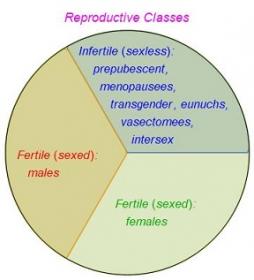
Arbitrary pie chart is arbitrary. I'll be back in a while with one that supports 'flat earth theory'.

And your evidence for your claim is what?

Here's the evidence for mine:


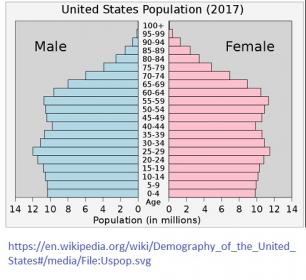
Though that chart is apparently from an earlier version of Wikipedia's article:

https://en.wikipedia.org/wiki/Demographics_of_the_United_States

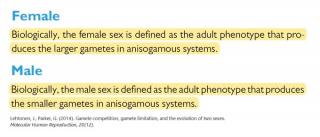
But my pie chart basically starts from the strict biological definitions for the sexes - i.e., those of Parker, Lehtonen, Griffiths, Google/OD, et al which stipulate that to have a sex is to have functional gonads (and "delivery systems") - and uses those typical demographics to "guestimate" which percentages of the population are likely to have functional gonads of two types or of neither. Logic 101. Q.E.D. HTH ... ;)

Though I'll concede, again, and emphasize that the proportions shown - 1/3 male, 1/3 female, 1/3 sexless - are just approximations. For example, other countries are likely to have very different percentages of people in the different age groups. Which will of course affect those percentages.

 
Intensional & stipulative definitions of male/female apply to all anisogamous species

Resolved: The unscientific definitions of Heying, Hilton, & Wright are flatly contradicted by and inconsistent with the standard biological definitions of Parker, Lehtonen, Griffiths, Google/OD, and many other sources. The former should therefore be deprecated, and be replaced in, to start with, all biological and sociological journals and applications with the latter.

The definitions of Hilton and Company essentially define each sex as a polythetic category; each sex becomes a discrete spectrum of three states or conditions:


The definitions of Parker, Lehtonen, and Company essentially define each sex as a monothetic category with single necessary & sufficient conditions for category membership -- i.e., functional gonads of two and only two types. Those organisms with neither are therefore sexless:


https://web.archive.org/web/20190326191905/https://en.oxforddictionaries.com/definition/sex
https://web.archive.org/web/20181020204521/https://en.oxforddictionaries.com/definition/female
https://web.archive.org/web/20190608135422/https://en.oxforddictionaries.com/definition/male
https://academic.oup.com/molehr/article/20/12/1161/1062990
https://link.springer.com/referenceworkentry/10.1007/978-3-319-16999-6_3063-1

Fairly clear description of the difference between monothetic and polythetic categories:


Some background on intensional, and stipulative definitions:

https://en.wikipedia.org/wiki/Extensional_and_intensional_definitions
https://en.wikipedia.org/wiki/Stipulative_definition
 
OK, I'm not thinking this through at the level Steersman wants us to think it. The type of body development, one path or the other, possessed by the individual at the relevant point in time? Would that work?

Glad you appreciate that a different level is required. Has a great deal of relevance to a great many social issues, not least to transgenderism.

But "one path or the other" might work in some anisogamous species, at least some of the time. But the issue is that they generally don't in all of them - hence the need for a different or deeper "level" of analysis.

I realise I'm digressing here, as you quite reasonably don't want to talk about clownfish, but it's an interesting intellectual point to consider while we're not being bombarded with misinterpreted and irrelevant links, meaningless charts and a large helping of condescension.

For those who DO want to talk about clownfish in the context of strict biological definitions for the sexes which apply not just to mammals, but to all anisogamous species, a brand new thread ;)

http://www.internationalskeptics.com/forums/showpost.php?p=13919917&postcount=1
 

ISF - Join now!

Every member here is approved by hand. No bots, no spam, just people who care about evidence and honest debate.

Membership is free!

Create your free account

Back
Top Bottom