The Sinking of MS Estonia: Case Re-Opened

Status
Not open for further replies.
Several experts in Evertsson's documentary describe the hole as breaching passenger cabins and also breaching the hull, due to the vertical tear, caused by the impact. With a surge of water penetrating the hull, the ship is no longer buoyant, which explains why it sank as fast as torpedoed and collided ships.

How much water would have penetrated the hull through a hole of that size above the waterline?
 
The point is that as its hull was not breached, it still had enough buoyancy to continue floating for a few days, after capsizing.

Yes, it's bows didn't fall off and flood the hull.

You have been shown examples of ships sinking just as quickly as the Estonia.
What point are you trying to make?
 
Last edited:
Y4et somehow, Herald of Free Enterprise or the other example I gave of a rapidly sinking ferry witha flooded car deck don't count.

On average two ships sink every week. Each one is different in detail.

As pointed out several times, the Herald of Free Enterprise, if it had got further out into deeper waters, would have followed the same pattern as the M/S Jan Heweliusz and floated turtle. As it toppled straight away, it was still in a shallow bank which is why it stayed on its side.

The report into the Herald of Free Enterprise was transparent and clear and everybody was happy with it.
 
It did indeed follow the laws of physics, specifically, Archimedes Principle, as it capsized and floated upside down on its still buoyant hull, before sinking days later.

Q.E.D.

::

Herald OF Free Enterprise flooded through an open bow door and sank more quickly than the Estonia.
 
As pointed out several times, the Herald of Free Enterprise, if it had got further out into deeper waters, would have followed the same pattern as the M/S Jan Heweliusz and floated turtle. As it toppled straight away, it was still in a shallow bank which is why it stayed on its side.

What is your evidence for this?
 
I was asking you though.

I already gave you the citation pages back.

The hull was not punctured by the iceberg, but rather dented such that the hull's seams buckled and separated, allowing water to seep in. Five of the ship's watertight compartments were breached. It soon became clear that the ship was doomed, as she could not survive more than four compartments being flooded. Titanic began sinking bow-first, with water spilling from compartment to compartment as her angle in the water became steeper.[164]
wiki

The rivets in the seam of the hull were not strong enough.
 
56 wouldn't be too old to go diving if that is your hobby and you know what you are doing. Bear in mind, the UK signed the Estonia Gravesite Treaty so he would be in danger of incriminating himself or his divers - if British - by naming them.

It does appear other diving teams have been down there. As the site is constantly monitored by the coastguards and navy, the fact it hasn't been publicised points to authorised navy expeditions.

You are literally making things up as you go along.
 
Yes, it's bows didn't fall off and flood the hull.

You have been shown examples of ships sinking just as quickly as the Estonia.
What point are you trying to make?

Please add them to my list, stating ship name, year of accident, tonnage and cause of sinking, together with time taken to sink.

Speed of sinking

Here are the ten worst passenger shipping accidents, together with tonnage, cause of the accident and time taken to sink. It is in the order of 'time taken to sink'.


1. Empress of Ireland (UK 1914) 14,191, COLLISION, 14 minutes
2. Admiral Nakhimov (USSR 1986) - 17,053, COLLISION - 15 minutes
3. Don Juan (Philippines 1980) - 2,311 - COLLISION - 15 minutes
4. Lusitania (UK, 1915) - 31,550 - TORPEDO - 15 minutes
5. Royal Pacific (Greece 1992) - 3,176 - COLLISION - 15 minutes
6. Salem Express (Egypt 1991) - 4,771 - COLLISION - 15 minutes
7. European Gateway (UK 1982) - 4,263 - COLLISION - 30 minutes
8. M/S Estonia (Estonia 1994) - 15,598 - "Er, the bow fell off" - 35 minutes
9. Jupiter (Greece 1988) - 6,306 - COLLISION - 40 minutes
10. Express Samina (Greece 2000) - 4,455 - COLLISION - 45 minutes
11. Wilhelm Gustloff (Germany 1945) - 19,350 - TORPEDOES - 50 minutes
12. Brittanic (UK 1916) - 48,158 - EXPLOSION - 55 minutes

Notandum: M/S Estonia is the only vessel that was supposedly 'intact' that sank in less than one hour.

 
It did indeed follow the laws of physics, specifically, Archimedes Principle, as it capsized and floated upside down on its still buoyant hull, before sinking days later.

Q.E.D.

::


Fill the kitchen sink, then float an empty tupperware box (which represents a ship's hull) on top of the water.

Next, fill several mugs of water from the tap, and pour them into the tupperware box.

Then observe how, at a certain point, the tupperware box (which now also contains those mugs-full of water) will cease to retain any buoyancy.

Then observe how the tupperware box (which now also contains those mugs-full of water) will either tip on its side and sink, or simply sink straight down retaining its original orientation.

Observe how the tupperware box, in this scenario, will not "turn turtle".

And all without the tupperware box - the proxy for the ship's hull, remember - needing to suffer any form of breach or ingress damage at or below the waterline.

As you say: QED.

:rolleyes:
 
Last edited:
Fill the kitchen sink, then float an empty tupperware box (which represents a ship's hull) on top of the water.

Next, fill several mugs of water from the tap, and pour them into the tupperware box.

Then observe how, at a certain point, the tupperware box (which now also contains those mugs-full of water) will cease to retain any buoyancy.

Then observe how the tupperware box (which now also contains those mugs-full of water) will either tip on its side and sink, or simply sink straight down retaining its original orientation.

Observe how the tupperware box, in this scenario, will not "turn turtle".

And all without the tupperware box - the proxy for the ship's hull, remember - needing to suffer any form of breach or ingress damage at or below the waterline.

As you say: QED.

:rolleyes:

Oh dear. Do look up displacement of air.
 
Do read the article supplied by Axxman300 about the bathymetry of the Baltic Sea. In particular, please pay special attention to the behaviour of waves in shallow seas as compared to deep oceans.

This is not a competition as to 'Who has the biggest waves?' It is about the type of conditions that cause waves and sea breaks. Ponder on that and then things will become clear.

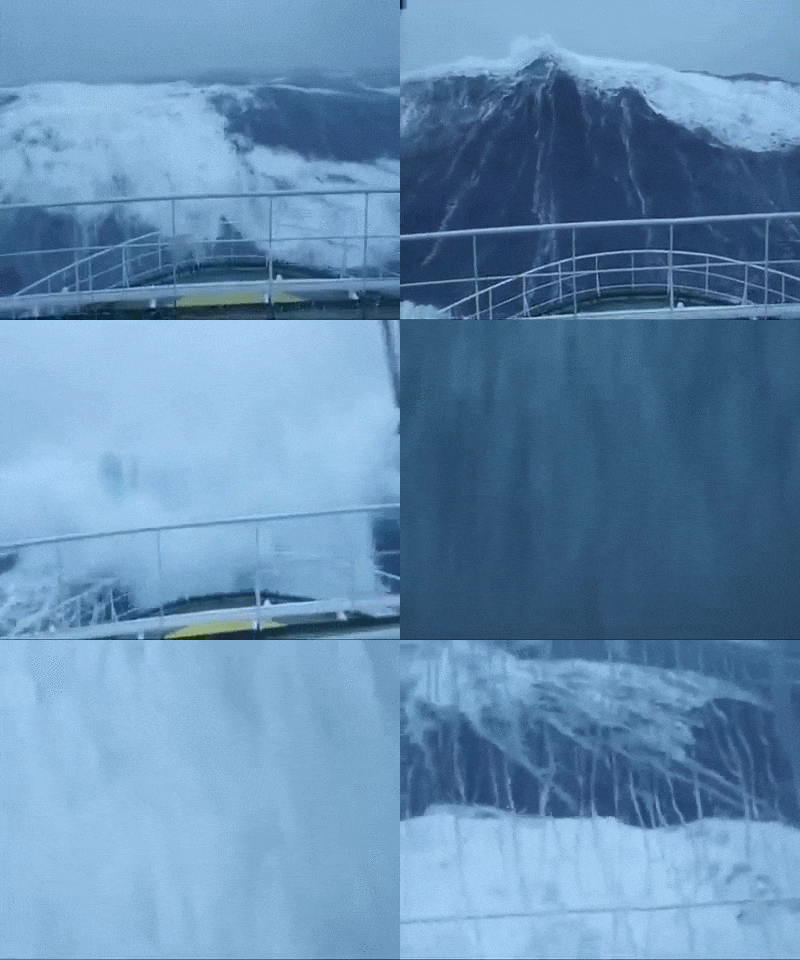
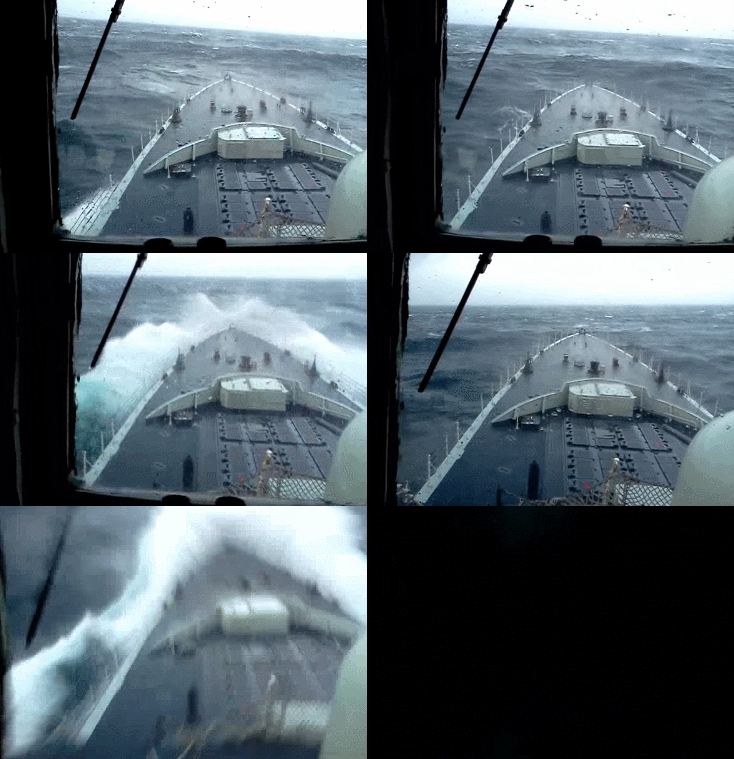
It's not about giant waves. I doubt the wave that knocked the bow-cover loose was much taller than the rest. My point, based on the bathymetric landscape combined with the recorded weather on the night of the sinking, is that many of those waves had more energy. Combine this with Estonia's heading and the fact she already had a 2-degree list the situation was a perfect storm. When most people hear the term, Rogue Wave they think of a giant wall of water, which is accurate much of the time, but just as often a rogue wave (also called Sneaker Waves) is of average height with far more directed energy.

Big:

giphy.gif


vs Power:

giphy.gif


giphy.gif


The Atlantic has the largest recorded waves largely because it has a long maritime history with heavy cross traffic, and it's bathymetry combined with the currents of warm water meeting cold water in key locations. The Pacific is larger with sea lanes being 200 to 400 years younger than the Atlantic making the maritime history sparse until the mid-19th Century. There are parts of the Pacific which are still lightly traveled because there's nothing there, and fuel is expensive.

All that matters are the events and factors of the night of the sinking. That's it.

Edit to add: The wave that killed my friend back in the 80s wasn't more than waist high. She was 100 meters from the surf-line because she was afraid of the ocean, and a rogue wave hit the beach and raced those 100 meters in seconds to sweep her and her daughter out to sea. Her daughter lived. It's not about size, it's about force.
 
Last edited:
Please add them to my list, stating ship name, year of accident, tonnage and cause of sinking, together with time taken to sink.

Speed of sinking

Here are the ten worst passenger shipping accidents, together with tonnage, cause of the accident and time taken to sink. It is in the order of 'time taken to sink'.


1. Empress of Ireland (UK 1914) 14,191, COLLISION, 14 minutes
2. Admiral Nakhimov (USSR 1986) - 17,053, COLLISION - 15 minutes
3. Don Juan (Philippines 1980) - 2,311 - COLLISION - 15 minutes
4. Lusitania (UK, 1915) - 31,550 - TORPEDO - 15 minutes
5. Royal Pacific (Greece 1992) - 3,176 - COLLISION - 15 minutes
6. Salem Express (Egypt 1991) - 4,771 - COLLISION - 15 minutes
7. European Gateway (UK 1982) - 4,263 - COLLISION - 30 minutes
8. M/S Estonia (Estonia 1994) - 15,598 - "Er, the bow fell off" - 35 minutes
9. Jupiter (Greece 1988) - 6,306 - COLLISION - 40 minutes
10. Express Samina (Greece 2000) - 4,455 - COLLISION - 45 minutes
11. Wilhelm Gustloff (Germany 1945) - 19,350 - TORPEDOES - 50 minutes
12. Brittanic (UK 1916) - 48,158 - EXPLOSION - 55 minutes

Notandum: M/S Estonia is the only vessel that was supposedly 'intact' that sank in less than one hour.


Herald of Free Enterprise sank in literally a matter of minutes.

Notandum (:rolleyes:): Herald of Free Enterprise was a RO-RO ferry which sank because of an open bow door letting water enter rapidly into the vehicle deck, causing swift destabilisation and loss of buoyancy, which in turn led to a capsize and sinking. Without any external breach of the hull at or below the waterline. I can't imagine how this might in any way be relevant to the Estonia incident.....:eye-poppi
 
I already gave you the citation pages back.

wiki

The rivets in the seam of the hull were not strong enough.

How strong should they have been?
It was a combination of the hull steel and the wrought iron rivets failing through brittle fracture due to the low temperature of the water and high impact loading of the collision coupled with design flaws in the ship design and layout.

Titanic was built using materials and techniques common to all ships at the time.

The failure of the hull steel resulted from brittle fractures caused by the high sulphur content of the steel, the low temperature water on the night of the disaster, and the high impact loading of the collision with the iceberg. When the Titanic hit the iceberg, the hull plates split open and continued cracking as the water flooded the ship. Low water temperatures and high impact loading also caused the brittle failure of the rivets used to fasten the hull plates to the ship's main structure. On impact, the rivets were either sheared off or the heads popped off because of excessive loading, which opened up riveted seams. Also, the rivets around the perimeter of the plates elongated due to the stresses applied by the water, which broke the caulking and provided another inlet for the water.

From
Causes and Effects of the Rapid Sinking of the Titanic
http://writing.engr.psu.edu/uer/bassett.html
 
If I am making it up, have a look at Evertsson's documentary and let me know who cut the railings off the car ramp?

I was referring to the one specific point regarding Brian Braidwood. There is zero evidence to say he dived on the wreck. Zero. Yet you literally just invented a reason why he did and consequently it was all hushed up. You are absolutely unwilling to concede anything, even when you are obviously wrong.
 
Status
Not open for further replies.

Back
Top Bottom