• Quick note - the problem with Youtube videos not embedding on the forum appears to have been fixed, thanks to ZiprHead. If you do still see problems let me know.

Dover Penn ID trial

Where does the effective removal of the old school leave the case? If the plaintiffs win, the new board will presumably not want to appeal the decision. Where does this leave the case as a precedent? What other courts is Judge Jones's decision binding on?

Ideally this would have gone all the way up to the SC and set a proper precedent, binding on all courts in the US.

The Board is being sued, not individuals on the board so the case goes on. The difference is, (as cited in the paper yesterday for which I have no reference) that the new board will 1) rescind the stupid ruling that got them in trouble in the first place and 2) not appeal a loss.
 
The Board is being sued, not individuals on the board so the case goes on. The difference is, (as cited in the paper yesterday for which I have no reference) that the new board will 1) rescind the stupid ruling that got them in trouble in the first place and 2) not appeal a loss.
That's the problem. It won't go up to a higher court. Will a verdict at this level be useable as a precedent in, say, Kansas?
 
That's the problem. It won't go up to a higher court. Will a verdict at this level be useable as a precedent in, say, Kansas?

I guess that it can be cited as case law but there is nothing binding, I think. It depends on how well the judge supports his decision. If he can flay the Board with a detailed analysis of their arguments it will have some influence I am sure. After all, if he can see thru their arguments and make his reasoning clear, then it would be up to another judge to go him one better if they disagree on the outcome.
 
The Board is being sued, not individuals on the board so the case goes on.
Could the plaintiffs conceivably still drop the suit, even though the final arguments have already been made?

I'm guessing they don't want to drop it given that (I think) they are likely to win. That would mean a win in both the courts and the polls and strengthen the social and legal arguments* against ID in the science classroom.


* as opposed to merely the scientific argument
 
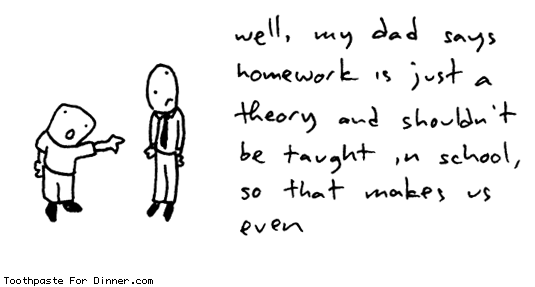
homework-is-just-a-theory.gif
 
That's the problem. It won't go up to a higher court. Will a verdict at this level be useable as a precedent in, say, Kansas?

It is in federal court so it would be considered a persuasive authority rather than a mandatory authority. Still, better than nothin I say.

If it DID go to trial in Kansas and they contradicted the Dover ruling, perhaps the Supreme Court would hear a new case directly to put the issue to rest once and for all.
 
Behe made it look easy. Says so himself.
As far as the "ordeal" goes, despite what the LA Times article makes it seem, it was actually all rather exhilirating. I rather enjoyed myself on the witness stand, because I got to explain in very great detail the argument for intelligent design, and the other side had to sit there and listen.

The cross examination was fun too, and showed that the other side really does have only rhetoric and bluster. At one point the lawyer for the other side who was cross examining me ostentatiously piled a bunch of papers on the witness stand that putatively had to do with the evolution of the immune system. But it was obvious from a cursory examination that they were more examples of hand waving speculations, which I had earlier discussed in my direct testimony. So I was able to smile and say that they had nothing more to say than the other papers. I then thought to myself, that here the NCSE, ACLU, and everyone in the world who is against ID had their shot to show where we were wrong, and just trotted out more speculation. It actually made me feel real good about things.
 
Could the plaintiffs conceivably still drop the suit, even though the final arguments have already been made?

I'm guessing they don't want to drop it given that (I think) they are likely to win. That would mean a win in both the courts and the polls and strengthen the social and legal arguments* against ID in the science classroom.


* as opposed to merely the scientific argument

I believe you could drop the case, but only in theory. It would be at the discretion of the court and they would be very unlikely to grant a withdrawl at this stage since it wouldn't serve the public interest.

Did I say "very unlikely"? I meant "basically impossible".
 
Behe made it look easy. Says so himself.
As far as the "ordeal" goes, despite what the LA Times article makes it seem, it was actually all rather exhilirating. I rather enjoyed myself on the witness stand, because I got to explain in very great detail the argument for intelligent design, and the other side had to sit there and listen.

The cross examination was fun too, and showed that the other side really does have only rhetoric and bluster. At one point the lawyer for the other side who was cross examining me ostentatiously piled a bunch of papers on the witness stand that putatively had to do with the evolution of the immune system. But it was obvious from a cursory examination that they were more examples of hand waving speculations, which I had earlier discussed in my direct testimony. So I was able to smile and say that they had nothing more to say than the other papers. I then thought to myself, that here the NCSE, ACLU, and everyone in the world who is against ID had their shot to show where we were wrong, and just trotted out more speculation. It actually made me feel real good about things.
:dl:
 
As someone on this forum is fond of saying, the problem with intellectual KO's is that the recipient usually doesn't notice them.

In Behe's mind, all of the stupid things he believes make perfect sense. From that perspective, it's clear he performed brilliantly on the stand. To be able to recognize he was made a fool of, he'd have to be able to recognize that he's spewing nonsense.

This inability to view one's own beliefs objectively is why a lot of scientific progress involves waiting for the oldguard to die off.
 
Actually, he'd just be doing his job. He's a professional moron.

You know, I think that's deeply unfair.

The guy's a biology professor at a Research I university. If you're saying that he's a professional moron, what are you saying about his colleagues?
 
The guy's a biology professor at a Research I university. If you're saying that he's a professional moron, what are you saying about his colleagues?
That they're employed at the same department as a professional moron?
 

Back
Top Bottom