Hawking says there are no gods

Status
Not open for further replies.
Oh lordy.

How about if the science you are citing has new discoveries in the last 30 years? Think those 'discoveries' you mention have been reassessed?

Then give actual links to at least a scientific journal.
I will read them. I am will to learn.
Not what you think.
 
...
We have no way of checking if there is something or nothing outside the universe, because we are inside the universe.
And you think I said something different?

If there's a god outside of the Universe, is it relevant? Does it have jack **** to do with people's fictional god beliefs?
 
You copied BadBoy's argument (though you probably thought you were being original).
You think this . . .
The default scientific position is to not rule IN the existence of things for which there is no evidence.
is a copy of this? . . .
I kind of meant that we don't want to go down the road of "we don't know what caused the big bang, so universe creating pixies may have done it".
:confused:
 
I do not owe you a college education in evolution theory and genetic science.

Here is one from the line of social work:
https://www.bemidjistate.edu/academ...al/issue17/articles/wulfekuehler_heidrun.html
...The theories here presented do not provide clear-cut answers and they are not tools that will allow practitioners to �simply� apply them in order to know what to do. Doubts and uncertainties will always remain a part of ethical decision making. We must live with this situation and accept that making ethical choices implies a never-ending struggle. ...
That is 2008.
 
I do not owe you a college education in evolution theory and genetic science.

And I don't owe you 25 years of studying philosophy.

But when you claim something about the universe you back it up and you check your own thinking:

Here is a really old one and it still applies:
"Man is the measure of all things: of the things that are, that they are, of the things that are not, that they are not." Protagoras.

It is still a fact, because measure in terms of morality and ethics haven't changed. It is still a case of relativism; i.e. individual, cultural and so on.

And no huff and puff from you can change, that you do it based on your measure (what you choose as a standard) and that other humans can do it differently.

In short, biology gives rise to moral and ethical relativism; i.e. individual, cultural and so on.
 
If you’re referencing an earlier post (#2746) that wasn’t anything to do with the post you quoted and responded to (#2750) with (#2758), and which I response to with (#2762), don’t you think an honest communicator should make it clear?

It's like you're deliberately making your communications confusing for some ulterior motive.
 
Last edited:
Piffle. If you are predicting that every unexplained phenomenon will turn out to have a completely natural explanation then you are simply fortune telling.
You have that AAF. A supernatural explanation would be simply fortune telling.
 
"You can't prove that magic doesn't make it work differently in a special place we can never see and can never affect us" is the most intellectually hollow and stupid argument a person can ever make.
 
Last edited:
"You can't prove that magic doesn't make it work differently in a special place we can never see and can never affect us" is the most intellectually hollow and stupid argument a person can ever make.

You up thread demanded a "we"; how we...
That, you demanded that, is subjective. You subjectively demand that there is we which can answer any question to your liking as you demand.

You subjectively don't accept certain answers, because subjectively to you subjectivity is "magic".
Well, your subjectivity is "magic", because it is not certain, that just because you demand an answer to your liking, that there is such an answer.

I accept "I don't know" and you demand we shall answer to your liking.
I don't have to do that, because I don't become a Darwin Award candidate just because I am not like you and I am an atheist, so pining God on me don't work.

Read my sig:
I don't believe in God and all the rest outside of methodological naturalism. But I am a cognitive and ethical relativist/subjectivist and skeptic.

The answer is in that sig. There is no overall answer to what reality is, because at the individual level is in part different from individual to individual.
There is no "magical" we, there are individuals, who form groups and, are forced into groups and groups/individuals who fight.
Sometimes we humans corporate, but we has never effectively cooperated on the level of the human species.

 
How exactly one judges "good" or "bad" philosophy or tells when one is doing philosophy well or poorly is another one of those questions I keep screaming into the void in these discussions never to have an answer.
 
How exactly one judges "good" or "bad" philosophy or tells when one is doing philosophy well or poorly is another one of those questions I keep screaming into the void in these discussions never to have an answer.

There are people who I believe are experts in philosophy. I would count, for example, the professor of philosophy who sat on the board of a theater I performed in. He has several degrees in philosophy from schools we can verify do a good job of testing the knowledge of students upon whom they confer degrees. He taught at a school that imposed similar standards.

My question here is simply aimed at pointing out the difference between Tommy's claim and Skeptic Ginger's. The big difference is whether one's mastery of the field has been measured according to a common standard. A nursing degree comes only after one demonstrates proficiency according to a standard agreed upon by nurses and those who teach nursing. Similar standards exist for philosophy, if someone wants demonstrate mastery in that.
 
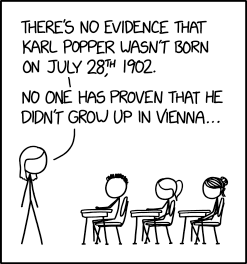
He he he... this morning's XKCD.

popper.png

Alt Text - "At least I don't think there's evidence. My claim that there is no evidence hasn't been falsified. That I know of."
 
It took you that long to get a degree? Or do you mean to say you've been puttering around philosophy for that long on your own? If the latter, how was your mastery of the field measured and adjudicated?

False dilemma. Figure it out yourself.
 
Status
Not open for further replies.

Back
Top Bottom