Cont: Brexit: Now What? Part 5

Status
Not open for further replies.
It doesn't need to be someone from Belarus. You can apply exactly the same argument for people who already are EU citizens: they could come from Poland, Romania, France, Germany, ...

The fact that many posters here are unable to understand why over 7.8% more Brits voted to leave than to remain demonstrates the woeful lack of critical thinking of posters - a shame in a forum devoted to promoting same.

Calling all those leave voters morons, racists, or some other derogatory term just doesn't wash - there are simply too many of them for that to be a reasonable explanation. Posters here should instead wonder why the popularity of the EC/EU fell so much from the 1975 referendum (67:33 in favor of remaining) to the 2016 referendum (52:48 in favor or leaving). It seems that forty years of membership convinced a majority of voters that they no longer wanted to be part of the club.

40 years of EU bashing from the media didn't help.
 
I wonder how Americans would react if someone said it was reasonable to have to request government permission to move to a different state.
I wonder how Americans would react if it were possible for people to move from other countries (Mexico, Columbia, ...) to the USA without any checks.

The EU is not the United States of Europe (yet). It's lots of separate countries, each with their own laws, languages, parliaments, and sometimes currencies.
 
Let's take the pretty central, known and well-publicised issue of immigration. Let's pick some random Belarus businessman who wants to move to the UK. Now, absent the EU this bloke'd have to go through UK immigration and, for some reason we won't get into here, he'd be rejected and would have to find some other place to move to. Now, with the EU, he could go to a different EU country -- say Greece --, and perhaps get a more lenient treatment that allows him to get a EU passport and therefore move to the UK despite the fact that they would've otherwise rejected him. So far that's just the situation, not the argument.

What reason is used to decide to accept or reject is rather central to the point...

Now, given that, and unless I'm mistaken about that process, I would find that some UK resident saying they'd like to have control over their immigration process, for any reason, to be rational. After all, every country has their own rules and standards, and even if you or I disagree with those of the UK outside of the EU, I think it's completely reasonable to expect a citizens to want their country to be able to apply those rules. Now, if we take some of that to extremes it leads to abuse, as usual, but it doesn't change the basic concept that a sovereign state, and a specific culture, would be quite reasonable in wanting control over who can come and live on their territory.

No. If the reasons are false, inflated, bigoted, etc then it's not rational.

Sure, if we set the reason for doing something aside, then what could be wrong with doing it...errr...
 
I wonder how Americans would react if it were possible for people to move from other countries (Mexico, Columbia, ...) to the USA without any checks.
To hear some people talk, that's already the case.

The EU is not the United States of Europe (yet). It's lots of separate countries, each with their own laws, languages, parliaments, and sometimes currencies.
Separate countries with their own laws, languages and parliaments? Like Scotland or Wales?
Why should the government be able to tell you where to live? I am sure there are good reasons.
 
Not confetti perhaps but some countries have been criticised for selling citizenship (and therefore an EU passport) to those that can afford it. Malta is probably the most high profile culprit with the scheme making up over 2% of it's GDP.

As regards immigration, the UK never took advantage of the existing EU rules to limit migration so it's really out own bloody fault.

https://brexit853.wordpress.com/201...-to-control-eu-freedom-of-movement-directive/

Curious you should mention Malta.
https://www.independent.co.uk/news/...ler-single-market-customs-union-a8185336.html
 
Why should the government be able to tell you where to live? I am sure there are good reasons.

It's the way most (all ?) of the world's countries operate. Maybe one day we'll be able to do away with independent countries and their governments and all just be citizens of the world - able to travel freely without passports and live wherever we like. But that's not the way things are right now.
 
I'm reticent to share because you have now more than once hinted to the fact that you wouldn't listen. What's the point of making a lengthy argument if the listener is telling you in advance that he'll chant 'la la la' while you're doing so?

But fine. I'll try to make it short to reduce the inevitable frustration.

Let's take the pretty central, known and well-publicised issue of immigration. Let's pick some random Belarus businessman who wants to move to the UK. Now, absent the EU this bloke'd have to go through UK immigration and, for some reason we won't get into here, he'd be rejected and would have to find some other place to move to. Now, with the EU, he could go to a different EU country -- say Greece --, and perhaps get a more lenient treatment that allows him to get a EU passport and therefore move to the UK despite the fact that they would've otherwise rejected him. So far that's just the situation, not the argument.

Now, given that, and unless I'm mistaken about that process, I would find that some UK resident saying they'd like to have control over their immigration process, for any reason, to be rational. After all, every country has their own rules and standards, and even if you or I disagree with those of the UK outside of the EU, I think it's completely reasonable to expect a citizens to want their country to be able to apply those rules. Now, if we take some of that to extremes it leads to abuse, as usual, but it doesn't change the basic concept that a sovereign state, and a specific culture, would be quite reasonable in wanting control over who can come and live on their territory.

Would you not agree? And please don't make this about racism, because it's entirely irrelevant to the argument above.

Some fair points, but not entirely accurate, as others have mentioned, it takes citizenship, not residence to be able to move freely. Assuming by Belorussian businessman, you don't mean gangster, I have no problem with someone coming to the country to start a business. That is generally good for the economy. In any event, these cases would be few and far between, and certainly don't seem to be a significant issue.

Some highlights of the recent Migration Advisory Committee report:

"Future policy

European citizens should not be given preferential treatment post-Brexit.
Remove the cap on tier-2 visas for general skilled workers.
Retain the salary threshold of £30,000.
Favour higher-skilled workers over lower-skilled workers post-Brexit.
No special scheme for low-skilled workers, with the exception of agricultural workers.

Overall impact of migration from European Economic Area

The overall impact is “small in magnitude when set against other changes”.
“Migrants have no or little impact” on the employment or unemployment outcomes of the UK-born workforce.
The fall of the pound after the referendum has had a “larger impact” on wages and employment opportunities.
Migration does not force down wages. There is some evidence that it does in lower-skilled areas, but the impact is small.
There is little or no impact on employment, wages or training.

House prices

Migration has increased house prices, mostly in areas with a squeeze on supply due to restrictive planning where councils find it harder to increase stock in line with demand.

Benefits

Migrants pay more in taxes than they receive in benefits.

Provision of public services

Insufficient attention is being paid to the flow of public money to areas with increased demand for education and medical services.

Social care

EU migrants are critical in care homes and social care, and there are concerns that the UK will struggle to find people to work in the sector, where demand is rising inexorably. There is an underlying problem of poor terms and conditions.

Education

There is no evidence that parents’ choice is reduced by the migrant population.
Children with English as a second language perform better than native English speakers.

Crime

Migration has no impact on crime and there is no evidence to suggest migrants are linked to increases in crime in England and Wales.

Low-skilled workers

There is no need for special schemes outside farming.
Low-skilled workers can come to the UK through updated youth schemes."


https://www.gov.uk/government/publications/migration-advisory-committee-mac-report-eea-migration

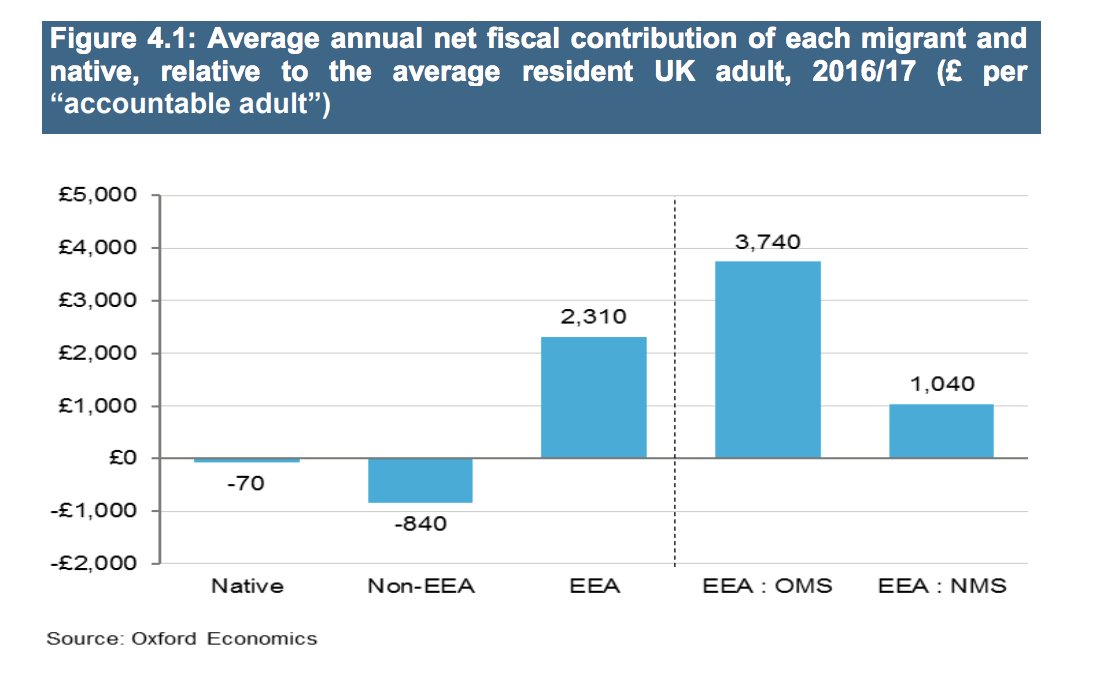
Overall it shows that migrants, particularly EU migrants, are a net benefit to the economy, and do not impact in any significantly detrimental way to either the economy, or the native population.

Quite clearly shown graphically, EU migrants contribute significantly, non EU migrants tend to be a drain, as do natives, to a lesser degree.

DnXgrMcX0AAVVO9.jpg
 
That's not how it works. If Greece wants to give residency rights to a Belarusian that wouldn't entitle him to freedom of movement across the EU. For that he would need Greek citizenship, which isn't something that's given out like confetti.

Sorry I wasn't clear. I meant citizenship first, then passport.

But my point was that if it's easier to do in Greece than the UK, would it not be rational for someone in the UK to object?

I wonder how Americans would react if someone said it was reasonable to have to request government permission to move to a different state.

Ask one of them, not me, but if I were to answer for myself, I'd say that you're comparing apples to oranges since the US _is_ a single country with a history of shared culture.

What reason is used to decide to accept or reject is rather central to the point...

Not for the purposes of my explanation it isn't. It could be some crime the bloke committed before, or some financial issues, or disease or whatnot. It doesn't matter to the larger point, which for some reason you didn't address.

No. If the reasons are false, inflated, bigoted, etc then it's not rational.

The point is that one country might have different standards and now they can't really apply them, even if you could find that reason entirely reasonable, but here you're basically short-circuiting the argument by calling the reason unreasonable to begin with.
 
Some fair points, but not entirely accurate, as others have mentioned, it takes citizenship, not residence to be able to move freely. Assuming by Belorussian businessman, you don't mean gangster, I have no problem with someone coming to the country to start a business.

As stated above I should have made myself clearer about EU citizenship. But yeah, the businessman could be a shady character and the Greek government, in need of dough, could ease his way through the process in exchange for money, leaving the UK with the broken vase.

Is that not a reasonable objection?
 
As stated above I should have made myself clearer about EU citizenship. But yeah, the businessman could be a shady character and the Greek government, in need of dough, could ease his way through the process in exchange for money, leaving the UK with the broken vase.

Is that not a reasonable objection?

In theory, maybe, but the negatives of leaving the EU kind of significantly outweigh the problem of the odd shady character slipping the net.
 
And to be fair and open, I'm a bit of a serial migrant. Born in the UK, moved to South Africa, then New Zealand, a short time in Australia, now back in the UK. I have three citizenships.

It would be hypocritical of me to be anti migration. Personally, I look forward to the day (figuratively, I'll never live to see it) when we are in some Star Trek type world, with no borders.

I learnt a long time ago that there are good people and bad people, and race, colour or nationality have nothing to do with those distinctions.

Life really should be simple.
 
The fact that many posters here are unable to understand why over 7.8% more Brits voted to leave than to remain demonstrates the woeful lack of critical thinking of posters - a shame in a forum devoted to promoting same.

Calling all those leave voters morons, racists, or some other derogatory term just doesn't wash - there are simply too many of them for that to be a reasonable explanation. Posters here should instead wonder why the popularity of the EC/EU fell so much from the 1975 referendum (67:33 in favor of remaining) to the 2016 referendum (52:48 in favor or leaving). It seems that forty years of membership convinced a majority of voters that they no longer wanted to be part of the club.
There were many reasons that 37.4% of the eligible voters chose to leave the EU. Some nothing to do with the EU. The question is do those people, still maintain that desire. Seems that the swing has headed back past the vertical into a remain majority.
 
There were many reasons that 37.4% of the eligible voters chose to leave the EU. Some nothing to do with the EU. The question is do those people, still maintain that desire. Seems that the swing has headed back past the vertical into a remain majority.
Regarding your 'swing' comment, what was the poll question and what were the results? There have been some very biased polls that split the 'leave' vote into two choices while having 'remain' as a single choice. When the results of such a poll are reported should all the different 'leave' votes be added together or do you just look at the one option that got the most votes?

If there is to be another Brexit referendum in the near future, what do you think the question should be?
 
Ask one of them, not me, but if I were to answer for myself, I'd say that you're comparing apples to oranges since the US _is_ a single country with a history of shared culture.
No, the situations are substantially identical. You have a region in which its citizens can move wherever they like without asking permission.

If it is reasonable that a country should control who settles within its borders, then surely the same arguments apply to states within a country. In fact, why not at even lower levels?
 
If it is reasonable that a country should control who settles within its borders, then surely the same arguments apply to states within a country. In fact, why not at even lower levels?
It applies at the lowest levels as virtually none of us let people come uninvited and live in our houses. It's at the middle levels where there isn't any control.
 
Sorry I wasn't clear. I meant citizenship first, then passport.

But my point was that if it's easier to do in Greece than the UK, would it not be rational for someone in the UK to object?

Ask one of them, not me, but if I were to answer for myself, I'd say that you're comparing apples to oranges since the US _is_ a single country with a history of shared culture.

Not for the purposes of my explanation it isn't. It could be some crime the bloke committed before, or some financial issues, or disease or whatnot. It doesn't matter to the larger point, which for some reason you didn't address.

The point is that one country might have different standards and now they can't really apply them, even if you could find that reason entirely reasonable, but here you're basically short-circuiting the argument by calling the reason unreasonable to begin with.

This whole discussion is somewhat undermined by the fact that the UK can and could always prevent any EU or Non-EU citizen entering the country if they had reason to do so.

So no.. not really a defensible argument for leaving the EU. Especially given the benefits being thrown away to achieve it.
 
As stated above I should have made myself clearer about EU citizenship. But yeah, the businessman could be a shady character and the Greek government, in need of dough, could ease his way through the process in exchange for money, leaving the UK with the broken vase.

Is that not a reasonable objection?

Erm the shady Russian businessmen don't need to get Greek citizenship to enter the UK. They already live in/own most of London.
 
No, the situations are substantially identical. You have a region in which its citizens can move wherever they like without asking permission.

If it is reasonable that a country should control who settles within its borders, then surely the same arguments apply to states within a country. In fact, why not at even lower levels?

And why do the people who think that a country within a Union should have control over immigration clearly NOT accept that principle within the United Kingdom?
 
Status
Not open for further replies.

Back
Top Bottom