ℵ
0 is defined as the smallest cardinal number greater than any given finite cardinal number.
The infinite binary tree has ℵ
0 levels, such that any cardinal number (represented by positional notation, where the radix point is placed at the ℵ
0 level) has its own unique path of ℵ
0 0;1 bits in this tree (every number is distinguished of the rest of the numbers).
By carefully observe the infinite binary tree, it is not hard to find more than one unique cardinal number represented by ℵ
0 0;1 bits, which is greater than any given finite cardinal number, for example:
Cardinal number 1100... (the radix point is placed at the ℵ
0 level),
Cardinal number 0101... (the radix point is placed at the ℵ
0 level),
Cardinal number 0010... (the radix point is placed at the ℵ
0 level),
...
Please observe the given diagram in
The Infinite Binary Tree.
Its order starts with the path of ℵ
0 0 bits (cardinal number ...000.) and ends with the path of ℵ
0 1 bits (cardinal number 111...), where the radix point is placed at the ℵ
0 level in both cases.
Question 1: What is the unique cardinal number taken from such representation of infinite cardinal numbers, which is the smallest cardinal number greater than any given finite cardinal number (this unique cardinal number is also known by the name ℵ
0)?
Question 2: Are cardinal numbers like 1100... (the radix point is placed at the ℵ
0 level) or 0101... (the radix point is placed at the ℵ
0 level) etc. can be used in order to define sizes that are greater than ℵ
0 and smaller than 2^ℵ
0?
One may claim that the answers are depend on what ordering is placed on the tree. Since the existence of a well ordering of these paths depends on the axiom of choice, it means that one can't get an explicit one.
------------------------
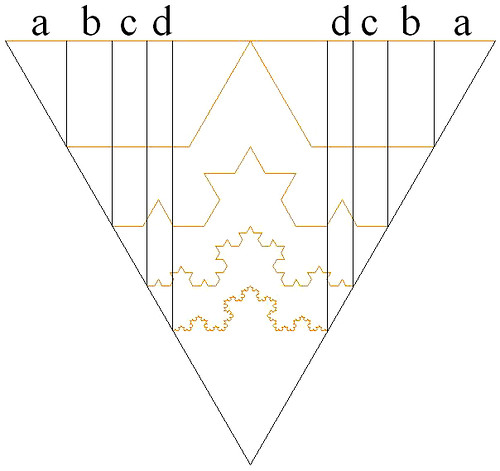
If one carefully observes the diagram that represents some part of the "top" of The Infinite Binary Tree (where according to Contemporary mathematics, each district path of it is constructed by ℵ
0 bits taken as a whole, and represent some cardinal number by positional notation (where the radix point is placed at the ℵ
0 level of that tree)) one realizes that its left and right sides are complements of each other.
For example:
The complement of the finite cardinal number 000...000. is the infinite cardinal number 111...111.
The complement of the finite cardinal number 000...001. is the infinite cardinal number 111...110. (which is the immediate predecessor of the infinite cardinal number 111...111.)
The complement of the finite cardinal number 000...010. is the infinite cardinal number 111...101. (which is the immediate predecessor of the infinite cardinal number 111...110.)
The complement of the finite cardinal number 000...011. is the infinite cardinal number 111...100. (which is the immediate predecessor of the infinite cardinal number 111...101.) ... etc. such that:
000...000. < 000...001. < 000...010. < 000...011. ... < ... 111...100. < 111...101. < 111...110. < 111...111.
So by using an accurate value like ℵ
0 in order to define an infinite cardinal number, one actually discovers (because of this accuracy) that infinite cardinal numbers are actually distinguished of each other by finite sizes (for example: ℵ
0 < ℵ
0+1 exactly by 1).
So by using an accurate value like ℵ
0 in order to define an infinite cardinal number, ℵ
0 = ℵ
0+1 is actually false exactly because ℵ
0 is accurate (measures collection of things as a whole).
I wish to clarify something about the issue at hand.
Whole is not the same as All (or Complete), which means that the size (the cardinality) of a given thing can be changed without changing its wholeness, for example: A given tree is growing without changing its, so called, organic wholeness.
Another example: Wholeness, in case of endless growing or endless shrinking circle is its invariant ratio between its circumference and its diameter, known as Pi.
In the case of The Infinite Binary Tree the complementary relationship between its left and it right sides is invariant during its growth.
Adding, for example, 1 not at its most right path (represented by 111...111.) does not add new level to The Infinite Binary Tree, and if more levels are added, it does not change the complementary relationship between its left and its right sides.
"if n is in S, then n+1 is in S" defines an ever growing S as a whole, where ℵ
0 actually measures S wholeness and not S completeness.
Complete things are invariant-only, where whole things are both variant AND invariant (as given in the examples above) without getting into contradiction, as complete things do exactly because they are invariant-only.
Currently the majority of mathematicians define, for example,
N in terms of completeness (actual infinity) and not in terms of wholeness (potential infinite), exactly because they are doing mathematics that its results are derived from their verbal-symbolic_only brain skills, instead of using both their verbal-symbolic AND visual-spatial brain skills in order to get valid mathematical results.